Primary & Middle School Mathematics · Grades 1–9
58The Pythagorean Theorem
The most famous theorem of all mathematics relates the three sides of a right triangle. With it, lengths become computable that no ruler could measure directly: diagonals, distances, heights. It is also our first big encounter with the difference between a theorem and its converse.
58.1 The theorem
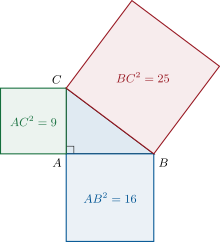
Theorem 58.1 (Pythagoras)
If a triangle is right-angled at , then
the square of the hypotenuse (the side opposite the right angle) equals the sum of the squares of the other two sides.
Idea of proof. Four copies of the triangle, arranged inside a big square of side , leave uncovered a tilted square built on the hypotenuse: comparing areas gives the equality. The detailed computation is proposed as Exercise 58.11; the theorem also drops out of the scalar product, studied in the High School volume. ∎
Method 58.2 (Computing a length)
In a right triangle where two sides are known:
- name the hypotenuse (opposite the right angle — always the longest side);
- write the equality of Theorem 58.1 with the known values;
- solve for the missing square: add the squares if the hypotenuse is unknown, subtract if a leg is unknown;
- take the square root, exactly or with a calculator, and check that the hypotenuse came out longest.
Example 58.3 (Finding the hypotenuse)
A right triangle has legs and . Hypotenuse :
(The number , the square root of , is the positive number whose square is ; square roots get a full chapter in Chapter 65.)
Example 58.4 (Finding a leg)
A m ladder leans against a wall, its foot m from the wall. Height reached : the ladder is the hypotenuse, so
Subtract, not add: the unknown here is a leg.
58.2 The converse
Theorem 58.5 (Converse of Pythagoras)
If, in a triangle , the sides satisfy , then the triangle is right-angled at .
Proof. Admitted at this level. ∎
Method 58.6 (Testing a right angle)
Given the three sides of a triangle:
- compute separately the square of the longest side, and the sum of the squares of the two others;
- if the two results are equal, the triangle is right-angled (converse), at the vertex opposite the longest side;
- if they differ, it is not right-angled — because Pythagoras’ theorem would force equality.
Example 58.7
Sides , , : longest side squared, ; sum of the other squares, . Equal: right-angled (opposite the side ).
Sides , , : but : not a right triangle (it is “almost” one — the numbers decide, not the eye).
Remark 58.8 (Theorem vs converse)
The theorem and its converse say different things: the theorem uses a right angle to compute lengths; the converse uses lengths to prove a right angle. Builders have used the converse for millennia: a rope with knots at , , units pulled taut gives a perfect right angle.
Example 58.9 (Diagonal of a square)
The diagonal of a square of side is the hypotenuse of a right triangle with legs and :
so — a number that is not a fraction, as the High School volume will prove. For a square of side , the diagonal is .
58.3 Exercises
Exercise 58.1 ★
In each right triangle, compute the hypotenuse: legs and ; legs and ; legs and .
Solution
Solution of Exercise 58.1.
; ; .
Exercise 58.2 ★
A right triangle has hypotenuse and one leg . Compute the other leg.
Solution
Solution of Exercise 58.2.
Leg, so the leg is .
Exercise 58.3 ★
Compute the diagonal of a rectangle of sides cm and cm; the diagonal of a square of side cm (exact value with a square root, then rounded to the mm).
Exercise 58.4 ★
Which triangles are right-angled? Justify with Method 58.6:
Solution
Solution of Exercise 58.4.
: and : right-angled.
: : not right-angled.
: : right-angled (it is halved).
Exercise 58.5 ★
A gate is braced by a diagonal plank. The gate is m wide and m tall: how long is the plank?
Solution
Solution of Exercise 58.5.
Plank m.
Exercise 58.6 ★
An isosceles triangle has two sides of cm and a base of cm. Its height splits it into two right triangles: compute that height, then the area of the triangle.
Solution
Solution of Exercise 58.6.
The height falls on the midpoint of the base (isosceles triangle), so each half-triangle has hypotenuse and one leg : cm. Area: cm.
Exercise 58.7 ★★
A television screen is a rectangle measuring cm by cm. Screens are sold by the diagonal, in inches ( inch cm). Compute the diagonal in cm, then in inches (round to the nearest inch).
Solution
Solution of Exercise 58.7.
Diagonal: cm. In inches: inches.
Exercise 58.8 ★★
A boat sails km east, then km north. How far is it from its starting point (as the crow flies)? Draw the situation first.
Solution
Solution of Exercise 58.8.
The two legs are km and km: km.
Exercise 58.9 ★★
A m ladder must reach a window sill m above the ground. How far from the wall must its foot be placed? Is the answer compatible with safety advice (foot at about a quarter of the ladder length from the wall)?
Solution
Solution of Exercise 58.9.
Foot distance: m. A quarter of the ladder is m: the m found is close to the advised placement — acceptable.
Exercise 58.10 ★★
On a coordinate grid, plot and , and draw the right triangle with legs parallel to the axes whose hypotenuse is . Compute . (This construction, for any two points, becomes the distance formula of coordinate geometry, in the High School volume.)
Solution
Solution of Exercise 58.10.
The legs measure (horizontal) and (vertical), so
Exercise 58.11 ★★★
Four copies of a right triangle with legs , and hypotenuse are placed in the corners of a square of side , leaving a tilted square of side uncovered in the middle.
- Express the area of the big square in two ways: directly, and as (four triangles) (tilted square).
- Expand (see Theorem 57.1) and deduce : you have proved the Pythagorean theorem.
Solution
Solution of Exercise 58.11.
1. Directly: . As pieces: four triangles of area each, plus the tilted square :
2. Expanding the left side: . So
58.4 Problem: Pythagorean triples
Problem 58.1
Weekend problem — whole-number right triangles, and the identity that generates them all
A Pythagorean triple is a triple of whole numbers with
like the builders’ . A Babylonian clay tablet catalogued huge ones — among them — more than a thousand years before Pythagoras. This problem hunts for triples, then builds the machine that produces them: an algebraic identity straight out of Chapter 57, put in the service of geometry.
Part I — Hunting for triples.
- Check that , and are Pythagorean triples. What does Theorem 58.5 say about triangles with these side lengths?
- Explain why a taut rope with twelve equal segments, laid out as a triangle with sides of , and segments, gives builders a perfect right angle.
- Show that if is a Pythagorean triple, so is for every whole number . Deduce three new triples from .
- The multiples of are the triples . Show that is not one of them.
- Explain why questions 3 and 4 together prove that scaling can never produce every Pythagorean triple: some other machine is needed.
Part II — The machine. Take two whole numbers and form the three numbers
Using the remarkable identities of Problem 57.1 (write and ), expand and , and prove that
the machine always outputs a Pythagorean triple.
- Run the machine on , , , and , and display the five triples in a table.
- One triple in your table is a scaled copy of a smaller one. Which, and of which?
- Find for which the machine outputs the triple of question 1 (legs in either order).
- Find and with , and deduce a Pythagorean triple whose hypotenuse is .
Part III — Families, and a parity finale.
- Run the machine with . Show that the odd leg is , the even leg , and the hypotenuse — so hypotenuse and even leg differ by exactly . Write out the triples for .
- Deduce that every odd number is the side of some whole-number right triangle, and give a triple containing .
- Even numbers work too: run the machine with , and produce a triple containing . Then obtain the same triple a second time, by scaling one from your table of question 7.
- Show that the square of an even number is even and that the square of an odd number is odd. (Write the number as or and use an identity.)
- Conclude the parity finale: there is no Pythagorean triple with all three numbers odd — in every whole-number right triangle, at least one side is even.
Solution
Solution of Problem 58.1.
1. ; ; . All three are triples, and by Theorem 58.5 a triangle with these side lengths is right-angled, the right angle facing the longest side.
2. The rope forms a triangle with sides , , (in segments), and : by the converse (Theorem 58.5), the angle between the sides of and segments is exactly right — no protractor needed, only knots.
3. If , then
From : for instance , and .
4. A multiple containing as its smallest number would need , and no whole number satisfies that ( gives , gives ). So is not a multiple of .
5. Question 3 shows scaling produces only the triples ; question 4 exhibits a genuine triple that is not of this form. So the family of all Pythagorean triples is strictly larger than the multiples of : producing them requires something new.
6. Write and . By the remarkable identities (Problem 57.1):
Adding:
7.
8. is the double of — that is, of the builders’ . The machine sometimes rediscovers an old triple in disguise.
9. We need and , so : trying , gives and , with hypotenuse . The machine outputs for .
10. , gives . The triple is
and indeed .
11. With :
(difference of consecutive squares, Problem 57.1); ; and . The hypotenuse exceeds the even leg by exactly . For :
12. Every odd number at least is for some , and question 11 provides a triple whose odd leg is exactly . For , take :
13. With the machine gives , whose even leg can be any even number from upward. For , take : the triple . The same triple appears by doubling from the table of question 7: — the same three numbers.
14. An even number is , and is even (a multiple of , even). An odd number is , and the first remarkable identity gives
an even number plus : odd.
15. Suppose all of , , were odd. By question 14, and are odd, so is a sum of two odd numbers: even. But would be odd. The equality is then impossible. So in every Pythagorean triple at least one of the three numbers is even — as every line of the table of question 7 confirms.