
Physics · Glossary

What is Hubble’s law and the hot beginning?

Definition 27.5 University Physics — Year 3 · Chapter 27 — Astrophysics

Every distant galaxy recedes, at speed proportional to distance:

v=H0d,H070km/s per megaparsec.v = H_0d , \qquad H_0 \approx 70\,\mathrm{km}/\mathrm{s} \text{ per megaparsec} .

This is not an explosion into space but an expansion of space — run it backwards and everything was once dense and hot: 1/H0141/H_0 \approx 14 billion years ago (Exercise 27.9). The early universe is this book replayed at speed. At one second it is a MeV\mathrm{MeV} particle soup (Chapter 26); in the first minutes, Chapter 25 runs wild and freezes out one quarter helium by mass — predicted by a Boltzmann factor, observed everywhere (Exercise 27.11). At 380 000 years and 3000K3000\,\mathrm{K}, Saha’s equation (Proposition 18.5) lets electrons finally settle onto protons; the fog clears, and that last-scattered light — stretched a thousandfold by expansion — arrives today as the cosmic microwave background: a 2.725K2.725\,\mathrm{K} Planck spectrum (Chapter 20), the oldest photograph there is. What the picture also shows: galaxies spin and cluster as if steered by dark matter no detector has caught, and the expansion accelerates under a dark energy nobody has explained — the ninety-five percent of the budget this book cannot yet write.
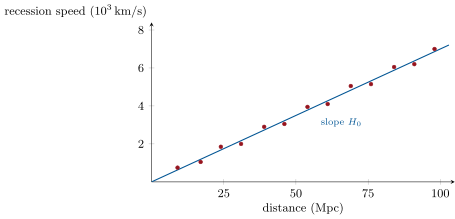
Hubble’s law: recession speed against distance, each dot a galaxy (speeds from Doppler shifts, ; distances from standard candles). The slope is H_0; its inverse is, roughly, the age of the universe.
Hubble’s law: recession speed against distance, each dot a galaxy (speeds from Doppler shifts, Chapter 4; distances from standard candles). The slope is H0H_0; its inverse is, roughly, the age of the universe.
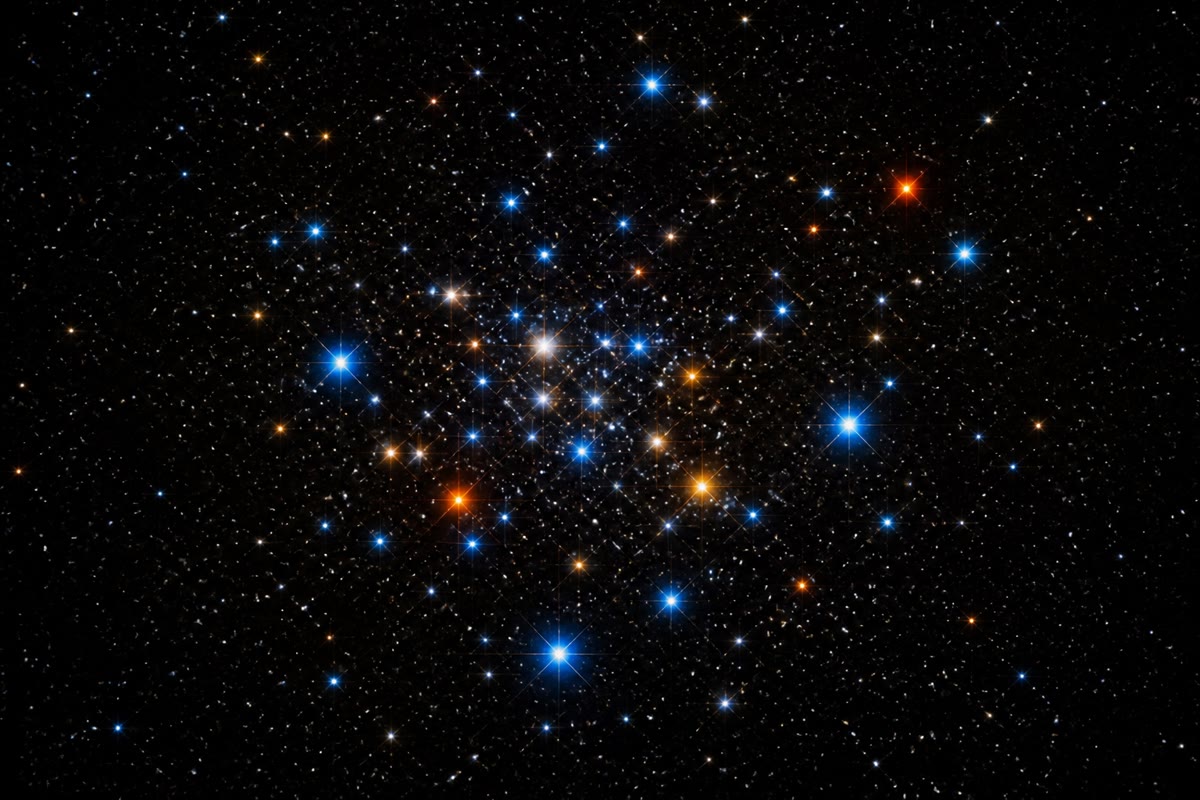
An open cluster: blue-white profligates and frugal orange dwarfs, born together, ageing at wildly different rates — the Hertzsprung–Russell diagram, photographed.
Read in context →