 Coach
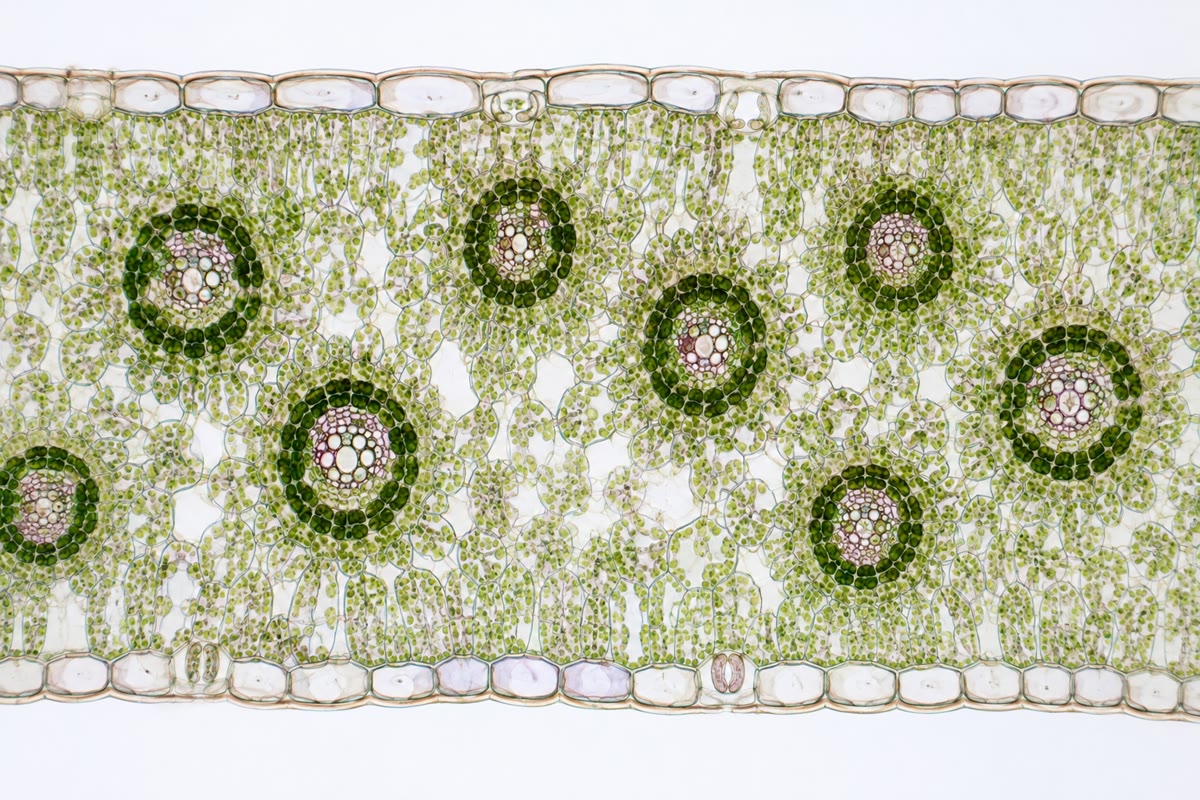
CoachC4 plants (maize, sugar cane, sorghum, many tropical grasses) seal the leak by concentrating : in the mesophyll cells an enzyme with no affinity for (PEP carboxylase) fixes bicarbonate into a four-carbon acid, which is shuttled into the bundle-sheath cells around the veins and decarboxylated there, raising the around RuBisCO tenfold and suppressing oxygenation — at a cost of two extra ATP per . The two cell types form the Kranz (“wreath”) anatomy. CAM plants (cacti, pineapple, agaves) separate the same two steps in time rather than space: they open their stomata at night, store as malic acid in the vacuole, and release it to RuBisCO by day behind closed stomata, losing a tenth of the water a C3 plant loses per carbon fixed.
Examples
Example 14.13 (Which plant where)
At in moist air a C3 wheat leaf and a C4 maize leaf fix carbon at similar rates, and the maize pays two ATP more per carbon. At in dry air the wheat loses a third of its fixation to photorespiration while the maize loses none: C4 grasses dominate hot open country, C3 plants the cool and shaded. A cactus fixes slowly by either standard but survives where the others would die of thirst.