
Biology · Glossary

What is Initial rate, saturation?

Also known as: reaction rate

Definition 13.5 University Biology — Year 1 · Chapter 13 — Enzymes and Biochemical Catalysis

The rate vv of an enzyme reaction is the amount of product formed per unit time (mol/s\mathrm{mol}/\mathrm{s}, or units of enzyme: 1µmol/min1\,\text{µ}\mathrm{mol}/\mathrm{min}). It is measured as the initial rate v0v_0, before the substrate is depleted or the product accumulates. At a fixed enzyme concentration v0v_0 rises with the substrate concentration [S][S] and then saturates at a maximum VmaxV_{\max}: the enzyme is fully occupied and can go no faster.
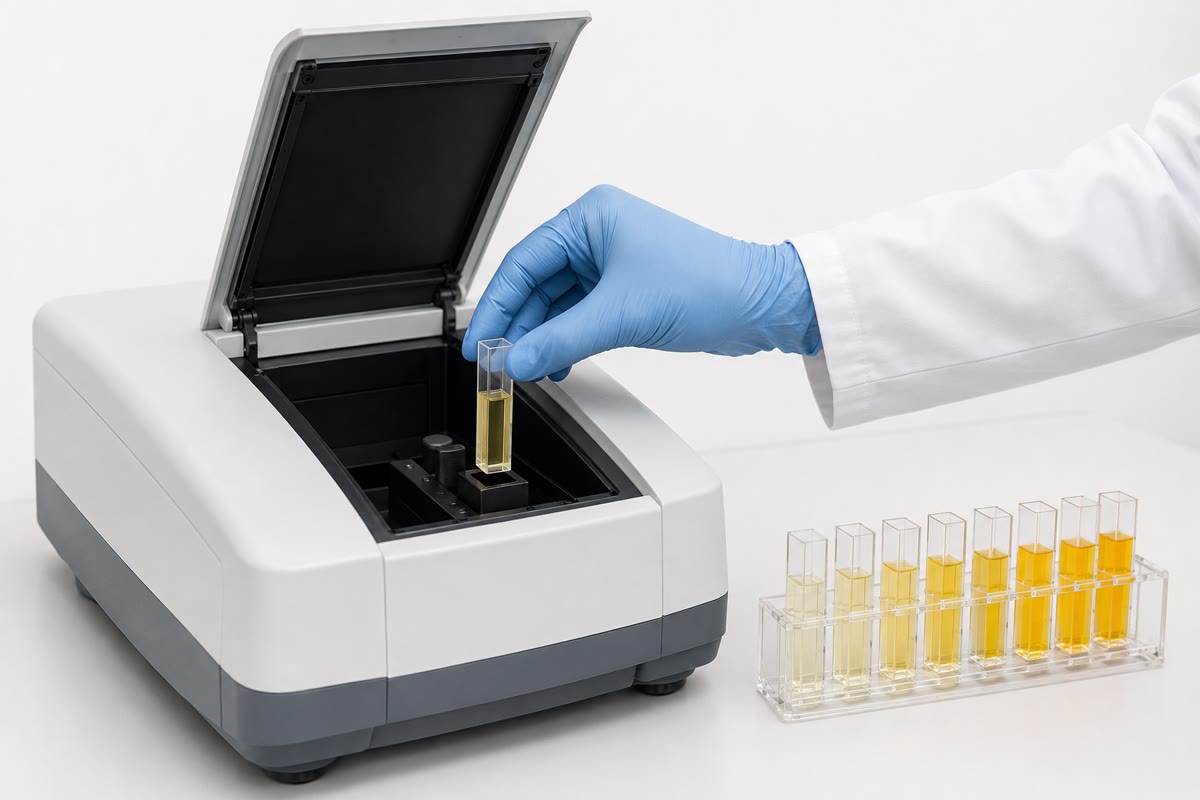
An enzyme assay: the product absorbs light, and the spectrophotometer records its appearance second by second; the initial slope is v_0.
An enzyme assay: the product absorbs light, and the spectrophotometer records its appearance second by second; the initial slope is v0v_0.

Examples

Example 13.8 (Enzymes compared)

enzymeKmK_m (mol/L\mathrm{mol}/\mathrm{L})kcatk_{\text{cat}} (s1\mathrm{s}^{-1})kcat/Kmk_{\text{cat}}/K_m (Lmol1s1\mathrm{L}\,\mathrm{mol}^{-1}\,\mathrm{s}^{-1})
catalase2.5×1022.5 \times 10^{-2}4×1074 \times 10^{7}1.6×1091.6 \times 10^{9}
carbonic anhydrase1.2×1021.2 \times 10^{-2}1×1061 \times 10^{6}8×1078 \times 10^{7}
chymotrypsin1.5×1021.5 \times 10^{-2}1007×1037 \times 10^{3}
lysozyme6×1066 \times 10^{-6}0.58×1048 \times 10^{4}
DNA polymerase1×1051 \times 10^{-5}151.5×1061.5 \times 10^{6}

Catalase and carbonic anhydrase work at the diffusion limit: every collision with substrate is productive. Chymotrypsin is slow but needs to be — it cuts a peptide bond, a far harder job than splitting peroxide.

Read in context →