
সব বই

পেশাদার

1 Markets I: The Ecosystem and Exchange-Traded Marketsবাজার অনলাইন 2 Markets II: Rates, FX and Creditবাজার অনলাইন 3 Markets III: Commodities, Energy and Cryptoবাজার অনলাইন 4 Quantitative Methodsপদ্ধতি অনলাইন 5 Derivatives and Volatilityডেরিভেটিভস অনলাইন 6 Rates, Credit, XVA and Riskসুদহার, ঋণ ও ঝুঁকি অনলাইন 7 Research Craft: Predictors, Backtests, Measurement, Portfoliosগবেষণা অনলাইন 8 Strategies I: Equities and Futuresকৌশল অনলাইন 9 Strategies II: Volatility, Relative Value, Macro and the Bank Desksকৌশল অনলাইন 10 Microstructure and Executionএক্সিকিউশন অনলাইন 11 Market Making and High-Frequency Tradingমার্কেট মেকিং অনলাইন 12 Machine Learning for Marketsমেশিন লার্নিং অনলাইন 13 Low-Latency Softwareপ্রযুক্তি অনলাইন 14 Networks, Hardware and Trading Infrastructureপ্রযুক্তি অনলাইন 15 Research, Data and Risk Platformsপ্রযুক্তি অনলাইন 16 The Desk and the Firmপ্রতিষ্ঠান অনলাইন 17 The Industry: Firms, Roles and Careersক্যারিয়ার অনলাইন 18 Interviews I: Maths, Probability and Speedক্যারিয়ার অনলাইন 19 Interviews II: Markets, Trading Games and the Final Roundক্যারিয়ার অনলাইন 20 Interviews III: Codeক্যারিয়ার অনলাইন
অ্যাপ পরিচিতি Coach সাইন ইন পড়া শুরু করো

বইগুলো এখনো বাংলা ভাষায় পাওয়া যায় না — ইংরেজি সংস্করণ দেখানো হচ্ছে।

Biology · পরিভাষা

Mutation, and its kinds কী?

Definition 3.1 University Biology — Year 2 · অধ্যায় 3 — Mutations and Genome Diversification

A mutation is a heritable change in the sequence of the genome. Point mutations change one or a few bases: a substitution replaces one base by another (a transition swaps purine for purine or pyrimidine for pyrimidine, A↔\leftrightarrowG or C↔\leftrightarrowT; a transversion swaps the classes); an insertion or deletion adds or removes bases. In a coding sequence a substitution is silent if the new codon specifies the same amino acid, missense if it specifies another, nonsense if it creates a stop; an insertion or deletion not a multiple of three shifts the reading frame (frameshift) and garbles every codon downstream. Chromosomal rearrangements move large segments: deletion, duplication, inversion, translocation between chromosomes. Genome mutations change the number of chromosomes: aneuploidy (one chromosome too many or too few, as in trisomy 21) and polyploidy (whole extra sets). A mutation in a somatic cell is inherited by that cell’s descendants only; a mutation in the germ line is inherited by the organism’s descendants, and only these matter for evolution.
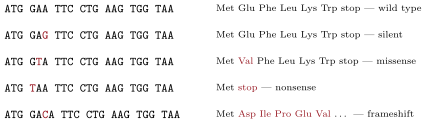
Point mutations in a short coding sequence (change in red). A silent substitution keeps the protein; a missense changes one residue; a nonsense truncates it; a single inserted base shifts the frame and rewrites everything downstream.
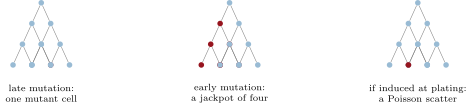
The fluctuation test. If mutations (red) occur at random during growth, the number of mutants depends on when the mutation happened, and independent cultures differ wildly; if the selecting agent induced them at plating, every culture would show a similar small number.

উদাহরণ

Example 3.8 (Resistance on the move)

A resistance gene typically arises once, by mutation or from the soil bacterium that makes the antibiotic, and then travels: from a chromosome onto a transposon, from the transposon onto a conjugative plasmid, from the plasmid across species by conjugation and across strains by transduction, and back into a chromosome by transformation. Plasmids carrying five or six resistances at once (assembled in integrons, which capture gene cassettes) were found in Japan in the 1950s, a few years after the drugs came into use; the gene for the carbapenemase NDM-1, first seen in 2008, reached every continent within three years on a plasmid. The evolution of resistance is mostly not the evolution of new genes but the movement of old ones.

প্রসঙ্গসহ পড়ো →