
সব বই

পেশাদার

1 Markets I: The Ecosystem and Exchange-Traded Marketsবাজার অনলাইন 2 Markets II: Rates, FX and Creditবাজার অনলাইন 3 Markets III: Commodities, Energy and Cryptoবাজার অনলাইন 4 Quantitative Methodsপদ্ধতি অনলাইন 5 Derivatives and Volatilityডেরিভেটিভস অনলাইন 6 Rates, Credit, XVA and Riskসুদহার, ঋণ ও ঝুঁকি অনলাইন 7 Research Craft: Predictors, Backtests, Measurement, Portfoliosগবেষণা অনলাইন 8 Strategies I: Equities and Futuresকৌশল অনলাইন 9 Strategies II: Volatility, Relative Value, Macro and the Bank Desksকৌশল অনলাইন 10 Microstructure and Executionএক্সিকিউশন অনলাইন 11 Market Making and High-Frequency Tradingমার্কেট মেকিং অনলাইন 12 Machine Learning for Marketsমেশিন লার্নিং অনলাইন 13 Low-Latency Softwareপ্রযুক্তি অনলাইন 14 Networks, Hardware and Trading Infrastructureপ্রযুক্তি অনলাইন 15 Research, Data and Risk Platformsপ্রযুক্তি অনলাইন 16 The Desk and the Firmপ্রতিষ্ঠান অনলাইন 17 The Industry: Firms, Roles and Careersক্যারিয়ার অনলাইন 18 Interviews I: Maths, Probability and Speedক্যারিয়ার অনলাইন 19 Interviews II: Markets, Trading Games and the Final Roundক্যারিয়ার অনলাইন 20 Interviews III: Codeক্যারিয়ার অনলাইন
অ্যাপ পরিচিতি Coach সাইন ইন পড়া শুরু করো

বইগুলো এখনো বাংলা ভাষায় পাওয়া যায় না — ইংরেজি সংস্করণ দেখানো হচ্ছে।

Biology · পরিভাষা

Tertiary and quaternary structure কী?

অন্য নাম: tertiary structure · disulfide bridge · quaternary structure

Definition 12.7 University Biology — Year 1 · অধ্যায় 12 — Amino Acids and Proteins

The tertiary structure is the complete three-dimensional arrangement of one polypeptide: its helices, sheets and loops packed together, often in several compact domains that fold independently. It is held by non-covalent forces — the hydrophobic effect burying non-polar side chains in a core away from water, hydrogen bonds, salt bridges between charged side chains, van der Waals packing — and sometimes by disulfide bridges, covalent S–S bonds between two cysteines, in proteins secreted to the oxidising outside. The quaternary structure is the assembly of several polypeptides (subunits) into one protein: haemoglobin is two α\alpha and two β\beta chains. Globular proteins are compact and water-soluble (enzymes, carriers); fibrous proteins are extended and insoluble (collagen’s triple helix, the coiled coils of keratin and myosin, silk).
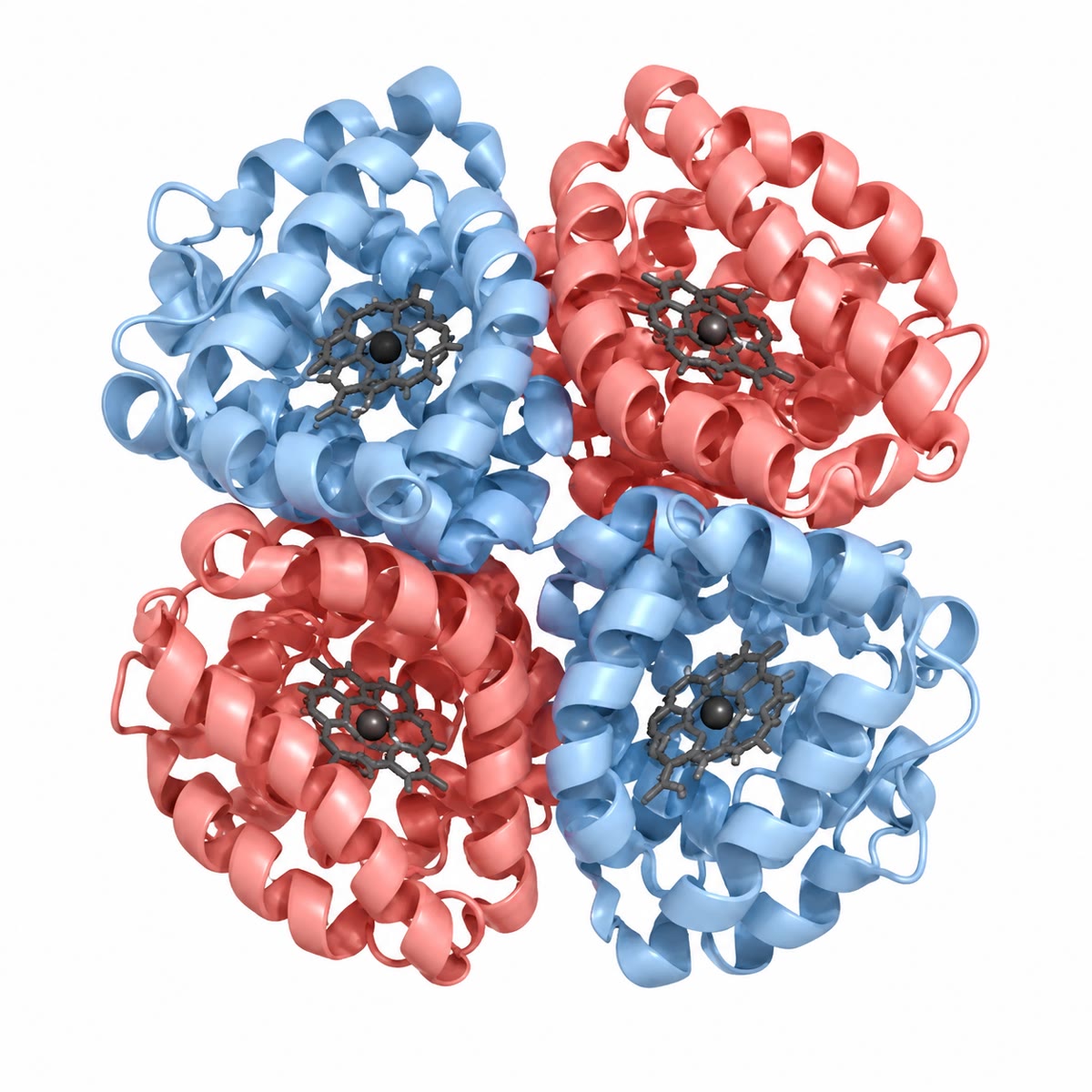
Haemoglobin: four subunits, two  (blue) and two  (red), each a bundle of  helices around a haem group (dark) whose iron binds one O_2. The four sites do not act independently.
Haemoglobin: four subunits, two α\alpha (blue) and two β\beta (red), each a bundle of α\alpha helices around a haem group (dark) whose iron binds one O2\mathrm{O_2}. The four sites do not act independently.

উদাহরণ

Example 12.15 (Reading a gel)

A crude extract shows dozens of bands; after affinity chromatography one band remains at the position of the 33 kDa33\,\mathrm{kDa} marker. Run without SDS and without reducing agent, the same protein migrates as a 66 kDa66\,\mathrm{kDa} species: it is a dimer of two identical chains held by a disulfide bridge, which the reducing agent breaks and the detergent separates. Two gels, one line of reasoning, and the quaternary structure is known.

প্রসঙ্গসহ পড়ো →