 Coach
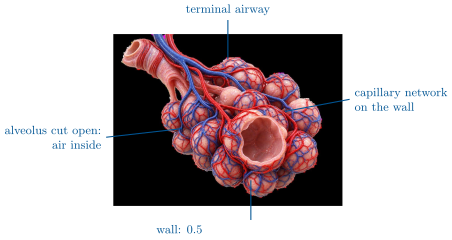
CoachA lung is an invagination of the body surface into a moist internal chamber, which keeps the surface wet in dry air. The mammalian lung is a tree of airways ending in some three hundred million alveoli, sacs across whose walls — one epithelial cell and one capillary endothelium, in all — add up to in a human, wrapped in a capillary net through which the whole cardiac output passes. It is ventilated tidally: the diaphragm and rib muscles enlarge the chest, air flows in; they relax, air flows out by the same path. A breath moves , of which only fills the airways (dead space) and never reaches an alveolus; the alveolar gas, renewed by a seventh at each breath, stays at and — the pressures the blood equilibrates with.
Examples
Example 21.13 (Altitude and depth)
At the air holds of oxygen and the alveoli : the carotid bodies drive ventilation up, which blows off and makes the blood alkaline — a brake the kidneys release over days by excreting bicarbonate; the red cells raise their BPG within days and the marrow raises haemoglobin within weeks (Chapter 12). A seal diving for twenty minutes does the opposite: it exhales before diving, slows its heart to a tenth, shuts the blood off from everything but brain and heart, and runs its muscles on the oxygen bound to their own myoglobin, ten times more concentrated than ours, and then on fermentation, tolerating a lactate the body clears at the surface. Its lungs collapse below , which keeps nitrogen out of its blood.