 Coach
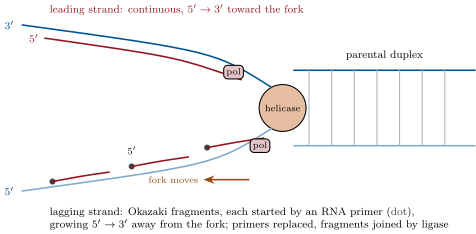
CoachReplication begins at an origin — one on the bacterial chromosome, tens of thousands on a eukaryotic genome — where the helix is opened and two replication forks move away in opposite directions. At each fork: a helicase unwinds the helix (one ATP per base pair), single-strand binding proteins keep the separated strands apart, and a topoisomerase ahead of the fork relieves the twist that unwinding builds up. DNA polymerase adds nucleotides only to the hydroxyl of an existing chain, so that every new strand grows and none can start from nothing: a primase first lays down a short RNA primer that the polymerase extends. On the template read the new strand grows continuously toward the fork: the leading strand. On the other template the new strand must grow away from the fork, in pieces of nucleotides in bacteria and in eukaryotes, the Okazaki fragments, each with its own primer: the lagging strand. A second polymerase replaces the primers with DNA and a ligase seals the fragments into one strand.
Examples
Example 18.4 (Speed and starting points)
A bacterial fork moves at base pairs a second: two forks copy the of E. coli in , and in rich medium, where the cell divides every twenty, a new round starts before the last has finished. A eukaryotic fork, slowed by chromatin, moves at a second: copying a human chromosome of from one origin would take a month, so the genome is copied from some origins in eight hours, in an order fixed for each cell type.