
সব বই

পেশাদার

1 Markets I: The Ecosystem and Exchange-Traded Marketsবাজার অনলাইন 2 Markets II: Rates, FX and Creditবাজার অনলাইন 3 Markets III: Commodities, Energy and Cryptoবাজার অনলাইন 4 Quantitative Methodsপদ্ধতি অনলাইন 5 Derivatives and Volatilityডেরিভেটিভস অনলাইন 6 Rates, Credit, XVA and Riskসুদহার, ঋণ ও ঝুঁকি অনলাইন 7 Research Craft: Predictors, Backtests, Measurement, Portfoliosগবেষণা অনলাইন 8 Strategies I: Equities and Futuresকৌশল অনলাইন 9 Strategies II: Volatility, Relative Value, Macro and the Bank Desksকৌশল অনলাইন 10 Microstructure and Executionএক্সিকিউশন অনলাইন 11 Market Making and High-Frequency Tradingমার্কেট মেকিং অনলাইন 12 Machine Learning for Marketsমেশিন লার্নিং অনলাইন 13 Low-Latency Softwareপ্রযুক্তি অনলাইন 14 Networks, Hardware and Trading Infrastructureপ্রযুক্তি অনলাইন 15 Research, Data and Risk Platformsপ্রযুক্তি অনলাইন 16 The Desk and the Firmপ্রতিষ্ঠান অনলাইন 17 The Industry: Firms, Roles and Careersক্যারিয়ার অনলাইন 18 Interviews I: Maths, Probability and Speedক্যারিয়ার অনলাইন 19 Interviews II: Markets, Trading Games and the Final Roundক্যারিয়ার অনলাইন 20 Interviews III: Codeক্যারিয়ার অনলাইন
অ্যাপ পরিচিতি Coach সাইন ইন পড়া শুরু করো

বইগুলো এখনো বাংলা ভাষায় পাওয়া যায় না — ইংরেজি সংস্করণ দেখানো হচ্ছে।

Biology · পরিভাষা

The replication fork and its enzymes কী?

Definition 18.2 University Biology — Year 1 · অধ্যায় 18 — DNA Replication and Mitosis

Replication begins at an origin — one on the bacterial chromosome, tens of thousands on a eukaryotic genome — where the helix is opened and two replication forks move away in opposite directions. At each fork: a helicase unwinds the helix (one ATP per base pair), single-strand binding proteins keep the separated strands apart, and a topoisomerase ahead of the fork relieves the twist that unwinding builds up. DNA polymerase adds nucleotides only to the 3′3' hydroxyl of an existing chain, so that every new strand grows 5′→3′5' \to 3' and none can start from nothing: a primase first lays down a short RNA primer that the polymerase extends. On the template read 3′→5′3' \to 5' the new strand grows continuously toward the fork: the leading strand. On the other template the new strand must grow away from the fork, in pieces of 1000 to 2000 1000\text{ to }2000\, nucleotides in bacteria and 100 to 200 100\text{ to }200\, in eukaryotes, the Okazaki fragments, each with its own primer: the lagging strand. A second polymerase replaces the primers with DNA and a ligase seals the fragments into one strand.
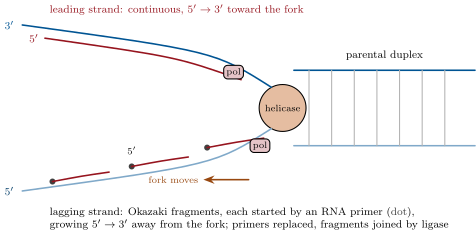
A replication fork. The helicase opens the parental duplex; the leading strand is copied continuously toward the fork, the lagging strand backward in Okazaki fragments, because polymerases build only in the 5' 3' direction.
A replication fork. The helicase opens the parental duplex; the leading strand is copied continuously toward the fork, the lagging strand backward in Okazaki fragments, because polymerases build only in the 5′→3′5' \to 3' direction.

উদাহরণ

Example 18.4 (Speed and starting points)

A bacterial fork moves at 1000 1000\, base pairs a second: two forks copy the 4.6 Mb4.6\,\mathrm{Mb} of E. coli in 40 min40\,\mathrm{min}, and in rich medium, where the cell divides every twenty, a new round starts before the last has finished. A eukaryotic fork, slowed by chromatin, moves at 50 50\, a second: copying a human chromosome of 250 Mb250\,\mathrm{Mb} from one origin would take a month, so the genome is copied from some 40 00040\,000 origins in eight hours, in an order fixed for each cell type.

প্রসঙ্গসহ পড়ো →