The Desk and the Firm · The firm
10Hiring and Compensation
A trader paid fifteen per cent of a twenty-million-dollar year and a trader paid nothing after a two-million-dollar loss on the next desk may have exactly the same skill. For a trader whose risk gives an annual P&L volatility of $10 million and whose true Sharpe ratio is the desk’s average of 0.8, the first year happens about one year in nine and the second one year in six. One year of P&L measures luck far more than ability: on the chapter’s desk, 87% of the differences in a year’s formulaic pay between traders are luck. A pay rule decides which of the two the firm is buying, and how long it takes to find out.
10.1 The pipeline and the interview
A trading firm hires from a funnel: applications, screens, tests, interviews, offers, acceptances. Two facts shape it. The base rate is low, so a test with a modest false-positive rate still fills the later stages with people who will not be hired; and every stage’s decision is a noisy measurement, so the order of stages matters: cheap, valid tests first, expensive ones last.
Definition 10.1 (Structured interview)
A structured interview asks every candidate for a role the same questions, chosen from an analysis of the job, and scores the answers against anchored scales agreed in advance, with several interviewers scoring independently before they confer.
The research on selection is unusually settled on one point. Schmidt and Hunter’s review of 85 years of studies (1998) and its revision by Sackett, Zhang, Berry and Lievens (2022), which found that earlier estimates had been overstated by 0.10 to 0.20 through over-corrections, agree that structured interviews predict job performance better than unstructured ones; in the revision they are the top-ranked selection procedure. The interview questions of this series are written for that purpose: the same question, a known good answer, and what the interviewer is looking for. One Quant Book 18 applies the same format to new questions.
Method 10.2 (Designing an interview loop)
- Write the role’s analysis: the three to five abilities that separate good performers from the rest.
- For each ability choose a test or structured questions, with anchored scores.
- Put cheap, valid tests first (a timed problem set, a coding test) and expensive ones (on-site loops) last.
- Score independently before discussing; record scores and outcomes, and check a year later which scores predicted performance.
10.2 Pay structures: base, bonus and deferral
Pay in trading has three parts: base salary, fixed for the year; a bonus, decided after it; and, above some level, a deferred part that vests over later years. The balance between them is the firm’s choice where no rule limits it and a regulator’s where one does.
Definition 10.3 (Bonus pool, formulaic payout, discretionary bonus)
A bonus pool is the total variable pay a firm or desk awards for a year, set by a rule or a decision from its results. A formulaic payout pays a trader or team a fixed share of their own P&L, usually net of costs and of losses carried forward (chapter 3). A discretionary bonus is set by management’s judgement of the individual’s contribution, within the pool.
Definition 10.4 (Deferred compensation, vesting schedule)
Deferred compensation is variable pay awarded for a year but paid in later years, in cash, shares or fund units. Its vesting schedule sets when each part becomes the employee’s: all at the end of a period (cliff) or in equal parts each year (pro rata).
Definition 10.5 (Malus, clawback)
Malus is the reduction or cancellation of variable pay that has been awarded but not yet vested, for misconduct, a material error or losses that come to light later. Clawback is the recovery of variable pay that has already been paid or has vested.
Definition 10.6 (Material risk taker)
A material risk taker is an employee whose activities, under banking and investment-firm remuneration rules, have a material impact on the institution’s risk profile; their variable pay is subject to the rules on deferral, instruments, malus and clawback.
As of September 2026 — The pay rules
European Union (Directive 2013/36/EU, article 94, as amended by Directive (EU) 2019/878): for material risk takers of banks, variable pay may not exceed 100% of fixed pay, or 200% with shareholders’ approval; at least half is paid in shares or equivalent instruments; at least 40% is deferred over four to five years, vesting no faster than pro rata (60% for particularly high amounts); up to 100% is subject to malus or clawback; guaranteed variable pay is allowed only when hiring, for the first year. United Kingdom: the PRA and the FCA removed the ratio limit (the “bonus cap”) for banks, building societies and PRA-designated investment firms from 31 October 2023 (PRA PS9/23, FCA PS23/15), citing its effect of raising fixed pay. United States: SEC Rule 10D-1 requires listed companies to recover incentive pay erroneously awarded to executive officers in the three fiscal years before an accounting restatement. High earners: the European Banking Authority counted 2 554 people earning more than € 1 million at EU banks and investment firms in 2024, up from 2 343 in 2023; in investment firms the number rose 30%, from 221 to 288.
10.3 Sizing a bonus pool
A pool is sized top-down, then allocated. The common rules are a share of revenue (the compensation ratio of chapter 1, fixed in advance) or a share of net profit after costs and a charge for the capital used (chapter 7). The second pays only for value added: a desk that earns less than its cost of capital has no pool, whatever its revenue. The choice matters most in the years the firm least wants to pay: a revenue-based pool pays out in a year the desk destroyed value on its capital.
Example 10.7 (Two pools)
A desk earns revenue of 100 with costs of 60 and a capital charge of 10. A pool of 20% of profit after the charge is . A pool of 6% of revenue is also 6 this year. In a year of revenue 70, the first pool is zero and the second is 4.2.
10.4 Formulaic against discretionary: paying for skill, not luck
A trader’s P&L in a year is skill plus luck. If skill across traders has a standard deviation (in P&L per year) and luck, the year’s noise, a standard deviation , then after years the average P&L correlates with skill at .
Proposition 10.8 (How long pay takes to find skill)
Let trader ’s annual P&L be , with drawn with variance and independent with variance . The share of the cross-sectional variance of one year’s P&L due to luck is , and the correlation of -year average P&L with reaches after
Proof. The average is with ; its covariance with is , so its correlation is . Setting it to and solving gives . ∎
On the chapter’s desk (illustrative: twenty traders, annual P&L volatility $10 million each, true Sharpe ratios spread with a standard deviation of 0.4, so and ), luck is 86% of the variance of one year’s P&L, and it takes 11.1 years of P&L for it to correlate with skill at 0.8. A formulaic payout of 15% of positive P&L inherits both: 87% of the variance of a year’s pay is luck, and its correlation with skill is 0.35 after one year, 0.64 after five and 0.80 after about twelve (Figure 10.1).
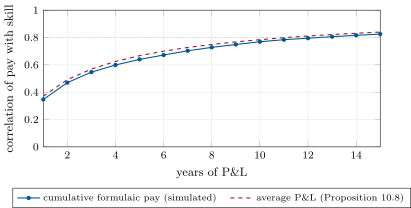
fm_pay.corr_by_years.A discretionary rule can do better only if it uses information the P&L does not contain: the quality of the trader’s decisions, their risk-taking, their contribution to others’ P&L. Judgement applied to the P&L alone is at best a shrinkage estimate of skill (Listing 10.1), and on the chapter’s desk it correlates with skill at 0.37 after one year against the formulaic 0.35, and slightly less after five (0.61 against 0.64), because shrinkage is proportional and the pool it shares moves with the desk’s luck. A risk-adjusted payout, charging each trader’s capital, correlates at 0.34 and 0.63: it pays for value added, not for skill detection.
def shrunk_skill(pnl_history, sigma: float, prior_mean: float, prior_sd: float):
    """pnl_history (years, traders), annual P&L in units where each trader's annual noise has sd `sigma`.
    Posterior mean of each trader's expected annual P&L under a normal prior N(prior_mean, prior_sd^2)."""
    h = np.atleast_2d(np.asarray(pnl_history, float))
    n = h.shape[0]
    w = prior_sd ** 2 / (prior_sd ** 2 + sigma ** 2 / n)
    return prior_mean + w * (h.mean(0) - prior_mean)


def discretionary(pnl_history, pool: float, sigma: float, prior_mean: float, prior_sd: float):
    s = np.maximum(shrunk_skill(pnl_history, sigma, prior_mean, prior_sd), 0.0)
    tot = s.sum()
    return pool * s / tot if tot > 0 else np.zeros_like(s)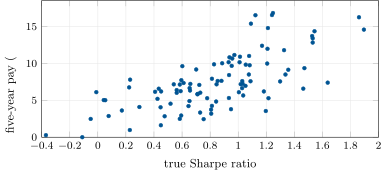
fm_pay.one_desk.Remark 10.9 (Why formulaic pay persists)
Formulaic payouts are common where the firm cannot or will not judge skill, and where the trader carries their own drawdown (chapter 3’s platforms): the formula is transparent and hard to dispute, and it attracts people who believe in their own edge. Its cost is that it pays luck, and that it makes a trader’s pay convex in their P&L, which rewards risk unless limits and deferral cap it.
10.5 Deferral, clawback and retention
Deferral does three jobs. It exposes pay to the losses that appear after the year (through malus); it aligns pay with the firm’s longer-term results; and it builds a balance that the employee loses by leaving. The chapter’s plan pays 60% of each award in cash and vests the rest in four equal annual parts (Figure 10.3). A trader who receives the same award every year carries, at each year end, an unvested balance equal to one full year’s award: .
Definition 10.10 (Deferral buyout)
A deferral buyout is the payment a hiring firm makes to a new employee to replace the deferred pay forfeited by leaving their previous employer, usually in the new firm’s own deferred instruments and on a similar schedule.
@dataclass(frozen=True)
class DeferralPlan:
    cash_share: float = 0.6
    years: int = 4


def schedule(award: float, plan: DeferralPlan) -> np.ndarray:
    """Payments of one award: the cash share at once, the rest in equal parts in each of the next `years` years."""
    out = np.zeros(plan.years + 1)
    out[0] = plan.cash_share * award
    out[1:] = (1 - plan.cash_share) * award / plan.years
    return out


def unvested(awards_by_year, plan: DeferralPlan, now: int) -> float:
    """Unvested balance at the end of year `now` (after that year's vesting), awards_by_year[t] granted in year t."""
    bal = 0.0
    for t, a in enumerate(awards_by_year[: now + 1]):
        s = schedule(a, plan)
        bal += s[now - t + 1:].sum() if now - t + 1 <= plan.years else 0.0
    return bal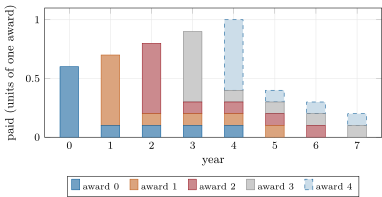
firm.bonuspool.schedule.The balance is the retention device and the price of a move. A competitor that hires the trader must buy out a year’s award in deferred instruments of its own, and the trader carries the firm’s malus risk for the years the balance vests. Clawback reaches further than malus, to pay already received, and is harder to enforce: the US rule for listed companies’ executives, the EU banking rules and most private firms’ plans all rely mainly on malus, applied to what is still unvested.
10.6 Tutorial: twenty traders and three pay rules
Goal. Measure how well each pay rule tracks skill, and the retention a deferral plan creates. End state: Figure 10.1 and the correlations of the text.
- The desk.
fm_pay.desk(rng)draws twenty traders’ true Sharpe ratios and five years of P&L. - The rules.
fm_pay.pay(pnl, rule)appliesfirm.bonuspool.formulaic,risk_adjustedanddiscretionary. - The correlations.
fm_pay.correlations()averages, over 2 000 desks, the correlation of one and five years’ pay with skill;luck_share_formulaic()computes the luck share of a year’s pay. - Deferral.
firm.bonuspool.unvested([1.0]*6, DeferralPlan(0.6, 4), 5)gives the steady unvested balance, one award.
What to change next. Double the skill spread and watch the years needed fall by four; give the discretionary rule a noisy observation of each trader’s decision quality alongside the P&L.
10.7 Build: the bonus pool
Purpose. The desk’s pay arithmetic: pool sizing, allocation rules, deferral and its balances, and how much of pay is luck.
Interface. firm.bonuspool: pool_from_profit, pool_from_revenue; formulaic, risk_adjusted, shrunk_skill, discretionary; DeferralPlan(cash_share, years), schedule, unvested, malus; luck_share_linear, years_for_correlation.
Rules. A pool is never negative; a discretionary allocation adds up to the pool; deferred awards vest pro rata; malus acts only on the unvested balance.
Acceptance tests. code/firm/bonuspool/tests/: pools and rules on hand numbers; the shrinkage weight; the schedule and the steady unvested balance; the closed forms of Proposition 10.8.
Stretch. Pay in fund units whose value tracks the desk’s later P&L; a guaranteed first-year award and its cost; the pool allocated by Shapley credit (chapter 9).
Sources and further reading
- F. L. Schmidt and J. E. Hunter, “The validity and utility of selection methods in personnel psychology”, Psychological Bulletin 124(2), 1998; P. R. Sackett, C. Zhang, C. M. Berry and F. Lievens, “Revisiting meta-analytic estimates of validity in personnel selection”, Journal of Applied Psychology 107(11), 2022.
- Directive 2013/36/EU, article 94, and Directive (EU) 2019/878; PRA PS9/23 and FCA PS23/15 (2023); 17 CFR 240.10D-1.
- European Banking Authority, press release on high earners in 2024, 16 April 2026.
10.8 Exercises
Exercise 10.1 ★
A trader’s expected annual P&L is $8 million with a volatility of $10 million. What are the probabilities of a year of $20 million or more and of a loss of $2 million or more?
Solution
Solution of Exercise 10.1.
(about one year in nine) and (one in six).
Exercise 10.2 ★
Compute the two pools of Example 10.7 in a year of revenue 120.
Solution
Solution of Exercise 10.2.
and .
Exercise 10.3 ★
A plan pays 60% of each award in cash and vests the rest over four years pro rata. What is paid, in total, in the fifth year of a trader who has received an award of 1 every year?
Solution
Solution of Exercise 10.3.
The year’s cash, 0.6, plus a quarter of the deferred part of each of the four previous awards, : a full award of 1.
Exercise 10.4 ★★
With skill spread and noise , compute the luck share of one year’s P&L and the years needed for a correlation of 0.8. Redo it for .
Solution
Solution of Exercise 10.4.
: luck share , years. : 61.0% and 2.78 years.
Exercise 10.5 ★★
Under the EU rules, a material risk taker’s variable pay is 150% of fixed pay. What approval does that need, and what is the least that must be deferred and paid in instruments?
Solution
Solution of Exercise 10.5.
Above 100% it needs shareholders’ approval (up to 200%, by a qualified majority). At least 40% must be deferred over four to five years (60% if the amount is particularly high) and at least 50% paid in shares or equivalent instruments.
Exercise 10.6 ★★
Why does a formulaic payout reward risk-taking, and which two tools in the chapter limit that?
Solution
Solution of Exercise 10.6.
Pay is , convex: more variance raises its expectation while losses cost the trader nothing below zero. Limits cap the risk; deferral with malus makes later losses reduce earlier pay.
Exercise 10.7 ★★★
Coding. Rerun fm_pay.correlations(n_desks=500, years=10). What is the ten-year correlation of formulaic pay with skill?
Solution
Solution of Exercise 10.7.
About 0.76, against 0.64 after five years and a closed-form 0.78 for average P&L.
Exercise 10.8 ★★★
Find the flaw. “Our best trader made $25 million last year, three times the desk average. Offer him a guaranteed $4 million to stay.”
Solution
Solution of Exercise 10.8.
One year of $25 million is weak evidence of skill (luck is 86% of a year’s variance on this desk); a guarantee pays whatever the next years show and removes the link between pay and results; and where EU rules apply guaranteed variable pay is allowed only on hiring. Offer deferred pay whose value depends on future results.
10.9 Problem: Paid for Luck
Problem 10.1
Weekend problem — paid for luck
A head of desk must choose how to pay twenty traders, and must decide whether to match a competitor’s offer to one of them.
Part I — Hiring.
- Define a structured interview and say what the research finds about it.
- Design a four-stage hiring loop for a trader and justify its order.
- Why does a low base rate make early screening matter?
Part II — The pool.
- Define a bonus pool, a formulaic payout and a discretionary bonus.
- Size a pool as 20% of profit after costs and a capital charge for revenue of 100, costs of 60 and a charge of 10; and in a year of revenue 70.
- Why does a pool on profit after a capital charge differ from one on revenue in a bad year?
Part III — Skill and luck.
- State and prove Proposition 10.8.
- Give the luck share of one year’s P&L and the years to a correlation of 0.8 on the chapter’s desk.
- Give the luck share of one year’s formulaic pay.
- Give each rule’s correlation with skill after one and five years.
- Why does discretion on the P&L alone not beat the formula, and what would let it?
- What is the ten-year correlation of formulaic pay with skill?
Part IV — Deferral and the offer.
- Define deferred compensation, a vesting schedule, malus, clawback and a deferral buyout.
- Give the steady unvested balance of the chapter’s plan.
- What must a competitor pay to hire a trader on that plan, and in what form?
- State the EU limits on the ratio, deferral and instruments, and the UK change of 2023.
- Why is malus easier to apply than clawback?
- Should the head of desk match the offer to the trader who made $25 million?
- State the named result: the luck share of a one-year formulaic payout, and the years of P&L after which pay tracks skill with a correlation of 0.8.
- In two sentences, write the desk’s pay policy.
Solution
Solution of Problem 10.1.
- See Definition 10.1; it is the top-ranked selection procedure in the 2022 revision of the validity research.
- A timed problem set, a structured phone interview, an on-site loop of structured interviews scored independently, and a decision meeting on the scores: cheapest valid tests first.
- Most candidates will not be hired, so a late-stage test spends its effort on people an early test could have removed.
- See Definition 10.3.
- 6 at revenue 100; 0 at revenue 70.
- It pays nothing in a year the desk does not earn its cost of capital; a revenue pool still pays.
- See Proposition 10.8.
- 86% and 11.1 years.
- 87%.
- One year: 0.35, 0.34, 0.37; five years: 0.64, 0.63, 0.61 (formulaic, risk-adjusted, discretionary).
- Judgement on the P&L is a shrinkage of it and cannot add information; observations of decision quality, risk and contribution to others can.
- About 0.76.
- See Definitions 10.4, 10.5 and 10.10.
- One full year’s award.
- The unvested balance, one year’s award, in its own deferred instruments on a similar schedule.
- Variable pay at most 100% of fixed (200% with approval), at least 40% deferred over four to five years, at least 50% in instruments; the UK removed the ratio limit from 31 October 2023.
- Malus reduces what the firm still holds; clawback must recover money already paid.
- Not with a guarantee: one year is mostly luck; match with deferred pay tied to future results, if at all.
- 87% of the variance of a year’s formulaic pay is luck; about twelve years of P&L (11.1 in closed form) for a correlation of 0.8 with skill.
- Pay a share of profit after the capital charge, allocated by results averaged over several years and by observed decision quality; defer a large part with malus, so that later results adjust earlier pay.
10.10 Interview questions
Interview question 10.1 ★ trader
Your firm pays you 15% of your P&L. Why might it still defer part of it?
Interview question 10.2 ★ trader, researcher
Interview question 10.3 ★★ researcher
Traders’ true Sharpe ratios differ with a standard deviation of 0.4 and each year’s P&L has a Sharpe-unit noise of 1. How many years until P&L ranks traders reliably?
Solution
Solution of Interview question 10.3.
Correlation ; 0.8 needs years.
What the interviewer is looking for: signal-to-noise and the term.
Interview question 10.4 ★★ trader
A competitor offers you a higher payout rate but no deferral buyout. How do you compare the offers?
Solution
Solution of Interview question 10.4.
Compare expected pay over several years, including the unvested balance forfeited, the vesting and malus terms, and the capital and limits each firm gives you.
What the interviewer is looking for: the unvested balance and risk-adjusted expectations.
Interview question 10.5 ★★ risk
Why does a formulaic payout on P&L create an incentive to take risk, and how would you control it?
Solution
Solution of Interview question 10.5.
Pay is convex in P&L; control it with risk limits, capital charges and deferral with malus.
What the interviewer is looking for: convexity and its antidotes.
Interview question 10.6 ★★★ researcher, risk
How would you design a pay rule that rewards skill faster than P&L alone can reveal it?
Solution
Solution of Interview question 10.6.
Add observations with a higher signal-to-noise ratio than P&L (decision quality, forecast calibration, execution quality), shrink P&L towards them, and defer so that the P&L’s later evidence can adjust the award.
What the interviewer is looking for: more information, shrinkage and deferral.