The Desk and the Firm · The firm
4The Asset Manager and the Fund
On 3 June 2019 a UK equity income fund suspended dealing. It had been worth more than £10.1 billion two years earlier and was worth £3.6 billion in the run-up to the suspension; its investors had kept asking for their money back, and its managers had kept selling what was easy to sell. The UK regulator later found that at the suspension only 8% of the fund’s investments could be sold within seven days, while its investors were entitled to their money within four. A fund’s liquidity terms are a promise about its assets, written in the documents of a vehicle; this chapter reads the vehicle, its fees and its promises as the manager must run them.
4.1 Structures: manager, fund and vehicle
An asset manager (One Quant Book 1, chapter 1) does not own the money it manages. It runs a fund, a separate legal vehicle owned by its investors, under a mandate (Book 1, chapter 3), and is paid fees out of it. The separation is what protects investors if the manager fails, and what lets one strategy be sold in several wrappers.
Definition 4.1 (General partner, limited partner)
Many private funds are limited partnerships. The general partner manages the partnership, is liable for its debts and usually delegates investment decisions to the manager, an affiliate. The limited partners are the investors: they contribute capital, share in its gains and losses, and are liable only up to what they contributed.
Definition 4.2 (Master–feeder structure)
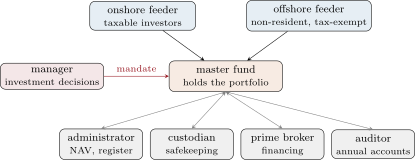
A master–feeder structure is a fund in which investors buy into one or more feeder funds, each built for a group of investors (onshore taxable investors, offshore or tax-exempt ones), and the feeders invest all their assets in a single master fund, which holds the portfolio.
Definition 4.3 (UCITS, separately managed account)
A UCITS is a fund authorised under the European Union’s directive on undertakings for collective investment in transferable securities: it may be sold to the public across the Union, and in exchange it must invest within eligible assets and diversification limits and redeem its units at any investor’s request, suspending only in exceptional cases. A separately managed account is a portfolio held in one investor’s own name and managed under an investment management agreement, outside any pooled fund.
4.2 Service providers: administrator, custodian, auditor, prime broker
Definition 4.4 (Fund administrator, custodian)
A fund administrator is the firm, independent of the manager, that computes a fund’s net asset value, keeps its register of investors, processes subscriptions and redemptions and calculates each investor’s fees. A custodian is the institution that holds a fund’s assets in safekeeping, in accounts segregated from its own and from the manager’s.
The service providers are the fund’s controls. An administrator that prices the portfolio independently stops a manager marking its own book; a custodian that holds the assets stops them being used for anything but the fund; an auditor tests both once a year. A prime broker (Book 1, chapter 6) finances the positions and often holds the assets it lends against, which is why a hedge fund’s documents say what may be rehypothecated (chapter 18). A manager chooses these firms, but investors’ due diligence (chapter 25) checks each of them.
4.3 Fees in practice: classes, hurdles, crystallisation and equalisation
A fund’s fees are the management and performance fees of Book 1, chapter 3, with a high-water mark; in practice they are set per share class, and three mechanisms decide who pays what.
Definition 4.5 (Share class, fee hurdle, crystallisation)
A share class is a category of a fund’s shares with its own terms: currency, fees, liquidity, minimum investment. A fee hurdle is a return, fixed or tied to a benchmark or a cash rate, that the fund must exceed before a performance fee is due. Crystallisation is the moment at which an accrued performance fee becomes payable to the manager and can no longer be reversed by later losses; the fund’s documents set its frequency.
The more often fees crystallise, the more the manager earns on the same returns: a gain crystallised in March is not given back when April loses. On five years of monthly returns with a mean of 8% a year and a volatility of 12%, a 20% performance fee crystallised every month takes 11.54% of the starting capital on average over 1 000 paths, against 11.26% quarterly and 10.78% annually.
Definition 4.6 (Equalisation)
Equalisation is the set of adjustments, or the practice of issuing a separate series of shares for each subscription date, by which each investor in a pooled fund pays performance fees on the gains of its own investment, measured from its own entry price.
Example 4.7 (The free ride)
Investor A subscribes 100 at a net asset value of 1.00. The fund falls 10%; investor B subscribes 100 at 0.90. The fund then rises to 1.05. With one pooled share price and one high-water mark at 1.00, the fund charges 20% of the 0.05 per share above the mark: A pays 1.00, B pays 1.11. B’s own gain was from 0.90 to 1.05; with series accounting B pays 3.33. Without equalisation B rode free on 2.22 of performance fee that A’s loss had created. The opposite case, an investor who buys above the mark and pays on gains that are not his, is as unfair and as common.
Method 4.8 (Checking a fund’s fee terms)
- List every share class and its management fee, performance fee, hurdle, high-water mark and crystallisation frequency.
- Check whether performance fees are computed per investor (series or equalisation) or on the pooled share price.
- Simulate the fee take over paths of the strategy’s returns, not on its expected return: crystallisation and the mark act on the path.
- Compare the result with the offering document’s worked example; the administrator computes the real fees and should reproduce it.
4.4 Liquidity terms and the liquidity mismatch
Definition 4.9 (Redemption notice period, lock-up period)
A fund’s redemption notice period is the time an investor must give between asking for its money and the dealing date at which it is redeemed. A lock-up period is an initial period after a subscription during which it cannot be redeemed, or only with a penalty.
Definition 4.10 (Redemption gate, side pocket, swing pricing)
A redemption gate limits the share of a fund’s (or an investor’s) assets that can be redeemed on one dealing date; requests above it are deferred. A side pocket is a separate account, or share class, into which illiquid or hard-to-value assets are moved, redeemable only when they are sold, so that investors who come and go do not trade them at a guessed price. Swing pricing adjusts the price at which investors subscribe or redeem on days of large net flows, so that the cost of trading for them falls on them and not on the investors who stay.
Definition 4.11 (Liquidity mismatch)
A fund has a liquidity mismatch when its investors may withdraw a larger share of its value within some period than it could sell within that period at a normal cost.
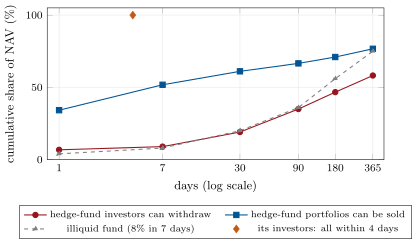
Form PF, the confidential report large US hedge-fund advisers file, gives the aggregate picture: investors in qualifying hedge funds could withdraw 9.0% of their capital within seven days in the third quarter of 2025, while the funds reported that they could sell 51.8% of their portfolios within seven days (Figure 4.2). At every horizon the portfolios were more liquid than the investors’ terms: in aggregate the hedge-fund industry is not mismatched. The fund suspended in 2019 was mismatched by a factor of more than twelve at seven days: its investors could have all of their money within four days, and it could sell 8% of its assets within seven.
As of September 2026 — The public record on fund liquidity
SEC Private Funds Statistics, third quarter of 2025 (qualifying hedge funds, aggregate NAV $4 750 billion): assets that may be suspended $3 182 billion and that may be gated $2 053 billion; assets gated $121 billion, side-pocketed $103 billion and suspended $25 billion (2.5%, 2.2% and 0.5% of NAV). UCITS Directive 2009/65/EC, article 84: a UCITS redeems at any unit-holder’s request and may suspend only temporarily, in exceptional cases and in the unit-holders’ interest. US open-end funds, SEC Rule 22e-4: an illiquid investment is one that cannot be sold within seven calendar days without significantly moving its price, and a fund may not buy one if more than 15% of its net assets would then be illiquid; Rule 22c-1(a)(3) permits swing pricing above a threshold of net flows.
As of September 2026 — The 2019 suspension in the regulator’s words
Financial Conduct Authority, 11 April 2024: the fund’s authorised corporate director “failed to manage the liquidity of the fund” between 31 July 2018 and the suspension on 3 June 2019; investors in the fund at the suspension receive a share of an up to £230 million redress scheme approved by the High Court in February 2024. FCA, 5 August 2025: the regulator decided to fine the manager £40 million and its founder £5 888 800 and to ban him from managing retail funds; both referred the decisions to the Upper Tribunal, so the findings are provisional. The regulator found that from July 2018 the fund “disproportionately sold more liquid investments” and bought less liquid ones.
Proposition 4.12 (Liquid first leaves the stayers illiquid)
Meet a redemption of a share of NAV by selling the most liquid assets first. If a share of NAV can be sold within horizon and , the remaining investors hold a fund of which only can be sold within ; if , none.
Proof. The sale removes from the liquid bucket and nothing from the others; the remaining NAV is before costs. ∎
Selling liquid first minimises the cost of today’s redemption and hands the remaining investors a less liquid fund; the next redemption is then more expensive, and redeeming early becomes worth more than staying. The model of firm.fundterms (Listing 4.1) meets a 30% redemption within a seven-day notice period for two ladders, the aggregate hedge-fund portfolio of Form PF and the illiquid fund, with illustrative selling costs that double for assets sold faster than their horizon:
| fund | policy | paid | cost borne by stayers | sellable in 7 days after |
|---|---|---|---|---|
| hedge-fund ladder | liquid first | 30% | 0.04% | 31.1% |
| pro rata | 30% | 5.39% | 51.8% | |
| gate at 10% | 10% | 0.01% | 46.4% | |
| liquid first, swing pricing | 30% | 0 | 31.1% | |
| illiquid fund | liquid first | 30% | 1.69% | 0 |
| pro rata | 30% | 8.81% | 8.0% | |
| gate at 10% | 10% | 0.09% | 0 | |
| liquid first, swing pricing | 30% | 0 | 0 |
def redeem(ladder, request: float, notice_days: int, policy: str = "liquid_first", gate: float | None = None,
           swing: bool = False, fire: float = 3.0) -> dict:
    """Meet a redemption of `request` (share of NAV) within notice_days. Buckets slower than the notice period
    can be sold only at `fire` times their cost. The gate caps the payment; the rest is deferred. Without swing
    pricing redeemers are paid at a NAV that ignores the selling cost, so the investors who stay bear all of it
    (their dilution); with it, the redeemers bear it. Returns shares of the starting NAV."""
    pay = request if gate is None else min(request, gate)
    order = sorted(ladder, key=lambda b: b.days)
    sold = {b: 0.0 for b in order}
    if policy == "liquid_first":
        need = pay
        for b in order:
            x = min(b.share, need)
            sold[b] = x
            need -= x
    elif policy == "pro_rata":
        for b in order:
            sold[b] = b.share * pay
    else:
        raise ValueError(policy)
    cost = sum(x * b.cost * (fire if b.days > notice_days else 1.0) for b, x in sold.items())
    stayers = 1.0 - pay
    # redeemers are paid at a NAV that ignores the cost of selling: without swing pricing the stayers bear all of it
    dilution = 0.0 if swing else cost / max(stayers, 1e-12)
    left = sum(b.share - sold[b] for b in order)
    after = [Bucket(b.days, (b.share - sold[b]) / max(left, 1e-12), b.cost) for b in order]
    return {"paid": pay, "deferred": request - pay, "cost": cost, "dilution_stayers": dilution, "ladder_after": after}
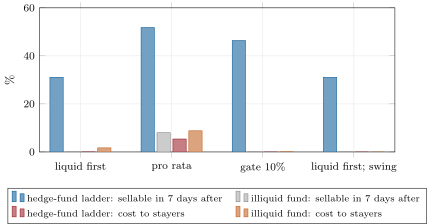
fm_fund.stress_table.The pro rata slice keeps the fund’s shape but costs the stayers 5.4% on the hedge-fund ladder and 8.8% on the illiquid one, because a slice of every bucket must be sold within a week. Swing pricing moves the cost to the redeemers and leaves the liquidity problem where it is. A gate buys time: it pays 10% now, defers 20%, and leaves the manager weeks to sell the slower assets at a normal cost. The illiquid fund has no good option: whatever it does, its first 8% of redemptions exhaust everything it can sell in a week. The largest redemption it can meet within seven days at a cost below 1% is 8% of its NAV; the Form PF ladder’s is 51.8%.
4.5 What investors ask for: side letters and managed accounts
Definition 4.13 (Side letter, most-favoured-nation clause)
A side letter is an agreement between a fund (or its manager) and one investor that varies the fund’s terms for that investor: lower fees, more information, better liquidity, a capacity commitment. A most-favoured-nation clause is a promise that the investor will be offered any better terms given to another investor of the same or smaller size.
A side letter that gives one investor better liquidity creates a mismatch among investors: it redeems first and leaves the others with a less liquid fund, which is why regulators and consultants ask whether any investor has preferential liquidity. Large investors that want full transparency, their own liquidity and no exposure to other investors’ flows use a separately managed account instead: the manager trades the investor’s own account on the same model, and the investor’s custodian holds the assets. The manager then runs several copies of one strategy, and must allocate trades among them fairly, which its compliance function tests (chapter 16).
Remark 4.14 (Liquidity is a property of the pair)
A fund is not liquid or illiquid; its assets and its terms are liquid or not relative to each other. The same portfolio is sound in a vehicle with quarterly dealing and 90 days’ notice and fragile in one with daily dealing. A manager who changes the portfolio’s liquidity, as the regulator found in 2019, changes the fund’s promise without changing its documents.
4.6 Tutorial: one fund, two investors and a bad week
Goal. Compute who pays which fees, and what a large redemption does to the investors who stay. End state: the stress table and Figure 4.3.
- Fees by investor.
fm_fund.free_ride()runs Example 4.7 throughfirm.fundterms.pooled_vs_series, which wraps One Quant Book 1’sfirm.fees. - Crystallisation.
fm_fund.crystallisation()averages the fee take over 1 000 paths for monthly, quarterly and annual crystallisation. - Ladders.
hedge_fund_ladder()turns Form PF’s cumulative portfolio liquidity into buckets;illiquid_ladder()builds the 8%-in-seven-days fund. - Stress.
stress_table()meets a 30% request under four policies (Proposition 4.12).
What to change next. Run two redemption weeks in a row and watch the liquid-first fund’s second week; give one investor a side letter with daily liquidity in a fund with monthly dealing.
4.7 Build: the fund’s terms
Purpose. The fund as its investors and administrator see it: fees by investor, crystallisation, and what its liquidity terms do under redemptions.
Interface. firm.fundterms: pooled_vs_series(returns, entries, terms); crystallised(returns, perf, every); Bucket(days, share, cost), ladder_share_within; redeem(ladder, request, notice_days, policy, gate, swing, fire); max_redemption(ladder, notice_days, max_cost).
Rules. Fee arithmetic is One Quant Book 1’s firm.fees, unchanged; without swing pricing the stayers bear the whole selling cost; a gate defers, it never cancels.
Acceptance tests. code/firm/fundterms/tests/: the free ride appears in the pooled fund and not in series; more frequent crystallisation never lowers the fee; liquid first is cheaper and leaves less liquidity than pro rata; the gate defers the rest; swing pricing removes the stayers’ dilution.
Stretch. Multiple dealing dates with deferred requests queued; a side pocket that removes a bucket from the redeemable NAV; an investor with a side letter.
Sources and further reading
- Financial Conduct Authority, press releases of 11 April 2024 (Link Fund Solutions) and 5 August 2025 (Woodford Equity Income Fund).
- US Securities and Exchange Commission, Division of Investment Management, Private Funds Statistics, third calendar quarter 2025.
- Directive 2009/65/EC (UCITS), article 84; 17 CFR 270.22e-4 and 270.22c-1 (US liquidity risk management and swing pricing).
4.8 Exercises
Exercise 4.1 ★
In Example 4.7, compute each investor’s performance fee under the pooled share price and under series accounting.
Solution
Solution of Exercise 4.1.
Pooled: A holds 100 shares and pays ; B holds 111.1 shares and pays 1.11. Series: A pays 1.00; B’s gain is , fee 3.33.
Exercise 4.2 ★
From Form PF’s 2025Q3 figures, what shares of NAV could qualifying hedge funds’ investors withdraw, and their portfolios sell, within 30 days?
Solution
Solution of Exercise 4.2.
Investors 19.1% of NAV; portfolios 61.1%.
Exercise 4.3 ★
Qualifying hedge funds reported $121 billion gated, $103 billion side-pocketed and $25 billion suspended, on NAV of $4 750 billion. Express each as a share of NAV.
Solution
Solution of Exercise 4.3.
2.5%, 2.2% and 0.5% of NAV.
Exercise 4.4 ★★
A fund can sell 20% of its NAV within seven days and receives a 15% redemption, met liquid first. What share of the remaining fund can be sold within seven days?
Solution
Solution of Exercise 4.4.
.
Exercise 4.5 ★★
Why does a performance fee crystallised monthly take more than one crystallised annually on the same returns? Give a two-month example.
Solution
Solution of Exercise 4.5.
A crystallised fee is never returned. Months of and : monthly crystallisation takes of capital in the first month; crystallised over the two months the fund ends at 0.99, below its mark, and pays nothing.
Exercise 4.6 ★★
In Figure 4.3, why does the pro rata policy cost the stayers more than liquid first, yet leave them a more liquid fund?
Solution
Solution of Exercise 4.6.
Pro rata sells a slice of every bucket within a week, including the slow ones at a fire-sale cost, which the stayers bear without swing pricing; in exchange the remaining portfolio keeps its original shape and liquidity. Liquid first sells only cheap assets and leaves the rest.
Exercise 4.7 ★★★
Coding. Run firm.fundterms.redeem on the illiquid ladder for a 5% request, then a second 5% request on the ladder left after the first, both liquid first with seven days’ notice. What share can be sold within seven days after each?
Solution
Solution of Exercise 4.7.
After the first 5%: sellable within seven days. The second 5% exceeds that and leaves nothing sellable within seven days.
Exercise 4.8 ★★★
Find the flaw. “Our fund can sell 60% of its assets within a week and our investors have monthly liquidity with 30 days’ notice, so we have no liquidity risk.”
Solution
Solution of Exercise 4.8.
Liquidity is a property of the pair and of the path: a first wave of redemptions met liquid first lowers the 60% for the next; side letters may give some investors better terms; the 60% may be an estimate from calm markets. Measure the ladder after a stressed redemption sequence, with stressed selling costs.
4.9 Problem: The Friday Queue
Problem 4.1
Weekend problem — the Friday queue
On Friday an open-ended fund with weekly dealing and seven days’ notice receives redemption requests for 30% of its NAV. You run its liquidity.
Part I — The vehicle.
- Define a master–feeder structure and the roles of the general and limited partners.
- What do the administrator and the custodian do, and why must they be independent of the manager?
- Define a redemption notice period, a lock-up, a gate, a side pocket and swing pricing.
- What does the UCITS directive require about redemptions?
Part II — The public record.
- Give Form PF’s investor and portfolio liquidity at seven days for 2025Q3.
- Is the hedge-fund industry mismatched in aggregate? At which horizon is the gap smallest in relative terms?
- Give the shares of qualifying hedge-fund NAV gated, side-pocketed and suspended.
- What did the regulator find about the fund suspended in 2019, and what is the status of its decisions?
Part III — The queue.
- State and prove Proposition 4.12.
- For the Form PF ladder, give the stayers’ cost and the share sellable within seven days afterwards under liquid first and pro rata.
- The same for the illiquid fund.
- What does a 10% gate pay, defer, and leave liquid, for each ladder?
- What does swing pricing change, and what not?
- Give the largest redemption each ladder can meet within seven days at a cost below 1%.
Part IV — The fees.
- Define equalisation and compute the free ride in Example 4.7.
- Give the mean fee take for monthly, quarterly and annual crystallisation.
- Why is a side letter with better liquidity a liquidity risk for the other investors?
- Define a liquidity mismatch.
- State the named result: the largest redemption each fund can meet within its notice period at a cost below 1%, and the dilution the stayers bear without swing pricing when 30% is met liquid first.
- In two sentences, what should the illiquid fund’s board have done before Friday?
Solution
Solution of Problem 4.1.
- Feeders built for different investors invest in one master that holds the portfolio; the general partner manages and is liable, limited partners contribute capital with limited liability.
- The administrator computes NAV, keeps the register and computes fees; the custodian holds the assets. Independence stops the manager from marking or using the assets itself.
- See the definitions of the chapter.
- A UCITS redeems at any unit-holder’s request and may suspend only temporarily and in exceptional cases.
- Investors 9.0%, portfolios 51.8%.
- No: the portfolios are more liquid than the investors’ terms at every horizon; the ratio is smallest at 365 days (76.7 against 58.2).
- 2.5%, 2.2% and 0.5%.
- Only 8% of its assets could be sold within seven days against a four-day right to redeem; liquid assets had been sold disproportionately. The 2025 decisions are referred to the Upper Tribunal and provisional; the corporate director settled with an up to £230 million redress scheme.
- See Proposition 4.12.
- Liquid first: 0.04% and 31.1%. Pro rata: 5.39% and 51.8%.
- Liquid first: 1.69% and 0. Pro rata: 8.81% and 8.0%.
- It pays 10% and defers 20%, leaving 46.4% (hedge-fund ladder) and 0 (illiquid fund) sellable within seven days.
- It puts the selling cost on the redeemers and removes the stayers’ dilution; it does not create liquidity.
- 51.8% and 8% of NAV.
- Adjustments so that each investor pays performance fees on its own gain; B’s free ride is .
- 11.54%, 11.26% and 10.78% of starting capital over five years.
- The side-letter investor can leave first and leave the others with a less liquid fund.
- When investors may withdraw more within a period than the fund can sell within it at a normal cost.
- Within seven days below a 1% cost: 51.8% for the Form PF ladder, 8% for the illiquid fund; liquid-first dilution for a 30% request without swing pricing: 0.04% and 1.69% of the stayers’ NAV.
- Match the terms to the assets: longer notice, less frequent dealing or a gate in the documents, before any redemption arrives; and keep a liquidity buffer instead of selling liquid assets first.
4.10 Interview questions
Interview question 4.1 ★ researcher
What is a master–feeder structure for, and who owns the portfolio?
Solution
Solution of Interview question 4.1.
To pool investors with different tax positions in one portfolio; the master fund owns the portfolio, and the investors own the feeders.
What the interviewer is looking for: the separation between the vehicle and the manager.
Interview question 4.2 ★ trader, risk
What is a redemption gate, and why might investors prefer a fund that has one?
Solution
Solution of Interview question 4.2.
A cap on redemptions per dealing date; it prevents a run from forcing fire sales that would dilute those who stay.
What the interviewer is looking for: the gate as protection for remaining investors.
Interview question 4.3 ★★ researcher
An investor buys into a pooled fund 10% below its high-water mark. Explain the free ride and how a fund prevents it.
Solution
Solution of Interview question 4.3.
With one share price and one mark, the new investor pays no performance fee until the mark is regained, although its own investment gained; series accounting or equalisation charges it on its own gain.
What the interviewer is looking for: one mark for many entry prices.
Interview question 4.4 ★★ risk
You must meet a large redemption. Why is selling the most liquid assets first not neutral for the investors who stay?
Solution
Solution of Interview question 4.4.
It leaves the stayers a less liquid fund, so the next redemption costs more and leaving early is rewarded (Proposition 4.12).
What the interviewer is looking for: the incentive to run.
Interview question 4.5 ★★ trader
What does swing pricing do, and what problem does it not solve?
Solution
Solution of Interview question 4.5.
It charges the cost of large net flows to the investors who cause them; it does not make the assets any easier to sell.
What the interviewer is looking for: dilution against liquidity.
Interview question 4.6 ★★★ risk, researcher
How would you measure a fund’s liquidity mismatch, and what data would you ask the manager for?
Solution
Solution of Interview question 4.6.
Compare, at each horizon, the share of NAV investors can withdraw (terms, gates, side letters) with the share the portfolio can be sold within at a stated cost, under stress; ask for the position-level liquidity ladder, the investor register by terms, and the side letters.
What the interviewer is looking for: both sides of the pair, and stress.
Terms defined in this chapter
- Equalisation
- Fund administrator, custodian
- General partner, limited partner
- Liquidity mismatch
- Master–feeder structure
- Redemption gate, side pocket, swing pricing
- Redemption notice period, lock-up period
- Share class, fee hurdle, crystallisation
- Side letter, most-favoured-nation clause
- UCITS, separately managed account