The Desk and the Firm · The firm
11Intellectual Property and Non-Competes
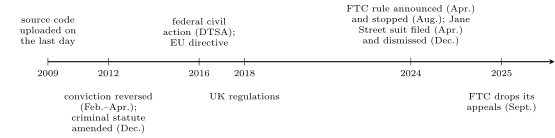
On 5 June 2009, his last day at Goldman Sachs, a programmer who had worked on the bank’s high-frequency trading system encrypted and uploaded more than 500 000 lines of its source code to a server in Germany; he had accepted a job at a start-up building its own trading system. A jury convicted him under two federal statutes and he was sentenced to 97 months in prison. In 2012 the Court of Appeals for the Second Circuit reversed both convictions: the code, it held, was not a stolen “good” under one statute, and under the other it was not related to a product “produced for or placed in interstate or foreign commerce”, since the bank sold and licensed its trading system to no one. Within the year Congress amended the second statute to cover products and services used in commerce. A trading firm’s most valuable assets are written in code and carried in people’s heads, and the law that protects them turns on words like these.
11.1 What a trading firm owns: code, models, data and know-how
A trading firm’s capital, premises and connections can be bought. What it owns that a competitor cannot buy is a set of things that are hard to see and easy to carry: source code, the structure of its models and their fitted parameters, cleaned and joined data, research logs (One Quant Book 7) recording what was tried and what failed, and the know-how of the people who built them. Most of it is protected in only two ways. Either the law treats it as a secret and punishes its taking, or contracts keep the people who know it from using it elsewhere for a while.
Patents and copyright do little of the work. A trading strategy is rarely patentable, and patenting it would publish it; copyright protects the text of code but not the idea it implements, and a competitor who rewrites a model from memory copies no text. So the firm’s protection rests on secrecy, and secrecy is a matter of degree: every departure, every conference talk and every vendor who sees the data leaks some of it.
Three things differ in how fast what leaks loses its value.
- The model’s structure: which effects the strategy trades and how it combines them. It decays slowly, at the pace of the effect itself: crowding and post-publication decay (One Quant Book 7) erode it over years.
- The parameters: the fitted weights, thresholds and sizes. Their value is high but short: they are re-fitted every few months, and a stale copy loses its edge quickly.
- The data: the pipeline that cleans and joins the inputs. Its value decays at the pace of the vendors’ own changes.
The chapter’s model gives each a share of the strategy’s profits that a competitor using it would take, and a half-life, the time for the value of what was taken to halve, which is Book 7’s signal half-life applied to the leaked knowledge.
11.2 Trade secrets and how they are protected
Definition 11.1 (Trade secret)
A trade secret is information, including source code, models and data, that is not generally known or readily ascertainable by others in the field, that has commercial value because it is secret, and that its holder has taken reasonable steps to keep secret.
The three conditions are nearly the same in the United States, the European Union and the United Kingdom (Box 11.1). The third is the one a firm controls, and the one litigation turns on: a court asks what the firm did, not what it intended. The reasonable steps are ordinary controls: access on a need-to-know basis, logging of copies and uploads, segregation of duties (One Quant Book 6) between those who write code and those who can move it off the firm’s systems, and contracts.
Definition 11.2 (Confidentiality agreement, invention assignment clause)
A confidentiality agreement binds an employee or counterparty not to disclose or use the firm’s confidential information, during and after the relationship. An invention assignment clause in an employment contract assigns to the employer the rights in work the employee creates in the course of the employment: code, models, research and documents.
As of September 2026 — Trade secret law
United States: 18 U.S.C. 1839(3) defines a trade secret as financial, business, scientific, technical, economic or engineering information, including programs and codes, whose owner has taken reasonable measures to keep it secret and which derives independent economic value from not being generally known or readily ascertainable. The Defend Trade Secrets Act of 2016 (18 U.S.C. 1836) gives the owner a federal civil action, with a civil seizure order available only in extraordinary circumstances, within three years of discovering the misappropriation; the criminal offence of 18 U.S.C. 1832 applies, since the Theft of Trade Secrets Clarification Act of 2012, to secrets related to “a product or service used in or intended for use in” interstate or foreign commerce. European Union: Directive (EU) 2016/943, article 2, requires the information to be secret, to have commercial value because it is secret, and to have been subject to reasonable steps to keep it secret. United Kingdom: the Trade Secrets (Enforcement, etc.) Regulations 2018 (SI 2018/597) implemented the directive’s rules. This box is a summary of public texts, not legal advice.
The criminal case of the hook shows why the words matter. The court held that the source code was intangible, so its transfer by upload was not the transport of a stolen “good” under the National Stolen Property Act; and that the trading system, which the bank kept to itself, was not a product produced for or placed in interstate commerce, so the Economic Espionage Act, as then worded, did not reach it. The 2012 amendment replaced those words with a product or service “used in or intended for use in” commerce, which an in-house trading system is. The civil action of 2016 added a federal route for the owner itself (Figure 11.4).
11.3 Non-competes, garden leave and non-solicitation
Trade secret law acts after the fact and must prove what was taken. Contracts act before: they keep the people who know the secret out of the market for a while, whether or not they take anything.
Definition 11.3 (Non-compete clause, garden leave, non-solicitation clause)
A non-compete clause bars a former employee from working for a competitor, or in a defined activity, for a period after leaving. Garden leave is a notice period during which the employee remains employed and paid but is kept away from work, clients and markets. A non-solicitation clause bars a former employee from soliciting the firm’s clients or hiring away its staff for a period.
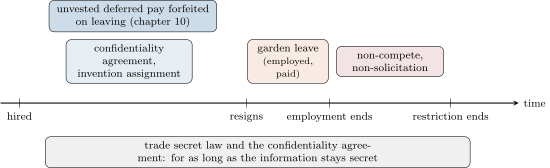
The two restrictions differ in who pays and in how courts see them. Garden leave is paid employment: the employee keeps salary and benefits, and the restriction is part of a notice period the employee agreed to. A non-compete starts after employment ends; some firms pay for it and some jurisdictions require them to, and whether it is enforceable, and for how long, depends on the jurisdiction and on the terms. In the United States a federal ban was announced in 2024 and abandoned in 2025 (Box 11.2). Deferred compensation (chapter 10) works alongside both: an employee who leaves forfeits the unvested balance, and a hiring firm that buys it out usually waits for the restriction to end.
As of September 2026 — The FTC non-compete rule
The Federal Trade Commission announced a rule in April 2024 that would have banned most non-compete clauses for workers in the United States. On 20 August 2024 a federal district court (Ryan, LLC v. FTC, N.D. Tex.) issued an order stopping the FTC from enforcing it; the FTC appealed on 18 October 2024. On 5 September 2025 the Commission voted 3–1 to dismiss its appeals and accede to the vacatur of the rule. The rule is not in effect; non-competes remain governed by state law and by the FTC’s case-by-case enforcement against particular agreements.
11.3.1 What garden leave protects
Let a strategy earn a year, with an edge that decays at rate whatever happens (half-life ). A departing employee could give a competitor something that takes a share of the strategy’s remaining profits from the day the competitor starts trading it. If the firm keeps the employee out of the market for years, at a cost of a year, and discounts at rate , then
The protected value rises quickly while what was taken is still fresh and flattens once it has decayed; the cost rises in a straight line. The restriction is worth its cost only while the knowledge it keeps out of the market is still worth more than the salary that keeps it there.
Proposition 11.4 (The six-month question)
If , the net value is maximised at
whatever the discount rate: the best restriction lasts as many half-lives of the knowledge as it takes the share of profits at stake to halve down to the salary. With the net value at is . If no restriction is worth its cost.
Proof. The derivative of the net value is , positive for and negative after. With , and . ∎
Example 11.5 (One researcher, one year)
A strategy earns 10 a year; a competitor would take half of it (); the knowledge has a half-life of a year; the leave costs 1 a year; no discounting. The loss if the competitor starts at once is . Six months of leave protect 2.11 and a year protects 3.61, for costs of 0.5 and 1: net 2.61 after a year. The best length is years, where the net value is .
def loss_if_start(P, L, lam, r, T):
    return L * P * math.exp(-(lam + r) * T) / (lam + r)


def protected(P, L, lam, r, T):
    return L * P * (1 - math.exp(-(lam + r) * T)) / (lam + r)


def leave_cost(S, r, T):
    return S * T if r == 0 else S * (1 - math.exp(-r * T)) / r


def net(P, L, lam, r, S, T):
    return protected(P, L, lam, r, T) - leave_cost(S, r, T)


def best_length(P, L, lam, S):
    """Where the discounted marginal protection L P e^{-(lam+r)T} equals the discounted marginal cost S e^{-rT}."""
    if L * P <= S:
        return 0.0
return math.log(L * P / S) / lamThe proposition’s length is an economic optimum, not a legal one. Where the knowledge decays slowly, runs to years, far beyond the three to twelve months of the usual restriction; there the restriction protects only a small part of what is at stake, and the rest must come from trade secret law and from the reasonable steps that keep the secret in the first place. Where it decays fast, a short restriction protects most of it.
11.4 Tutorial: pricing garden leave
Goal. Estimate how fast a strategy’s edge decays after a key researcher leaves, under three assumptions about what they carry, and price garden leave of three, six and twelve months against the value it protects. End state: Figure 11.2 and Table 11.1.
- The strategy. It earns $20 million a year; garden leave costs $1.5 million a year in salary and benefits; the discount rate is 8% (illustrative).
- Three cases. The researcher carries the model’s structure (a competitor would take 30% of the profits; true half-life 24 months), its parameters (60%, 6 months) or its data pipeline (20%, 12 months).
- The half-lives.
fm_ip.edge_seriesdraws 48 months of noisy edge for each case, andfirm.gardenleave.half_life_from_seriesestimates the half-life with Book 7’s decay fit (Figure 11.1). - The prices.
fm_ip.table()gives the protected value and the net value of each length, the loss with no restriction, and the best length of Proposition 11.4.
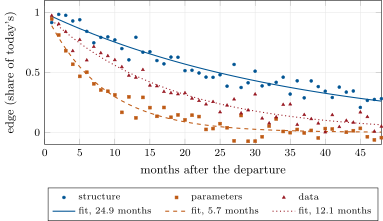
fm_ip.edge_series.| half-life | best | protected by | net of cost | loss with | ||||
| knowledge | (months) | (years) | 3 mo | 6 mo | 12 mo | 6 mo | 12 mo | no leave |
| structure | 24.9 | 4.14 | 1.42 | 2.71 | 4.91 | 1.97 | 3.47 | 14.47 |
| parameters | 5.7 | 1.42 | 2.49 | 4.18 | 6.12 | 3.45 | 4.67 | 7.78 |
| data | 12.1 | 1.43 | 0.91 | 1.66 | 2.79 | 0.93 | 1.35 | 5.22 |
fm_ip.table.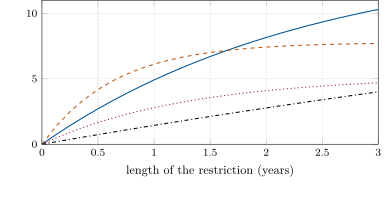
fm_ip.curves.The three cases split cleanly. Six months of leave protect 54% of what the parameters are worth to a competitor, 32% for the data and only 19% for the structure. Every restriction in the table is worth more than its cost, since the salary is small against a strategy’s profits. The best lengths are three half-lives for the parameters (), two for the structure () and 1.42 for the data (): 1.42, 4.14 and 1.43 years. The fastest-decaying knowledge is the one a restriction protects best, and the slowest, the model’s structure, is the one it protects least: a four-year restriction is neither usual nor, in most places, likely to be enforced.
What to change next. Rerun with seed=12: the fitted half-lives move to 23.9, 6.6 and 11.7 months and the best lengths to 3.99, 1.65 and 1.38 years, so the ranking is robust and the digits are not. Then let the competitor need six months to rebuild a trading system: the restriction then protects the parameters for longer than it lasts.
11.5 The public litigation record
The disputes that reach a court are few, and most end without a judgement on the merits. What the public record shows is the shape of the claims and how they end (Figure 11.4).
In April 2024 Jane Street Group sued Millennium Management and two former employees in the Southern District of New York (No. 1:24-cv-02783). The complaint alleged breach of contract, tortious interference, trade secret misappropriation, unjust enrichment and unfair competition: that the two employees, who had resigned in February 2024 to join Millennium, had taken a proprietary trading strategy with them. On 6 December 2024 the parties filed a stipulation dismissing all claims and defences with prejudice, each party bearing its own costs and fees. The docket records the allegations and the dismissal; it records no finding that anything was taken.
Remark 11.6 (What the record teaches a head of desk)
The criminal case turned on the words of a statute and the civil case ended in a dismissal: neither gave a firm a judgement on the merits to rely on. What a firm controls is what happens before anyone leaves: what the employee could reach, what was logged, what the contracts said, and whether the secret was treated as a secret. A research log (One Quant Book 7) dated and access-controlled is evidence of what the firm knew and when; a restriction that the firm does not pay for or does not enforce consistently is weaker evidence that the information needed protecting.
Method 11.7 (Protecting what leaves with people)
- List what the firm owns in the three kinds (structure, parameters, data) and estimate how fast each loses value once out.
- Take the reasonable steps: need-to-know access, logged copies and uploads, segregation of duties, confidentiality and invention assignment in every contract.
- Set notice and restriction lengths by kind of knowledge (Proposition 11.4), within what local law allows, and pay for them.
- At every departure: cut access on resignation, review the logs, remind the employee of the obligations in writing.
- Take legal advice before relying on any restriction or bringing any claim.
11.6 Build: the garden-leave calculator
Purpose. No honest build: the chapter’s subject is legal. The analytical tool prices a restriction as a decaying asset against its salary cost.
Interface. firm.gardenleave: loss_if_start, protected, leave_cost, net, best_length, half_life_from_series (wrapping firm.decay.half_life_fit).
Rules. Protected value plus remaining loss equals the loss with no restriction; the best length maximises the net value and does not depend on the discount rate; no restriction is worth it when .
Acceptance tests. code/firm/gardenleave/tests/: the identity, the best length against a grid search, and the half-life of a clean decay.
Stretch. A competitor that needs time to rebuild; a probability that the restriction is not enforced; the expected cost of a leak against the cost of enforcing a claim.
Sources and further reading
- United States v. Aleynikov, 676 F.3d 71 (2d Cir. 2012); Theft of Trade Secrets Clarification Act of 2012, Pub. L. 112-236.
- 18 U.S.C. 1836 and 1839; Directive (EU) 2016/943; The Trade Secrets (Enforcement, etc.) Regulations 2018 (SI 2018/597).
- Federal Trade Commission, Noncompete Rule page and press release of September 2025.
- Jane Street Group, LLC v. Millennium Management LLC et al., No. 1:24-cv-02783 (S.D.N.Y.), complaint and stipulation of dismissal.
11.7 Exercises
Exercise 11.1 ★
In Example 11.5, compute the value protected by six and twelve months of leave and the loss with no leave.
Solution
Solution of Exercise 11.1.
With and : , so 2.11 for six months and 3.61 for a year; the loss with no leave is .
Exercise 11.2 ★
List the three conditions for information to be a trade secret. Is a signal described in a published paper a trade secret? Is the firm’s fitted version of it?
Solution
Solution of Exercise 11.2.
Not generally known or readily ascertainable; commercial value because secret; reasonable steps to keep it secret. The published signal is not a secret; the firm’s fitted version, its parameters and implementation can be, if the firm keeps them secret.
Exercise 11.3 ★
What does garden leave cost for three, six and twelve months at $1.5 million a year, discounted at 8%?
Solution
Solution of Exercise 11.3.
: 0.37, 0.74 and 1.44 ($ million).
Exercise 11.4 ★★
For which half-life is six months the best length when ? When ?
Solution
Solution of Exercise 11.4.
months gives months when and months when . Six months is the right length only for knowledge that decays within a few months.
Exercise 11.5 ★★
Why was the conviction of the hook reversed, and what did Congress change in 2012?
Solution
Solution of Exercise 11.5.
The court held the source code intangible, so not a stolen “good” under the National Stolen Property Act, and the trading system, which was not sold or licensed, not a product “produced for or placed in” interstate commerce under the Economic Espionage Act. The 2012 Act replaced those words with a product or service “used in or intended for use in” commerce.
Exercise 11.6 ★★
Derive the net value at the best length with and check it on Example 11.5.
Solution
Solution of Exercise 11.6.
and , so the net is . With , , : , as in the example.
Exercise 11.7 ★★★
Coding. Rerun fm_ip.table(seed=12). What happens to the half-lives and the best lengths?
Solution
Solution of Exercise 11.7.
Half-lives 23.9, 6.6 and 11.7 months; best lengths 3.99, 1.65 and 1.38 years. The ranking of the three kinds is unchanged; the lengths move by a few months, as much as the noise in the fitted half-lives.
Exercise 11.8 ★★★
Find the flaw. “Our model’s structure is the valuable part. A two-year non-compete protects it fully.”
Solution
Solution of Exercise 11.8.
Protection lasts only as long as the restriction: with a half-life of 24.9 months, two years protect 56% of the structure’s value to a competitor (net $5.38 million after the leave’s cost), and the rest leaks when it ends. A two-year restriction may also not be enforceable, and it does nothing against leaks through other people. The structure is protected mostly by keeping it a trade secret.
11.8 Problem: The Six-Month Question
Problem 11.1
Weekend problem — the six-month question
A senior researcher on a strategy earning $20 million a year resigns to join a competitor. The head of desk must decide what to protect and how long to keep the researcher out of the market.
Part I — What the firm owns.
- List what a trading firm owns that a competitor cannot buy.
- Why do patents and copyright protect little of it?
- Define a trade secret and name the condition the firm controls.
- Define a confidentiality agreement and an invention assignment clause.
Part II — The law.
- Summarise the facts and the outcome of United States v. Aleynikov.
- What did the 2012 amendment change, and what did the 2016 Act add?
- What is the status of the FTC’s non-compete rule?
- What did the Jane Street complaint allege, and how did the case end?
Part III — The model.
- Define a non-compete clause, garden leave and a non-solicitation clause.
- Write the protected value and the cost of a restriction of length .
- State and prove Proposition 11.4.
- Give the fitted half-lives of the three kinds of knowledge.
- Give the value protected by six months for each, and its share of the loss with no leave.
- Give the best lengths, and say why each is that many half-lives.
Part IV — The decision.
- The researcher knows the structure and the parameters. How long a restriction would you want, and what does six months buy?
- What protects the structure beyond any restriction?
- List the steps to take on the day of the resignation.
- How robust are the best lengths to the noise in the half-life estimates?
- State the named result: the garden-leave length at which the marginal edge protected equals the marginal salary cost.
- In two sentences, write the firm’s policy on restrictions.
Solution
Solution of Problem 11.1.
- Source code, model structure and parameters, cleaned data, research logs and the know-how of the people who built them.
- A strategy is rarely patentable and a patent would publish it; copyright protects the text of code, not the idea it implements.
- See Definition 11.1; the reasonable steps to keep it secret.
- See Definition 11.2.
- A programmer uploaded more than 500 000 lines of the bank’s trading-system code on his last day; he was convicted and sentenced to 97 months; the Second Circuit reversed in 2012 because neither statute, as worded, covered the conduct.
- It extended the criminal offence to secrets related to products or services used in commerce; the 2016 Act gave owners a federal civil action.
- Announced in April 2024, stopped by a court in August 2024; the FTC abandoned its appeals in September 2025. It is not in effect.
- Breach of contract, trade secret misappropriation and related claims over a trading strategy taken by two employees who joined Millennium; it was dismissed with prejudice by stipulation in December 2024, with no finding on the merits.
- See Definition 11.3.
- and .
- See Proposition 11.4.
- 24.9, 5.7 and 12.1 months (true 24, 6 and 12).
- 2.71, 4.18 and 1.66 ($ million): 19%, 54% and 32% of the loss with no leave (14.47, 7.78 and 5.22).
- 4.14, 1.42 and 1.43 years: half-lives, that is 2, 3 and 1.42.
- On the model, 1.4 years for the parameters and four for the structure; six months protects 54% of the parameters’ value and 19% of the structure’s, at a cost of 0.74.
- Trade secret law, and the reasonable steps that keep it a secret: access control, logging and contracts.
- Cut access, review the logs of copies and uploads, confirm the obligations in writing, start the notice period, take legal advice.
- Moderately: another draw of the noise moves them by a few months (3.99, 1.65, 1.38 years), not the ranking.
- , whatever the discount rate: as many half-lives as it takes the profits at stake to halve down to the salary.
- Keep the secret by access, logs and contracts; set paid notice and restrictions by how fast each kind of knowledge decays, within what local law allows, and rely on them for the fast-decaying part only.
11.9 Interview questions
Interview question 11.1 ★ researcher, trader
What is garden leave, and why would a firm pay you not to work?
Solution
Solution of Interview question 11.1.
Paid notice during which you stay employed but away from work and markets; it keeps what you know from reaching a competitor while it is still fresh, and costs less than the edge it protects.
What the interviewer is looking for: the decaying value of information.
Interview question 11.2 ★ developer
You wrote a backtesting library at your last job. Can you bring it with you?
Solution
Solution of Interview question 11.2.
No: under an invention assignment clause it belongs to the old employer, and it may be a trade secret. You bring your general skill and knowledge, not the code.
What the interviewer is looking for: ownership and the line between skill and the employer’s property.
Interview question 11.3 ★★ researcher
A signal’s value halves every six months. How much of it does a six-month non-compete protect?
Solution
Solution of Interview question 11.3.
Half of its remaining value, before discounting: with .
What the interviewer is looking for: .
Interview question 11.4 ★★ risk
What would you log to show that the firm takes reasonable steps to keep its code secret?
Solution
Solution of Interview question 11.4.
Access grants and their reviews, copies and uploads off the firm’s systems, removable media, repository clones, and the acknowledgements of confidentiality obligations.
What the interviewer is looking for: evidence of reasonable steps.
Interview question 11.5 ★★ researcher
Which leaks faster in value: a model’s parameters or its structure? What follows for a firm’s contracts?
Solution
Solution of Interview question 11.5.
The parameters: they are re-fitted every few months. A short restriction protects them well; the structure needs secrecy, since no enforceable restriction lasts long enough.
What the interviewer is looking for: half-lives by kind of knowledge.
Interview question 11.6 ★★★ researcher, trader
Derive the length of garden leave that maximises its net value to the firm.
Solution
Solution of Interview question 11.6.
Net value ; its derivative vanishes at .
What the interviewer is looking for: marginal protection against marginal cost, and that drops out.