The Desk and the Firm · The firm
24Entering a New Market
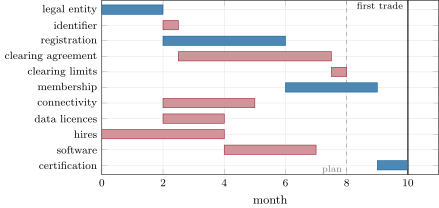
The plan says eight months to the first trade. The clearing agreement alone takes five, and it cannot start until the legal entity exists and has its identifier; the exchange will not certify the software until the clearing firm has set the firm’s limits; and the regulatory registration that membership requires takes four months of its own, starting only when the entity exists. Drawn as a network, the entry takes ten months, and the long pole is not the clearing agreement everyone was watching but the registration nobody had put on the chart.
24.1 Why enter: the edge and the size of the prize
A trading firm enters a new market (an asset class, a region, a venue) because an edge it has elsewhere should work there, or because a client or counterparty it already serves trades there. Flow Traders’ 2025 annual report is a public example of the second kind of reasoning: it described expanding its presence in Asia and “initiating active trading in China, an attractive growth market aligned with our core ETP strengths”, with its exchange-traded product value traded in Asia rising from € 114 billion in 2024 to € 152 billion in 2025. Whatever the reason, the entry costs money for months before the first trade, and the prize is uncertain until the firm has traded for a while.
Definition 24.1 (Entry plan, time to first trade)
An entry plan sets out the workstreams needed to trade in a new market (legal entity, authorisation, clearing, membership, connectivity, data, people, software, certification), their durations, costs and dependencies, the expected revenue ramp and the points at which the firm decides whether to continue. The time to first trade is the time from the decision to enter to the first live trade, set by the longest chain of dependent workstreams.
24.2 The checklist: access, clearing, data, legal, staffing
The workstreams are the chapters of this series. The entity needs a legal entity identifier (Book 2) before most counterparties will open an account; authorisation or registration follows chapter 17’s map and its statutory periods; clearing through a futures commission merchant or a clearing member (Book 1) needs know-your-customer checks, legal agreements (chapter 18) and limits; membership and certification (Book 13) follow; connectivity (Book 14), market data licences (chapter 22) and people (chapter 10) run alongside. The chapter’s example is a futures market in a new region (Table 24.1); durations and costs are illustrative inputs.
| workstream | months | $k/month | after | slack |
|---|---|---|---|---|
| legal entity | 2.0 | 25 | – | 0 |
| legal entity identifier | 0.5 | 2 | entity | 1.0 |
| regulatory registration | 4.0 | 30 | entity | 0 |
| clearing agreement | 5.0 | 20 | identifier | 1.0 |
| clearing limits set | 0.5 | 5 | clearing agreement | 1.0 |
| exchange membership | 3.0 | 15 | registration | 0 |
| connectivity | 3.0 | 40 | entity | 4.0 |
| market data licences | 2.0 | 10 | entity | 6.0 |
| hires | 4.0 | 60 | – | 2.0 |
| software adaptation | 3.0 | 80 | hires | 2.0 |
| certification | 1.0 | 10 | limits, membership, | 0 |
| connectivity, software |
fm_entry.TASKS, firm.entryplan.schedule.24.3 The critical path
Definition 24.2 (Critical-path method)
The critical-path method schedules a project given as tasks with durations and precedence constraints: each task starts when all its predecessors finish; the project’s length is the longest path through the network; a task’s slack is how much it can be delayed without delaying the end; the critical path is the chain of tasks with no slack.
Kelley and Walker described the method in 1959 for construction and maintenance projects; it applies unchanged to an entry plan (Listing 24.1).
def schedule(tasks):
    by = {t.name: t for t in tasks}
    es, ef = {}, {}

    def finish(n):
        if n not in ef:
            t = by[n]
            es[n] = max((finish(p) for p in t.after), default=0.0)
            ef[n] = es[n] + t.months
        return ef[n]

    end = max(finish(n) for n in by)
    lf = {n: end for n in by}
    for n in sorted(by, key=lambda x: -ef[x]):          # latest finish: min over successors' latest start
        for s in by.values():
            if n in s.after:
                lf[n] = min(lf[n], lf[s.name] - s.months)
    return {n: (es[n], ef[n], lf[n] - ef[n]) for n in by}


def critical_path(tasks):
    """Tasks with zero slack, in order of their earliest start."""
    sch = schedule(tasks)
    return [n for n, (s, _, sl) in sorted(sch.items(), key=lambda x: (x[1][0], x[1][1])) if abs(sl) < 1e-9]


def cost_by_month(tasks, horizon):
    sch = schedule(tasks)
    out = np.zeros(horizon)
    for t in tasks:
        s, f, _ = sch[t.name]
        for m in range(horizon):
            overlap = max(0.0, min(f, m + 1) - max(s, m))
            out[m] += overlap * t.monthly_cost
return outThe critical path runs through the legal entity, the regulatory registration, the exchange membership and the certification: ten months to the first trade (Figure 24.1). The clearing chain, which the plan’s eight months were built around, finishes after eight months and has a month of slack. Connectivity has four months of slack and the data licences six: they can start late without cost. Before the first trade the entry spends $949 000, at most $170 000 in a month, when software, hires, registration and connectivity overlap.
firm.entryplan.schedule.24.4 Staging the investment
Definition 24.3 (Staged investment)
A staged investment commits money in steps separated by decision points, each with a kill criterion (Book 7’s stage gates) stated in advance, so that the firm can stop when what it has learnt says the rest is not worth spending.
After the first trade the revenue ramps towards a steady state a month, as with months, against running costs of $250 000 a month; the horizon is three years and the discount rate 10%. The steady state is the uncertain part: in the chapter’s model it is lognormal with a median of $400 000 a month. A weak outcome ($150 000) loses $3.55 million of present value; the base case ($450 000) gains $2.00 million, an internal rate of return of 104% a year; a strong one ($800 000) gains $8.46 million.
Proposition 24.4 (A kill point never hurts with perfect information)
If at the kill point the firm learns exactly and stops when is below the running cost , the entry’s expected net present value with the kill point is at least its value without.
Proof. After the kill point, continuing adds each month when , and stopping adds zero; when the firm continues and nothing changes. The kill point therefore raises the value in every state with and leaves the others unchanged; so does its expectation. ∎
In practice the firm sees a noisy estimate. The chapter’s firm observes with a 25% error after six months of live trading and stops if the estimate is below the $250 000 running cost (Listing 24.2).
def staged_npv(tasks, first_trade, Rs, tau, run_cost, horizon, rate, kill_after, threshold, noise, seed=0):
    """For each true steady-state revenue in Rs: the NPV without staging, and with a kill point after `kill_after`
    months of trading, where the firm observes R with multiplicative noise and stops if the estimate is below
    `threshold`. Returns (npv without, npv with, killed flags)."""
    rng = np.random.default_rng(seed)
    stop_month = int(math.ceil(first_trade)) + kill_after
    plain, staged, killed = [], [], []
    for R in Rs:
        plain.append(npv(entry_cash(tasks, first_trade, R, tau, run_cost, horizon), rate))
        est = R * math.exp(noise * rng.standard_normal())
        k = est < threshold
        killed.append(k)
        staged.append(npv(entry_cash(tasks, first_trade, R, tau, run_cost, horizon, stop_month if k else None), rate))
return np.array(plain), np.array(staged), np.array(killed)24.5 Tutorial: eight months to first trade
Goal. Draw the entry’s critical path, price it, and value a kill point after six months of trading. End state: the Gantt chart (Figure 24.1) and the NPV distributions with and without staging (Figure 24.2).
- The network.
fm_entry.TASKS;firm.entryplan.scheduleandcritical_path. - The costs.
cost_by_monthspreads each workstream’s cost over its months. - The outcomes.
fm_entry.scenario_npvs()for three revenue levels;revenue_drawsfor 4 000 lognormal draws. - The kill point.
fm_entry.staging()compares the NPVs;threshold_curve()varies the kill threshold.
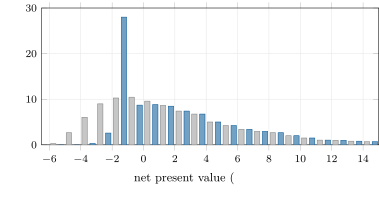
fm_entry.staging.Without a kill point the entry’s expected NPV is $2.52 million, with a 38.6% chance of losing money and a 5th percentile of million. With the kill point the firm stops 22.7% of entries; the expected NPV rises by $200 000 to $2.72 million, and the 5th percentile to million. The probability of losing money barely moves (39.6%): stopping turns large losses into smaller ones rather than into gains, and the set-up costs are sunk. The noise costs something: 3.6% of all entries are weak and continue, and 5.5% are sound and stopped.
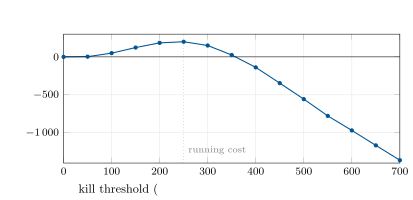
fm_entry.threshold_curve.The threshold matters as much as the kill point (Figure 24.3). Set at the running cost, as Proposition 24.4 suggests, it adds $200 000; at $300 000 it adds $150 000; at $400 000 it destroys $138 000, because a rule that demands the base case kills entries that would have paid. A kill criterion is written before entry, at a level the firm could defend if the market then turned out well.
24.6 A worked entry plan
Method 24.5 (Planning an entry)
- State why the firm’s edge should work in the market, and the size of the prize, with evidence (Book 7’s research standards).
- List every workstream with its owner, duration, cost and predecessors; draw the network and its critical path; put the owners of the critical workstreams in the weekly meeting.
- Start the long, cheap workstreams first (registration, clearing); start the short, expensive ones (hires, connectivity) as late as their slack allows.
- Write the kill criteria before entry: when they will be measured, on what data, and the threshold.
- Review the plan at every stage gate against the network and the criteria, not against the original dates.
Remark 24.6 (Which slack to use)
Slack is an option on delay. Starting the hires two months later, within their slack, defers $240 000 of salaries without delaying the first trade, and keeps the option not to spend it if the registration or the clearing agreement fails first. The same logic applies to connectivity, with four months of slack and fees that start on delivery: the cheapest workstream to start is the one that decides the date.
24.7 Build: the entry plan
Purpose. An entry as a network of workstreams: the critical path and slack, the cost schedule, revenue ramps, NPV and IRR, and the value of staging.
Interface. firm.entryplan: Task, schedule, critical_path, cost_by_month, npv, irr, entry_cash, staged_npv.
Rules. A task starts when all its predecessors finish; the critical path has zero slack; a killed entry stops its running costs and revenue at the kill month.
Acceptance tests. code/firm/entryplan/tests/: a four-task network’s schedule, slack and path; costs, NPV and IRR on hand numbers; the kill rule with exact information.
Stretch. Uncertain durations and the probability of meeting a date; costs from Book 1’s clearing and fee models; several kill points.
Sources and further reading
- Flow Traders, Annual Report 2025.
- J. E. Kelley and M. R. Walker, “Critical-path planning and scheduling”, Eastern Joint Computer Conference, 1959.
- A. K. Dixit and R. S. Pindyck, Investment under Uncertainty, 1994.
24.8 Exercises
Exercise 24.1 ★
Compute the length of the clearing chain and of the registration chain. Which is critical?
Solution
Solution of Exercise 24.1.
Clearing: months to limits, 9 with certification. Registration: months to membership, 10 with certification. The registration chain is critical.
Exercise 24.2 ★
Which workstreams have the most slack, and what does that allow?
Solution
Solution of Exercise 24.2.
Market data licences (6 months) and connectivity (4 months): they can start later without delaying the first trade, which defers their costs.
Exercise 24.3 ★
What does the entry cost before the first trade, and in which month does it spend most?
Solution
Solution of Exercise 24.3.
$949 000; the peak is $170 000 in month 5, when registration, connectivity, data, hires and software overlap.
Exercise 24.4 ★★
If the registration took two months instead of four, what would the time to first trade be, and which chain would be critical?
Solution
Solution of Exercise 24.4.
Nine months; the clearing chain (entity, identifier, clearing agreement, limits, certification) becomes critical.
Exercise 24.5 ★★
Prove Proposition 24.4, and explain why it can fail with a noisy estimate.
Solution
Solution of Exercise 24.5.
See the proof of Proposition 24.4. With noise, the firm sometimes stops a sound entry (losing its later profits) or continues a weak one, so the kill point can lower the value if the threshold is set too high.
Exercise 24.6 ★★
Why does the kill point barely change the probability of losing money while raising the 5th percentile by $1.6 million?
Solution
Solution of Exercise 24.6.
Stopped entries have already spent their set-up costs and some months of losses, so they still lose money, but much less than if they had run for three years: the losses shrink rather than disappear.
Exercise 24.7 ★★★
Coding. Rerun fm_entry.threshold_curve() and find the best threshold. What does a threshold of $400 000 do?
Solution
Solution of Exercise 24.7.
The best threshold is $250 000, the running cost, adding $200 000; at $400 000 the rule stops almost half the entries and lowers the expected value by $138 000.
Exercise 24.8 ★★★
Find the flaw. “The clearing agreement is the long pole: we will start it first and the rest can wait.”
Solution
Solution of Exercise 24.8.
The critical path runs through registration and membership, which are two months longer; starting clearing first while registration waits delays the first trade. Draw the network before choosing what to start.
24.9 Problem: Eight Months to First Trade
Problem 24.1
Weekend problem — eight months to first trade
A head of business development must present an entry plan for a futures market in a new region, with a date and a decision rule.
Part I — Why and what.
- Why would a trading firm enter a new market? Give the public example of the chapter.
- Define an entry plan and the time to first trade.
- List the workstreams and the chapter each draws on.
- Which dependencies does the hook describe?
Part II — The network.
- Define the critical-path method.
- Give the schedule and the critical path.
- Give the slack of each workstream and what to do with it.
- Give the cost before the first trade and its peak month.
Part III — The money.
- Describe the revenue ramp and the three scenarios’ NPVs.
- Define a staged investment.
- State and prove Proposition 24.4.
- Give the NPV distribution with and without the kill point.
- How should the kill threshold be set?
Part IV — The plan.
- Which workstreams would you start first, and which last?
- Who should attend the weekly meeting?
- What would you report at each stage gate?
- What would make you shorten the kill point to three months?
- What does the model leave out?
- State the named result: the time to first trade on the critical path, and the value that the kill point adds to the entry’s NPV.
- In two sentences, write the plan.
Solution
Solution of Problem 24.1.
- An edge that should transfer, or clients who trade there; Flow Traders’ expansion into China, with ETP value traded in Asia up from € 114 billion to € 152 billion.
- See Definition 24.1.
- Entity and identifier (Book 2), registration (chapter 17), clearing (Book 1, chapter 18), membership and certification (Book 13), connectivity (Book 14), data (chapter 22), people (chapter 10).
- Clearing after the identifier; certification after the clearing limits; membership after registration.
- See Definition 24.2.
- See Table 24.1; entity, registration, membership, certification: ten months.
- Identifier, clearing agreement and limits 1 month; hires and software 2; connectivity 4; data 6: start them late.
- $949 000, peaking at $170 000 in month 5.
- against $250 000 a month; million, $2.00 million and $8.46 million.
- See Definition 24.3.
- See Proposition 24.4.
- Mean $2.52 million without, $2.72 million with; 5th percentile and million; loss probability 38.6% and 39.6%.
- Near the running cost, and written before entry.
- Registration and clearing first; hires, connectivity and data as late as their slack allows.
- The owners of the critical workstreams.
- Progress on the critical path, the revenue estimate against the kill criterion, and the spending.
- A faster, more reliable measure of the steady state, or a costlier running rate.
- Uncertain durations, costs that depend on each other, competitors’ response, and more than one kill point.
- Ten months on the critical path; the kill point adds $200 000 to the expected NPV.
- Start registration and clearing at once, the rest within their slack, for a first trade in ten months; stop after six months of trading if estimated steady-state revenue is below the running cost.
24.10 Interview questions
Interview question 24.1 ★ developer
Compute the critical path of a small project from its tasks and dependencies.
Solution
Solution of Interview question 24.1.
Earliest start of each task is the maximum finish of its predecessors; the project length is the largest finish; walk back to find latest finishes and slack; the zero-slack tasks form the critical path.
What the interviewer is looking for: forward and backward passes.
Interview question 24.2 ★ trader
What has to be in place before a firm can trade futures on a new exchange?
Solution
Solution of Interview question 24.2.
A legal entity with an identifier, any required registration, a clearing arrangement with limits, membership or access, connectivity, market data licences, certified software and staff.
What the interviewer is looking for: the full checklist.
Interview question 24.3 ★★ researcher
How would you value the option to stop a new business after six months?
Solution
Solution of Interview question 24.3.
As a real option: the expected value with the right to stop when an estimate falls below a threshold, minus the value without it, allowing for the estimate’s noise.
What the interviewer is looking for: option value and noise.
Interview question 24.4 ★★ risk
What kill criteria would you set for a new market entry, and why before entering?
Solution
Solution of Interview question 24.4.
A revenue or capture level after a fixed period, on defined data, near the level at which continuing adds value; set before entry so that the decision is not captured by sunk costs.
What the interviewer is looking for: sunk-cost bias.
Interview question 24.5 ★★ trader, researcher
Why might a firm that is profitable elsewhere lose money entering a new region?
Solution
Solution of Interview question 24.5.
Its edge may not transfer, set-up and running costs come before revenue, local competitors are established, and the ramp is slower than planned.
What the interviewer is looking for: costs first, revenue uncertain.
Interview question 24.6 ★★★ developer, researcher
Durations are uncertain. How would you estimate the probability of trading by a given date?
Solution
Solution of Interview question 24.6.
Simulate durations from distributions, recompute the critical path each time (it can change), and count the share of runs finishing by the date.
What the interviewer is looking for: Monte Carlo over the network.