The Desk and the Firm · The firm
29Case Studies II
On 1 August 2012 a market maker, Knight Capital, lost more than $460 million in forty-five minutes. Five days later it had sold $400 million of convertible preferred stock to a group of investors, convertible into about 73% of its shares; eleven months later it merged with GETCO under a new holding company. The controls failed in the morning; the decisions that set what the failure cost the firm’s owners came in the next five days, and many years before. This chapter reads four more failures from the public record: a software incident, a family office’s prime brokers, an exchange that was also a counterparty, and an exchange’s decision in a squeeze.
29.1 2012: a software incident and a rescue
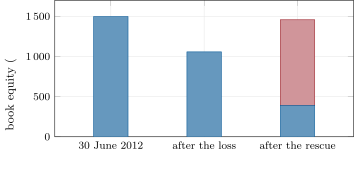
The Securities and Exchange Commission’s order of October 2013 sets out the morning: a technician did not copy a new release of the firm’s order router to one of its eight servers, where an old function remained present and callable, and over 45 minutes it sent millions of orders and obtained more than 4 million executions in 154 stocks, for more than 397 million shares. Book 11 read the order for its controls: no automated limit on the firm’s aggregate exposure, and monitoring that did not alert on it. The firm lost over $460 million on the order’s figures; its quarterly report put the realised pre-tax loss at about $440 million, against total equity of $1 497 million on 30 June.
As of September 2026 — The public record of the chapter’s cases
Knight Capital (SEC order 34-70694; Forms 10-Q, 8-K of 6 August 2012 and KCG’s 8-K12G3 of 1 July 2013): over $460 million lost on 1 August 2012; $400 million of convertible preferred stock sold on 6 August, convertible into about 73% of the common stock, under the stock exchange’s financial viability exception to shareholder approval; merged with GETCO under KCG Holdings on 1 July 2013, each share exchanged for $3.75 in cash or a third of a KCG share. Archegos (Credit Suisse special committee report, 29 July 2021): Credit Suisse lost about $5.5 billion; the Federal Reserve Board fined UBS Group $268.5 million for Credit Suisse’s counterparty risk management on 24 July 2023, about $387 million with the Prudential Regulation Authority’s penalty; the founder was convicted in July 2024 and sentenced to 18 years in prison. LME nickel: the Divisional Court held that the exchange acted lawfully in cancelling the 8 March 2022 trades, and the Court of Appeal dismissed the appeal on 7 October 2024; the FCA fined the exchange £9 245 900 on 19 March 2025 for failing to maintain orderly trading.
On 6 August the firm sold 400 000 shares of convertible preferred stock for $400 million to a group including Jefferies, Blackstone and GETCO, convertible into about 266.7 million common shares, $1.50 each, against 97.9 million shares outstanding. Issuing that much stock normally needs a shareholder vote; the board’s finance and audit committee relied instead on the exchange’s exception for a delay that would seriously jeopardise the company’s financial viability, and the exchange did not object. Eleven months later the firm merged with GETCO under a new holding company, and each share became $3.75 in cash or a third of a share of the new company.
| 30 June 2012 | after the loss | after the rescue | |
|---|---|---|---|
| Book equity ($ million) | 1 497 | 1 057 | 1 457 |
| Shares (million) | 97.9 | 97.9 | 364.6 |
| Old shareholders’ fraction | 100% | 100% | 26.9% |
| Old shareholders’ book equity ($ million) | 1 497 | 1 057 | 391 |
| Book value per share ($) | 15.29 | 10.80 | 4.00 |
fm_cases2.knight.The table is the firm-level arithmetic of a rescue under time pressure. The loss alone cost the shareholders 29.4% of the book equity; the rescue, priced at $1.50 a share when book value per share was still $10.80, cost them a further $666 million of book equity, transferred to the new investors, who paid $400 million for $1 066 million. The price was set by the days the firm had left: its clients and counterparties, the quarterly report says, had reduced order flow and lost confidence, and a firm without capital cannot keep making markets. What it had not decided in advance (the limit on aggregate exposure, the capital held against a morning like that one, a standing facility that could be drawn in a day) set the terms.
fm_cases2.knight.29.2 2021: a family office and its prime brokers
The Credit Suisse board’s special committee published its report on the bank’s losses from Archegos, a family office, in July 2021. On the evening of 25 March 2021, after the value of its largest positions had fallen steeply since the 22nd, Archegos told its prime brokers that it had $120 billion of gross exposure, $70 billion long and $50 billion short, against $9 to $10 billion of equity, and asked them to agree a standstill while it wound its positions down. They declined. Credit Suisse’s own gross exposure was about $27 billion on 23 March and $17 billion on 26 March; it had called $2.8 billion of margin on the 25th; it lost about $5.5 billion.
Definition 29.1 (Dynamic margining)
Dynamic margining sets a client’s margin from the current risk of its portfolio (its volatility, concentration, liquidity and directional bias), recomputed as positions and prices change, rather than as a fixed percentage of each trade’s notional at inception.
The report describes both regimes inside one bank. The prime brokerage book was dynamically margined; the swaps were margined statically, the initial margin fixed in dollars at inception, so that as the positions rose in value the margin as a share of them eroded. The average margin on the swaps was about 9.4% on 23 March. A concentrated position that its own holder estimated would take two weeks to a month to liquidate carried the margin of a diversified one.
Definition 29.2 (Exit race)
An exit race is the sequential liquidation, by several creditors, of collateral or hedges in the same concentrated positions after a common client defaults: each sells into prices moved by those who sold before it, so each creditor’s loss depends on its place in the order as well as on its margin.
The report records the race. On 26 March Goldman organised block sales of some of the positions, and Credit Suisse took part in three without knowing how many shares were offered or whose were sold first; it sold just over $3 billion that day, keeping its algorithmic selling within 2 to 3% of average daily volume. Over the weekend several banks, including Deutsche Bank, Morgan Stanley and Goldman, were not interested in a managed liquidation; Credit Suisse, UBS and Nomura agreed one and sold blocks in April.
29.3 Tutorial: the rescue, the race, the run, the squeeze
Goal. Extend the casebook to the four cases: the 2012 rescue’s dilution; an exit race among seven prime brokers calibrated to the report; the 2022 exchange’s shortfall and run; and a nickel short’s margin call against its cash. End state: Table 29.1 and Figures 29.1, 29.2, 29.3 and 29.4.
- The rescue.
firm.casebook.rescuewith the equity, the loss, $400 million for 266.7 million shares, and 97.9 million old shares. - The race. Seven brokers (Credit Suisse and the six the report names) each hold one seventh of the position, each $17 billion like Credit Suisse on 26 March, about the $120 billion gross in all. They sell in turn; the price falls linearly with the cumulative fraction sold (Book 10’s permanent impact).
- The calibration. The impact coefficient is set so that a broker with Credit Suisse’s exposure and its 9.4% margin, selling sixth, loses $5.5 billion:
race_impactgives 0.531, a fall of 53% by the time all seven have sold. The place is an assumption: the report puts Credit Suisse among the brokers that sold into April. - The run.
ftx_balancesandftx_flowsread Book 3’s transcription of the debtors’ shortfall table. - The squeeze. An illustrative short of 10 000 tonnes of nickel with $300 million of cash, margined from the 7 March close.
def exit_race(shares, margins, impact):
    """Brokers holding fractions `shares` of one long position (value 1 at default) sell in turn, in list order,
    under linear permanent impact: the price after a cumulative fraction f is sold is 1 - impact f. Each broker's
    loss per unit of the whole position, net of its margin (fraction of its exposure), floored at zero."""
    out, f = [], 0.0
    for s, m in zip(shares, margins, strict=True):
        avg = 1 - impact * (f + s / 2)                 # average price over its segment
        out.append(max(0.0, s * (1 - avg - m)))
        f += s
    return out


def race_impact(loss_share, share, margin, shares_before):
    """Impact coefficient at which a broker with `share` and `margin`, after `shares_before`
    was sold ahead of it, loses `loss_share` of the whole position."""
    return (loss_share / share + margin) / (shares_before + share / 2)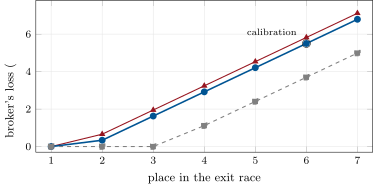
fm_cases2.race.In the model the first broker to sell loses nothing at any of the three margins: it sells at an average fall of 3.8%, inside its margin. The last loses $6.79 billion at 9.4%, and $4.99 billion even at 20%. The margin that would have left each broker whole is the average fall over its segment: 3.8% for the first, 26.6% for the middle, 49.3% for the last. No static percentage covers the race, because the loss depends on the order, which no broker controls in advance.
Proposition 29.3 (The race redistributes a fixed fall)
With linear permanent impact and brokers holding shares of the position, summing to one, the total fall in value realised by all the brokers is of the position, whatever the order; the order only decides who bears it. The broker in place bears , where is the share sold before it.
Proof. Broker sells between the cumulative fractions and at the average price , so its fall is . Summing over gives . ∎
The proposition is why a standstill is rational for the creditors together and irrational for each one alone: a managed liquidation leaves the total fall unchanged (or smaller, if slower selling lowers the impact), while selling first moves one’s own share of it onto the others. Dynamic margining is the defence each broker controls: a margin that grows with the position’s size against the market’s volume and with the broker’s ignorance of what the client holds elsewhere, set before the race starts.
29.4 2022: an exchange that was also a counterparty
Book 3 read FTX’s collapse from the debtors’ filings. For a trading firm the lesson is about exposure. A firm that holds cash and tokens on an exchange is a creditor of the exchange; if the exchange lends customers’ assets to an affiliate, the firm is also, without knowing it, a creditor of that affiliate. The debtors’ first interim report found that the affiliate, Alameda, had a borrowing limit set to $65 billion and settings that let it withdraw below it and run a negative balance; the shortfall analysis found that at the petition, for the most liquid tokens, the exchange held assets worth 6.6% of what it owed customers, and 22.6% for all tokens with receivables.
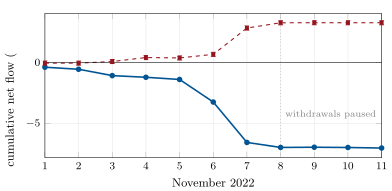
fm_cases2.ftx, from Book 3’s transcription of the debtors’ table.The run was fast: customers withdrew a net $3.3 billion on 7 November, and on 8 November the exchange paused withdrawals. A firm that learned of the shortfall on the 8th had no exit left; the decisions that mattered were the limits set earlier on how much the firm held on any one venue, how quickly excess balances were swept back, and what evidence of segregation it required (chapter 27’s trapped assets).
29.5 2022: the nickel squeeze and the exchange’s decision
On 7 March 2022 the London Metal Exchange’s three-month nickel contract closed at $48 078 a tonne, up from an opening just under $30 000. In the first hours of 8 March it rose to $101 365 at 06:08 and stayed above $80 000 from 07:00. The Court of Appeal’s judgment records what the exchange faced: if the morning’s trades stood, members would have had to post some $19.75 billion of margin by 09:00, and at least five were expected to default. It suspended trading at 08:15 and cancelled every trade made since midnight. Large short positions had been built by several participants, among them Tsingshan on the over-the-counter market. The FCA’s notice adds that margin calls had set records of $3.5 billion on 4 March and $5.1 billion on the morning of 7 March, and that the price bands were switched off from 04:49 to 08:15 on a decision by junior staff.
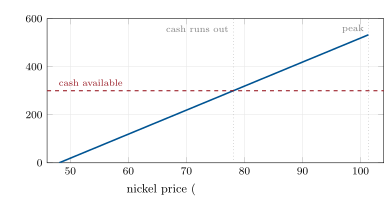
fm_cases2.nickel.For the short, the arithmetic is chapter 14’s: a call that grows linearly with the price, against cash that does not. For the exchange it was a choice between a margin call that would have defaulted several members and a cancellation that would take trades from those who made them. The Divisional Court held the cancellation lawful, and dismissed Jane Street’s similar claim; the Court of Appeal dismissed Elliott’s appeal, holding that the only alternative, collecting margin at the previous close, would have put the clearing house in breach of its own obligations. Two firm-level lessons follow for a trading firm: an exchange can cancel trades in extreme conditions, so a profit made in a disorderly market is not yet a profit; and the firm’s margin plan must survive calls several times larger than any seen before, since the record ones came on consecutive trading days.
29.6 What the four share
Method 29.4 (From a case to a control)
- State the decision the record shows was taken, or not taken, before the event: a limit, a margin method, a venue exposure, a funding plan.
- Size the event on the public figures: the loss against equity, the race’s losses by place, the shortfall, the call against cash.
- Write the control that would have changed the size: an aggregate exposure limit and a capital plan for it; dynamic margins with concentration add-ons; limits and sweeps on venue balances; a margin plan for record calls.
- Test the control on the firm’s own book with the casebook’s model, and record the result in the risk register (chapter 12).
The four failures differ in cause and share a structure. In each, a counterparty’s terms were fixed before the event on assumptions the event broke: a rescue priced in days, a margin set at inception, a balance left on a venue, a margin call sized for ordinary moves. And in each the firms that did best had decided their response in advance: the brokers that sold first, the exchange with the power to cancel, the firms whose exposures were already small. Chapter 27’s drill is where a firm finds out which of these decisions it has taken.
29.7 Build: the casebook, part 2
Purpose. The four cases’ public figures as tables tied to their ledger rows; a rescue-dilution calculator; the exit race with a calibration to a stated loss; the exchange shortfall and run from Book 3’s data; a short’s margin call against its cash.
Interface. firm.casebook: KNIGHT, ARCHEGOS, NICKEL, rescue, exit_race, race_impact, ftx_balances, ftx_flows, margin_call, break_price.
Rules. Figures come from the ledger or from committed data with a licence row; illustrative inputs are named as such; the race’s total fall is independent of the order (Proposition 29.3).
Acceptance tests. code/firm/casebook/tests/: the race’s zero-sum property and its calibration, the rescue on hand numbers, the margin call and break price, and the shortfall table’s coverage.
Stretch. Square-root impact in the race with each broker’s own selling speed; a managed liquidation as a joint schedule; the nickel short with initial margin raised by the clearing house.
Sources and further reading
- US Securities and Exchange Commission, In the Matter of Knight Capital Americas LLC, Release 34-70694, 16 October 2013.
- Knight Capital Group, Form 10-Q for the quarter ended 30 June 2012; Form 8-K, 6 August 2012; KCG Holdings, Form 8-K12G3, 1 July 2013.
- Credit Suisse Group Special Committee of the Board of Directors, Report on Archegos Capital Management, 29 July 2021.
- Board of Governors of the Federal Reserve System, press release, 24 July 2023; US Attorney’s Office, SDNY, press release, 19 December 2024.
- FTX Debtors, Preliminary Analysis of Shortfalls, 2 March 2023; J. J. Ray III, First Interim Report, 9 April 2023.
- R (Elliott Associates) v London Metal Exchange [2024] EWCA Civ 1168; Financial Conduct Authority, Final Notice to the London Metal Exchange, 19 March 2025.
29.8 Exercises
Exercise 29.1 ★
From Table 29.1, what fraction of the 2012 firm did its old shareholders own after the rescue, and what price per share did the rescue investors pay?
Solution
Solution of Exercise 29.1.
; a share, when book value per share after the loss was still $10.80.
Exercise 29.2 ★
Define dynamic margining and say why static margin on a rising concentrated position erodes.
Solution
Solution of Exercise 29.2.
See Definition 29.1. Static initial margin is fixed in dollars at inception: as the position’s value rises, the same dollars are a smaller percentage of it, so the client’s leverage with the broker rises exactly as the concentration grows.
Exercise 29.3 ★
A short of 10 000 tonnes is margined from $48 078. What is its call at $80 000, and at what price does $300 million of cash run out?
Solution
Solution of Exercise 29.3.
million; cash runs out at .
Exercise 29.4 ★★
Prove Proposition 29.3. What does it imply for a standstill agreement among creditors?
Solution
Solution of Exercise 29.4.
See the proof of Proposition 29.3. A standstill with a slower joint sale leaves the total fall at most unchanged and spreads it by agreement; without one, each creditor gains by selling first, which moves its share of the fall onto the others.
Exercise 29.5 ★★
In the calibrated race, what margin leaves the first, the sixth and the last broker whole, and what margin covers the position if one broker held all of it?
Solution
Solution of Exercise 29.5.
for the first, for the sixth, for the last; a single broker selling the whole position suffers an average fall of .
Exercise 29.6 ★★
Which limits would have protected a trading firm with balances on the 2022 exchange, and which records would have told it the balances were at risk?
Solution
Solution of Exercise 29.6.
A limit on balances at any one venue, a daily sweep of excess back to a bank or custodian, and a requirement for evidence of segregation. The exchange’s terms of service and financial statements, and any attestation of reserves against liabilities, would have been the records to ask for; withdrawal delays are the late signal.
Exercise 29.7 ★★★
Coding. Rerun the race with a 20% margin. Which places lose nothing, and what does the last lose?
Solution
Solution of Exercise 29.7.
The first three places lose nothing; the fourth to seventh lose $1.12, 2.41, 3.70 and 4.99 billion. The last still loses $4.99 billion.
Exercise 29.8 ★★★
Find the flaw. “Our margin on the client is 20%, twice the industry’s, so we cannot lose on it.”
Solution
Solution of Exercise 29.8.
In a race a broker’s loss depends on its place and on what the client holds elsewhere: in the calibrated model the last seller needs 49.3%, and a 20% margin still loses $4.99 billion. A margin must scale with concentration against market volume and with what the broker does not see.
29.9 Problem: The Last to Sell
Problem 29.1
Weekend problem — the last to sell
The head of a prime brokerage business must explain to the board what the four cases mean for its margin policy and its own exposures.
Part I — The concepts.
- Define dynamic margining.
- Define an exit race.
- State Proposition 29.3.
- Why is a standstill rational for creditors together and not for each alone?
Part II — The record.
- Summarise the public record of the 2012 incident and rescue.
- What did the family office tell its prime brokers on 25 March 2021, and what did they do?
- Summarise the 2022 exchange’s shortfall and run.
- What did the nickel market’s exchange decide, and what did the courts and the FCA find?
Part III — The reconstructions.
- Give the rescue’s dilution table.
- Describe the exit race model and its calibration.
- Give the losses by place at a 9.4% margin.
- Give the losses by place at 20%, and the margin each place needs.
- What does the model leave out?
- Give the illustrative nickel short’s calls and break price.
Part IV — The policy.
- What margin method would you adopt for concentrated clients?
- How would you learn what a client holds at other brokers?
- What limits would you set on the firm’s own balances at venues?
- What would you change in the firm’s capital plan after the 2012 case?
- State the named result: each prime broker’s loss as a function of its place in the exit race and of its margin, calibrated to the public figures, and the dilution of the 2012 rescue.
- In two sentences, write the recommendation.
Solution
Solution of Problem 29.1.
- See Definition 29.1.
- See Definition 29.2.
- See Proposition 29.3.
- Together they bear a fixed fall, lower if they sell slowly; alone, each can move its share onto the others by selling first.
- See Box 29.1: over $460 million lost in 45 minutes on 1 August 2012; $400 million of preferred stock convertible into about 73% of the shares sold on 6 August without a shareholder vote; the merger with GETCO on 1 July 2013 at $3.75 a share or a third of a new share.
- $120 billion of gross exposure and $9–10 billion of equity, and a request for a standstill; they declined, and sold, some in blocks on 26 March, three under a managed liquidation into April.
- Assets of 6.6% of liquid-token payables and 22.6% of all payables at the petition; customers withdrew a net $7.0 billion from 1 to 11 November, $3.3 billion on the 7th, and withdrawals were paused on the 8th.
- It suspended trading and cancelled all trades since midnight on 8 March; the courts held that lawful, and the FCA fined it £9 245 900 for failing to maintain orderly trading.
- Table 29.1: old shareholders from 100% to 26.9%, book value per share from $15.29 to $10.80 to $4.00.
- Seven brokers of $17 billion each, linear permanent impact, the coefficient 0.531 chosen so that the sixth with 9.4% loses $5.5 billion.
- $0, 0.34, 1.63, 2.92, 4.21, 5.50 and 6.79 billion.
- $0, 0, 0, 1.12, 2.41, 3.70 and 4.99 billion; 3.8%, 11.4%, 19.0%, 26.6%, 34.2%, 41.8% and 49.3%.
- Unequal exposures, the price fall before default, short positions and hedges, block trades that do not move the screen price linearly, and recovery from the client’s estate.
- $319 million at $80 000, $533 million at the peak; cash of $300 million runs out at $78 078.
- Dynamic margins with concentration and liquidity add-ons, recomputed daily, and the right to raise them quickly.
- Ask the client, contractually, for its positions across brokers; watch public filings; assume the worst when it will not say.
- A limit per venue and a daily sweep of excess, with tighter limits where segregation cannot be verified.
- Hold capital for a morning like 1 August 2012 under a hard aggregate exposure limit, and arrange committed funding that can be drawn in a day.
- At 9.4% margin, $0 for the first seller up to $6.79 billion for the last ($4.99 billion at 20%); the old shareholders kept 26.9% of the 2012 firm, $391 million of book equity instead of $1 057 million.
- Margin concentrated clients dynamically, for the whole position’s exit rather than one broker’s share, and agree in advance how to act if the client fails. Cap the firm’s own balances at any venue and hold capital and committed funding for a loss of a day’s worth of its largest exposure.
29.10 Interview questions
Interview question 29.1 ★ risk
What is the difference between static and dynamic margining?
Solution
Solution of Interview question 29.1.
Static margin is fixed at inception as a percentage of notional; dynamic margin is recomputed from the portfolio’s current volatility, concentration, liquidity and bias.
What the interviewer is looking for: erosion of static margin as prices move.
Interview question 29.2 ★ developer, risk
A new release starts sending orders nobody intended. Which controls should have stopped it, and which decision determines what it costs the owners?
Solution
Solution of Interview question 29.2.
Pre-trade limits, an aggregate exposure limit with a kill switch, and deployment checks; what it costs the owners is set by the capital and funding held against such a loss and whether a rescue must be arranged in days.
What the interviewer is looking for: controls, then capital.
Interview question 29.3 ★★ risk, trader
A client defaults on swaps you and five other banks hold on the same stocks. The others are proposing a standstill. What do you do?
Solution
Solution of Interview question 29.3.
Weigh the race: selling first moves the loss to others, but a joint slow sale lowers the total; join a managed liquidation if it is binding and covers the overlapping positions, and hedge meanwhile.
What the interviewer is looking for: the zero-sum structure of the race.
Interview question 29.4 ★★ risk
How much of the firm’s cash would you hold on a single crypto exchange, and why?
Solution
Solution of Interview question 29.4.
Only what trading needs that day, swept back daily, under a limit set by what the firm could lose without distress, since the balance is an unsecured claim unless segregation is verified.
What the interviewer is looking for: the balance as a credit exposure.
Interview question 29.5 ★★ trader
You made a large profit on a trade in a market that the exchange then declared disorderly. What should you expect?
Solution
Solution of Interview question 29.5.
That the exchange may cancel the trades under its rules, as the nickel market’s did; book nothing until the trades are confirmed to stand.
What the interviewer is looking for: cancellation powers.
Interview question 29.6 ★★★ researcher, risk
Model the losses of several creditors liquidating the same collateral in turn. What does the order change, and what does it not?
Solution
Solution of Interview question 29.6.
With linear permanent impact the total fall is fixed at half the impact coefficient times the position; the order decides who bears it, and the last seller bears the most. Slower joint selling or block trades can lower the total.
What the interviewer is looking for: the integral argument.