The Desk and the Firm · The firm
15Finance, Product Control and Tax
Between mid-2012 and mid-2015 Denmark’s tax authority paid 4 170 claims for refunds of dividend tax, just under 12.1 billion kroner (about £1.4 billion), to claimants whose share trades had been arranged on cum-ex terms. None of the claims was valid under Danish law. The scheme’s principal organiser is among those convicted in Denmark; a New York jury awarded the authority $500 million against some of the parties. But in October 2025 London’s Commercial Court dismissed the authority’s contested civil claims against the defendants there, because it had not shown that it was deceived: its controls for paying refund claims, the judge found, “were so flimsy as to be almost non-existent”. A tax rule shapes which trades exist, and a trade whose profit is a tax refund is a legal question before it is a trading question. So is a P&L number: someone has to sign it, and what they check decides what it means.
15.1 The daily P&L: flash, final and sign-off
Every trading day ends with two numbers. The first comes minutes after the close, from the desk’s own systems and marks; the second the next morning, after every trade is booked, fees are charged and the marks are checked by someone other than the trader (Book 6’s product control).
Definition 15.1 (Flash P&L, P&L sign-off)
The flash P&L is a desk’s estimate of the day’s P&L, produced shortly after the close from the trades captured by a cut-off time and the desk’s own end-of-day marks. The P&L sign-off is the daily approval of the final P&L by product control and the desk head, after independent price verification, fees and adjustments, with every exception explained and recorded.
Definition 15.2 (Flash-to-final walk)
The flash-to-final walk splits the difference between the final and the flash P&L into categories that each have an owner: market moves after the flash marks, trades booked after the cut-off, fees and commissions, and valuation adjustments from independent price verification and reserves. Whatever the categories do not explain is reported as unexplained.
Built as a sequence of revaluations of the same book, the walk adds up by construction: move the marks from flash to close on the flash trades, add the late trades at the close, charge the fees, then move the marks from close to verified. Each step is the difference of two totals of a firm.pnl book (Book 1), and the steps telescope from the flash to the final (Listing 15.1). A walk that does not add up is itself an exception: some trade, mark or fee is in one number and not the other.
def walk(sod, sod_marks, fills, cut, flash_marks, close_marks, final_marks):
    early = day_book(sod, sod_marks, fills, cut, fees=False)
    all_nofee = day_book(sod, sod_marks, fills, None, fees=False)
    all_fee = day_book(sod, sod_marks, fills, None, fees=True)
    flash = early.total(flash_marks)
    w = {"flash": flash,
         "market moves after the flash": early.total(close_marks) - flash,
         "late trades": all_nofee.total(close_marks) - early.total(close_marks),
         "fees": all_fee.total(close_marks) - all_nofee.total(close_marks),
         "valuation adjustments": all_fee.total(final_marks) - all_fee.total(close_marks),
         "final": all_fee.total(final_marks)}
    w["unexplained"] = w["final"] - w["flash"] - sum(v for k, v in w.items() if k not in ("flash", "final"))
    return w


def exceptions(w, abs_tol, rel_tol, cat_tol):
    """Reasons to stop a sign-off: the flash-to-final difference beyond max(abs_tol, rel_tol |flash|); any
    category beyond its own tolerance; any unexplained remainder."""
    out = []
    diff = w["final"] - w["flash"]
    if abs(diff) > max(abs_tol, rel_tol * abs(w["flash"])):
        out.append(("flash to final", diff))
    for k, tol in cat_tol.items():
        if abs(w[k]) > tol:
            out.append((k, w[k]))
    if w["unexplained"] != 0:
        out.append(("unexplained", w["unexplained"]))
return out15.2 Tutorial: a day from flash to final
Goal. Produce a day’s flash and final P&L, walk from one to the other, and decide whether the day can be signed. End state: Table 15.1 and the walk chart (Figure 15.1).
- The book. Ten equities held at the start of the day, $66.5 million gross, eight long and two short; three are illiquid (synthetic;
fm_finance.day). - The trades. Forty fills through the day; the six after the 16:15 cut-off miss the flash. Every fill pays a fee of 5 basis points.
- The marks. The flash uses the desk’s 16:00 marks; the close marks follow; independent price verification moves the three illiquid marks to the edge of a 0.5% band around a consensus (
firm.pnlexplain.ipv, Book 6). - The rules. Stop the sign-off if the final differs from the flash by more than $100 000 or 10% of the flash, whichever is larger; if valuation adjustments exceed $100 000 or late trades $50 000; or if anything is unexplained.
| step | $ |
|---|---|
| flash P&L | 475 100 |
| market moves after the flash | +63 910 |
| late trades (6 fills) | +1 580 |
| fees | 11 670 |
| valuation adjustments | 149 787 |
| final P&L | 379 133 |
| unexplained | 0 |
fm_finance.the_walk.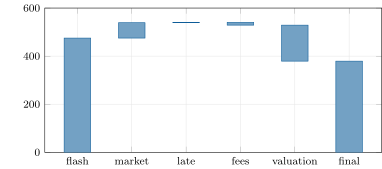
fm_finance.the_walk.The final is 20.2% below the flash, $95 967, which is inside the total tolerance of $100 000; a rule on the total alone would sign it. The category rule stops it: valuation adjustments of $149 787 exceed their $100 000 tolerance, so the day is escalated with the reason recorded (fm_finance.day_signoff). The adjustment has one clear cause. The desk closed its largest illiquid position, 73 000 shares, at $123.49 against a consensus of $122.01, 1.2% higher; verification moved the mark to the edge of the 0.5% band, $122.63, and did the same, in smaller amounts, on the other two. A desk whose closing marks on illiquid names sit at the favourable edge of consensus day after day is the pattern product control exists to see.
Method 15.3 (Signing the daily P&L)
- Publish the flash with its cut-off time and its marks’ source.
- Book late trades, fees and adjustments; verify marks independently and apply reserves (Book 6’s prudent valuation).
- Walk from flash to final by category; the walk must add up.
- Apply the thresholds on the total and on each category; escalate every exception with a written reason.
- Sign, and keep the trail: who signed what, when, and on what evidence. The trail is only ever appended to.
15.3 Valuation control in a trading firm
Product control’s authority rests on the same independence as the risk function’s (chapter 12): it reports outside the desks, it owns the marks that go into the books and records, and its adjustments cannot be reversed by the trader. In a bank the function is large and regulated; in a proprietary firm or a fund it may be two people, or an administrator (chapter 4), and the temptations are the same. A trader’s marks on illiquid positions are an estimate by the person whose pay depends on it (chapter 10). The controls are Book 6’s: independent verification against consensus or observed trades, tolerance bands, reserves for what cannot be verified, and unexplained P&L investigated rather than absorbed.
Remark 15.4 (The flash as a control)
A flash that is always above the final is information: it says the desk’s own marks are optimistic, its trade capture is late, or its fees are forgotten. Tracking the walk’s categories over months, and not only the day’s exceptions, turns the sign-off into a measure of how well a desk knows its own position.
15.4 Taxes that shape strategies
Taxes enter a strategy’s return as costs on its trades, on its income and on its gains. The first two are paid whatever the result and scale with activity; they decide which strategies exist in which markets.
Definition 15.5 (Tax drag)
The tax drag of a strategy is the reduction in its annual return caused by taxes: transaction taxes on its turnover, withholding taxes on the dividends and interest it receives that it cannot reclaim, and taxes on its gains, for a given investor and jurisdiction.
Proposition 15.6 (The turnover that tax takes)
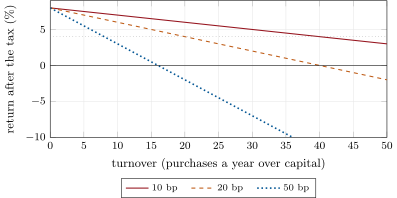
A strategy with a net return a year before a transaction tax, paying a rate on its purchases, which total times its capital a year, earns after the tax. The tax takes half its net return at
and all of it at twice that turnover.
Proof. The tax paid in a year is the rate times the purchases, per unit of capital; setting gives . ∎
For a strategy earning 8% a year, a tax of 10 basis points takes half its return at a turnover of 40 times a year, 20 basis points at 20 times, and 50 basis points, the UK’s rate on share purchases (Box 15.1), at 8 times (Figure 15.2). A market maker or statistical arbitrageur turning its book over forty times a year cannot trade a taxed instrument at 50 basis points; it trades where the tax does not apply, where the rules allow, or not at all.
firm.signoff.tax_drag.Withholding tax falls on the other end: the income strategies. A value strategy with a 3.5% dividend yield loses 0.53% a year to an unrecoverable 15% withholding, and a turnover of 0.8 a year costs it only 0.40% at 50 basis points; for a statistical arbitrage book turning over forty times, the same 50 basis points cost 20% a year (Table 15.2). The rates in the table are illustrative inputs; the dated box holds the rules as they stand.
| gross | turn- | dividend | regime 1 | regime 2 | regime 3 | |
| strategy | return | over | yield | |||
| statistical arbitrage | 12.0 | 40 | 1.0 | 11.85 | 8.00 | 3.85 |
| momentum | 9.0 | 6 | 1.5 | 8.77 | 6.00 | 7.58 |
| value | 7.0 | 0.8 | 3.5 | 6.48 | 6.60 | 6.31 |
fm_finance.tax_table.Definition 15.7 (Cum-ex trading, wash-sale rule)
Cum-ex trading is trading shares around a dividend date so that a trade entered into on or before the dividend declaration date settles after the record date, used to generate claims for refunds of dividend tax by more than one party for the same dividend, or by parties who never received it. A wash-sale rule disallows a tax loss on the sale of a security when the seller acquires the same or a substantially identical security within a set period around the sale.
The Danish case is the first kind of trade taken to its end: a trade whose economic content was a tax refund, claimed on shares the claimants had not owned. The UK court found every one of the 4 170 claims invalid under Danish law, and found that the scheme’s architects had no reasonable basis to believe them valid; it still dismissed the contested civil claims for deceit, on the ground that the authority’s processes did not rely on what it was told. Book 1 describes the German cases, which ended in criminal convictions. For a trading firm the lesson is the chapter’s hook: a strategy whose return depends on a tax position is approved by the firm’s tax and legal functions before it is traded, and its profit is audited as a tax position, not a trading one.
As of September 2026 — Tax rules that shape trading
United States: under 26 U.S.C. 1256, regulated futures and other section 1256 contracts held at year end are treated as sold at fair market value on the last business day, and their gains and losses are 60% long-term and 40% short-term, whatever the holding period; under 26 U.S.C. 1091, a loss on a sale of stock or securities is disallowed if substantially identical securities are acquired within 30 days before or after the sale, unless the seller is a dealer acting in the ordinary course of business. United Kingdom: a tax or duty of 0.5% is usually payable on purchases of shares (Stamp Duty Reserve Tax, or Stamp Duty on paper transfers). Rates on gains depend on the investor and are not stated here. This box summarises public texts and is not tax advice.
With illustrative rates of 37% short-term and 20% long-term, the 60/40 rule taxes a futures gain at a blended 26.8% whatever the holding period, which is why the same trend-following return can be worth more after tax in futures than in stocks held for weeks (firm.signoff.blended).
15.5 Legal entities and transfer pricing
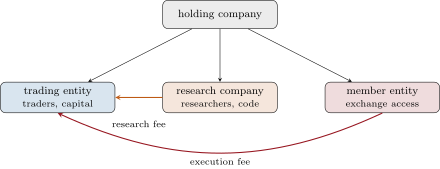
A firm that trades in several countries does so through several legal entities: a trading entity where its traders sit, an entity that holds the exchange memberships, a management company that employs the researchers, a fund or a proprietary vehicle that owns the capital. Each is taxed where it is resident, and each charges the others for what it provides: research, execution, technology, capital.
Definition 15.8 (Transfer pricing)
Transfer pricing is the setting of prices for transactions between entities of the same group (services, licences of intellectual property, financing, the sharing of trading profits), which tax authorities require to be those that independent parties would agree in comparable circumstances: the arm’s length principle.
For a trading firm the hard cases are the ones this book has already met: who owns the strategy (chapter 11), where the decisions that earn the profit are taken, and what a desk in one country pays a research team in another. The OECD’s Transfer Pricing Guidelines (2022 edition) are the reference text on the arm’s length principle; the documentation they require is kept by finance, and it is the reason a firm’s organisation chart and its legal-entity chart are drawn separately and must agree.
15.6 Build: the sign-off engine
Purpose. The daily P&L from flash to final, the walk between them, the sign-off rules with an audit trail, and a tax-drag calculator whose rates are inputs.
Interface. firm.signoff: day_book (on firm.pnl), verified_marks (on firm.pnlexplain.ipv), walk, exceptions, Trail, sign; tax_drag, half_turnover, blended.
Rules. The walk adds up exactly, in ledger units; a sign-off with exceptions is escalated, never signed; the trail is append-only; tax rates are always inputs.
Acceptance tests. code/firm/signoff/tests/: a two-instrument walk checked line by line; verified marks at the band’s edge; the exception rules; the tax formulas.
Stretch. Reserves for bid-offer and model uncertainty; a month of walks with category trends by desk; withholding reclaims with a lag.
Sources and further reading
- Skatteforvaltningen v Solo Capital Partners LLP and others [2025] EWHC 2364 (Comm), judgment of 2 October 2025.
- 26 U.S.C. 1256 and 1091; GOV.UK, “Tax when you buy shares”.
- OECD, Transfer Pricing Guidelines for Multinational Enterprises and Tax Administrations 2022.
15.7 Exercises
Exercise 15.1 ★
Check that the steps of Table 15.1 add up to the final.
Solution
Solution of Exercise 15.1.
, with nothing unexplained.
Exercise 15.2 ★
At what turnover does a 20 basis point tax take half the return of a strategy earning 8% a year? All of it?
Solution
Solution of Exercise 15.2.
times a year; all of it at 40.
Exercise 15.3 ★
Under the 60/40 rule and illustrative rates of 37% and 20%, what is the blended rate on a futures gain?
Solution
Solution of Exercise 15.3.
.
Exercise 15.4 ★★
Why did the tutorial’s day pass the rule on the total and fail the rule on valuation adjustments? Which rule is right?
Solution
Solution of Exercise 15.4.
The total moved $95 967, inside the $100 000 tolerance, because a gain in market moves after the flash offset most of the valuation adjustment; the category moved $149 787. Both rules are needed: offsetting categories hide exactly the problems the walk is there to find.
Exercise 15.5 ★★
A trader sells a stock at a loss on 20 December and buys it back on 5 January. What does the wash-sale rule do, and what if the trader is a dealer acting in the ordinary course of business?
Solution
Solution of Exercise 15.5.
The repurchase falls within 30 days after the sale, so the loss deduction is disallowed; the rule does not apply to a dealer in securities realising the loss in the ordinary course of business.
Exercise 15.6 ★★
Why did the UK court dismiss the tax authority’s claims although it found none of the refund claims valid?
Solution
Solution of Exercise 15.6.
Its claims for deceit required it to prove that it paid because it was misled; the court found that its controls were so limited that it paid without relying on the representations, so causation failed, even though the refund claims were invalid.
Exercise 15.7 ★★★
Coding. Run fm_finance.the_walk(17). What are the flash and the final, and which rule stops the sign-off?
Solution
Solution of Exercise 15.7.
A flash of $529 950 and a final of $463 393; the total moves $66 557, inside tolerance, and the valuation adjustments again exceed $100 000.
Exercise 15.8 ★★★
Find the flaw. “Our flash is always within 5% of the final, so our marks are good.”
Solution
Solution of Exercise 15.8.
A small total can hide large offsetting categories, and a flash built from the same marks as the final agrees with it whatever the marks are worth. The test of the marks is independent verification, not the flash.
15.8 Problem: The Turnover That Tax Takes
Problem 15.1
Weekend problem — the turnover that tax takes
A new finance director must set the firm’s sign-off rules and review whether its strategies survive the taxes of the markets it plans to enter.
Part I — The daily P&L.
- Define the flash P&L, the P&L sign-off and the flash-to-final walk.
- Why does a walk built from revaluations add up exactly?
- Give the tutorial day’s walk.
- Which rules stop its sign-off, and why?
- Explain the valuation adjustment on the largest illiquid position.
Part II — Control.
- What makes product control independent?
- What does a flash that is always above the final tell you?
- What must the sign-off trail record?
Part III — Tax.
- Define tax drag.
- State and prove Proposition 15.6.
- Give the half turnovers at 10, 20 and 50 basis points for an 8% strategy.
- Give the three strategies’ returns under the three regimes.
- State the 60/40 and wash-sale rules and the UK rate on share purchases.
Part IV — The law.
- Define cum-ex trading.
- Summarise the Danish refund claims and the UK judgment.
- What should a firm do before trading a strategy whose return depends on a tax position?
- Define transfer pricing and give two intra-group charges in a trading group.
- Why must the organisation chart and the legal-entity chart agree?
- State the named result: the annual turnover at which a transaction tax of basis points removes half a strategy’s net return, and the flash-to-final difference that should stop a sign-off.
- In two sentences, write the firm’s rules for P&L sign-off and for tax-dependent strategies.
Solution
Solution of Problem 15.1.
- See Definitions 15.1 and 15.2.
- Each step is the difference of two totals of books, and consecutive steps share a total, so the sum telescopes from flash to final.
- See Table 15.1.
- Only the valuation-adjustment rule: $149 787 against $100 000; the total, $95 967, is inside tolerance.
- 73 000 shares closed at $123.49, 1.2% above a consensus of $122.01, moved to the edge of the 0.5% band at $122.63.
- A reporting line outside the desks, ownership of the official marks, and adjustments the trader cannot reverse.
- That the desk’s marks are optimistic, its trade capture late, or its fees forgotten.
- Who signed, when, on what evidence, every exception and its reason; entries are only appended.
- See Definition 15.5.
- See Proposition 15.6.
- 40, 20 and 8 times a year.
- See Table 15.2: statistical arbitrage 11.85, and 3.85%; momentum 8.77, 6.00 and 7.58%; value 6.48, 6.60 and 6.31%.
- See Box 15.1.
- See Definition 15.7.
- 4 170 claims paid from mid-2012 to mid-2015, just under DKK 12.1 billion, none valid; the contested civil claims failed because the authority was not shown to have been misled.
- Obtain the approval of its tax and legal functions, and audit the profit as a tax position.
- See Definition 15.8; research fees and execution fees.
- Transfer prices must follow where the work and the decisions are; if the charts disagree, the pricing has no basis.
- ; a difference beyond the total tolerance, or any category beyond its own tolerance, or anything unexplained.
- Sign daily only walks that add up and pass the total and category thresholds, escalating every exception on the record; trade no strategy whose return depends on a tax position without prior tax and legal approval.
15.9 Interview questions
Interview question 15.1 ★ trader
What is the difference between the flash and the final P&L?
Solution
Solution of Interview question 15.1.
The flash is the desk’s early estimate from its own marks and the trades captured by a cut-off; the final includes late trades, fees and independently verified marks and is signed off.
What the interviewer is looking for: cut-off, fees and verification.
Interview question 15.2 ★ developer
How would you make sure the flash-to-final walk always adds up?
Solution
Solution of Interview question 15.2.
Build each step as the difference of two revaluations of the same book, in exact units, and report any remainder as unexplained.
What the interviewer is looking for: telescoping revaluations.
Interview question 15.3 ★★ researcher
Your strategy earns 6% a year with a turnover of 25. The market charges 20 basis points on purchases. Do you trade it?
Solution
Solution of Interview question 15.3.
The tax costs a year, leaving 1%: five-sixths of the return goes to tax. Not in that instrument; trade where the tax does not apply, if the rules allow, or slow the strategy down.
What the interviewer is looking for: turnover times rate against the return.
Interview question 15.4 ★★ risk
A desk’s illiquid marks are always at the favourable edge of the consensus band. What do you do?
Solution
Solution of Interview question 15.4.
Track it as a pattern, tighten the bands or require observable prices, apply reserves, and raise it with the desk head and risk: the marks are the trader’s estimate of their own pay.
What the interviewer is looking for: independence and patterns over days.
Interview question 15.5 ★★ trader, researcher
Why can the same trend-following return be worth more in futures than in stocks, for a US taxpayer?
Solution
Solution of Interview question 15.5.
Section 1256 taxes futures gains 60% long-term and 40% short-term whatever the holding period; the same gains on stocks held for weeks are all short-term.
What the interviewer is looking for: the 60/40 rule.
Interview question 15.6 ★★★ risk, developer
Design the thresholds for an automated P&L sign-off across fifty desks.
Solution
Solution of Interview question 15.6.
Thresholds on the total and each category scaled to each desk’s volatility and size, a zero tolerance on unexplained P&L, trend alerts on categories, and escalation routes with deadlines.
What the interviewer is looking for: scaled, per-category and trended.