The Desk and the Firm · The firm
2The Proprietary Market-Making Firm
In July 2024 the board of a listed exchange-traded-product market maker announced that it would stop paying regular dividends. The money was to stay in the firm as trading capital: the capital its prime brokers require it to keep with them before it may trade, and which sets how much it can trade. Eighteen months later that capital stood at € 1 044 million, a third more than a year earlier, and the firm had borrowed $200 million on top. A proprietary trading firm has no clients’ money and no fees; everything it can trade is what its owners have left in it, and what it can borrow against that. How much to leave in, and how much to spend each year to stay fast enough to earn anything, are the two decisions this chapter models.
2.1 Ownership: partnerships, private companies and listed firms
A proprietary trading firm (One Quant Book 1, chapter 1) is owned by the people who founded it and those they have admitted since; a few are listed. Ownership decides three things: who receives the profit, who can withdraw capital and when, and who bears a loss.
Definition 2.1 (Limited liability partnership, members’ capital)
A limited liability partnership is a body corporate, with legal personality separate from its members, whose members share its profit under a members’ agreement and whose liability is limited to what they have contributed. A member’s members’ capital is the capital the member has contributed or left in the firm, recorded in the member’s capital account and repayable on departure on the terms of the agreement.
Private companies owned by their founders and staff work the same way in substance: profit is distributed by dividends or by bonuses instead of allocations, and capital is equity instead of members’ capital. A listed firm adds outside shareholders who expect a dividend policy and a share price, which is why its decisions to retain profit are announced, as in the hook, and a private firm’s are not.
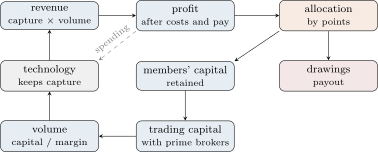
firm.partnership.The members’ agreement fixes each member’s points, the share of profit allocated to them, and how much of an allocation may be drawn. A departing member’s capital is typically repaid over several years, so that a departure does not drain the trading capital at once. That delay is part of the firm’s capital planning: a departure is a withdrawal of capital scheduled in advance.
Example 2.2 (An allocation)
Four members hold 40, 30, 20 and 10 points and draw 80% of their allocations. A year’s profit of $116.25 million allocates $46.5 million to the first; she draws $37.2 million and $9.3 million stays in her capital account. In all the members draw $93.0 million and leave $23.25 million, a retention ratio of 20%.
Definition 2.3 (Retention ratio)
A firm’s retention ratio is the share of a year’s profit it keeps as capital instead of distributing to its owners; one minus it is the payout ratio.
2.2 Capital: what it is for and how much is required
A proprietary firm holds capital for three masters: its regulator, its clearing firms and prime brokers, and itself. The regulator’s requirement protects the market from the firm’s failure; the clearing firm’s and the prime broker’s protect them from the firm’s losses before they can close it out; the firm’s own buffer keeps it trading through the losses it expects.
Definition 2.4 (Own funds, fixed overheads requirement, K-factor requirement)
An investment firm’s own funds are the regulatory capital it counts against its requirements: mostly paid-up equity and retained earnings. Under the European rules for investment firms its requirement is the highest of a permanent minimum, a fixed overheads requirement, one quarter of the preceding year’s fixed overheads, and a K-factor requirement, the sum of charges proportional to measures of its activity (for a dealer on its own account: its daily trading flow, and the risk of its net positions or the margin it posts to clearing).
As of September 2026 — The capital rules for proprietary trading firms
European Union. Regulation (EU) 2019/2033 (the Investment Firms Regulation), article 11: own funds of at least the highest of the fixed overheads requirement (article 13: one quarter of the preceding year’s fixed overheads), the permanent minimum (article 14, the initial capital of Directive (EU) 2019/2034, article 9: € 750 000 for a firm dealing on its own account) and the K-factor requirement (article 15). For a dealer the K-factors include K-DTF, 0.1% of the daily trading flow in cash trades and 0.01% in derivatives, the flow being the average of daily absolute buys and sells over six months that end three months before the calculation (article 33), and either K-NPR, net position risk, or K-CMG, the margin posted to a clearing member (article 21). The United Kingdom’s MIFIDPRU rules follow the same design. United States. SEC Rule 15c3-1: a broker-dealer’s net capital is its net worth adjusted by, among other things, haircuts on its securities positions; aggregate indebtedness may not exceed 1 500% of net capital, or, under the alternative standard, net capital must be at least the greater of $250 000 and 2% of aggregate debit items; a dealer keeps at least $100 000.
Definition 2.5 (Net capital rule)
The net capital rule is the United States requirement that a broker-dealer keep its net capital, its net worth less illiquid assets and less haircuts on its positions, above a floor set by its business and by its indebtedness or its customers’ debits.
The European design ties a small firm’s regulatory capital to its cost base, not to its risk. The chapter’s firm has fixed overheads of $95 million a year (people $60 million, technology $35 million) and trades $10 billion a day of cash securities: its fixed overheads requirement is $23.75 million, its K-DTF $10 million, its permanent minimum $0.75 million. The binding requirement is the fixed overheads one (Figure 2.2): a firm that hires or buys servers raises its regulatory capital before it has traded a share more.
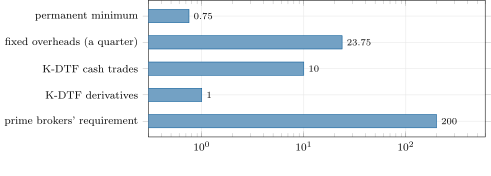
fm_partner.regulatory.The requirement that binds a market maker’s growth is usually not the regulator’s. Its prime brokers and clearing firms set their own requirements, by internal haircut and margin models, and a market maker must post capital with them before it can hold positions; the listed market maker of the hook calls this its trading capital and plans it daily. In the chapter’s model the prime brokers require capital of 2% of the firm’s daily volume: $200 million supports $10 billion a day, eight times the regulatory requirement.
As of September 2026 — One firm’s trading capital
Flow Traders Ltd. (Annual Report 2025): in July 2024 the board announced a Trading Capital Expansion Plan and suspended regular dividend payments; no interim dividend was paid for 2024 or 2025. Net trading capital (net liquidity at clearing and prime brokers plus cash at bank) was € 1 043.6 million at 31 December 2025, against € 774.9 million a year earlier. In 2025 the firm took a $200 million term loan and a $75 million revolving facility. Its prime brokers “require the Company to maintain certain minimum capital levels”, computed with internal haircut and margin-based models. Net profit for 2025: € 133.6 million; 635 full-time equivalents at the year end.
Method 2.6 (Sizing a trading firm’s capital)
- Compute the regulatory requirement: the highest of the permanent minimum, a quarter of last year’s fixed overheads and the K-factors of the planned flow and positions (Listing 2.1).
- Compute each prime broker’s and clearing firm’s requirement for the planned positions, on their models.
- Add a buffer for the worst loss the firm plans to survive without cutting activity (chapters 7 and 8).
- The firm needs the larger of the regulatory requirement and the sum of the posting requirements, plus the buffer; everything above is idle.
def own_funds_requirement(fixed_overheads, dtf_cash, dtf_deriv, npr, permanent=0.75,
                          k_dtf_cash=0.001, k_dtf_deriv=0.0001):
    """Highest of the permanent minimum, a quarter of the preceding year's fixed overheads, and the K-factor
    requirement (coefficients on the average daily trading flow in cash and derivatives, plus a net-position
    charge npr). Returns the requirement and which of the three binds."""
    parts = {"permanent": permanent, "fixed overheads": 0.25 * fixed_overheads,
             "K-factors": k_dtf_cash * dtf_cash + k_dtf_deriv * dtf_deriv + npr}
    which = max(parts, key=parts.get)
return parts[which], which2.3 Reinvestment and payout
The model of firm.partnership (Listing 2.2) runs a firm year by year: trading capital sets volume up to what the market can give it; capture per unit traded depends on its technology; profit after fixed costs, technology spending and variable pay is split into payout and retention. The chapter’s firm starts with $200 million, captures one basis point at technology parity, pays 25% of its result as variable pay, and its markets can give it at most $20 billion a day, which $400 million of capital supports. In its first year it trades $10 billion a day, earns $250 million, spends $35 million on technology and $60 million on everything else, and makes $116.25 million.
    for t in range(p.years):
        spend = p.spend_share * tech
        rel = tech / front
        vol = min(cap / p.margin, p.market * (1 + p.market_growth) ** t)
        c = float(capture(rel, p.c0, p.eta))
        rev = c * vol * p.days
        pre = rev - p.people - spend
        prof = pre - p.var_pay * max(pre, 0.0)
        r = retention(t, cap, p) if callable(retention) else retention
        pay = (1 - r) * max(prof, 0.0)
        cap += prof - pay
        for k, v in (("capital", cap), ("volume", vol), ("capture", c), ("revenue", rev), ("spend", spend),
                     ("profit", prof), ("payout", pay), ("rel", rel)):
            out[k][t] = v
        tech = (1 - p.d) * tech + spend
        front = (1 + p.g) * front
    return out
Proposition 2.7 (Retain until the market is full)
Suppose volume is for capital , a margin per unit of daily volume and a market of size , and profit per unit of volume exceeds the partners’ discount rate times . Then every dollar retained while earns more than it would earn outside the firm, and every dollar retained once earns nothing. Among policies that depend only on capital, retaining everything until reaches and paying out everything afterwards maximises the discounted payout.
Partial proof. Below capacity a retained dollar adds to daily volume and so a return of a year, the profit per unit of daily volume per year; if exceeds the discount rate, deferring the payout raises its present value. Above capacity volume does not move and a retained dollar returns nothing, while a paid-out dollar is worth its face value now. The policy that fills capacity as fast as possible and then pays everything out is therefore optimal among capital-dependent policies; the model’s fixed and variable costs do not change the argument because they do not depend on retention. A full proof over all policies is a dynamic programme (One Quant Book 4, chapter 9). ∎
At the chapter’s parameters the best fixed retention ratio is 20%, worth $939 million of discounted payout over ten years at 10% (Figure 2.3); at 20% the firm fills its market in year 6, at 50% in year 3. Retaining everything until capital reaches $400 million and paying out everything afterwards is worth $1 210 million: the partners give up two years of payout and gain $271 million of value.
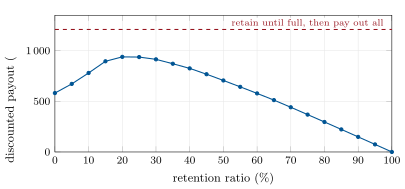
fm_partner.retention_curve, illustrative parameters.A departure is a retention decision the firm did not choose. If the member with 30 points leaves at the end of year 5 and is repaid over three years, the firm (retaining 20%) has the capital to fill its market by the end of year 8 instead of year 6. Staggered repayment is what makes the departure survivable; a members’ agreement that let a senior partner withdraw everything at once would give that partner the power to stop the firm growing.
2.4 The technology treadmill
A market maker’s capture depends on how fast it is compared with the others (One Quant Book 11, chapter 9): who reaches a stale quote first, whose quote is picked off. Speed is relative, so standing still is falling behind.
Definition 2.8 (Technology treadmill)
The technology treadmill is the condition of a trading firm whose revenue depends on its technology relative to its competitors’: because they keep investing, it must keep spending at their rate to hold its capture constant, and spending less lowers its capture even if its own systems do not change.
Proposition 2.9 (The spending that holds parity)
Let competitors’ technology grow at a rate a year and the firm’s technology stock depreciate at a rate , so that for spending . The firm’s relative technology , with , stays constant if and only if , and then its spending grows at the rate .
Proof. iff , i.e. ; then and . ∎
At and the firm must spend 35% of its technology stock every year, $35 million in year 1 and $123 million in year 10. If it spends 25%, its relative technology, and with it its capture, falls to 0.44 of parity by year 10 (Figure 2.4). With a market that does not grow, the treadmill eventually wins either way: the parity spender’s profit reaches zero in year 20, when spending that grows at 15% a year catches a revenue that cannot grow; the lean spender’s in year 18, from falling capture (Figure 2.5). With a market growing 10% a year the parity spender stays profitable until year 56.
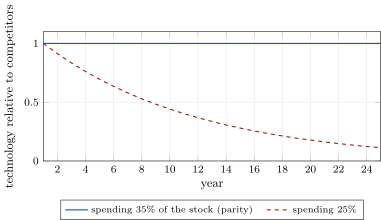
fm_partner.treadmill.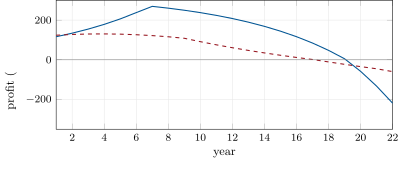
fm_partner.treadmill.Remark 2.10 (What the filings show, and do not)
The listed electronic market maker of chapter 1 reported communication and data costs of $209.4 million in 2019 and $249.2 million in 2025, up 19% while its net trading revenue swung between $1.0 billion and $2.3 billion; its costs nearly tripled between 2016 and 2019, but through two acquisitions, not through the treadmill alone. A filing mixes the treadmill with growth, acquisitions and inflation. The treadmill is a mechanism the published research supports: Budish, Cramton and Shim describe a continuing arms race for speed in which improvements are competed away, and Baron, Brogaard, Hagströmer and Kirilenko found that firms which improved their relative speed earned more (One Quant Book 11, chapter 1).
2.5 Tutorial: ten years of a partnership
Goal. Choose how much of each year’s profit a trading partnership should keep, with its capital rules and the treadmill in the model. End state: Figures 2.3 and 2.5.
- The requirement.
fm_partner.regulatory()computes year 1’s own funds requirement from fixed overheads ($95 million) and daily trading flow ($10 billion): $23.75 million, set by fixed overheads. - The allocation.
fp.Partnershipwith members of 40, 30, 20 and 10 points allocates $116.25 million (Example 2.2);fm_partner.accounts()runs ten years with a departure in year 5. - Retention.
fm_partner.retention_curve()simulates ten years for retention ratios from 0 to 100% in steps of 5% and discounts the payouts at 10%;target_value()runs the fill-then-pay policy. - The treadmill.
fm_partner.treadmill()runs 25 years at 35% and at 25% of the technology stock.
What to change next. Let the market grow (exercise 7); give the prime brokers a stricter margin in a volatile year and watch the target capital move.
2.6 Build: the partnership model
Purpose. The owners’ side of a proprietary firm: who owns the capital, what the rules require of it, and what keeping it or paying it out does to the firm.
Interface. firm.partnership: Member, Partnership with allocate(profit, payout_ratio), depart(name, years), pay_departures(), total_capital; own_funds_requirement(fixed_overheads, dtf_cash, dtf_deriv, npr, …); steady_spend_share(g, d), capture(rel, c0, eta); Params, simulate(params, retention) with a ratio or a policy, target_capital(target), discounted_payout(sim, rate, terminal_multiple).
Rules. A loss is allocated by points and reduces capital; nothing is drawn from a loss. A departing member’s capital leaves in equal instalments. Volume never exceeds capital over margin nor the market’s size. Coefficients are inputs.
Acceptance tests. code/firm/partnership/tests/: allocations by points, losses and staggered repayment; the requirement picks the highest part; parity spending holds relative technology at one and lower spending decays it; capital changes by profit less payout; the target-capital policy pays nothing until the target is reached.
Stretch. A stochastic capture with losing years and a stop on trading when capital falls below the requirement; a term loan that adds trading capital at an interest cost.
Sources and further reading
- Regulation (EU) 2019/2033 on the prudential requirements of investment firms (articles 11, 13–15, 21, 33) and Directive (EU) 2019/2034, article 9.
- US Code of Federal Regulations, 17 CFR 240.15c3-1 (net capital rule).
- Limited Liability Partnerships Act 2000 (United Kingdom), section 1.
- Flow Traders Ltd., Annual Report 2025.
- E. Budish, P. Cramton and J. Shim, “The high-frequency trading arms race: frequent batch auctions as a market design response”, Quarterly Journal of Economics 130(4), 2015.
2.7 Exercises
Exercise 2.1 ★
A dealer on its own account had fixed overheads of $95 million last year, trades $10 billion a day of cash securities and holds no overnight positions. Compute the three parts of its European own funds requirement and say which binds.
Solution
Solution of Exercise 2.1.
Permanent minimum $0.75 million; fixed overheads requirement million; K-DTF million (no net-position charge). The fixed overheads requirement binds: $23.75 million.
Exercise 2.2 ★
The same firm trades $10 billion a day of derivatives notional instead. What is its K-DTF, and does the binding requirement change?
Solution
Solution of Exercise 2.2.
K-DTF million. The requirement is still $23.75 million, set by fixed overheads.
Exercise 2.3 ★
Allocate a profit of $116.25 million to members of 40, 30, 20 and 10 points who draw 80% of their allocations. What does each draw, and what stays in the firm?
Solution
Solution of Exercise 2.3.
Allocations 46.5, 34.875, 23.25 and 11.625; draws $37.2, 27.9, 18.6 and 9.3 million, $93.0 million in all; $23.25 million stays in the firm.
Exercise 2.4 ★★
Competitors’ technology grows 15% a year and the firm’s depreciates 20%. What share of its stock must it spend to hold parity, and how much is that in year 10 if it spends $35 million in year 1?
Solution
Solution of Exercise 2.4.
of the stock each year (Proposition 2.9); spending grows at 15%: million in year 10.
Exercise 2.5 ★★
The market is full at $20 billion a day and one basis point of capture, fixed costs are $60 million and parity spending starts at $35 million and grows 15% a year. In which year does spending make profit before variable pay zero? Derive it in closed form.
Solution
Solution of Exercise 2.5.
Full-market revenue million. Profit before variable pay is zero when : , so year 20.
Exercise 2.6 ★★
In Figure 2.3, why does the value fall for retention ratios above 20%, and why is the fixed-ratio curve always below the dashed line?
Solution
Solution of Exercise 2.6.
Above 20% the firm fills its market in a few years and keeps retaining capital it cannot use, delaying payouts for no gain. Any fixed ratio either retains too little while capital is short or too much once it is not; the fill-then-pay policy is optimal among capital-dependent policies (Proposition 2.7).
Exercise 2.7 ★★★
Coding. Rerun the parity spender for 60 years with a market growing 10% a year (fm_partner.growing_market). In which year does its profit first fall to zero, and why does it fall at all?
Solution
Solution of Exercise 2.7.
Year 56. Parity spending grows at 15% a year and revenue at most at the market’s 10%, so spending catches up with revenue less fixed costs eventually, however large the starting margin. A treadmill is sustainable only while the firm’s market grows at least as fast as its competitors’ spending.
Exercise 2.8 ★★★
Find the flaw. “We cut technology spending from 35% to 25% of our stock last year and profit rose from $116 million to $124 million. Cut it again.”
Solution
Solution of Exercise 2.8.
The cut saves spending at once and loses capture only as the stock depreciates relative to competitors: in the model the lean firm earns more in year 1 ($124 million against $116 million) and less from year 2, with capture at 0.44 of parity by year 10. Measure capture per unit traded and relative speed, not one year’s profit.
2.8 Problem: Keep It or Pay It Out
Problem 2.1
Weekend problem — keep it or pay it out
Four partners run a market-making firm with $200 million of capital. They must decide how much of each year’s profit to keep, and how much to spend on technology.
Part I — The rules.
- Define own funds and state the European own funds requirement.
- Compute the firm’s fixed overheads requirement in year 1.
- Compute its K-DTF on $10 billion a day of cash trades, and on the same notional of derivatives.
- Which requirement binds, and how does it compare with the $200 million its prime brokers require?
- State the US net capital rule’s mechanism in one sentence.
Part II — The partnership.
- Define a limited liability partnership and members’ capital.
- Compute year 1’s volume, revenue, technology spending and profit.
- Allocate year 1’s profit to the 40-point member at 80% payout: her draw and what she leaves in.
- The 30-point member leaves at the end of year 5, repaid over three years. In which year does the firm fill its market (retention 20%), against which year without the departure?
Part III — Retention.
- Define the retention ratio.
- Give the ten-year discounted payout at retention ratios of 0, 20, 50 and 80%.
- Give the best fixed retention ratio and its value.
- Give the value of retaining everything until the market is full, and explain the gain with Proposition 2.7.
- In which year is the market full at retention ratios of 20, 50 and 80%?
Part IV — The treadmill.
- Define the technology treadmill.
- Derive the spending share that holds parity.
- What is the lean spender’s capture after ten years, as a fraction of parity?
- In which year does each firm’s profit reach zero in a market that does not grow?
- State the named result: the parity spending share and its year-10 amount, the best retention policy and its value against the best fixed ratio.
- In two sentences, what should the partners do first?
Solution
Solution of Problem 2.1.
- Regulatory capital, mostly equity and retained earnings; the requirement is the highest of the permanent minimum, a quarter of last year’s fixed overheads and the K-factors.
- million.
- $10 million on cash trades; $1 million on derivatives notional.
- The fixed overheads requirement, $23.75 million; the prime brokers require $200 million, 8.4 times it.
- Net capital, net worth less illiquid assets and haircuts on positions, must stay above a floor set by the business and by indebtedness or customers’ debits.
- A body corporate whose members share profit under an agreement and whose liability is limited; the capital a member contributed or left in, repayable on departure.
- $10 billion a day, $250 million, $35 million, $116.25 million.
- Allocation $46.5 million; draw $37.2 million; $9.3 million left in.
- By the end of year 8, against year 6 without the departure.
- The share of profit kept as capital.
- $582, 939, 706 and 296 million.
- 20%, $939 million.
- $1 210 million, $271 million more: capital earns a high return until the market is full and nothing afterwards.
- Years 6, 3 and 2.
- Revenue depends on technology relative to competitors, so the firm must keep spending at their pace to stand still.
- : 35% of the stock.
- 0.44 of parity.
- Year 20 for the parity spender, year 18 for the lean spender.
- Parity spending is 35% of the technology stock, $35 million in year 1 and $123 million in year 10; retaining everything until capital fills the market and then paying out all is worth $1 210 million against $939 million for the best fixed ratio (20%).
- Keep profit until the firm’s trading capital fills the market it can serve, then pay out; hold technology spending at the competitors’ pace and look for markets that grow at least as fast.
2.9 Interview questions
Interview question 2.1 ★ trader, risk
Under the European rules, why can a small proprietary firm’s regulatory capital rise when it hires, even if it trades no more?
Solution
Solution of Interview question 2.1.
Its fixed overheads requirement is a quarter of the previous year’s fixed overheads: hiring and technology raise it whatever the firm trades.
What the interviewer is looking for: the fixed overheads requirement and that it can bind before risk does.
Interview question 2.2 ★ trader
Which capital requirement usually binds a market maker’s growth: the regulator’s or its prime brokers’? Why?
Solution
Solution of Interview question 2.2.
Usually the prime brokers’ and clearing firms’: they require capital posted against the positions, on their haircut and margin models, often several times the regulatory figure.
What the interviewer is looking for: posting requirements set trading capacity.
Interview question 2.3 ★★ trader, researcher
Your firm can use $400 million of trading capital and has $250 million. Should the partners draw this year’s profit?
Solution
Solution of Interview question 2.3.
Not all of it: while capital is below what the market can use, each retained dollar earns the firm’s return on capital, far above the partners’ alternative. Keep enough to reach $400 million, then pay out.
What the interviewer is looking for: the marginal return on retained capital and the capacity cap.
Interview question 2.4 ★★ developer
Competitors’ technology improves 10% a year and yours depreciates 25%. What share of your technology stock must you spend each year to keep up?
Solution
Solution of Interview question 2.4.
of the stock a year, and the amount grows at 10%.
What the interviewer is looking for: the steady-state condition .
Interview question 2.5 ★★ risk
Why do members’ agreements repay a departing partner’s capital over several years?
Solution
Solution of Interview question 2.5.
The departing capital is trading capital: repaying it at once would cut the firm’s volume and could breach its requirements. Staggering turns the withdrawal into a planned reduction.
What the interviewer is looking for: capital as capacity, and the regulatory floor.
Interview question 2.6 ★★★ trader, developer
A firm cut its technology budget and its profit rose the next year. What would you measure before concluding the cut was right?
Solution
Solution of Interview question 2.6.
Capture per unit traded, relative latency and fill quality over several quarters: the saving is immediate, the loss of capture arrives as the technology falls behind competitors’.
What the interviewer is looking for: the lag between spending and capture, and relative measures.