High School Biology · Grades 10–12
30Photosynthesis
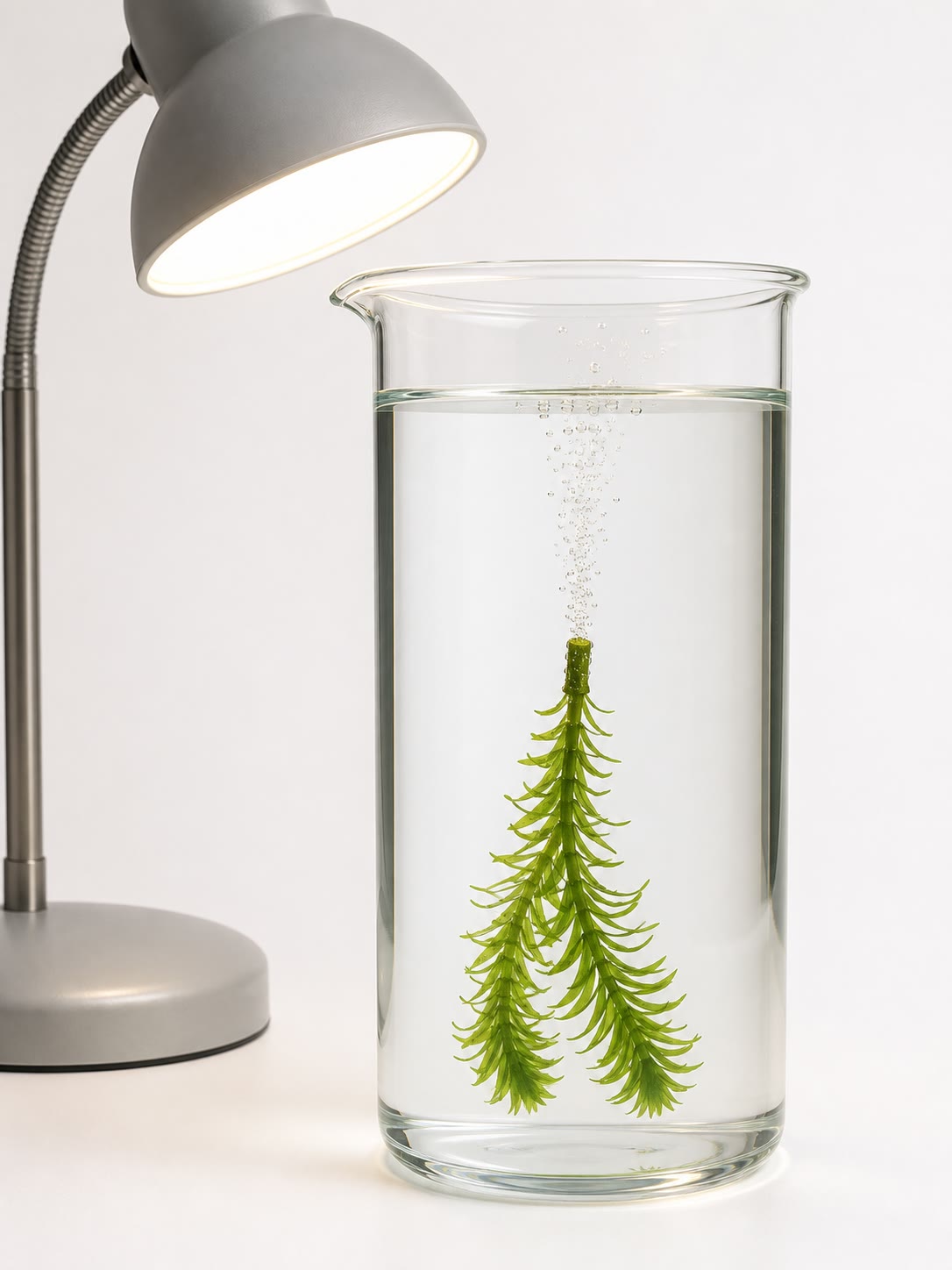
Put a sprig of pondweed upside down in a jar of water under a lamp, and a stream of bubbles rises from the cut stem: oxygen, one bubble every few seconds, faster if the lamp is brought closer, stopping when it is switched off. The gas is the visible half of a process that is feeding every animal on the planet and that made the air breathable two billion years ago. Chapter 4 gave it in one line: carbon dioxide and water, with light, become sugar and oxygen. This chapter opens the chloroplast and follows the energy of a photon into a chemical bond.
30.1 The chloroplast
Definition 30.1 (Chloroplast)
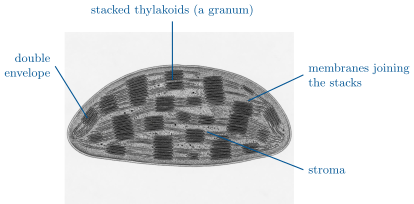
The chloroplast is the organelle of photosynthesis: a lens-shaped body some long, bounded by a double membrane, containing a fluid, the stroma, in which lie stacks of flattened membrane sacs, the thylakoids. The thylakoid membranes hold the pigments — chlorophylls a and b, green, and orange carotenoids — and the proteins that convert light energy; the stroma holds the enzymes that build sugar. A leaf cell contains tens of chloroplasts, a square millimetre of leaf some half a million.
Proposition 30.2 (Which light is used)
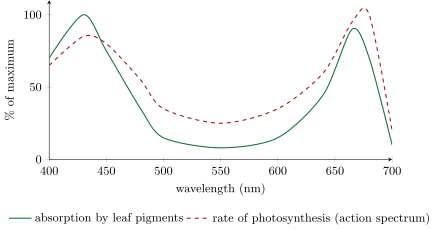
Chlorophyll absorbs blue and red light strongly and green light hardly at all — which is why leaves are green. Photosynthesis is driven by the wavelengths the pigments absorb: measured against wavelength, its rate (the action spectrum) rises and falls with the pigments’ absorption, with peaks in the blue and the red and a trough in the green.
Evidence. Engelmann (1882) laid a filament of green alga in a drop of water containing bacteria that swim towards oxygen, and projected a spectrum along the filament through the microscope: the bacteria gathered around the segments lit in blue and in red, and avoided the green — oxygen was being released where those colours fell. Modern measurement of oxygen output under coloured lamps gives the same curve, and it matches the absorption spectrum of the extracted pigments. ∎
30.2 The light phase: water split, energy stored
Proposition 30.3 (What happens in the thylakoids)
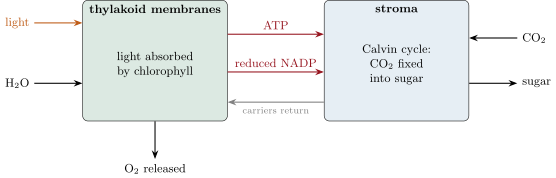
In the thylakoid membranes, in the light, three things happen together:
- water molecules are split: their oxygen is released as — the oxygen of photosynthesis comes from water, not from carbon dioxide — and their hydrogen is retained as electrons and protons;
- the energy of the absorbed photons is used to load those electrons onto a carrier molecule, reduced NADP, which the stroma will use as a source of hydrogen;
- the same energy drives the synthesis of ATP.
The light phase thus converts light into two chemical products, ATP and reduced NADP, and releases oxygen as a by-product. No carbon dioxide is involved.
Evidence. Hill (1937) illuminated isolated chloroplasts in water with an artificial electron acceptor and no carbon dioxide: they released oxygen and reduced the acceptor. So oxygen release needs light and water but not , and is coupled to the transfer of electrons. Ruben and Kamen (1941) supplied algae with water containing the heavy isotope O: the oxygen released was heavy; supplied with heavy carbon dioxide and ordinary water, it was not. The oxygen comes from the water. ∎
30.3 The carbon phase: sugar built
Proposition 30.4 (The Calvin cycle)
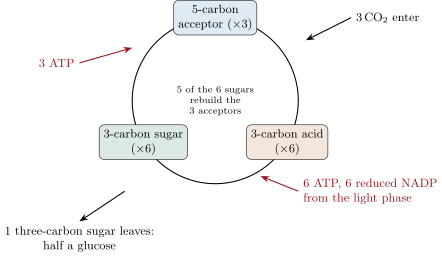
In the stroma, carbon dioxide is attached, one molecule at a time, to a five-carbon sugar already present, by the most abundant enzyme on Earth; the six-carbon product splits at once into two three-carbon molecules, which are reduced — using the ATP and the reduced NADP of the light phase — into three-carbon sugars. Most of these are recycled to regenerate the five-carbon acceptor, closing the Calvin cycle; one in six leaves the cycle as the plant’s net gain. Three turns of the cycle, three fixed, nine ATP and six reduced NADP spent: one three-carbon sugar exported. Two of them make a glucose.
Evidence. Calvin (1950s) gave algae carbon dioxide labelled with radioactive C for a few seconds, killed them in boiling alcohol, and separated their molecules: after five seconds the label was in a single three-carbon acid; after thirty, in three-carbon sugars and the five-carbon acceptor; after minutes, in sucrose and starch. Cutting off the light left the acceptor unregenerated and the three-carbon acid accumulating; cutting off the left the acceptor accumulating. The order of appearance is the order of the cycle. ∎
Example 30.5 (The bookkeeping of a glucose)
One glucose needs six carbon dioxides, hence six turns of the cycle, 18 ATP and 12 reduced NADP, all supplied by the light phase, which splits 12 water molecules and releases six oxygens to make them. Net: — the summary equation of Chapter 4, now with the water on both sides, since the oxygen released comes from the water split, not from the carbon dioxide.
30.4 What the sugar becomes, and how much there is
Proposition 30.6 (Fates of the product)
The three-carbon sugars leaving the cycle are assembled, in the chloroplast, into starch, the leaf’s daytime store, or exported to the cytoplasm and turned into sucrose, the sugar the phloem carries (Chapter 28). From these the plant makes everything else: cellulose for walls, lipids, and — with nitrogen and sulfur from the soil — amino acids and nucleotides. Photosynthesis is the source not only of the plant’s energy but of all its organic matter, and, through the food chains, of almost all organic matter on Earth.
Proof. Admitted at this level. ∎
Example 30.7 (Efficiency, from leaf to planet)
Full sunlight delivers about per square metre, of which about 45% is in wavelengths the pigments can use; a leaf converts at best some 5% of that into sugar during the day, and a crop, over a season, 1% to 2% of the total sunlight into biomass. Small as the fraction is, the sum is immense: photosynthesis fixes about of carbon a year — a seventh of the carbon in the atmosphere — and releases the oxygen that respiration, fire and rust consume.
Method 30.8 (Reasoning about a photosynthesis experiment)
- Identify what is measured: oxygen released (the light phase), carbon dioxide taken up or sugar formed (the carbon phase), or biomass (everything, over time).
- Identify what is varied: light (intensity, colour), carbon dioxide, temperature, water — and which phase it acts on.
- Remember that the plant respires at the same time: a measured oxygen output is production minus respiration; in the dark only respiration shows (Chapter 4).
- Trace labels: O in water appears in the oxygen; C in carbon dioxide appears in the sugars, in the order of the cycle.
Remark 30.9 (Light, and then chemistry)
The only step of photosynthesis that needs light is the first: the loading of electrons from water onto a carrier, with the release of oxygen. Everything after — the making of ATP, the fixation of carbon dioxide, the building of sugar — is chemistry that continues in the dark as long as the carriers last, and that the next chapter’s respiration will run in reverse. The chloroplast is where sunlight is turned into chemical currency; the rest of the cell, and the rest of the biosphere, spends it.
30.5 Exercises
Exercise 30.1 ★
Describe the chloroplast and say where the pigments and where the sugar-building enzymes are.
Exercise 30.2 ★
Why are leaves green? Which colours drive photosynthesis best?
Solution
Solution of Exercise 30.2.
Chlorophyll absorbs blue and red and reflects green, which is what we see. Blue and red light drive photosynthesis best.
Exercise 30.3 ★
List the three products of the light phase and say which is a by-product.
Solution
Solution of Exercise 30.3.
ATP, reduced NADP and oxygen; the oxygen is the by-product, released.
Exercise 30.4 ★
Where does the oxygen released by a plant come from, and how was it shown?
Solution
Solution of Exercise 30.4.
From the water that is split, not from the carbon dioxide: algae given water labelled with heavy oxygen released heavy ; given labelled carbon dioxide, they did not.
Exercise 30.5 ★
How many carbon dioxide molecules, ATP and reduced NADP does one glucose require?
Solution
Solution of Exercise 30.5.
Six , 18 ATP and 12 reduced NADP.
Exercise 30.6 ★★
From the spectrum figure, read the absorption and the photosynthetic rate at and at . A greenhouse is lit with green lamps to save energy: comment.
Solution
Solution of Exercise 30.6.
At : absorption about 8%, rate about 25%. At : absorption about 90%, rate about 95%. Green lamps deliver the light the leaf uses least; the greenhouse would save energy by growing almost nothing.
Exercise 30.7 ★★
Interpret Engelmann’s experiment step by step: what the bacteria detect, why they gather where they do, and what the experiment establishes.
Solution
Solution of Exercise 30.7.
The bacteria swim towards oxygen; they gather where oxygen is being released, i.e. where the alga photosynthesises; that is under the blue and red parts of the spectrum. Photosynthesis, measured by its oxygen, depends on the colour of the light and follows the pigments’ absorption.
Exercise 30.8 ★★
Isolated chloroplasts in water, in the light, with an artificial electron acceptor and no , release oxygen. What does this show about the relation between oxygen release and carbon fixation?
Solution
Solution of Exercise 30.8.
Oxygen is released without any carbon being fixed: the light phase, which splits water and moves electrons, is separate from the carbon phase and does not need ; it needs light, water and something to receive the electrons.
Exercise 30.9 ★★
In Calvin’s experiment the light is switched off while continues: the three-carbon acid accumulates and the five-carbon acceptor disappears. Explain both observations.
Solution
Solution of Exercise 30.9.
Without light there is no ATP and no reduced NADP, so the three-carbon acid cannot be reduced and accumulates; the acceptor goes on capturing for a while but is no longer regenerated, and is used up.
Exercise 30.10 ★★
A pondweed releases 30 bubbles per minute under a lamp at ; at it releases 8. Explain, and predict the count in the dark.
Solution
Solution of Exercise 30.10.
Light intensity falls with distance (roughly as its square: four times less at twice the distance), and the light phase runs slower. In the dark no oxygen is released — and the plant consumes some by respiration.
Exercise 30.11 ★★
A leaf fixes of per square metre per hour. What mass of glucose is that, and what mass of oxygen is released? (Molar masses: 44, glucose 180, 32 .)
Solution
Solution of Exercise 30.11.
of : of glucose, about ; of , about .
Exercise 30.12 ★★★
Explain why the carbon phase is often called the "dark phase" and why the name is misleading, using what happens to it in a plant kept in the dark for an hour.
Solution
Solution of Exercise 30.12.
It does not itself use light, only the light phase’s products. But in a plant kept in the dark it stops within a minute, once the ATP and reduced NADP are spent: it runs in the light, fed by the light phase, and "dark" describes what it needs, not when it happens.
Exercise 30.13 ★★★
A plant given water labelled with O and carbon dioxide labelled with C. Say where each label is found after a minute, after an hour, and after a day.
Solution
Solution of Exercise 30.13.
O: in the released within a minute, and there after an hour and a day (some also in water made by respiration). C: after a minute in the three-carbon acid and sugars of the cycle; after an hour in sucrose and starch; after a day in cellulose, lipids, amino acids, and in the respired away.
Exercise 30.14 ★★★
Full sun delivers . A leaf stores of it as sugar. Compute the efficiency; then list three places where the rest goes.
Solution
Solution of Exercise 30.14.
. The rest is reflected (the green), absorbed by the wrong wavelengths and turned into heat, spent in the transpiration that evaporates water, or lost as heat in the light reactions themselves.
Exercise 30.15 ★★★
The oxygen of the atmosphere (21%) is entirely of photosynthetic origin. Explain why an Earth without photosynthesis would lose its oxygen within some thousands of years, and what this says about the first two billion years of the planet.
Solution
Solution of Exercise 30.15.
Respiration, combustion and the oxidation of rocks and iron consume oxygen continuously; without photosynthesis to renew it, the atmosphere’s stock would be used up in a few thousand years. The early atmosphere had no free oxygen; it accumulated only after photosynthetic organisms had produced it for a very long time — the first two billion years were oxygen-poor.
30.6 Problem: A Square Metre of Leaf
Problem 30.1
Weekend problem — the energy of sunlight followed into sugar: photons counted, carriers reckoned, oxygen and carbon balanced, and a leaf’s efficiency computed
A square metre of leaf in full sun receives , of which lie in the wavelengths the pigments absorb; it fixes of per hour. Glucose holds per mole. Molar masses: 44, 32, 18, glucose .
Part I — Carbon and oxygen.
- How many moles of does the leaf fix per hour?
- How many moles, and grams, of glucose does that make?
- How many moles of are released, and what volume is that ( per mole)?
- How many water molecules are split to release that oxygen? How does this compare with the of water the square metre transpires in the hour?
- Where does each oxygen atom of the released come from, and how do you know?
Part II — The carriers.
- How many turns of the Calvin cycle are needed per hour?
- How many ATP and how many reduced NADP does the light phase supply per hour?
- Each reduced NADP carries two electrons taken from water. How many water molecules must be split per hour to supply them? Compare with question 4.
- If the leaf’s light phase stopped (say, the chloroplasts were poisoned for water splitting), which of ATP, reduced NADP, oxygen and sugar would stop being made, and in what order?
- If instead the were removed, what would happen to the light phase within seconds, and why?
Part III — Energy.
- Compute the energy stored in the glucose made per hour, in kilojoules, then as a power in watts.
- Compute the leaf’s efficiency relative to the full sunlight, and relative to the absorbed wavelengths.
- A photon of red light () carries about per mole of photons. Fixing one needs about 8 photons. Compute the energy of the photons used per mole of and compare with the energy stored per mole of fixed ().
- What fraction of the energy of the absorbed photons ends in the glucose? Where does the rest go?
- The leaf also respires of glucose per hour. What is its net gain, and how would you measure it?
Part IV — From the leaf to the planet. Plants fix about of carbon a year; the atmosphere holds about of carbon as ; the ocean’s algae fix roughly as much as the land’s plants.
- If nothing returned carbon to the air, how many years would it take photosynthesis to empty the atmosphere of ?
- Name the process that returns it, and explain why the atmosphere’s was, until recently, roughly stable.
- Compute the mass of oxygen released per year for of carbon fixed (one per carbon).
- The atmosphere holds about of oxygen. How many years of photosynthesis does that represent, and why is the answer not the age of the oxygen?
- State the result: the efficiency of the square metre of leaf, the origin of the oxygen it releases, and the fraction of the atmosphere’s carbon that passes through leaves each year.
Solution
Solution of Problem 30.1.
1. .
2. , about .
3. of , about .
4. Two water molecules per : , about — one per cent of the transpired.
5. From the water molecules split in the thylakoids: shown by the heavy-oxygen labelling, which appears in the only when the water is labelled.
6. One turn per : of turns.
7. Three ATP and two reduced NADP per turn: of ATP and of reduced NADP.
8. Each water split gives two electrons, one reduced NADP: of water — the same figure as question 4, as it must be.
9. Oxygen would stop at once; reduced NADP and ATP would stop being made and be exhausted within seconds; sugar would stop as soon as the carriers ran out.
10. The carriers would no longer be spent by the Calvin cycle; with nothing to receive their electrons and energy, the light phase would back up and slow within seconds — the two phases are coupled by the carriers.
11. per hour, i.e. .
12. of the full sunlight; of the absorbed wavelengths.
13. of photons per mole of ; stored: .
14. About a third; the rest is released as heat in the successive energy transfers of the two phases.
15. Net gain of glucose per hour. Measured as the net uptake in the light; the respiration alone is measured in the dark and added back to get the gross photosynthesis.
16. years — with the ocean’s algae fixing as much again, about 4 years.
17. Respiration (of plants, animals, fungi and bacteria), with fire, returns carbon dioxide at nearly the same rate; fixation and return balanced, so the stock was steady until fossil-fuel burning added a new source.
18. of carbon is ; the same number of moles of is about of oxygen.
19. years of production (about 2000 with the ocean’s share). But respiration consumes oxygen at nearly the same rate as photosynthesis makes it, so the stock is a balance, not an accumulation: the oxygen in the air was built up over hundreds of millions of years by the small excess of production over consumption.
20. About 2% of the full sunlight (5% of the usable wavelengths) is stored as sugar; the oxygen released is the oxygen of the water split; roughly a quarter of the atmosphere’s carbon passes through photosynthesis each year.