
সব বই

পেশাদার

1 Markets I: The Ecosystem and Exchange-Traded Marketsবাজার অনলাইন 2 Markets II: Rates, FX and Creditবাজার অনলাইন 3 Markets III: Commodities, Energy and Cryptoবাজার অনলাইন 4 Quantitative Methodsপদ্ধতি অনলাইন 5 Derivatives and Volatilityডেরিভেটিভস অনলাইন 6 Rates, Credit, XVA and Riskসুদহার, ঋণ ও ঝুঁকি অনলাইন 7 Research Craft: Predictors, Backtests, Measurement, Portfoliosগবেষণা অনলাইন 8 Strategies I: Equities and Futuresকৌশল অনলাইন 9 Strategies II: Volatility, Relative Value, Macro and the Bank Desksকৌশল অনলাইন 10 Microstructure and Executionএক্সিকিউশন অনলাইন 11 Market Making and High-Frequency Tradingমার্কেট মেকিং অনলাইন 12 Machine Learning for Marketsমেশিন লার্নিং অনলাইন 13 Low-Latency Softwareপ্রযুক্তি অনলাইন 14 Networks, Hardware and Trading Infrastructureপ্রযুক্তি অনলাইন 15 Research, Data and Risk Platformsপ্রযুক্তি অনলাইন 16 The Desk and the Firmপ্রতিষ্ঠান অনলাইন 17 The Industry: Firms, Roles and Careersক্যারিয়ার অনলাইন 18 Interviews I: Maths, Probability and Speedক্যারিয়ার অনলাইন 19 Interviews II: Markets, Trading Games and the Final Roundক্যারিয়ার অনলাইন 20 Interviews III: Codeক্যারিয়ার অনলাইন
অ্যাপ পরিচিতি Coach সাইন ইন পড়া শুরু করো

বইগুলো এখনো বাংলা ভাষায় পাওয়া যায় না — ইংরেজি সংস্করণ দেখানো হচ্ছে।

Biology · পরিভাষা

Chloroplast কী?

অন্য নাম: thylakoid · stroma

Definition 30.1 High School Biology · অধ্যায় 30 — Photosynthesis

The chloroplast is the organelle of photosynthesis: a lens-shaped body some 5 µm5\,\text{µ}\mathrm{m} long, bounded by a double membrane, containing a fluid, the stroma, in which lie stacks of flattened membrane sacs, the thylakoids. The thylakoid membranes hold the pigments — chlorophylls a and b, green, and orange carotenoids — and the proteins that convert light energy; the stroma holds the enzymes that build sugar. A leaf cell contains tens of chloroplasts, a square millimetre of leaf some half a million.
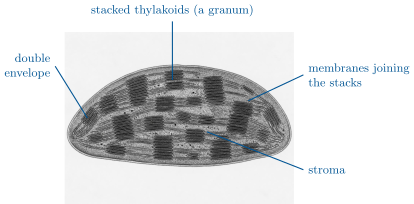
A chloroplast in the electron microscope: the double envelope, the stroma, and the thylakoid membranes stacked into grana, where the pigments sit. Light is captured in the membranes; sugar is built in the fluid around them.
প্রসঙ্গসহ পড়ো →
Definition 14.1 University Biology — Year 1 · অধ্যায় 14 — Photosynthesis and Autotrophy

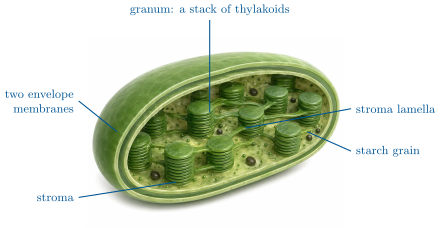
The chloroplast is a lens-shaped organelle 3 to 10 µm3\text{ to }10\,\text{µ}\mathrm{m} long bounded by two envelope membranes; its interior, the stroma, holds the enzymes of carbon fixation, starch grains, ribosomes and a circular DNA; within the stroma a third membrane system, the thylakoids, forms flattened sacs stacked into grana and connected by lamellae, enclosing one continuous thylakoid lumen. The light reactions take place in the thylakoid membrane; carbon fixation in the stroma. A leaf cell holds 20 to 100 20\text{ to }100\, chloroplasts; a square millimetre of leaf, half a million.

A chloroplast cut open. Two envelope membranes around the stroma; inside, stacks of thylakoids (grana) connected by lamellae and enclosing a single lumen. Light is captured in the thylakoid membrane and sugar is made in the stroma.

উদাহরণ

Example 14.7 (Cyclic and non-cyclic flow)

The linear path from water to NADPH gives, per O2\mathrm{O_2}, two NADPH and about three ATP; the Calvin cycle needs a ratio of three ATP to two NADPH exactly, and other work of the chloroplast needs more ATP. When ATP runs short, electrons from ferredoxin return to plastoquinone instead of going to NADP+\mathrm{NADP^+} (cyclic photophosphorylation): PSI alone, pumping protons and making ATP without oxygen or NADPH. The two modes are balanced to the demand.

প্রসঙ্গসহ পড়ো →