University Biology — Year 1 · Bachelor Year 1
22Digestion and Absorption
A cow eats ten kilograms of grass a day and lives on acetic acid; a horse eats the same grass and lives, in part, on glucose; a rabbit eats its own night droppings and would sicken without them. None of them can digest cellulose, and all of them do, by keeping bacteria that can. A human, who cannot, digests a meal of bread, meat and butter to sugars, amino acids and fatty acids within a few hours and absorbs nine litres of water a day through a wall one cell thick. This chapter describes the digestive tract of a mammal, the enzymes and secretions that take food apart, the cells that take the pieces in, the signals that time it all, and the partnerships with microbes by which herbivores live on what no mammalian enzyme can touch.
22.1 Heterotrophic nutrition
Definition 22.1 (Nutrition, digestion, absorption)
A heterotroph must take from its food energy and carbon, the amino acids and fatty acids it cannot make (Chapter 16), vitamins, minerals and water. Food arrives as macromolecules — starch, protein, fat — that cannot cross a membrane. Digestion is their hydrolysis, by enzymes, into monomers small enough to be taken up: glucose, amino acids, fatty acids and glycerol, nucleotides. Absorption is the transport of those monomers across the epithelium of the gut into the blood or lymph. In animals digestion is extracellular, in the lumen of a tube open at both ends, which lets food be processed in stages as it moves, and lets the tube’s regions specialise.
Proposition 22.2 (The digestive tract of a mammal)
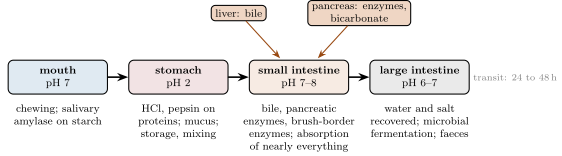
From mouth to anus the tube of a mammal is divided into regions, each with its own epithelium, secretions and muscle: the mouth, where teeth grind and saliva moistens and begins to digest starch; the oesophagus, a conduit; the stomach, a bag of acid where proteins are unfolded and cut, and food is held and released as a paste (chyme); the small intestine — duodenum, jejunum, ileum, six metres in a human — where the secretions of the liver (bile) and the pancreas (enzymes and bicarbonate) complete digestion and where nearly all absorption takes place; the large intestine, where water is recovered and a dense microbial community ferments what is left; and the rectum. Muscle in the wall (Chapter 4) mixes the contents and propels them by peristalsis; sphincters hold them at each stage.
22.2 Taking food apart
Proposition 22.3 (The digestive enzymes)
| enzyme | source, site | substrate product | optimum |
|---|---|---|---|
| amylase | saliva; pancreas, small intestine | starch maltose, dextrins | pH 7 |
| pepsin | stomach (as pepsinogen) | proteins large peptides | pH 2 |
| trypsin, chymotrypsin | pancreas (as zymogens) | proteins small peptides | pH 8 |
| carboxypeptidases | pancreas | peptides amino acids | pH 8 |
| lipase (with colipase) | pancreas | triglycerides fatty acids monoglycerides | pH 8 |
| nucleases | pancreas | nucleic acids nucleotides | pH 8 |
| maltase, sucrase, lactase | brush border of enterocytes | disaccharides monosaccharides | pH 7 |
| peptidases | brush border | di- and tripeptides amino acids | pH 7 |
Each enzyme is a hydrolase (Chapter 13) specific for one class of bond; each works at the pH of its region; and the proteases are made and stored as inactive zymogens, activated only in the lumen. Bile, made by the liver and stored in the gall bladder, contains no enzyme: its bile salts emulsify fat into droplets a micrometre across, on whose surface lipase can work, and carry the products in micelles to the absorbing cells (Chapter 9).
Example 22.4 (A meal’s chemistry)
A slice of bread with butter and cheese: the starch is attacked by salivary amylase in the mouth, stopped by the acid of the stomach, resumed by pancreatic amylase in the duodenum and finished by the brush-border maltase on the enterocytes themselves; the cheese protein is unfolded by the acid, cut by pepsin, cut further by trypsin and chymotrypsin, and finished to amino acids and dipeptides at the brush border; the butter is melted, emulsified by bile, split by lipase into fatty acids and monoglycerides, and ferried in micelles to the membrane. Three hours from mouth to blood.
Proposition 22.5 (Control of secretion)
Secretion is timed to the food. The sight and smell of a meal, through the vagus nerve, start the flow of saliva and gastric juice before the first bite. Food in the stomach stretches its wall and its peptides release the hormone gastrin, which stimulates acid secretion; acid entering the duodenum releases secretin, which makes the pancreas pour bicarbonate to neutralise it; fat and peptides in the duodenum release cholecystokinin, which makes the gall bladder contract and the pancreas release its enzymes, and slows the stomach’s emptying so that the intestine is not overwhelmed. Each secretion is called by the substrate it acts on.
Evidence. Beaumont (1833) observed the stomach of a man left with an open wound, and saw gastric juice appear only when food touched the wall, and digest meat in a glass as it did in the stomach. Pavlov (1890s) fitted dogs with pouches of the stomach and fistulae of the pancreatic duct: the sight of food made the stomach secrete (cut the vagus and it did not); acid placed in the duodenum made the pancreas secrete even after every nerve was cut, and Bayliss and Starling (1902) showed that an extract of duodenal lining injected into the blood did the same — the first hormone, secretin. ∎
22.3 Taking the pieces in
Definition 22.6 (The absorptive surface)
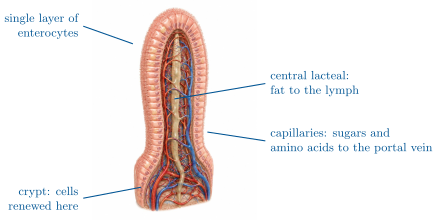
The small intestine folds its lining into circular folds, then into villi a millimetre high, each covered by a single layer of enterocytes whose apical membranes bear microvilli — the brush border — so that a tube of offers some of membrane (Chapter 4). Inside each villus run a capillary network, which carries away sugars and amino acids to the liver by the portal vein, and a central lacteal, a lymphatic vessel that carries away fat. The enterocytes live four days and are replaced from the crypts between the villi.
Proposition 22.7 (Routes of absorption)
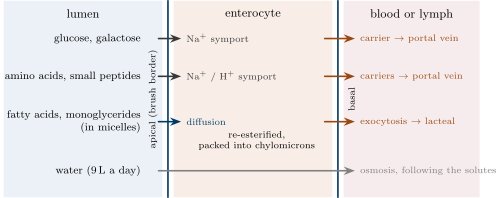
Sugars: glucose and galactose enter the enterocyte by the sodium–glucose symporter (Chapter 7), fructose by a carrier, and all leave by a carrier on the basal side into the blood. Amino acids enter by several sodium-coupled symporters, and small peptides by a proton-coupled one, to be cut inside the cell. Fats: fatty acids and monoglycerides leave their micelles and diffuse through the apical membrane; inside the cell they are re-esterified into triglycerides, coated with protein into chylomicrons a micrometre across, and exocytosed into the lacteal, whose lymph reaches the blood only at the neck — fat bypasses the liver. Water follows the solutes osmotically: a day enter the gut (two drunk, seven secreted as saliva, gastric juice, bile, pancreatic and intestinal juice), and all but a tenth of a litre are reabsorbed, most in the small intestine and the rest in the colon. Vitamins, iron and calcium each have their carriers; vitamin B needs a protein from the stomach to be absorbed at all.
Method 22.8 (Reading an absorption experiment)
- Turn a segment of intestine inside out (an everted sac), fill it with saline, and bathe it in a solution of the substance: what appears inside has crossed the epithelium from the former lumen.
- Measure the transfer against concentration: saturating and stopped by the cold or by a poison of ATP synthesis — active or carrier-mediated; linear and insensitive — diffusion.
- Remove sodium from the bath: if glucose or amino-acid transfer collapses, it was sodium-coupled. Add a competing sugar: if transfer falls, the two share a carrier.
- Compare segments: most sugars and amino acids cross in the jejunum, bile salts and vitamin B only in the ileum, water and salt everywhere.
Example 22.9 (The water budget)
Of the nine litres that enter a human gut each day, the small intestine absorbs eight, the colon a further one, and leaves in the faeces. The small intestine’s sodium-coupled uptake of glucose drags water with it — which is why a solution of glucose and salt, taken by mouth, rehydrates a child with cholera when the toxin has turned the crypts into secretors: the symporter is untouched and absorbs water faster than the toxin loses it (Chapter 7).
22.4 Living on grass
Proposition 22.10 (Symbiotic digestion of cellulose)
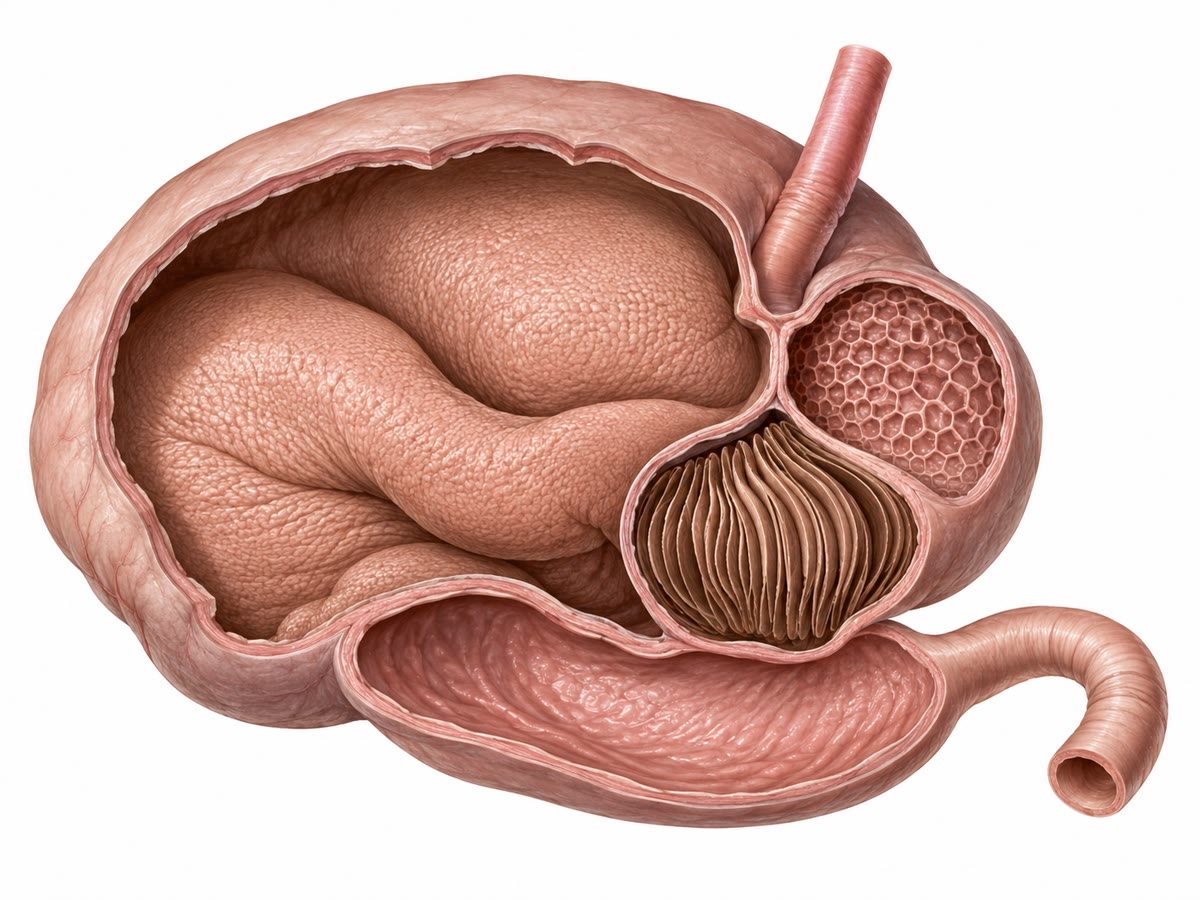
No mammal makes a cellulase. Herbivores digest cellulose by housing bacteria, protists and fungi that do, in a fermentation chamber where the microbes break the bonds (Chapter 10) and ferment the sugars, without oxygen, to volatile fatty acids — acetate, propionate, butyrate — plus carbon dioxide and methane. The host absorbs the acids and lives on them. Ruminants (cattle, sheep, deer) put the chamber before the true stomach: the rumen, a vat of a hundred litres in a cow, where food is fermented for a day or two, regurgitated and chewed again, and from which the microbes themselves pass on to the abomasum and intestine to be digested as the animal’s main source of protein. Hindgut fermenters (horses, rabbits, elephants) put the chamber after the small intestine, in an enlarged caecum and colon: they digest starch and protein themselves first, ferment the fibre afterward, and lose the microbial protein in their faeces — unless, like the rabbit, they eat their soft night droppings and pass them through a second time (caecotrophy).
Example 22.11 (Two ways to eat a meadow)
A cow ferments two thirds of the fibre and gets sixty percent of her energy as acetate and propionate — from which her liver must make every gram of glucose she needs, since almost none reaches her intestine; her rumen also turns the nitrogen of urea, recycled from her blood into her saliva, into microbial protein, so she can live on hay poorer in protein than any other mammal could. A horse ferments less than half the fibre but digests the grass’s starch and protein itself, absorbs glucose, and passes food through in a day and a half instead of three: it gets less from each kilogram and eats more kilograms. The cow wins on poor pasture, the horse when it must run.
Remark 22.12 (The length of a gut)
A carnivore’s intestine is four times its body length, a herbivore’s ten to twenty: the poorer the food, the longer the tube and the larger the chambers. A tadpole eating algae has a long coiled gut that shortens abruptly at metamorphosis when the frog turns to insects; the same rule, written in one animal’s lifetime.
22.5 Exercises
Exercise 22.1 ★
List the regions of the digestive tract and the main event in each.
Solution
Solution of Exercise 22.1.
Mouth: chewing, salivary amylase. Oesophagus: transport. Stomach: acid, pepsin, storage and mixing. Small intestine: bile and pancreatic enzymes complete digestion; absorption. Large intestine: water and salt recovered, fermentation by microbes. Rectum: storage and egestion.
Exercise 22.2 ★
Which enzymes digest protein, where, and at what pH? Why are they made as zymogens?
Solution
Solution of Exercise 22.2.
Pepsin in the stomach at pH 2; trypsin, chymotrypsin and carboxypeptidases from the pancreas in the small intestine at pH 8; brush-border peptidases at pH 7. As zymogens, so that they do not digest the cells that make them; they are activated only in the lumen.
Exercise 22.3 ★
From the absorption figure, name the route by which glucose, an amino acid and a fatty acid cross the enterocyte, and where each ends up.
Solution
Solution of Exercise 22.3.
Glucose: sodium symport in, carrier out, to the portal vein and the liver. Amino acid: sodium symport in, carrier out, portal vein. Fatty acid: diffusion in from a micelle, re-esterified, packed into a chylomicron, exocytosed into the lacteal and the lymph.
Exercise 22.4 ★
What does bile do, and why does its absence make fat digestion fail although lipase is present?
Solution
Solution of Exercise 22.4.
Bile salts emulsify fat into micrometre droplets and carry the products of lipase in micelles to the enterocytes. Without them the fat stays as large drops with almost no surface for lipase, and the fatty acids released cannot be delivered to the membrane: fat passes through undigested.
Exercise 22.5 ★★
A meal of of starch is digested to glucose in three hours. Compute the moles of glycosidic bonds hydrolysed, the water consumed, and the mean rate of glucose absorption in millimoles per minute.
Solution
Solution of Exercise 22.5.
of glucose units, hence about of bonds and of water (); of glucose absorbed.
Exercise 22.6 ★★
Explain, with the hormones of the chapter, what happens in the duodenum in the minutes after acid chyme and fat arrive from the stomach, and why the stomach then slows down.
Solution
Solution of Exercise 22.6.
Acid releases secretin, which makes the pancreas secrete bicarbonate that neutralises the chyme; fat and peptides release cholecystokinin, which contracts the gall bladder (bile enters), stimulates the pancreatic enzymes, and inhibits gastric emptying, so that the duodenum receives chyme only as fast as it can neutralise and digest it.
Exercise 22.7 ★★
An everted sac transfers glucose from a bath until the inside reaches ; with sodium replaced by potassium in the bath, the inside stops at . Interpret both results.
Solution
Solution of Exercise 22.7.
Glucose was concentrated eightfold against its gradient: active transport. Without sodium the transport stops at equilibrium: the uptake is coupled to the sodium gradient (the sodium–glucose symporter), not to ATP directly.
Exercise 22.8 ★★
Why does fat reach the blood through the lymph rather than the portal vein, and what would happen if chylomicrons entered the portal blood directly?
Solution
Solution of Exercise 22.8.
Chylomicrons, a micrometre across, cannot cross the tight capillary wall but can enter the open-ended lacteals; the lymph joins the blood at the neck, so fat reaches the whole body before the liver, which would otherwise take it all up first. Entering the portal blood directly, the chylomicrons would clog the liver’s sinusoids and saturate its capacity to process fat after every meal.
Exercise 22.9 ★★
A cow secretes of saliva a day. Explain three functions of that saliva in a ruminant, one of them concerning nitrogen.
Solution
Solution of Exercise 22.9.
It moistens and floats the fibre for rumination; its bicarbonate and phosphate buffer the acids the microbes produce, holding the rumen near pH 6.5; and it carries urea from the blood, which the microbes turn into ammonia and then into their own protein, recycling nitrogen that would otherwise be lost in urine.
Exercise 22.10 ★★★
A patient’s pancreas fails. Predict the fate of each class of nutrient, the appearance of the faeces, and which foods could still be digested by the enzymes that remain.
Solution
Solution of Exercise 22.10.
Without pancreatic amylase, proteases, lipase and bicarbonate: starch is partly digested by saliva and the brush border only; proteins are cut by pepsin but not to absorbable size; fat is not digested at all and appears in bulky, pale, greasy faeces. Sugars and disaccharides (brush-border enzymes remain), some starch, and small peptides can still be handled; fat and most protein cannot.
Exercise 22.11 ★★★
A rabbit prevented from eating its night droppings loses weight on a diet on which control rabbits thrive. Explain what it loses, why a cow does not need such a habit, and why a horse cannot make up the loss either.
Solution
Solution of Exercise 22.11.
The caecal droppings carry the microbial protein and the B vitamins made in the caecum, which lies beyond the small intestine and so cannot be digested on the first passage; eaten, they pass the stomach and small intestine and are absorbed. The cow ferments before the stomach, so its microbes are digested downstream without any second passage. The horse’s caecum is also downstream, and the horse neither eats its droppings nor has any other route: its microbial protein is lost.
Exercise 22.12 ★★★
“A cow is a fermentation vat with legs.” Discuss in a paragraph: what the microbes give the cow (energy, protein, vitamins), what the cow gives them, and where the design fails (methane, glucose, speed).
Solution
Solution of Exercise 22.12.
The microbes give the cow the energy of cellulose as fatty acids, protein made from poor grass and even from urea, and every B vitamin; the cow gives them a warm, buffered, anaerobic vat kept full and stirred, and a hundred litres of saliva a day. The design’s costs: a tenth of the energy leaves as methane, no glucose is absorbed so the liver must make it all from propionate, digestion takes three days, and the vat and its contents weigh a fifth of the animal — a cow cannot sprint, and a lion can.
22.6 Problem: The Cow and the Horse
Problem 22.1
Weekend problem — ten kilograms of grass through a rumen and through a caecum: fibre fermented, acids absorbed, microbial protein gained or lost, methane vented, ending on the fraction of a cow’s energy that comes from volatile fatty acids
A cow and a horse each eat of grass dry matter a day holding, by mass, cellulose and hemicellulose (fibre), starch and sugars, protein and of indigestible lignin and ash. Energy: carbohydrate and protein . Fermentation of of carbohydrate yields volatile fatty acids holding of its energy, methane holding , and heat and microbial growth the rest; it also yields of microbial protein. The rumen ferments of the fibre and all the starch and sugars; the horse’s hindgut ferments of the fibre, while its small intestine digests of the starch and of the protein before the fibre reaches the hindgut. Both animals need of metabolisable energy a day.
Part I — The cow’s rumen.
- Compute the mass of fibre, of starch and sugars, and of protein eaten per day.
- Compute the mass of carbohydrate fermented in the rumen.
- Compute the energy of that carbohydrate and the energy recovered as volatile fatty acids.
- Compute the energy lost as methane, and the mass of methane () and its volume ().
- Compute the microbial protein produced.
- Explain why the cow’s own protein supply is largely the microbes, and where they are digested.
- Compute the fraction of the fibre that leaves the rumen unfermented, and its fate.
Part II — The cow’s balance. The cow also digests of the dietary protein that escapes the rumen ( of the protein eaten escapes) and all the microbial protein, at .
- Compute the energy the cow obtains from protein (dietary escape plus microbial).
- Compute the cow’s total metabolisable energy: volatile fatty acids plus protein.
- Compute the fraction of that energy supplied as volatile fatty acids.
- Does the cow meet her need of ? What does she do if not?
- Almost no glucose is absorbed by the cow. Name the acid from which her liver makes glucose, and the process.
Part III — The horse’s hindgut.
- Compute the energy the horse obtains from starch digested in its small intestine (absorbed as glucose, ).
- Compute the energy from dietary protein digested in the small intestine.
- Compute the fibre fermented in the hindgut and the energy recovered as volatile fatty acids.
- Compute the microbial protein produced in the hindgut. What becomes of it?
- Compute the horse’s total metabolisable energy and the fraction supplied as volatile fatty acids.
- Does the horse meet its ? How much grass would it need to eat, and how does it manage it?
Part IV — Comparing designs.
- Compute the energy each animal extracts per kilogram of grass dry matter.
- The cow’s methane is of the fermented energy. Compute its share of the cow’s gross energy intake, and the mass of methane a herd of a hundred cows vents in a year.
- The cow’s food stays in the tract, the horse’s . Compute the mass of dry matter each holds in its gut at any moment, at constant intake.
- A rabbit ferments fibre in its caecum and then eats its caecal droppings. What fraction of the microbial protein of question 16 could a horse recover if it did the same? Why does no horse do it?
- Explain why the cow can live on a diet of straw with protein plus urea, and the horse cannot.
- A sprinting horse burns glucose from its own glycogen; a cow cannot sprint. Relate this to the two designs.
- State the result: the fraction of the cow’s metabolisable energy that comes from volatile fatty acids, the horse’s fraction, and the energy each extracts per kilogram of grass.
Solution
Solution of Problem 22.1.
1. Fibre , starch and sugars , protein . 2. . 3. ; VFA . 4. ; of methane, about . 5. . 6. Most dietary protein is degraded by the microbes in the rumen and rebuilt as microbial protein; the microbes flow on to the abomasum and small intestine, where they are digested like any meat. 7. of the fibre, : partly fermented in the colon, mostly excreted. 8. Escaped dietary protein , digested ; microbial ; total . 9. . 10. (about once the heat of fermentation and the energy of the colon’s contribution are accounted in fuller budgets; on this reckoning, three quarters). 11. is short of : the cow must eat more (), or better grass, or draw on her fat. 12. Propionate; gluconeogenesis in the liver. 13. . 14. . 15. ; VFA . 16. , lost in the faeces (the hindgut is beyond the small intestine). 17. ; VFA share . 18. No: it needs of grass, and manages by eating for sixteen hours a day and passing food through twice as fast. 19. Cow ; horse . 20. Gross intake (lignin and ash excluded); methane is of it; a hundred cows: of methane a year. 21. Cow of dry matter in the gut (plus ten times that of water); horse . 22. In principle all , worth and its essential amino acids; a horse’s caecal contents are not separated into a soft nutrient-rich fraction as a rabbit’s are, and an animal of half a tonne cannot recover its own droppings from the ground in a useful state. 23. The rumen microbes make protein from urea nitrogen and straw carbon, and the cow digests the microbes: she needs almost no dietary protein. The horse’s microbes are beyond its small intestine, so their protein is lost, and the horse must find its amino acids in the food itself. 24. The horse absorbs glucose and stores glycogen in its muscles for anaerobic sprinting; the cow absorbs none, makes glucose slowly from propionate, and carries a hundred-litre vat — built to graze, not to run. 25. About three quarters of the cow’s metabolisable energy on this budget ( in a full accounting) as volatile fatty acids, against a third for the horse; against per kilogram of grass.