The Industry: Firms, Roles and Careers · Careers
1A Map of the Industry
The United States government’s industry classification has an entry for “market making for securities”. It files it under code 523150, Investment Banking and Securities Intermediation, beside the underwriting departments of the largest banks. A firm that trades only its own money is a “securities speculator for own account” and goes to 523910, Miscellaneous Intermediation, with “individuals investing in financial contracts on own account”. On the other side of the same securities industry, the SEC’s code 6211 covers an investment bank, an electronic market maker and an asset manager with $14 trillion under management alike. None of these codes says whose capital is at risk, who pays the firm, or how long it holds a position, and those three answers decide what a job there is. This chapter builds the map the rest of the book uses, and shows how to place an employer on it from public records alone.
1.1 Five questions that place an employer
Book 1 defined the firms that trade: the market maker, the proprietary trading firm, the hedge fund and the multi-manager platform, the asset manager, and the bank’s dealing desk. For someone choosing where to work, five questions separate them more finely than any name.
- Whose capital is at risk? The owners’ (a proprietary firm), outside investors’ (a fund), clients’ under a mandate (an asset manager), shareholders’ within a regulated balance sheet (a bank).
- Who pays the firm? Counterparties through the spread, investors through fees on assets and on profits, clients through commissions, or nobody but the market.
- How long is a position held? Seconds for a market maker, minutes to days for a medium-frequency firm, months for a trend follower, years for an asset owner.
- What does it sell, and in which markets? A service (liquidity, execution, a product, a licence) in one or several asset classes.
- How large is it? In people, in capital and in revenue: tens, hundreds, thousands or hundreds of thousands of employees.
Definition 1.1 (Employer taxonomy)
An employer taxonomy of the markets industry classifies an employer, or one business line of a group, by its business model – the answers to the first three questions – and then by product and size. This book uses thirteen business models in four groups: principal trading (market maker, medium-frequency proprietary firm, crypto trading firm), investment manager (systematic fund, multi-manager platform, discretionary fund, asset manager, asset owner), bank, and infrastructure (exchange, broker, vendor, regulator).
| business model | whose capital | who pays | holding period |
|---|---|---|---|
| market maker | owners’ | the spread and rebates | seconds to hours |
| medium-frequency proprietary firm | owners’ | trading profit | minutes to days |
| systematic fund | investors’ | fees on assets and profits | minutes to months |
| multi-manager platform | investors’ | pass-through costs and profits | days to months |
| asset manager | clients’ | fees on assets | months to years |
| asset owner | beneficiaries’ | its own budget | years |
| bank markets division | shareholders’ | spread and client business | minutes to months |
| exchange, broker, vendor | shareholders’ | transaction, data and licence fees | none |
Example 1.2 (Three employers, five answers)
A commodity trading advisor running trend-following futures programmes risks investors’ capital, is paid a management and a performance fee, holds positions for weeks to months, sells a managed-futures product in every liquid futures market, and may employ a few dozen people. An exchange-traded-fund market maker risks its owners’ capital, is paid by the spread between the fund’s price and its basket, holds positions for minutes to hours, and sells liquidity in the funds it quotes. A bank’s rates flow desk risks shareholders’ capital inside a regulated balance sheet, is paid through the spread and the client relationship, holds positions for days, and sells prices to institutional clients. Three jobs called “trader” with nothing in common but the screens.
Remark 1.3 (Groups and legal entities)
A group may own a market maker, a fund and a technology subsidiary under one brand, and a bank’s markets division contains businesses of several kinds. The taxonomy classifies the legal entity or the business line an employee joins, not the brand. Where a group’s businesses differ, its job offers do too.
1.2 The taxonomy: business models and their sub-types
Figure 1.1 draws the thirteen models in their four groups, with the chapters of this book that describe each as an employer. The principal-trading group is where the exchange-industry associations draw their own line.
Definition 1.4 (Principal trading firm)
A principal trading firm is a proprietary trading firm (One Quant Book 1) in the sense the exchange-industry associations use: a firm that trades only its own capital, on exchanges and electronic venues, mostly as a provider of liquidity, and has no clients whose money it invests.
The United States association limits membership of its principal traders’ group to “firms trading their own capital”; the European association describes its members as “independent market makers and providers of liquidity and risk transfer”. The term matters to an employee because it fixes two things at once: every dollar of revenue is trading revenue, and nobody but the owners has a claim on the profit (Book 16, chapter 2).
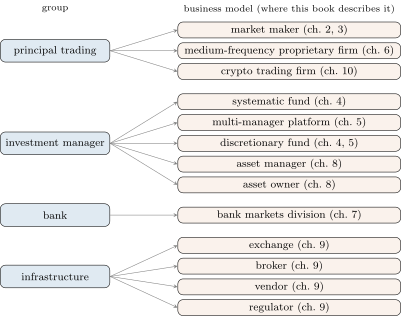
Within each model, sub-types differ enough to change the job. Among market makers, an electronic delta-one firm quoting shares, futures and currencies (chapter 2) is not an options house pricing thousands of strikes (chapter 3). Among investment managers, a research-driven multi-strategy fund, a trend follower and a statistical-arbitrage house share a method but not a pace (chapter 4). Banks differ by product strength: some earn most of their markets revenue in equity derivatives, most in rates and credit (chapter 7). The map is also a map of this series. The table below lists, for each business model, the books a newcomer to it should read.
| business model | One Quant Books that teach its work |
|---|---|
| market maker | 1 (markets), 10 (microstructure), 11 (market making), 13–14 (systems, networks) |
| medium-frequency proprietary firm | 7 (research craft), 8 (strategies), 12 (machine learning) |
| crypto trading firm | 3 (crypto markets), 11, 14 (crypto connectivity) |
| systematic fund | 4 (methods), 7, 8, 9 (strategies), 12 |
| multi-manager platform | 8, 16 (the desk and the firm) |
| asset manager and owner | 1, 8 (the asset managers’ strategies) |
| bank markets division | 2 (rates, FX, credit), 5 (derivatives), 6 (XVA and risk), 9 (bank desks) |
| exchange, broker, vendor, regulator | 1, 10, 14, 15 (platforms), 16 |
1.3 Size: headcount, capital and revenue
Size is the fifth question and the most visible one. It ranges over five orders of magnitude, from trading firms of a dozen people to banks of hundreds of thousands, and it changes the job more than it seems: a firm of fifty has no separate risk department, one of fifty thousand has several.
As of September 2026 — How large employers are
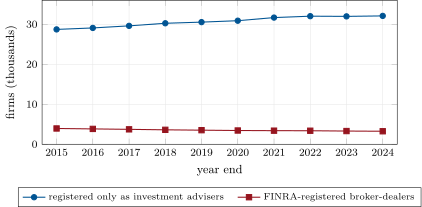
Headcounts from filings and firms’ own pages (end of 2025 unless stated): JPMorganChase 318 512 employees; Goldman Sachs a headcount of 47 400; BlackRock about 24 900; CME Group about 3 875; Virtu Financial about 1 027 (February 2026). Two multi-manager platforms state on their home pages “7 000+ employees globally” and “360+ investment teams” (Millennium) and “2000+ investment team and support professionals” (Balyasny). Counts of firms (FINRA, end of 2024): 3 249 registered broker-dealers, of which 2 891 have 1–150 registered representatives, 209 have 151–499 and 149 have 500 or more; 32 090 firms registered only as investment advisers. FINRA places 103 broker-dealers in its proprietary-trading and market-making business segments, 93 of them small by its definition and none large.
Two lessons follow. The number of registered investment advisers is ten times the number of broker-dealers, and it grew while the number of broker-dealers fell (Figure 1.2): most firms in the industry manage money, and most are small. And the principal trading firms are few and mostly small by the regulator’s count, which measures registered representatives, not staff: a market maker with a thousand engineers and traders may register only the few who deal with the public, so its FINRA size says nothing about its real size. Every size has a unit, and the unit has to be read.
in_map.finra.Remark 1.5 (Size bands in this book)
Where this book sorts employers by size it uses staff, not registered representatives, in four bands: under 50, 50 to 500, 500 to 5 000, and above 5 000. A headcount is a dated range, never a point: firms round, count contractors differently, and change size faster than their filings do.
1.4 Reading an employer from outside
An outsider can place an employer from three kinds of public record: the industry codes that statistical agencies and regulators assign, the registrations and periodic reports the law requires, and the firm’s own publications.
Definition 1.6 (Industry classification code)
An industry classification code assigns an establishment or a company to one industry of a statistical classification by its main activity: the North American Industry Classification System (NAICS, six digits), the Standard Industrial Classification that the SEC still uses on EDGAR (SIC, four digits), or the European Union’s NACE.
The codes are coarse where the industry is fine. NAICS 2022 merged “investment banking and securities dealing” and “securities brokerage” into one code, 523150, and “portfolio management” and “investment advice” into 523940: the codes that once told a dealer from a broker no longer do. The SEC assigns an SIC code only to issuers of registered securities, so a private firm on EDGAR has none, however large it is. Codes are the first reading, never the last.
Registrations say more. A broker-dealer files an annual audited report (Form X-17A-5) and periodic financial reports (FOCUS), of which only the audited statement of financial condition is public; an institutional investment manager with more than $100 million of US equities files quarterly holdings on Form 13F; an issuer files annual and quarterly reports; an operator of an alternative trading system files Form ATS-N. These are obligations, not choices, and they follow the business, not the brand: each is a fact about what the entity does. The legal entity identifier (Book 2, chapter 28) ties the entities of a group together, and its reference data are free to reuse.
Method 1.7 (Placing an employer from public records)
- List the group’s legal entities: the LEI records, EDGAR’s entity search, the national company registries.
- Read the industry codes, knowing their limits: SIC only for issuers, NAICS coarse, NACE coarser.
- List each entity’s registrations and the families of forms it files: broker-dealer reports, holdings reports, issuer reports, venue-operator forms.
- Read the firm’s own statement of what it does, on its website and in any filing that describes the business.
- Decide the business model of the entity the job belongs to, and write down which record decided it.
Example 1.8 (One firm, three codes)
Virtu Financial, the listed holding company of an electronic market maker, carries SIC code 6211, Security Brokers, Dealers & Flotation Companies, on EDGAR. Its US operating subsidiary, a broker-dealer, has no SIC code at all but files broker-dealer annual reports and an alternative-trading-system form. The same SIC code 6211 is carried by Goldman Sachs and by BlackRock, a bank holding company and an asset manager. The code puts three different employers in one box; the forms put the market maker’s subsidiary in the right one.
1.5 Tutorial: classifying employers from their filings
Goal. Measure how well the public codes and the forms an entity files recover its business model. End state: the table of scores below and Figure 1.3.
- The sample.
data/industry/employer_sample.csvholds 21 entities that file on EDGAR: eleven market-making entities, four systematic funds’ advisers, two multi-manager platforms, two banks, an asset manager and an exchange. For each, the SIC code and the families of forms in its recent filing history come from EDGAR’s submissions data; the business model comes from the firm’s own statement, with a ledger row per entity. The rules.
firm.industrymapimplements three rules (Listing 1.1): the SIC code alone; the forms alone (a broker-dealer that is not an issuer is a principal trading firm; a filer of holdings reports that is neither is an investment manager); and the forms first, with SIC for issuers.def sic_class(sic): """Business model implied by an SIC code, UNKNOWN when there is none (every private filer).""" return _SIC.get(str(sic).strip(), UNKNOWN) def forms_class(families): """Business model implied by the families of forms an entity files. A broker-dealer that is not an issuer is read as a principal trading firm; a filer of 13F holdings reports that is neither a broker-dealer nor an issuer is read as an investment manager (the rule cannot tell a systematic fund from a platform, so it answers the first investment-manager model). Issuers are left to SIC. """ fam = set(families) if "issuer" in fam: return UNKNOWN if "broker-dealer" in fam: return "market maker" if "13F" in fam: return "systematic fund" return UNKNOWN def by_sic(e): return sic_class(e.sic) def by_forms(e): return forms_class(e.families) def combined(e): g = forms_class(e.families) return g if g != UNKNOWN else sic_class(e.sic)Listing 1.1. Three rules that classify an entity from its public records. code/firm/industrymap/firm_industrymap.py - Score.
in_map.accuracy()scores each rule at two levels: the coarse group (principal trading, investment manager, bank, infrastructure) and the fine business model. - Read the misses.
in_map.misses()lists the entities the best rule gets wrong.
| rule | right group | right model |
|---|---|---|
| SIC code alone | 3 of 21 | 3 of 21 |
| forms filed alone | 15 of 21 | 13 of 21 |
| forms, then SIC for issuers | 18 of 21 | 16 of 21 |
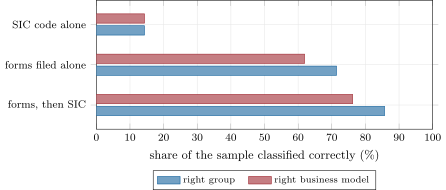
in_map.accuracy.The SIC code places only the five issuers, and two of those wrongly: an investment bank and an asset manager sit under the dealers’ code. The forms place every private market maker whose broker-dealer carries the firm’s name. The three misses of the best rule are instructive. One quantitative trading firm’s entity in the sample files only holdings reports: the entity chosen was not a broker-dealer, and the rule saw a fund manager. And the issuer’s SIC code misplaces the bank and the asset manager. Each miss is a place where the method’s step 1, listing the group’s entities, was skipped.
What to change next. Add a rule that reads an issuer with SIC 6211 and holdings reports as an asset manager, and see what it fixes and what it breaks (exercise 7); add ten entities of your own choosing, and ask whether your choice of entities flatters the rules (exercise 8).
1.6 Build: the employer map
Purpose. One taxonomy of employers for the whole book, so that pay data (chapter 14), firm profiles (chapters 2–10) and roles (Part III) are sorted the same way.
Interface. firm.industrymap: MODELS (business model to group, whose capital, who pays, holding period), GROUP, BOOKS; Entity(name, cik, sic, families, truth), load_sample(path); sic_class, forms_class, and the rules by_sic, by_forms, combined; score(entities, rule, level) and confusion(entities, rule, level).
Rules. A rule answers a business model or unknown, never a guess without a record behind it; every business model has a group and a list of books; a score states its level.
Acceptance tests. code/firm/industrymap/tests/: every model has a group and books; SIC and forms rules on constructed entities; the combined rule falls back to SIC for issuers; scores at the two levels differ where the rule cannot separate a platform from a systematic fund.
Stretch. Add a rule on the NAICS code an employer reports in its labour-condition filings (chapter 14), and on a UK firm’s permissions on the FCA register.
Sources and further reading
- US Census Bureau, North American Industry Classification System 2022: codes, index file and 2017-to-2022 concordance.
- SEC EDGAR submissions data (
data.sec.gov) for the 21 entities of the sample; Forms 10-K for 2025 of JPMorgan Chase, Goldman Sachs, BlackRock, CME Group and Virtu Financial. - The firms’ own home pages for their descriptions of their business (ledger rows F4–F19).
- FINRA, Industry Snapshot 2025, tables 2.1.3, 2.1.5 and 2.6.1–2.6.3.
- FIA, Principal Traders Group and European Principal Traders Association pages; GLEIF, LEI data terms of use.
1.7 Exercises
Exercise 1.1 ★
Give the NAICS 2022 code of a firm that makes markets in securities, of one that trades only for its own account, and of an investment adviser, and say which of them the 2017 codes would have separated.
Solution
Solution of Exercise 1.1.
Market making for securities: 523150; speculators for own account: 523910; an investment adviser: 523940. The 2017 codes separated a dealer (523110) from a broker (523120), and portfolio management (523920) from investment advice (523930); 523910 is unchanged.
Exercise 1.2 ★
From the dated box, what share of FINRA-registered broker-dealers at the end of 2024 had 150 registered representatives or fewer, and what share of the proprietary-trading and market-making segments did?
Solution
Solution of Exercise 1.2.
of broker-dealers are small; of the proprietary-trading and market-making segments .
Exercise 1.3 ★
Answer the five questions of section 1 for an ETF issuer’s index fund, a pension fund’s in-house equity team and a crypto exchange.
Solution
Solution of Exercise 1.3.
Index fund: clients’ capital, paid a fee on assets, holds for years, sells index exposure; in-house equity team of a pension fund: beneficiaries’ capital, paid from the fund’s budget, holds for years, manages the fund’s own assets; crypto exchange: shareholders’ capital (not at risk in trades it matches), paid transaction and listing fees, holds no position by design, sells a venue.
Exercise 1.4 ★★
The SIC rule classifies 3 of the 21 entities correctly. How many does it leave as unknown, and why?
Solution
Solution of Exercise 1.4.
It leaves 16 unknown: only the five issuers carry an SIC code on EDGAR, and of those it gets three right (the bank, the exchange and the listed market maker) and two wrong (the investment bank and the asset manager under code 6211).
Exercise 1.5 ★★
From 2015 to 2024, by how much did the number of FINRA-registered broker-dealers fall, and the number of firms registered only as investment advisers rise, in per cent?
Solution
Solution of Exercise 1.5.
Broker-dealers: . Adviser-only firms: .
Exercise 1.6 ★★
In Figure 1.3, why is the “right model” bar lower than the “right group” bar for the forms rule, and which two entities make the difference?
Solution
Solution of Exercise 1.6.
The forms rule reads every holdings-report filer as a systematic fund: it gets the group right for the two multi-manager platforms (Millennium, Balyasny) but not their business model, so 15 right groups become 13 right models.
Exercise 1.7 ★★★
Coding. Extend the combined rule so that an issuer with SIC 6211 that also files holdings reports is an asset manager. How many of the 21 entities does it now place in the right group, and which entity does the new rule still get wrong, and why?
Solution
Solution of Exercise 1.7.
The asset manager moves to the right group: 19 of 21. The investment bank also files holdings reports (its asset management arm) and carries SIC 6211, so the new rule calls it an asset manager, still wrong; the quantitative trading firm whose entity files only holdings reports stays wrong.
Exercise 1.8 ★★★
Find the flaw. “The forms rule places 86% of employers in the right group, so a job seeker can classify any trading firm from its EDGAR filings.”
Solution
Solution of Exercise 1.8.
The sample was chosen: its eleven broker-dealers were all market makers, so the rule “broker-dealer means principal trading” was never tested on agency brokers, banks’ dealer subsidiaries or retail brokers, which file the same forms. Most of the industry’s firms are small advisers or broker-dealers not in the sample. The 86% is an in-sample score on a convenience sample, not an accuracy.
1.8 Problem: Classifying from the Outside
Problem 1.1
Weekend problem — classifying from the outside
A careers adviser wants a tool that tells students what kind of firm has offered them a job, from public records only. You have the chapter’s sample and its rules.
Part I — The questions.
- State the five questions that place an employer, and say which three define its business model.
- Answer them for a market maker and for a systematic fund.
- Define a principal trading firm, and say what the two associations’ membership rules add to Book 1’s proprietary trading firm.
- Why does the chapter classify legal entities or business lines rather than brands?
- Give the four groups of the taxonomy and the number of business models in each.
Part II — The codes.
- Which NAICS 2022 code covers market making for securities, and which covers speculators for own account?
- Which 2017 codes were merged into 523150 and into 523940?
- Why does a private market maker’s broker-dealer have no SIC code on EDGAR?
- Which three entities of the sample carry SIC code 6211, and what are their business models?
- How many entities of the sample does the SIC rule place correctly, and how many does it leave unknown?
Part III — The forms.
- Name the form families the rules read, and what each proves about the entity.
- How many entities does the forms rule place in the right group, and in the right business model?
- Why can the forms rule not tell a multi-manager platform from a systematic fund?
- How many entities does the combined rule place correctly, at each level?
- Name the three misses of the combined rule at the group level and the cause of each.
Part IV — The verdict.
- How many broker-dealers did FINRA count at the end of 2024, and how many in its proprietary-trading and market-making segments?
- Why is a FINRA size band a poor measure of a market maker’s headcount?
- State the named result: the share of the sample each rule classifies correctly, at the group level.
- Which step of Method 1.7 would have caught every miss?
- In two sentences, what should the adviser’s tool report besides its answer?
Solution
Solution of Problem 1.1.
- Whose capital, who pays, holding period, product and markets, size; the first three define the business model.
- Market maker: owners’ capital, paid by the spread and rebates, seconds to hours. Systematic fund: investors’ capital, paid fees on assets and profits, minutes to months.
- A proprietary trading firm that trades only its own capital, on exchanges and electronic venues, mostly as a liquidity provider, with no clients’ money; the associations add the self-description as independent market makers and the rule that members trade their own capital.
- Because a group can own businesses of several models, and the job belongs to one of them.
- Principal trading 3, investment manager 5, bank 1, infrastructure 4: thirteen.
- 523150 and 523910.
- 523110 and 523120 into 523150; 523920 and 523930 into 523940.
- The SEC assigns SIC codes to issuers of registered securities; a private broker-dealer is not one.
- Goldman Sachs (bank), BlackRock (asset manager), Virtu Financial (market maker).
- 3 correct; 16 unknown; 2 wrong.
- Broker-dealer reports (a registered broker-dealer), 13F holdings (a manager with at least $100 million of 13(f) securities), issuer reports (registered securities outstanding), ATS-N (an operator of an NMS stock alternative trading system).
- 15 of 21 groups; 13 of 21 models.
- Both file holdings reports and neither is a broker-dealer or an issuer.
- 18 of 21 groups; 16 of 21 models.
- The trading firm whose chosen entity is not its broker-dealer (read as a fund manager); the investment bank and the asset manager (both under SIC 6211, read as dealers).
- 3 249 broker-dealers; 103 in the proprietary-trading and market-making segments.
- It counts registered representatives, who deal with the public, not engineers, researchers or traders who do not.
- SIC alone 14% (3 of 21); forms alone 71% (15 of 21); forms then SIC 86% (18 of 21).
- Step 1, listing the group’s legal entities.
- The record that decided the answer and the rule’s known blind spots, so that the student can check them; and that the tool was scored on a hand-picked sample.
1.9 Interview questions
Interview question 1.1 ★ trader, researcher
What distinguishes a market maker from a hedge fund? Give three differences that matter to someone who works there.
Solution
Solution of Interview question 1.1.
Whose capital is at risk (owners’ against investors’), who pays the firm (the spread against fees), how long positions are held (seconds against weeks or months). For the employee: pay comes from trading profit, not fees; feedback is fast or slow; there are no investors to report to, or there are.
What the interviewer is looking for: the business model, not the asset class.
Interview question 1.2 ★ trader
Why does it matter to a trader who pays the firm?
Solution
Solution of Interview question 1.2.
It decides what the trader is paid for: capturing spread with little risk (market maker), serving clients well (bank), or earning a return on investors’ money after fees (fund). It also decides what is a good day.
What the interviewer is looking for: the link from revenue source to incentives.
Interview question 1.3 ★★ developer, risk
An entity files annual X-17A-5 reports with the SEC. What does that tell you about it, and what does it not?
Solution
Solution of Interview question 1.3.
It is a registered broker-dealer, its audited statement of financial condition and notes are public, and it is subject to net capital rules. It does not say whether it is a market maker, an agency broker or a bank’s dealer, nor how many people work there; its periodic FOCUS reports are confidential.
What the interviewer is looking for: knowing what a public record proves and what it does not.
Interview question 1.4 ★★ researcher
Estimate how many people work for principal trading firms in the United States. State your method and your range.
Solution
Solution of Interview question 1.4.
Count firms: FINRA’s segments list 103 proprietary-trading and market-making broker-dealers at the end of 2024; add some 50 to 100 futures-only principal trading firms (an assumption). Size them by band (assumptions): 80 firms of 20–100 people, 20 of 100–500, 10 of 500–3 000. That gives to : about 10 000 to 50 000, dominated by the ten largest firms.
What the interviewer is looking for: a decomposition, stated assumptions, and a range driven by the largest firms.
Interview question 1.5 ★★ bank, risk
A bank’s flow desk and a market maker both hold inventory to serve buyers and sellers. Whose capital is at risk in each, and what limits how much each can hold?
Solution
Solution of Interview question 1.5.
The bank’s shareholders, inside a regulated balance sheet: limits come from capital rules (risk-weighted assets, leverage) and the bank’s risk appetite. The market maker’s owners: limits come from its own capital, its clearing firms’ and prime brokers’ margin, and its own risk limits.
What the interviewer is looking for: capital source and the binding constraint for each.
Interview question 1.6 ★★★ researcher, mle
You build a classifier that labels employers’ business models from their public filings and it scores 86% on a sample you assembled. How would you know whether to trust the number?
Solution
Solution of Interview question 1.6.
Not until it is scored on entities it was not built from: the sample is small, hand-picked and labelled by the builder, so the score is in-sample and biased towards the cases the rules were written for. Draw a random sample of filers, label them blind from their own statements, report per-class accuracy with intervals (18 of 21 has a wide interval), and look at the classes the sample never contained.
What the interviewer is looking for: selection bias, out-of-sample evaluation and uncertainty on a small count.