The Industry: Firms, Roles and Careers · Careers
16Trader
On 4 May 2021 the largest US derivatives exchange group announced that it would not reopen the trading pits it had closed during the pandemic, except one options pit; by 2025, 93% of its volume was electronic. The trader’s job had moved from shouting to clicking, and from clicking to supervising algorithms that quote and trade faster than any person. What remains a trader’s is judgement: which risks to hold, how to set the machines, when to stop them, and how to answer for them. This chapter opens Part III, one chapter per role, and each follows the same plan: what the role is at each kind of employer, how it has changed, what controls and rules bind it, a documented or composite day, the pay evidence of chapter 14 for the role, and one analysis that shows what the role’s work consists of. For the trader the analysis is a question every desk faces: how many algorithms one person can watch.
| Role card: trader | |
|---|---|
| employers | market makers, banks, hedge funds, platforms |
| horizon of decisions | seconds to days |
| P&L | owns a book (risk trader) or none (execution trader) |
| reports to | head of desk |
| occupation codes in filings | 13-2099.01, 13-2051, 41-3031; titles with “trader”, “trading analyst” |
| where the series teaches it | Book 1, chapter 2; Book 10, chapter 24; Book 11, chapter 27 |
16.1 Three traders: market maker, bank flow desk, hedge fund
The word “trader” covers jobs that share little but a screen. Two definitions separate the main kinds.
Definition 16.1 (Risk trader, execution trader)
A risk trader decides which positions the firm holds, within limits, and owns the profit and loss of a book. An execution trader carries out orders decided by someone else, a portfolio manager or a client, and is judged on the cost and quality of execution rather than on the position’s profit.
- At a market maker the trader is a risk trader whose book is the inventory the firm’s quotes leave it with (Book 11, chapters 1–3). One market maker describes its quantitative traders as “in the thick of the action–closely watching the markets, making quick decisions” and adds that “they build tools to automate trading decisions”; its institutional traders “interact with brokers and other trading teams”.
- At a bank’s flow desk the trader makes prices to the bank’s clients through sales (Book 1, chapter 2) and manages the resulting risk: a risk trader whose book is the franchise’s flow (Book 9, chapter 24).
- At a hedge fund the trader is usually an execution trader for the portfolio managers, working orders through brokers and algorithms (Book 10, chapter 24); some funds also give traders risk of their own.
The three share the discipline of limits and the obligation to know, at every moment, what the firm holds; they differ in whom they serve, what they own, and how their pay is judged (chapter 13).
16.2 From click trading to supervising algorithms
Definition 16.2 (Click trader, algorithm supervisor)
A click trader enters and manages orders by hand on an electronic screen. An algorithm supervisor is a trader in charge of one or more trading algorithms who sets their parameters, monitors them in real time, handles their alerts and stops them when they misbehave.
The pit trader of chapter 2 read the crowd; the click trader read the screen; the algorithm supervisor reads the algorithms. The change was not only technical. EU rules for algorithmic trading make the supervisor a named duty: the real-time monitoring of algorithmic trading “shall be undertaken by the trader in charge of the trading algorithm or algorithmic trading strategy, and by the risk management function”, and the staff in charge “shall respond to operational and regulatory issues in a timely manner”. A supervisor’s day is therefore a queue: alerts arrive from the algorithms, each needs attention, and an alert that waits is risk that runs unattended. How many algorithms one person can supervise is a queueing question, and the chapter answers it in section 5.
16.3 Controls and accountability: registrations, certification, kill switches
Definition 16.3 (Certification regime)
A certification regime is a rule that makes a firm assess, at hiring and at least yearly, that people in named functions are fit and proper for them, and certify it; in the UK the functions include proprietary traders who could cause significant harm and the people who approve or monitor trading algorithms.
As of July 2026 — The rules a trader works under
US: a securities trader at a broker-dealer who trades on its own account away from an exchange registers as a Securities Trader Representative, after the Securities Industry Essentials and Series 57 examinations. UK: acting as “a proprietary trader whose activity involves, or might involve, a risk of significant harm to the firm or any of its customers” is a certification function, and so are approving the deployment of a trading algorithm and having significant responsibility for monitoring whether an algorithm remains compliant (FCA Handbook, SYSC 27.8). EU: a firm trading algorithmically “shall be able to cancel immediately, as an emergency measure, any or all of its unexecuted orders” (the kill functionality), and must monitor its algorithms in real time through the trader in charge and its risk function (Delegated Regulation 2017/589, Articles 12 and 16).
The rules turn a trader’s judgement into a documented responsibility. A kill switch (Book 11, chapter 27) exists at the firm and at the venue; a loss limit stops a book when its losses reach a stated size; a pre-trade risk check rejects an order that breaches a limit before it leaves the firm. The trader’s part is to know which of them apply, to set the limits the firm delegates, and to use the stop when it is needed rather than when it is too late. Chapter 24 describes the risk and compliance functions on the other side of these controls.
16.4 A documented day
The rules and one firm’s published description allow a composite day of an algorithm supervisor at a market maker; it is a composite, not any firm’s schedule.
- Before the open: check the algorithms’ parameters, limits and kill paths; review overnight events and positions; agree the day’s plan with researchers and developers.
- The open: the busiest minutes, when quotes widen and alerts come fastest; the supervisor watches fills, positions and the algorithms’ own health signals.
- The session: adjust parameters as conditions change, answer alerts, investigate anything unexplained, and escalate to risk and technology when an issue is beyond the desk.
- Incidents: stop an algorithm, a product or the whole book when behaviour is not understood, and record why.
- After the close: reconcile positions and profit and loss, review the day’s alerts and fills, and feed what was learned back into the models and the controls.
The bank flow trader’s day adds clients: prices requested through sales, trades to hedge, and a franchise to protect (chapter 23). The hedge fund execution trader’s day follows the portfolio managers’ orders and the brokers’ algorithms.
As of September 2025 — What traders are paid: the public evidence
US labour condition applications, fiscal 2025, role family “trader”: median offered base $195 000 at market makers (65 applications, 9 employers; interquartile range $150 000–250 000) and $235 000 at banks (58 applications, 5 employers; $152 500–282 500); cells for systematic funds and platforms are suppressed. The government’s occupational survey for securities, commodities and financial services sales agents in the securities industry, May 2025: median $103 030, 10th to 90th percentile $55 130–309 440. Base salary only in the first, most bonuses excluded from the second (chapter 14).
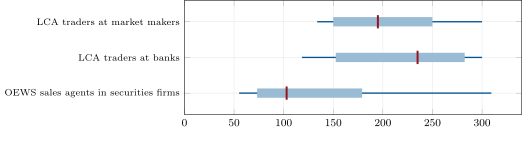
data/industry/lca_ranges.csv, oews_finance.csv, through in_trader.pay.The filings show base salaries between $150 000 and $250 000 for most sponsored traders at both kinds of employer, with the banks’ median higher; the survey’s occupation mixes traders with brokers and advisers, which is why its median is half the filings’. Bonus, which chapter 14 found can multiply base several times at a market maker, is in neither.
16.5 Tutorial: one supervisor, many algorithms
Goal. Find how many algorithms one supervisor can watch while keeping alerts from waiting, under stated rates. End state: Figures 16.1, 16.2 and 16.3.
- Pay evidence.
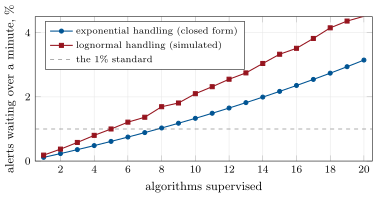
firm.roles.lca_cells(rows, role)with the roletraderreads chapter 14’s ranges for the role family, with its suppressed cells; the occupational survey’s row comes fromoews_finance.csv. The queue. Each algorithm raises alerts at an illustrative 1 per hour, as a Poisson stream; handling takes 30 seconds on average; the standard is that at most 1% of alerts wait more than one minute. With exponential handling the waiting time exceeds with probability (Book 4, chapter 8).
def mm1_wait_tail(lam, mu, t):
    """P(wait > t) in an M/M/1 queue with arrival rate lam and service rate mu (same time unit as t)."""
    if lam >= mu:
        return 1.0
    return (lam / mu) * math.exp(-(mu - lam) * t)


def max_strategies(a, h, t, p):
    """Largest number of strategies, each alerting at rate a per hour, that one supervisor with exponential handling
    of mean h seconds can watch with P(an alert waits more than t seconds) <= p."""
    mu = 3600.0 / h
    n = 0
    while mm1_wait_tail((n + 1) * a, mu, t / 3600.0) <= p:
        n += 1
    return n
Listing 16.1. The M/M/1 waiting-time tail and the largest number of algorithms one supervisor can watch within the standard. code/firm/roles/firm_roles.py - A heavier tail.
lindley_tailsimulates the queue with lognormal handling times (mean 30 seconds, standard deviation 45 seconds) by the Lindley recursion.
With these rates the supervisor meets the standard for 7 algorithms: at 7 algorithms 0.89% of alerts wait more than a minute, and at 8, 1.03%. The answer is sensitive to the alert rate: at half an alert an hour it is 15, at two alerts 3, at four only 1 (Figure 16.3). It is even more sensitive to the standard: allowing five minutes instead of one raises the number to 71 at one alert an hour. And the tail of the handling time matters: with lognormal handling of the same mean, 1.37% of alerts wait more than a minute at 7 algorithms (Figure 16.2).
in_trader.tails (400 000 simulated alerts per point).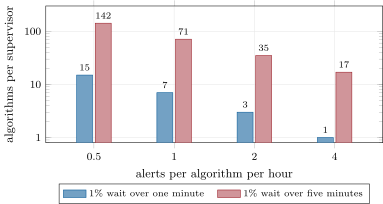
in_trader.capacity.Example 16.4 (Pooling)
A desk runs 40 algorithms at one alert an hour each. Split into separate books of at most 7, it needs 6 supervisors to meet the one-minute standard. With the same standard and one shared queue, 2 supervisors suffice: at 40 alerts an hour only 0.17% of alerts wait more than a minute, because an alert waits only when both are busy; two pooled supervisors can take 76 algorithms and three 174. The price of pooling is that each supervisor must be able to handle any algorithm’s alert.
The lesson for a desk is not a number but a design: fewer, better alerts raise a supervisor’s reach more than any other change, which is why much of a supervising trader’s work, and of the developers beside them (chapter 19), goes into deciding what deserves an alert.
What to change next. Give alerts two priorities and serve the urgent ones first; let alert rates rise with market volatility (chapter 12) and find the number of supervisors a desk needs on its busiest days.
16.6 Build: the role registry and the supervision model
Purpose. Record each role of Part III as data, and hold one analysis per role; this first increment adds the registry, the trader’s card and the supervision model.
Interface. firm.roles: RoleCard(name, firm_types, horizon, pnl, reports_to, soc_codes, title_patterns, books, chapter); REGISTRY, register, card; lca_cells(rows, role, fy, level); mm1_wait_tail(lam, mu, t); max_strategies(a, h, t, p); lindley_tail(lam, service, t, n, rng). NumPy.
Rules. A role is registered once; its pay cells come from chapter 14’s table with suppression kept; the supervision model’s rates are the caller’s, labelled illustrative.
Acceptance tests. code/firm/roles/tests/: registering a role twice fails; the M/M/1 tail is 1 at or above full load and matches the simulated queue within sampling error; the largest number of algorithms is monotone in the alert rate and the standard.
Stretch. Priorities and several supervisors (M/M/c); alerts that cluster in bursts; handling that depends on the supervisor’s load.
Sources and further reading
- CME Group, press release of 4 May 2021; Form 10-K for 2025.
- FINRA, Series 57; FCA Handbook, SYSC 27.8; Commission Delegated Regulation (EU) 2017/589, Articles 12 and 16.
- Optiver, “Breaking down the trading industry”.
- Chapter 14’s tables from the Department of Labor’s LCA files and the BLS occupational survey.
16.7 Exercises
Exercise 16.1 ★
Classify as risk trader or execution trader: a market maker’s options trader; a hedge fund trader working a portfolio manager’s order; a bank’s rates trader pricing a client’s swap and hedging it.
Solution
Solution of Exercise 16.1.
Risk trader (the market maker’s options book); execution trader (the portfolio manager’s order); risk trader (the bank trader prices the swap and owns the hedge’s residual risk).
Exercise 16.2 ★
In an M/M/1 queue with alerts an hour and , compute the probability that an alert waits more than one minute.
Solution
Solution of Exercise 16.2.
and : 0.89%.
Exercise 16.3 ★
Which three rules in the dated box would apply to an algorithm supervisor at a UK firm trading on EU venues, and what does each require of the person?
Solution
Solution of Exercise 16.3.
The UK certification functions for approving and monitoring algorithms (he must be assessed and certified as fit and proper), and the EU’s real-time monitoring and kill-functionality rules on the venues (he must monitor in real time, respond in a timely way and be able to have orders cancelled at once).
Exercise 16.4 ★★
Show that at a fixed standard the number of algorithms scales roughly in inverse proportion to the alert rate when the supervisor is lightly loaded.
Solution
Solution of Exercise 16.4.
When , , so the standard gives , a fixed total alert rate; with algorithms at each, . Here alerts an hour: about 8.9 algorithms at one alert each, 7 once the in the exponent is kept.
Exercise 16.5 ★★
Why is the occupational survey’s median for securities sales agents about half the labour filings’ median for traders?
Solution
Solution of Exercise 16.5.
The survey’s occupation includes brokers, advisers and sales staff across the securities industry, not only traders at market makers and banks; and the filings’ employers are the book’s trading firms, whose base salaries are higher.
Exercise 16.6 ★★
With the same mean handling time, why does a lognormal handling time with a standard deviation of 45 seconds make waits longer than an exponential one?
Solution
Solution of Exercise 16.6.
The waiting time of a single-server queue grows with the variance of the handling time (the Pollaczek–Khinchine formula): long handlings, which the lognormal makes more frequent, hold up everyone behind them.
Exercise 16.7 ★★★
Coding. With two supervisors sharing one queue (M/M/2), how many algorithms meet the one-minute standard at one alert an hour? Simulate or use the Erlang C formula.
Solution
Solution of Exercise 16.7.
With the Erlang C formula, two supervisors sharing one queue meet the standard for 76 algorithms at one alert an hour (0.99% of alerts wait over a minute; 1.03% at 77): far more than twice 7, because an alert waits only when both are busy.
Exercise 16.8 ★★★
Find the flaw. “Our supervisors handle each alert in 30 seconds and there are 60 alerts an hour per person, so they are only half busy and could watch twice as many algorithms.”
Solution
Solution of Exercise 16.8.
Utilisation of one half means the supervisor is busy half the time, so half the alerts wait, and in an M/M/1 queue , far above a 1% standard; doubling the load would make the queue unstable.
16.8 Problem: One Trader, Many Algorithms
Problem 16.1
Weekend problem — one trader, many algorithms
A market maker is moving its options desk from click trading to supervised algorithms and asks how many algorithms each trader should watch.
Part I — The role.
- Define risk trader and execution trader; give an example of each.
- Describe the trader at a market maker, a bank flow desk and a hedge fund.
- Define click trader and algorithm supervisor.
- What did the largest US derivatives exchange group decide in 2021, and what share of its volume was electronic in 2025?
- What do the EU’s rules require of the trader in charge of an algorithm?
Part II — Controls.
- Define a certification regime and name the UK functions that concern traders.
- What registration does a US securities trader at a broker-dealer need?
- What is kill functionality, and who must have access to it?
- Describe a composite day of an algorithm supervisor.
- What does the pay evidence say, and what does it leave out?
Part III — The queue.
- State the model: arrivals, handling, standard.
- Write the M/M/1 waiting-time tail and compute it at 7 and 8 algorithms.
- How does the answer change with the alert rate?
- How does it change with a five-minute standard?
- How does it change with lognormal handling?
Part IV — The verdict.
- State the named result: the largest number of algorithms one supervisor can oversee with at most a 1% chance that an alert waits more than a minute, and its sensitivity to the alert rate.
- Which change raises a supervisor’s reach most?
- Why is utilisation a poor guide to capacity here?
- What should the desk measure before choosing the number?
- In two sentences, answer the market maker.
Solution
Solution of Problem 16.1.
- One who decides positions and owns a book’s P&L (a market maker’s options trader); one who executes others’ decisions (a hedge fund’s execution trader).
- Market maker: a risk trader of the quotes’ inventory who builds and watches automation; bank flow desk: prices clients through sales and manages the flow risk; hedge fund: mainly execution for the portfolio managers.
- One who trades by hand on a screen; one who sets, monitors, handles alerts from and stops trading algorithms.
- Not to reopen its trading pits except one options pit; 93%.
- Real-time monitoring by the trader in charge together with the risk function, and a timely response to operational and regulatory issues.
- A rule to assess and certify people in named functions as fit and proper; in the UK, proprietary traders who could cause significant harm and the people who approve or monitor trading algorithms.
- Securities Trader Representative, after the SIE and Series 57 examinations.
- The ability to cancel all or any unexecuted orders at once as an emergency measure; the firm, through its traders and risk staff, with compliance in contact with them.
- Pre-open checks, the open, the session’s adjustments and alerts, incidents and stops, and the after-close reconciliation and review.
- Median offered base $195 000 (market makers) and $235 000 (banks); the survey’s sales agents $103 030; bonuses are in neither.
- Poisson alerts at one an hour per algorithm, handling of 30 seconds on average, at most 1% of alerts waiting over a minute.
- : 0.89% at 7, 1.03% at 8.
- 15 at 0.5 an hour, 7 at 1, 3 at 2, 1 at 4.
- 71 at one alert an hour.
- 1.37% of alerts wait over a minute at 7 algorithms, so fewer than 7 meet the standard.
- Seven algorithms at one alert an hour each; 15, 3 and 1 at 0.5, 2 and 4 alerts an hour.
- Fewer alerts per algorithm (and a shared queue with a colleague).
- The waiting time grows much faster than utilisation near full load, and a busy fraction says nothing of the tail.
- The real alert rate and its peaks, the handling-time distribution, and the cost of a late response.
- About seven algorithms per trader at an alert an hour, if a minute is the standard; spend first on better alerts and on pooling traders on one queue, which multiply that number far more than hiring does.
16.9 Interview questions
Interview question 16.1 ★ trader
Your algorithm starts losing money in a way you do not understand. What do you do in the next sixty seconds?
Solution
Solution of Interview question 16.1.
Stop it (or reduce it to flat) first, then understand: check positions, recent fills, market data and parameter changes; tell risk and the desk head; restart only when the cause is known.
What the interviewer is looking for: stopping before diagnosing, and escalation.
Interview question 16.2 ★ trader, risk
What is the difference between a kill switch and a loss limit?
Solution
Solution of Interview question 16.2.
A kill switch cancels orders at once on command; a loss limit stops trading automatically when losses reach a threshold. One is a tool for a person, the other a rule.
What the interviewer is looking for: manual emergency action against automatic threshold.
Interview question 16.3 ★★ trader, researcher
Alerts arrive at 60 an hour and each takes 30 seconds. What fraction of the time is the supervisor busy, and what is the mean wait in an M/M/1 queue?
Solution
Solution of Interview question 16.3.
; mean wait hours, 30 seconds.
What the interviewer is looking for: utilisation and the M/M/1 mean wait.
Interview question 16.4 ★★ developer, trader
Design the alerts for an options market-making algorithm. Which would you page on, and which only log?
Solution
Solution of Interview question 16.4.
Page on anything that threatens money or orderliness now: position or loss limits near, fills without matching hedges, stale market data, rejected orders at a venue, quoting outside expected spreads. Log slow drifts and one-off parameter warnings, and review them after the close.
What the interviewer is looking for: urgency and actionability as the criteria.
Interview question 16.5 ★★ bank, trader
A client asks for a price in size just before a data release. How do you decide the price and the hedge?
Solution
Solution of Interview question 16.5.
Widen for the event risk and the size, hedge part before and the rest after if the client allows, and agree with sales what the client is told; never trade ahead of the client.
What the interviewer is looking for: event risk, size, and conduct.
Interview question 16.6 ★★★ trader, researcher
How would you decide whether a trader adds value to a set of algorithms, rather than only watching them?
Solution
Solution of Interview question 16.6.
Compare the algorithms’ results in comparable periods with and without the trader’s interventions, or measure each intervention’s effect on the following P&L and risk; judge the average effect net of the interventions that hurt.
What the interviewer is looking for: a counterfactual, not anecdotes.