The Industry: Firms, Roles and Careers · Careers
3The Options Market-Making Houses
In the early 1980s a group of friends from college began trading on the floor of the Philadelphia Stock Exchange, and in 1987 they joined together in one firm. Two years later two traders working side by side on the floor of the Amsterdam equity options exchange founded another. In 2002 a third firm took its place in the index-options pit on the floor of the Chicago Board Options Exchange. Each firm tells its own origin this way, on its own pages, and each is today an options market maker that quotes on screens around the world. The floor taught them to price every strike, to hold the book, and to hedge what they held; they still hire and train people to do the same, now at the speed of software. This chapter describes these houses as employers: where they come from, how they train, how their work differs from that of the electronic firms of chapter 2, and what the one of them that publishes its results shows.
3.1 Three lineages: Amsterdam, Chicago, Philadelphia
Listed options were once traded on exchange floors, among them in Chicago, Amsterdam and Philadelphia. The market makers of those floors were small partnerships of floor traders (chapter 2) who priced options with models and hedged them with the underlying shares. Some of their firms became the options houses of today.
Definition 3.1 (Options market-making house)
An options market-making house is a principal trading firm whose core business is quoting exchange-listed options, across many strikes and expiries of many underlyings, usually under market-maker appointments with quoting obligations, and hedging the resulting positions in the underlying and in other options.
The definition describes a firm; the role it plays on a venue, the options market maker with its quoting obligations and its protections, is Book 1’s (chapter 24). Figure 3.1 draws the origins that the houses state. Three of them tie their founding to a specific floor; the others give a city and a year.
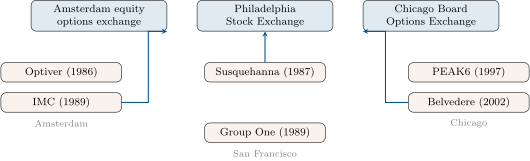
Four of the six firms give founding years in the 1980s, the decade of the floors; one each in the 1990s and 2000s. Two of the six began in Amsterdam; chapter 27 describes the tax and visa arrangements that bring staff to the cities where the houses are.
Definition 3.2 (Spin-out)
A spin-out is a firm founded by people who leave an existing firm to do the same or a related business on their own. Unlike a spin-off, the parent firm does not distribute or keep the new firm’s shares.
Lineages in this industry are often told as chains of spin-outs, from one house to the traders who left it. None of the six firms states such an origin on its own pages, so the chapter’s graph has no spin-out edges: a lineage built from public sources is thinner than the one the industry tells about itself, and chapter 28 returns to what the public record does show about people leaving to start firms.
3.2 Training programmes as the firms describe them
An options house turns graduates into traders who price and hedge thousands of instruments at once, and it says so when it recruits. One house, whose founders built their first strategies with “poker experience”, states that “we use strategy games and decision science to teach many of our new employees”; its campus page carries an intern’s account of a ten-week internship spent on an index volatility desk. Another describes its education as “learning built for live markets and real-time systems”. The content taught is the content of Books 1, 5 and 11: option payoffs and parity, the Greeks, volatility surfaces, inventory and hedging. What the houses add is practice: simulated markets, trading games, and months of supervised work before a trader holds risk alone.
Remark 3.3 (What a programme is)
A training programme is the firm’s investment in turning a hire into someone it trusts with risk. Its length, its content and whether a hire who leaves early must repay anything are terms of the employment contract, and differ by firm and by country. The firms’ pages describe the experience, not the terms; a candidate reads the contract (chapter 13).
3.3 How an options house differs from an electronic delta-one firm
Chapter 2’s firms mostly quote instruments with one price each: a share, a future, a currency pair. An options house quotes a surface. The differences follow.
- The number of instruments. One underlying with twenty listed expiries and fifty strikes each has options series. A house quoting a few hundred underlyings maintains hundreds of thousands of quotes, updated together as the underlying moves (Book 11, chapter 19).
- The risk held. A delta-one market maker aims to be flat within minutes. An options house holds a book of volatility, skew and time-decay exposures for days or weeks, hedging the direction (delta) continuously and the rest by trading other options.
- The obligations. Market-maker appointments on options exchanges carry quoting obligations over many series (Book 1, chapter 24): the house must be present when it would rather not be.
- The model. Prices come from a volatility surface fitted live to the market (Book 11, chapter 19; Book 5), not from a single fair price; a trader’s judgement acts on the surface’s parameters.
For an employee the consequence is a different job. A trader at an options house manages a book of Greeks and decides where the surface should be; a trader at a delta-one firm supervises strategies that race for a single price. Both use the same computers; the questions are different.
Example 3.4 (One house’s scale)
One house, founded on the Amsterdam floor, states that it trades on 120 venues with 2 070 employees in ten offices. If each venue lists options on only a hundred underlyings of 2 000 series, the house could quote on the order of million series; the actual number is smaller, because many venues list the same underlyings and many series are never quoted, but the order of magnitude explains why quoting is software and a trader’s work is supervision and pricing judgement.
3.4 Size and footprint
Unlike most private trading firms, one options house publishes its results every year, with a short annual review.
As of September 2026 — The options houses in their own words
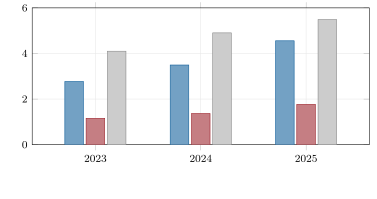
Optiver (results for 2025, published 31 March 2026): net trading income € 4 556 million (2024: € 3 494 million; 2023: € 2 773 million); net profit attributable to equity holders € 1 769 million (2024: € 1 369 million; 2023: € 1 158 million); total equity € 5 490 million (2024: € 4 905 million); “more than 2 000 employees” (2 100 in the 2024 release), established in Amsterdam in 1986, with offices in ten other cities. IMC: founded in 1989; 2 070 employees across ten offices, trading on 120 venues. Group One: founded in San Francisco in 1989; “over 100” people in four cities; an options market maker or specialist on every major US exchange group. Akuna Capital: “a leading proprietary trading firm specializing in options market making”. The first two describe their options business in their own words: one prices “1M+” instruments “from options and ETFs to equities, bonds and currencies”; the other calls itself “a top-3 liquidity provider by volume traded in listed options globally”.
The published results make one house’s economics visible (Figure 3.2). Net trading income rose by 26% in 2024 and by 30% in 2025; the net profit margin on it was 39.2% and 38.8%; the return on average equity was 30.4% and 34.0%. With 2 100 employees in 2024, net trading income was € 1.66 million per head; with “more than 2 000” in 2025, at most € 2.28 million per head. Chapter 12 puts these numbers beside the other firms that file.
in_options.results.Remark 3.5 (Why one house publishes)
A privately owned firm that publishes results chooses to: for its counterparties, its lenders and its recruits. The numbers are the firm’s own, audited but unfiled in any register a reader can check line by line, and the review is written by the firm. They are a primary source for what the firm reports, not for how it compares with firms that report nothing.
3.5 What the filings show for the options houses
Three of the sourced market makers, Optiver, IMC and Susquehanna, are the options houses of this chapter, and together they file enough labour condition applications (chapter 14) to be compared with the other market makers without publishing any one firm’s pay.
As of September 2025 — Options houses and other market makers in the filings
Fiscal 2025 labour condition applications, offered base: the three options houses, 130 applications, median $150 000 (10th–90th percentile $84 800–200 000); the other seven market makers, 237 applications, median $200 000 ($130 000–300 000). Researchers $150 000 against $200 000; software engineers $146 100 against $190 000; traders $200 000 against $192 500. At wage level I: 23 of the options houses’ 130 applications, 8 of the others’ 237. Base salary only.
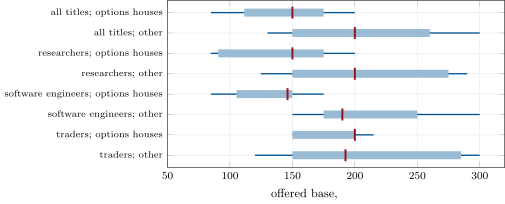
data/industry/lca_options.csv, through in_options.options_pay.The options houses’ median offer is $50 000 lower (95% bootstrap interval to ) for all titles and for researchers, and their software engineers’ $43 900 lower; their traders’ is level with the others’ (Figure 3.3). Two cautions come before any reading. The options houses file many more applications at the entry level, 17.7% at wage level I against 3.4%, consistent with the graduate training programmes described above; and base salary is only part of pay at a market maker, where chapter 14 found the implied ratio of total pay to base largest. The filings show where base offers sit, not what the jobs pay.
3.6 Tutorial: the houses’ origins and one house’s numbers
Goal. Build the lineage graph from the firms’ own statements, and compute one house’s economics from its published results. End state: Figure 3.1’s edges and the ratios of the section above.
The graph.
data/industry/lineage.csvlists three venues and six firms; three rows carry an edge from a firm to the floor its founders traded on.in_options.graph()loads it withfirm.lineage, which refuses a node or an edge without a ledger row (Listing 3.1).def add_node(self, n): if not n.ledger: raise ValueError(f"node {n.name} has no source") self.nodes[n.name] = n def add_edge(self, e): if not e.ledger: raise ValueError(f"edge {e.src}->{e.dst} has no source") if e.src not in self.nodes or e.dst not in self.nodes: raise KeyError(f"edge {e.src}->{e.dst}: unknown node") self.edges.append(e)Listing 3.1. An edge enters the graph only with a source and between known nodes. code/firm/lineage/firm_lineage.py - Query.
g.by_place()groups the firms by city,g.by_decade()counts founding decades (1980s 4, 1990s 1, 2000s 1), andg.unsourced()lists the three firms whose origin the public record used does not tie to a floor. - The numbers.
in_options.metrics()computes growth, margin, return on average equity and income per head fromdata/industry/optiver_results.csv, treating “more than 2 000 employees” as a lower bound on headcount, and so an upper bound on income per head.
What to change next. Add the founding year and origin of another options house from its own pages, and see whether it changes the decade counts; compute what 2025 income per head would be if headcount were 2 500 (exercise 7).
3.7 Build: the lineage graph
Purpose. A sourced genealogy of trading firms, for this chapter’s floors and for chapter 28’s question of where new firms come from.
Interface. firm.lineage: Node(name, kind, year, place, ledger), Edge(src, dst, relation, ledger); Graph.load(path), add_node, add_edge; firms, by_place, by_decade, children, ancestors, unsourced.
Rules. No node or edge without a ledger row; an edge joins two known nodes; a founding year is optional and is never inferred.
Acceptance tests. code/firm/lineage/tests/: grouping by place and decade, children and ancestors on a constructed graph; unsourced and dangling edges are refused.
Stretch. Export the graph to TikZ with computed positions; add acquisition edges from filings (a listed firm’s 10-K names its acquisitions).
Sources and further reading
- The firms’ own pages: IMC (About us), Susquehanna (About, Campus), Belvedere Trading, PEAK6, Group One, Akuna Capital, Optiver (home page, Education).
- Optiver, results releases for 2024 (27 March 2025) and 2025 (31 March 2026).
- Cboe Global Markets, Form 10-K for 2025, on the Cboe Options trading floor.
3.8 Exercises
Exercise 3.1 ★
How many options series does an underlying with 15 expiries and 40 strikes each list, counting calls and puts?
Solution
Solution of Exercise 3.1.
series.
Exercise 3.2 ★
From the dated box, compute the house’s net profit margin on net trading income in 2023.
Solution
Solution of Exercise 3.2.
.
Exercise 3.3 ★
Which of the six firms of Figure 3.1 tie their founding to a floor, and which floor?
Solution
Solution of Exercise 3.3.
IMC (the Amsterdam equity options exchange), Susquehanna (the Philadelphia Stock Exchange), Belvedere Trading (the Chicago Board Options Exchange).
Exercise 3.4 ★★
Compute the house’s growth in net profit in 2024 and 2025, and explain why profit grew more slowly than net trading income in 2024.
Solution
Solution of Exercise 3.4.
in 2024 and in 2025. In 2024 net trading income grew 26%: costs (pay, technology, tax) grew faster than income, so the margin fell from 41.8% to 39.2%. The releases do not break costs down, so which cost grew is not known from them.
Exercise 3.5 ★★
The house’s net trading income per head was € 1.66 million in 2024. What range does 2025 income per head lie in if headcount was between 2 000 and 2 400?
Solution
Solution of Exercise 3.5.
to : € 1.90 to € 2.28 million per head.
Exercise 3.6 ★★
Give two reasons an options house holds risk longer than an electronic delta-one market maker.
Solution
Solution of Exercise 3.6.
Its book is a surface of volatility, skew and time-decay exposures that can be hedged only partly and slowly, by trading other options; and its quoting obligations make it take positions it would not choose.
Exercise 3.7 ★★★
Coding. Compute the return on average equity for 2024 and 2025 with in_options.metrics, and the 2025 income per head for a headcount of 2 500.
Solution
Solution of Exercise 3.7.
30.4% in 2024 and 34.0% in 2025; million per head.
Exercise 3.8 ★★★
Find the flaw. “Options houses earn about € 2 million per employee: the published results of one house prove it for the industry.”
Solution
Solution of Exercise 3.8.
One house that chooses to publish is not a sample of the industry: it may be among the largest and most successful; its headcount is a lower bound, so its figure is an upper bound; and 2024–2025 were years of high volumes by the house’s own account. Per-head income varies by firm, by year and by what is counted.
3.9 Problem: Three Floors, One Screen
Problem 3.1
Weekend problem — three floors, one screen
A graduate choosing between an options house and a delta-one trading firm wants to understand the houses’ origins, their work and one house’s economics.
Part I — Origins.
- Define an options market-making house, and say how it differs from Book 1’s options market maker.
- Name the three floors of Figure 3.1 and the firm tied to each.
- Count the six firms’ founding decades.
- Define a spin-out and say why the graph has none.
- What does the Chicago options exchange’s floor still do, according to its operator?
Part II — The work.
- How many series does an underlying with 20 expiries and 50 strikes list?
- Give the four differences between an options house and a delta-one firm.
- What does a training programme teach, by the firms’ account, and what does it add to the books?
- Why is quoting software and a trader’s job supervision and pricing judgement?
- What does a candidate read to learn a programme’s terms?
Part III — One house’s numbers.
- Give net trading income and net profit for 2023–2025.
- Compute growth in net trading income in 2024 and 2025.
- Compute the net profit margin in each year.
- Compute the return on average equity in 2024 and 2025.
- Compute net trading income per head in 2024, and its upper bound in 2025.
Part IV — The verdict.
- State the named result: the house’s net trading income, margin and return on average equity in 2025, and the share of the six firms tied to a floor by their own account.
- Why is “more than 2 000” an upper bound on income per head?
- Why can one house’s published numbers not stand for the industry’s?
- Which public source would tell the graduate most about a house that does not publish?
- In two sentences, what should the graduate take from the chapter to the choice?
Solution
Solution of Problem 3.1.
- A principal trading firm whose core business is quoting listed options across strikes and expiries and hedging them; Book 1’s options market maker is the role on a venue, with its obligations.
- Amsterdam equity options exchange (IMC), Philadelphia Stock Exchange (Susquehanna), Chicago Board Options Exchange (Belvedere Trading).
- 1980s 4, 1990s 1, 2000s 1.
- A firm founded by people who leave an existing firm to do the same business; no firm states such an origin on its own pages.
- It runs a hybrid market combining open outcry floor trading with electronic trading.
- .
- The number of instruments, the risk held, the obligations, the model (a surface, not a price).
- Pricing, the Greeks, surfaces, inventory and hedging; practice through games, simulated markets and supervised work.
- Hundreds of thousands of quotes move with every change in the underlying; no person can update them.
- The employment contract.
- Net trading income € 2 773, 3 494, 4 556 million; net profit € 1 158, 1 369, 1 769 million.
- 26.0% and 30.4%.
- 41.8%, 39.2%, 38.8%.
- 30.4% and 34.0%.
- € 1.66 million in 2024; at most € 2.28 million in 2025.
- € 4 556 million, 38.8% and 34.0%; three of the six firms (50%) tie their founding to a floor.
- More than 2 000 employees means dividing by at least 2 000.
- It chose to publish, it is one firm, and its years were busy; there is no sample.
- Its UK subsidiary’s accounts, or its US broker-dealer’s public statement (chapter 2).
- The houses train for pricing and risk judgement on a surface, which is a different job from racing for a price; one house’s numbers show the business can be very profitable, not what a given house earns.
3.10 Interview questions
Interview question 3.1 ★ trader
Why does an options market maker hold risk overnight when an equity market maker tries to end the day flat?
Solution
Solution of Interview question 3.1.
Its inventory is a set of options whose risk (vega, skew, gamma) cannot be flattened quickly without paying the spread on many series; it hedges delta continuously and carries the rest, managing it over days.
What the interviewer is looking for: the difference between hedging delta and flattening a book of Greeks.
Interview question 3.2 ★ trader, researcher
A single stock has options at 12 expiries and 30 strikes. How many quotes does a market maker maintain if it quotes both sides of every series?
Solution
Solution of Interview question 3.2.
series, two sides each: 1 440 quotes.
What the interviewer is looking for: calls and puts, bids and offers.
Interview question 3.3 ★★ trader
An exchange’s market-maker appointment obliges you to quote a wide range of series. Why would a firm accept the obligation, and what does it cost?
Solution
Solution of Interview question 3.3.
For the appointment’s benefits: fee rebates, allocation or priority advantages and the flow that comes with being present (Book 1, chapter 24). The cost is being present in series and at times the firm would avoid, adversely selected and with capital tied up.
What the interviewer is looking for: obligations bought with privileges.
Interview question 3.4 ★★ researcher, risk
A firm’s net profit rose 29% and its equity rose 12%. What happened to its return on equity, roughly, and what would you check before concluding the business got better?
Solution
Solution of Interview question 3.4.
Roughly : return on equity up by about 15%. Check whether the year was unusually volatile, whether the growth came from one business or event, and whether risk taken rose.
What the interviewer is looking for: ratio arithmetic and the cycle before skill.
Interview question 3.5 ★★ trader
What would you expect to learn in the first six months at an options house that a textbook does not teach?
Solution
Solution of Interview question 3.5.
How the firm’s own models and surfaces behave on its own flow; how to manage a real book under limits; how the desk’s tools and alerts work; the market’s microstructure on specific venues.
What the interviewer is looking for: practice, tools and judgement, not theory.
Interview question 3.6 ★★★ trader, risk
Your options book is long gamma and short vega after a busy day. Describe what you would do before the close, and why.
Solution
Solution of Interview question 3.6.
Long gamma earns from moves but decays; short vega loses if implied volatility rises. Check the delta hedge, the overnight event calendar and the vega by expiry; reduce the vega if an event could lift implied volatility, and decide how much gamma to keep given the expected overnight move against the decay.
What the interviewer is looking for: Greeks as risks with prices, and an overnight plan.