The Industry: Firms, Roles and Careers · Careers
2Proprietary Market Makers and High-Frequency Firms
One electronic market maker files a Form 10-K every February: its revenue, its costs, its headcount and its offices are public. Firms of comparable or larger size file nothing of the kind. What the public can learn about them comes through side doors: the one page of their United States broker-dealer’s annual report that the law makes public, the accounts of their British subsidiaries at Companies House, their own web pages, the talks and code their engineers publish, and what regulators find when they study the market as a whole. This chapter reads those doors for a handful of proprietary market makers and high-frequency firms, and builds a profile of each that says what is known, as of when, and from where — and, as plainly, what is not.
2.1 What the public record holds for a private trading firm
A private trading firm has no shareholders to report to, but it is not invisible. Four kinds of record are public.
- The broker-dealer’s statement. A US broker-dealer files an annual report with the SEC; the statement of financial condition, its notes and the auditor’s report are filed as a separate document that is “not confidential”, while the income statement and the periodic reports may be kept confidential. The public part gives the entity’s balance sheet and a paragraph describing its business.
- Subsidiaries’ accounts. A company registered in the United Kingdom files audited accounts every year, free to download, with a strategic report describing its activity (chapter 11).
- The firm’s own publications. Home pages, careers pages, engineering blogs, open-source code, conference talks.
- Regulators’ and researchers’ studies of the market, which describe the industry without naming firms.
Definition 2.1 (Firm profile)
A firm profile, in this book, is a set of facts about an employer, each a range with a unit, the date it describes, its scope (the whole firm or one legal entity of it) and the public source it comes from. A field with no admissible fact is left empty and says so.
The scope matters most. A subsidiary’s accounts describe the subsidiary, not the group: a British entity that trades on behalf of its group under a transfer-pricing agreement (Book 16, chapter 15) earns what the agreement assigns it.
Example 2.2 (One group’s European subsidiary)
Jane Street Europe Limited, a London-based subsidiary of Jane Street Group, LLC, states in its 2025 strategic report that its group of subsidiaries “primarily carries out principal trading activities” and is compensated for trading performed on behalf of the group under a trading services agreement and the group’s transfer-pricing arrangements. It reports revenues of $643.0 million for 2025 against $995.8 million for 2024, a fall of 35.4%, after-tax profits of $437.4 million (68.0% of revenue) against $654.9 million, and total equity of $3 058.9 million, up 15.1%. These are the numbers of one entity of the group under the group’s own allocation rules; they are not the firm’s revenue, and they cannot be scaled up to it.
Example 2.3 (One broker-dealer’s balance sheet)
The public statement of financial condition of Citadel Securities LLC at 31 December 2023 describes a company that “primarily engages in market making and liquidity provision in U.S. options, equities, government securities, and foreign exchange products”, with total assets of $52 344 million and member’s capital of $4 693 million: assets of 11.2 times capital. It says nothing of revenue, profit or staff.
Method 2.4 (Building a profile from public records)
- List the legal entities (chapter 1, method 1.1) and, for each, the public filings that exist.
- For each field of the profile, take the most primary source: a filing before the firm’s page, the firm’s page before the press.
- Record every fact as a range with a unit, a date and a scope; a figure the source rounds is the range it rounds (“300 employees” is 250–350).
- Keep the entity’s figures apart from the firm’s: never add, scale or extrapolate across entities.
- Leave a field empty, and say so, when no source gives it.
2.2 Origins: from the floors to the screens
The firms of this chapter that state a founding year give one in the 1990s or early 2000s, the years in which trading moved from exchange floors to screens.
Definition 2.5 (Open outcry, floor trader)
Open outcry is trading on an exchange floor or in a pit, where members make bids and offers by voice and hand signals and trade face to face. A floor trader is an exchange member who traded there in person, for its own account (a “local”) or for others; the US industry classification still lists “securities floor traders” and “commodity contracts floor traders” as principals dealing with investors.
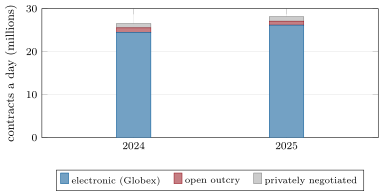
The floors are almost gone. The largest US derivatives exchange group reports that 93% of its 2025 volume was electronic, with open outcry kept in Chicago only for options on SOFR futures (Figure 2.1). What the floors left to the firms that replaced them is a way of working: quote both sides, hold the position briefly, hedge it, and measure the day’s result at the close. Figure 2.2 places the founding dates the firms themselves give.
in_profiles.cme.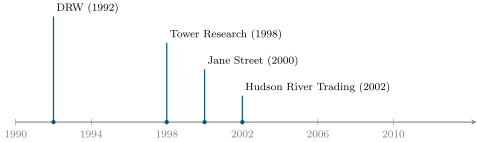
Remark 2.6 (What a founding year does not say)
A founding year dates a legal entity or a partnership, not the firm’s current business. One firm states that it made its first bitcoin trade in 2010 and launched a crypto trading business in 2014; another that it launched a client market-making business in 2022. Firms of this kind change products faster than names.
2.3 Profiles: products, headcount and offices
The dated box gathers what the firms and their filings state. Each cell is a range from one source, dated; an empty cell means that no primary source gave the field on the date of access.
As of September 2026 — Eight profiles from public sources
| firm | founded | employees | offices | firm revenue |
|---|---|---|---|---|
| DRW | 1992 | over 2 000 | – | – |
| Hudson River Trading | 2002 | – | 14 cities | – |
| Jane Street | 2000 | over 3 000 | 5 | – |
| Jump Trading | – | – | 13 cities | – |
| Tower Research | 1998 | – | – | – |
| Virtu Financial | – | about 1 027 | 13 countries | $3 632 million (2025) |
| XTX Markets | – | 250–350 | – | – |
| Citadel Securities | – | – | – | – |
Firms’ own statements of what they do: “a quantitative trading firm and liquidity provider” (Jane Street); “a multi-asset class quantitative trading firm that provides liquidity on global markets and directly to our clients” (Hudson River Trading); “a home for … quantitative trading teams, powered by a high-performance technology platform” (Tower Research); “a diversified trading firm” (DRW); “a global trading firm” in “every asset class” (Jump Trading); an algorithmic trading firm producing “price forecasts for over 50 000 financial instruments”, with “$250bn daily traded volume” (XTX Markets). Virtu Financial reports a market-making and an execution-services segment. For Citadel Securities only its US broker-dealer’s balance sheet is public (Example 2.3).
Three things stand out. Only the listed firm has a revenue figure; for the others, the revenue numbers that circulate come from press accounts of documents shown to lenders, which are not public, and this book does not use them. The headcounts that are public are lower bounds or rounded figures: “over 3 000” is a range with no upper end. And offices are counted in different units, cities, countries or offices, which cannot be compared without the list.
Remark 2.7 (Reading headcounts)
A firm that states “more than 3 000 employees” in 2026 and a filing that states “approximately 1 027 employees” describe two firms whose revenue per head is unknown for one and $3.5 million for the other. Revenue per head is chapter 12’s subject; it can be computed only where both numbers exist for the same scope and year.
2.4 Culture and technology as the firms describe them
The firms publish a great deal about how they work, because they recruit on it. Their statements are the firms’ own, not independent evidence, and are read as statements of what the firm wants a candidate to know.
- Languages and code. One firm states that it uses OCaml, “a statically typed functional language, as our primary development platform”. Another’s crypto arm publishes Firedancer, “a new Solana validator client written entirely in C”. The choice of language is also a statement about hiring: it tells a candidate what will be learned on the job (Book 13, chapter 10).
- Research as scale. One firm describes “an unrivalled level of computational resources … with a growing research cluster” and machine-learning forecasts for tens of thousands of instruments; another lists “800+ technologists” among over 2 000 staff.
- Organisation. One firm describes itself as “a home for … quantitative trading teams” on a shared technology platform: a structure closer to chapter 5’s platforms than to a single-book market maker.
- Clients. Firms that began trading only against the market now make prices to clients directly: one dates its single-dealer platform to 2018 and its client market-making to 2022.
2.5 Size and concentration
Regulators’ studies of the market describe the industry’s concentration without naming firms. The UK regulator’s study of latency-arbitrage races on the London Stock Exchange found “clear concentration of winners, with the top 3 firms winning 54% of races, and the top 6 firms winning 82% of races”; the same six firms lost 85% of races, so the business of racing is a contest among a handful of firms on both sides. Races took about 22% of the daily volume of the largest UK shares, and the study put the sums at stake at about $5 billion a year across global equity markets (Book 11, chapter 9, describes the races).
For an employee the concentration has two readings. The largest firms in the fastest businesses are few, so a specialist’s market is small and its employers know one another. And the firms that win races are the ones that also lose them: what they compete on is speed and pricing at the margin, which is why the engineering chapters of Part III describe their jobs as they do.
2.6 Tutorial: eight profiles and their gaps
Goal. Build the chapter’s profiles from sourced facts and measure what public sources leave out. End state: the dated box’s table and Figure 2.3.
- The facts.
data/industry/profiles/facts.csvholds 24 facts, one per row: firm, field, low and high, unit, date, scope (firm or entity), ledger row, and a text value for descriptive fields. Validate.
in_profiles.check()runsfirm.profiles.problemsagainst the ledger rows of this chapter (Listing 2.1); it returns an empty list.def problems(facts, ledger_ids, today, max_age_days=None): """Reasons a fact may not be printed: no ledger row, no date, an inverted range, no value, stale.""" out = [] for f in facts: tag = f"{f.firm}/{f.field}" if f.ledger not in ledger_ids: out.append(f"{tag}: ledger row {f.ledger!r} missing") if not f.as_of: out.append(f"{tag}: no date") elif max_age_days is not None and (today - _date(f.as_of)).days > max_age_days: out.append(f"{tag}: older than {max_age_days} days") if f.low is not None and f.high is not None and f.low > f.high: out.append(f"{tag}: low above high") if f.low is None and f.high is None and not f.text: out.append(f"{tag}: no value") if f.scope not in ("firm", "entity"): out.append(f"{tag}: scope must be firm or entity") return outListing 2.1. A fact enters a profile only with a ledger row, a date, an ordered range and a value. code/firm/profiles/firm_profiles.py - Render.
firm.profiles.table(facts, fields)prints one row per firm; entity-scope facts (the subsidiary’s revenue, the broker-dealer’s assets) are kept out of the firm columns. - Measure the gap.
in_profiles.gap()counts, for five standard fields (founded, employees, offices, firm revenue, products), how many each firm’s public sources fill.
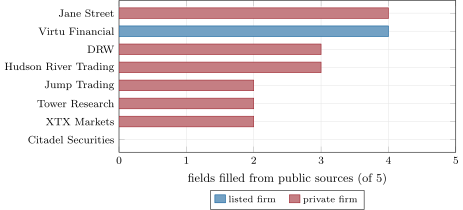
data/industry/profiles/facts.csv, through in_profiles.gap.The listed firm is missing only a founding year that its annual report does not state. A private firm with an active careers site fills as many fields; the others fill two or fewer, and the broker-dealer whose balance sheet is public fills none at the firm level. Revenue is the field that separates them: no private firm in the sample has a primary source for it.
What to change next. Add the UK subsidiaries’ average number of employees as entity-scope facts and see why they cannot fill the firm’s headcount (exercise 7); tighten the staleness limit to 60 days and see which facts would have to be re-verified before a reprint.
2.7 Build: the profile store
Purpose. One way to hold every firm fact the book prints, so that chapters 3–10 and 12 check each fact against the ledger before it reaches the page.
Interface. firm.profiles: Fact(firm, field, low, high, unit, as_of, scope, ledger, text); load_facts(path); problems(facts, ledger_ids, today, max_age_days); widen(value, rounding); coverage(facts, fields, scope); gap(facts, fields, listed); table(facts, fields).
Rules. No fact without a ledger row and a date; a point value only where the source gives one, a rounded figure as the range it rounds; entity facts never fill a firm field; an open bound stays open.
Acceptance tests. code/firm/profiles/tests/: an admissible fact passes; each rule fires on a fact that breaks it; widen and coverage on constructed facts; table cells print years without separators.
Stretch. Read facts straight from the source ledger’s rows; flag facts older than the book’s 60-day rule for dated boxes.
Sources and further reading
- Virtu Financial, Form 10-K for 2025; CME Group, Form 10-K for 2025.
- Citadel Securities LLC, Form X-17A-5 Part III, statement of financial condition at 31 December 2023 (public document under Rule 17a-5(e)(3)).
- Companies House: annual reports for 2025 of Jane Street Europe Limited (05903707), Hudson River Trading Europe Ltd. (06796079) and XTX Markets Limited (09415174).
- The firms’ own pages (ledger F2–F15), accessed 29 September 2026.
- M. Aquilina, E. Budish and P. O’Neill, Quantifying the High-Frequency Trading “Arms Race”, FCA Occasional Paper 50, 2020.
2.8 Exercises
Exercise 2.1 ★
From the CME figures, what share of the exchange group’s 2025 volume was traded by open outcry, and by how much did open-outcry volume fall from 2024?
Solution
Solution of Exercise 2.1.
of 2025 volume; open outcry fell from 1 023 to 920 thousand contracts a day, .
Exercise 2.2 ★
Write the range each statement implies: “300 employees”, “more than 3 000 employees”, “approximately 1 027 employees”. Which has no upper bound?
Solution
Solution of Exercise 2.2.
250–350 (rounded to the hundred); 3 000 and above, with no upper bound; about 1 027, a point the source qualifies as approximate. The second has no upper bound.
Exercise 2.3 ★
From Example 2.3, compute the broker-dealer’s member’s capital and its ratio of assets to capital.
Solution
Solution of Exercise 2.3.
million; .
Exercise 2.4 ★★
From Example 2.2, compute the subsidiary group’s after-tax margin in 2024 and 2025 and its return on average equity in 2025. Why can none of these be read as the firm’s?
Solution
Solution of Exercise 2.4.
In 2024 the margin is , in 2025 . The return on average equity in 2025 is . The entity’s revenue is what the group’s transfer-pricing arrangements assign it for trading done on the group’s behalf; its equity is what the group chose to leave in it.
Exercise 2.5 ★★
In the race study, the top six firms win 82% of races and lose 85%. What share of races do they win and lose among themselves at least, and what does that say about who they compete with?
Solution
Solution of Exercise 2.5.
At least of races have a top-six firm as both winner and loser: the top six mostly compete with one another, and the business is a contest among a few specialists.
Exercise 2.6 ★★
Read Figure 2.3: which fields does the listed firm fill, and which one does no private firm fill?
Solution
Solution of Exercise 2.6.
Employees, offices, firm revenue and products; no private firm fills firm revenue.
Exercise 2.7 ★★★
Coding. Add to the facts a UK subsidiary’s average number of employees as an entity-scope fact. Show that coverage does not change, and argue from Example 2.2 why it must not.
Solution
Solution of Exercise 2.7.
The fact has scope entity, and coverage counts only firm-scope facts, so the counts are unchanged. They must be: the subsidiary’s staff are those the group places in it, as its revenue is what the group’s agreements assign it, so neither measures the firm.
Exercise 2.8 ★★★
Find the flaw. “The firm’s European subsidiary earned $643 million in 2025; Europe is about a quarter of world trading, so the firm earned about $2.6 billion.”
Solution
Solution of Exercise 2.8.
The entity’s revenue is an allocation under the group’s transfer-pricing arrangements, not the trading revenue earned in Europe; and even if it were, a firm’s share of revenue by region need not follow a region’s share of trading. The figure cannot be scaled up to the firm.
2.9 Problem: What Can the Public Know?
Problem 2.1
Weekend problem — what can the public know?
A student with offers from two private trading firms and one listed firm wants to compare them from public sources only. You build the profiles.
Part I — The records.
- Name the four kinds of public record about a private trading firm.
- Which part of a US broker-dealer’s annual report is public, and which may be kept confidential?
- What does a UK subsidiary’s strategic report describe, and why is its revenue not the firm’s?
- Define a firm profile and its scope.
- Give the five steps of Method 2.4.
Part II — The numbers that exist.
- Give the subsidiary group’s revenue in 2024 and 2025 and its change.
- Give its after-tax margin in each year and its return on average equity in 2025.
- Give the broker-dealer’s member’s capital and its assets-to-capital ratio at the end of 2023.
- Give the listed firm’s 2025 revenue, headcount and revenue per head.
- Give the share of the exchange group’s 2025 volume that was electronic.
Part III — The profiles.
- Which firms state a founding year, and which years?
- Write each stated headcount as a range.
- Why can offices not be compared across the table as printed?
- How many of the five fields does each firm fill at the firm level?
- Which field does no private firm fill, and why?
Part IV — The verdict.
- State the named result: the fields filled by the listed firm, the median for the private firms, and the number of private firms with a firm revenue.
- In the race study, what share of races do the top three and the top six firms win?
- What does the concentration of race winners imply for a specialist’s job market?
- Which two public records would most improve the private firms’ profiles, and which of them exists?
- In two sentences, what should the student conclude about comparing the offers on public numbers?
Solution
Solution of Problem 2.1.
- The US broker-dealer’s public statement, subsidiaries’ accounts, the firm’s own publications, regulators’ and researchers’ studies.
- The statement of financial condition, its notes and the auditor’s report are public; the rest of the annual report and the periodic reports may be confidential.
- The subsidiary’s activity and results; its revenue is set by the group’s agreements for trading done on the group’s behalf.
- Dated, sourced ranges with units; the scope is the whole firm or one legal entity.
- List entities and filings; take the most primary source per field; record ranges, dates and scopes; keep entity and firm figures apart; leave empty fields empty.
- $995.8 million and $643.0 million, .
- 65.8% and 68.0%; 15.3%.
- $4 693 million; 11.2.
- $3 632.1 million; about 1 027; $3.54 million of total revenue per head.
- 93%.
- DRW 1992, Tower Research 1998, Jane Street 2000, Hudson River Trading 2002.
- Over 2 000 (DRW); over 3 000 (Jane Street); about 1 027 (Virtu); 250–350 (XTX Markets).
- They are counted in cities, countries or offices.
- DRW 3, Hudson River Trading 3, Jane Street 4, Jump Trading 2, Tower Research 2, Virtu 4, XTX Markets 2, Citadel Securities 0.
- Firm revenue: private firms do not publish it, and the documents that describe it are shown to lenders, not filed.
- Listed firm 4 of 5; private median 2 of 5; no private firm with a firm revenue.
- 54% and 82%.
- Few employers, who know one another and compete with one another; a specialist’s options are few and visible.
- Group accounts and the broker-dealer’s income statement; neither is public for these firms.
- Public numbers compare the listed firm with nothing: the private firms’ economics are not public. Compare the offers on their terms, and use the profiles for what they state (products, offices, size bounds).
2.10 Interview questions
Interview question 2.1 ★ trader, developer
What does it mean for a firm to be a principal trading firm, and how does that change what a trader there is paid for?
Solution
Solution of Interview question 2.1.
It trades only its own capital and has no clients’ money: every dollar of revenue is trading revenue. A trader there is paid, directly or through a pool, for trading profit, not for client business or assets gathered.
What the interviewer is looking for: whose capital, and where revenue comes from.
Interview question 2.2 ★ researcher
A firm’s site says it has “more than 3 000 employees”. How would you record that in a dataset?
Solution
Solution of Interview question 2.2.
As a range with a lower bound of 3 000 and no upper bound, dated and with its source; never as 3 000.
What the interviewer is looking for: ranges, open bounds and provenance.
Interview question 2.3 ★★ risk
A broker-dealer has assets of 11 times its capital. Is that high for a market maker? What would you want to know first?
Solution
Solution of Interview question 2.3.
Not by itself: a market maker’s balance sheet holds hedged inventory and securities-financing positions that inflate gross assets. Ask what the assets are (owned securities, securities borrowed, receivables), how much is hedged, what the net and stressed exposures are, and what its clearing firms and regulators require.
What the interviewer is looking for: gross against net, and the composition of assets.
Interview question 2.4 ★★ trader, researcher
Six firms win most latency races and also lose most of them. What does that tell you about the business?
Solution
Solution of Interview question 2.4.
They compete mainly with one another: winning and losing are concentrated in the same firms, so the edge is relative speed and pricing among a few specialists, and it can be competed away by any of them.
What the interviewer is looking for: concentration on both sides, and relative edge.
Interview question 2.5 ★★ developer
Why might a trading firm choose a less common programming language as its primary platform, and what does it cost?
Solution
Solution of Interview question 2.5.
For correctness and expressiveness (a strong type system, fewer classes of bug) and for a distinct hiring signal; the cost is a smaller hiring pool, in-house tooling and libraries, and training every hire.
What the interviewer is looking for: the trade-off, including hiring.
Interview question 2.6 ★★★ researcher
A subsidiary’s revenue fell 35% in a year in which the markets it trades were busier than the year before. Give three explanations that do not involve the firm doing worse.
Solution
Solution of Interview question 2.6.
The group changed its transfer-pricing allocation; activity moved to other entities of the group; the entity’s revenue is measured in a currency or on a basis that moved; one-off items in the prior year.
What the interviewer is looking for: entity against group, and allocation against activity.