The Industry: Firms, Roles and Careers · Careers
15Pay Regulation and Tax by Location
The European Union’s 2013 capital directive capped a bank risk-taker’s variable pay at the level of fixed pay, or twice it with the shareholders’ approval; the United Kingdom removed the cap from 31 October 2023, and the cap has not applied to EU investment firms since 2021. Where the cap binds, pay is shifted from bonus to base; where it does not, the bonus can be several times the base, as chapter 14’s high-earner figures showed. And once a package is set, where the employee lives decides how much of it is left: a package of one million dollars leaves about $516 000 in Amsterdam and all of it in Dubai, and a special regime for incomers can move the answer by tens of thousands. This chapter covers the rules that shape pay and the taxes that take from it, for eight places where the industry employs people, and computes what a package is worth after tax in each. It explains how the systems work; it is not tax advice, and a reader’s own case turns on facts the chapter does not see.
15.1 Pay regulation: the bonus cap, deferral rules and who they cover
Definition 15.1 (Bonus cap)
A bonus cap is a legal limit on the ratio of variable to fixed pay. In the EU’s capital requirements directive the variable component “shall not exceed 100 % of the fixed component” for each individual whose work has a material impact on the institution’s risk, with up to 200 % allowed if the owners approve.
Three facts decide whether a rule applies to a given person.
- The employer’s status. The cap and the deferral rules of chapter 13 apply to credit institutions and, in the UK, to banks, building societies and the investment firms the regulator designates; the EU’s investment firms have been under their own regime since 2021, without the cap.
- The person’s role. Within a covered firm the strictest rules apply to material risk takers (Book 16, chapter 10), identified by their role and their pay.
- The place. The UK’s removal of the cap in 2023 and its 2025 changes to deferral apply to UK-regulated firms; which regulator’s rules apply to a person depends on the entity that employs them and where it is authorised.
The cap does not limit total pay: a firm that cannot pay a larger bonus can pay a larger base, which is what the UK regulators gave as the cap’s effect when they removed it (Book 16, chapter 10). For a candidate, the cap changes the mix more than the level: more is fixed, which is safer, and less can be clawed back or deferred. US rules take a different route: listed issuers must claw back incentive pay after an accounting restatement (Book 16, chapter 10).
Example 15.2 (The cap and the mix)
A bank wants to offer a risk-taker a total of € 1 000 000 in a normal year. Under the EU cap without the owners’ approval, variable pay may not exceed fixed pay, so fixed pay must be at least € 500 000; with approval (200%), at least € 333 333; uncapped, as in the UK since 2023, the bank may offer, say, € 300 000 fixed and € 700 000 variable. In a year when the variable award is zero, the employee is paid € 500 000, € 333 333 or € 300 000: the cap is insurance for the employee and a fixed cost for the bank, which is why the bank’s own view of it, in Book 16, chapter 10, is about the loss-absorbing share of pay.
15.2 Income tax on salary and bonus
Definition 15.3 (Marginal tax rate, average tax rate)
The marginal tax rate is the share of the next unit of pay taken in income tax and employee social contributions; the average tax rate is the share of the whole of pay so taken. A bonus is taxed at the marginal rates it falls into; a comparison of packages uses the average rate.
In every system the chapter models, a bonus is taxed as employment income like salary: withholding on a bonus may follow special tables during the year, but the year’s tax is the same whether pay comes as salary or bonus. The systems differ in their rates, their thresholds, their social contributions and whether contributions are capped.
As of September 2026 — Rates for a single employee, 2026
| London | 20%, 40%, 45% above £125 140; personal allowance £12 570, withdrawn above £100 000; employee National Insurance 8% to £50 270, 2% above. |
| New York | federal 10% to 37% above $640 600; state 4% to 10.9% (9.65% from $1 077 550), with the lower rates recaptured above $107 650 of income; city 3.078% to 3.876%; Social Security 6.2% to $184 500, Medicare 1.45% and 0.9% more above $200 000. |
| Chicago | federal and payroll as New York; Illinois 4.95% flat; no city income tax in the model. |
| Amsterdam | 35.75% to € 38 883, 37.56% to € 78 426, 49.5% above, national insurance included; credits withdrawn at higher incomes; expat scheme: up to 30% of wages tax-free, capped at € 262 000 of wages. |
| Zurich | federal tax to 11.5% of all income at the top; cantonal simple tax to 13%, multiplied by 2.14 (canton 95%, city 119%); social insurance 5.3%, and 1.1% to CHF 148 200. |
| Singapore | residents 0% to 24% above SGD 1 000 000. |
| Hong Kong | the lower of 2% to 17% on income after allowances and 15% of income (16% above HKD 5 000 000); MPF 5% to HKD 18 000 a year. |
| Dubai | no income tax on individuals. |
UK 2026/27; US federal and payroll 2026; New York State and City from the 2025 instructions; the Netherlands and Zurich 2026; Singapore from YA 2024; Hong Kong 2026/27. Every parameter with its source in data/industry/tax_2026.csv.
Figure 15.1 shows the average rate from $150 000 to $3 million. The places separate into three groups: Dubai at zero; Hong Kong and Singapore between 10% and 24%, Hong Kong nearly flat because its standard rate caps the average; and the other five between 23% and 52%, rising toward their top marginal rates. New York crosses London near $1 million, when the state’s 9.65% bracket and its recapture take effect; Zurich starts low and ends near Chicago.
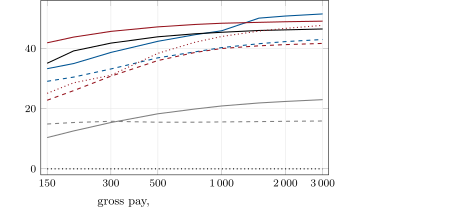
firm.aftertax on the 2026 parameters, through in_tax.curve.15.3 Expatriate regimes
Definition 15.4 (Tax residence, expatriate tax regime)
Tax residence is the status that makes a person taxable in a country on their income, usually on worldwide income, decided by that country’s rules on days present, home and ties. An expatriate tax regime is a rule that taxes a newly arrived resident more lightly for a limited period, by exempting a share of pay or foreign income, to attract people with scarce skills.
Two regimes illustrate the range.
- The Netherlands’ expat scheme lets an employer pay an eligible incomer up to 30% of wages tax-free for up to five years, falling to 27% from 1 January 2027; the tax-free amount is capped by applying the share to at most € 262 000 of wages, a maximum of € 78 600. On the one-million package it raises net pay from $516 376 to $560 341; its average rate falls from 48.4% to 44.0%, while the marginal rate on the bonus stays 49.5%, because above the cap every extra euro is taxed in full.
- The United Kingdom replaced its remittance basis, based on domicile, with “a new tax regime based on residence from 6 April 2025”: full relief “on foreign income and gains for new arrivals … in their first 4 years of tax residence” after ten years away. It relieves income and gains from abroad; it does not by itself reduce the tax on pay for work done in London.
Other countries have regimes of their own, with conditions on qualifications, previous residence and duration; each is a statute to read, not a rate to assume.
15.4 Deferred and equity pay: when it is taxed
In the United States, property subject to a substantial risk of forfeiture is income when it vests, at its value then (chapter 13): deferred pay is taxed when the employee receives it, not when it is awarded. The chapter’s model applies the same timing everywhere; other systems have their own rules for share awards, to be read before a move. Three consequences follow for a package where the rule applies.
- The rate is the rate of the vesting year. An award granted in a year of low income and vesting in a year of high income is taxed at the high year’s marginal rate.
- The value is the value at vesting. Shares that rise between award and vesting are taxed on the higher value; shares that fall are taxed on less, but the employee bears the fall (chapter 10 showed the extreme case of tokens).
- A move between countries during vesting can leave more than one country with a claim on the same award; the chapter does not model the apportionment, which depends on each country’s rules and treaties.
15.5 What a number is worth after tax
The marginal rate is what a bonus meets; Figure 15.2 shows it across the range of packages. It reaches its ceiling early in London (47% once the personal allowance has gone) and Amsterdam (49.5%), steps up in New York when the state’s recapture takes effect (in the model, which approximates the state’s worksheets, the extra tax exceeds the extra pay over a band of $50 000 of income above $1 077 550 of taxable income), and stays at or below 24% in Singapore and 17% in Hong Kong throughout. At the low end, withdrawals of allowances and credits push the marginal rate above the top statutory rate: 62% in London and 56% in Amsterdam at $150 000.
| $1 million package (30% base, 70% bonus) | local currency | net pay ($) | average rate | marginal rate |
|---|---|---|---|---|
| Dubai | USD 1 000 000 | 1 000 000 | 0.0% | 0.0% |
| Hong Kong | HKD 7 796 944 | 844 104 | 15.6% | 16.0% |
| Singapore | SGD 1 305 833 | 791 283 | 20.9% | 24.0% |
| Zurich | CHF 829 243 | 599 515 | 40.0% | 44.4% |
| Chicago | USD 1 000 000 | 597 361 | 40.3% | 44.3% |
| London | GBP 758 235 | 545 545 | 45.4% | 47.0% |
| New York | USD 1 000 000 | 540 584 | 45.9% | 50.1% |
| Amsterdam | EUR 884 969 | 516 376 | 48.4% | 49.5% |
Net pay from the same million ranges from $516 376 in Amsterdam to all of it in Dubai, a ratio of 1.94 (Figure 15.3). Among the five places whose average rate is 40% or more, the spread is narrower: $516 376 to $599 515, 16%. The split between base and bonus does not change these figures, because both are taxed as employment income; it changes the risk (chapter 13) and, under a bonus cap, what the firm may offer.
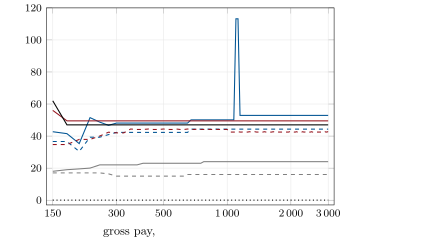
in_tax.marginal_curve.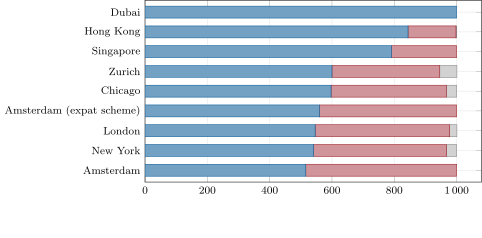
in_tax.million.The comparison is in dollars, and exchange rates move. At the 2024 average rate a pound bought $1.2785; at the 2025 average, $1.3189. A London package fixed in pounds was worth 3.2% more in dollars in 2025 than in 2024 with no change in pay, and a comparison made in one year’s rates can reverse in the next. A package is paid in the local currency; a candidate who expects to spend or save in another currency carries that exchange risk.
Tax is not the only difference of place. Chapter 27 sets these figures against the cost of living, the size of each place’s industry and the commute; and whether a given employer has a desk in a given place is a separate question from what the place’s tax would leave.
15.6 Tutorial: a million, eight ways
Goal. Compute net pay and the average and marginal rates of packages from $150 000 to $3 million in eight places. End state: the dated table, Figures 15.1 and 15.3 and the table above.
- Parameters.
data/industry/tax_2026.csvholds every bracket, rate, cap and credit with a ledger id;ch_federal_tax_2026.csvthe Swiss federal table’s break points. Structure.
firm.aftertax.net_local(params, place, gross)applies each system’s structure; New York’s benefit recapture is approximated (Listing 15.1).def _new_york_state(P, g): """New York State tax with the benefit recapture approximated: once income exceeds the recapture start, the tax moves over 50,000 of income from its value at the bracket's start (all lower income at the previous bracket's flat rate) to the bracket's flat rate on all taxable income; continuous at every bracket edge.""" ti = max(0.0, g - P["ny", "standard_deduction"]) br = P["ny", "brackets"] sched = progressive(ti, br) if g <= P["ny", "recapture_start"]: return sched rate = _rate_at(ti, br) edges = [0.0] + [u for u, _ in br[:-1]] k = max(i for i, e in enumerate(edges) if e < ti or i == 0) lower, prev = edges[k], (br[k - 1][1] if k > 0 else None) if lower <= P["ny", "recapture_start"] or prev is None: start, t0 = P["ny", "recapture_start"], sched else: start, t0 = lower, prev * lower + rate * (ti - lower) w = min(1.0, max(0.0, (g - start) / P["ny", "recapture_phase"])) return t0 + w * (rate * ti - t0)Listing 15.1. New York State tax with the recapture of the lower brackets phased in over $50 000, continuous at every bracket edge. code/firm/aftertax/firm_aftertax.py - Convert and compare.
net_usdconverts at the 2025 average rates;marginaldifferences net pay over the last thousand dollars.
What to change next. Add the occupational pension contribution that Zurich deducts from taxable income; model a UK bonus paid in the following tax year; try a married couple with one income, which changes the answer in several places.
15.7 Build: the after-tax calculator
Purpose. Put every pay figure of the role chapters and of chapter 30’s choice on an after-tax basis.
Interface. firm.aftertax: load(path, fed_path); progressive(x, brackets); net_local(params, place, gross, expat); local_per_usd; net_usd; marginal; LOCATIONS. Python standard library.
Rules. Parameters are data with a source each, never literals in the code; one employee, single, no other income, standard deductions only; bonus and salary taxed alike; simplifications named in the module’s documentation.
Acceptance tests. code/firm/aftertax/tests/: a UK case at £100 000 and £200 000 by hand; the US federal tax on $1 million of taxable income; New York’s tax continuous and flat at 6.85% and 9.65% where the recapture is complete; Hong Kong’s progressive and standard tax equal at the official threshold of HKD 2 132 500; Singapore’s table values; the Swiss federal table’s printed values, including the rounding to CHF 100; the Dutch credits and expat cap.
Stretch. Married and family cases; pension deductions; the timing of bonus withholding; a second country during vesting.
Sources and further reading
- HMRC, Rates and thresholds for employers 2026 to 2027; gov.uk, Income Tax rates and Personal Allowances; HM Treasury and HMRC, Reforming the taxation of non-UK domiciled individuals.
- IRS, inflation adjustments for 2026 and Topic 751; SSA, contribution and benefit base; New York State, IT-201-I (2025) and tax expenditure report; Illinois Department of Revenue.
- Belastingdienst, loonheffingen 2026 tables; Business.gov.nl, the expat scheme.
- ESTV, Kantonsblatt Zürich and the 2026 federal tax table; Stadt Zürich, Steuerfuss 2026; AHV/IV leaflets 2.01 and 2.08.
- IRAS, individual income tax rates; GovHK, salaries tax rates; IRD, PAM 61; MPFA; UAE Government portal.
- Directive 2013/36/EU, Article 94; European Banking Authority, high earners 2024.
15.8 Exercises
Exercise 15.1 ★
Compute the UK income tax and employee National Insurance on £100 000 of salary in 2026/27.
Solution
Solution of Exercise 15.1.
The allowance is £12 570 (income is below £100 000 of the taper), so taxable income is £87 430: 20% of £37 700 is £7 540 and 40% of £49 730 is £19 892, £27 432 in all. National Insurance: 8% of £37 700 (£3 016) and 2% of £49 730 (£994.60), £4 010.60. Net £68 557.40.
Exercise 15.2 ★
A bank risk-taker in the EU has fixed pay of € 400 000. What is the most variable pay the cap allows, with and without the owners’ approval?
Solution
Solution of Exercise 15.2.
€ 400 000 of variable pay (100% of fixed); € 800 000 with the owners’ approval (200%).
Exercise 15.3 ★
From the table, which place has the highest marginal rate on the bonus of a $1 million package, and what is it?
Solution
Solution of Exercise 15.3.
New York: 50.1% on the last thousand dollars (37% federal, 2.35% Medicare, 6.85% state and 3.876% city).
Exercise 15.4 ★★
Show that Hong Kong’s progressive and standard-rate tax are equal at HKD 2 132 500 with the basic allowance of HKD 145 000.
Solution
Solution of Exercise 15.4.
Net chargeable income . Progressive: on the first 200 000, plus : HKD 319 875. Standard rate: HKD 319 875. They are equal.
Exercise 15.5 ★★
Why does the Dutch expat scheme lower the average rate on a $1 million package but not its marginal rate?
Solution
Solution of Exercise 15.5.
The tax-free amount is 30% of wages up to € 262 000, at most € 78 600; the package, € 884 969, is far above the cap, so the exemption is a fixed amount that lowers the average rate (from 48.4% to 44.0%) while every further euro is taxed at 49.5%.
Exercise 15.6 ★★
Why does New York’s average rate rise from 45.9% at $1 million to 50.1% at $1.5 million, when the federal and city rates are unchanged over that range?
Solution
Solution of Exercise 15.6.
Taxable income passes $1 077 550, the start of New York State’s 9.65% bracket, and once income is $50 000 beyond it the recapture taxes all taxable income at 9.65% instead of 6.85%: the state tax jumps by 2.8 points of the whole income.
Exercise 15.7 ★★★
Coding. With firm.aftertax, find, to the nearest thousand dollars, the gross pay at which New York’s net pay first falls below London’s, and explain the crossing.
Solution
Solution of Exercise 15.7.
At $839 000 of gross pay. Below it New York’s lower federal-plus-state rates on the first slices leave more than London’s 45% band; above it the state’s recapture and the city tax make New York’s average rate the higher, and London’s is nearly flat.
Exercise 15.8 ★★★
Find the flaw. “Dubai pays twice as much: a million there is worth the same as two million in Amsterdam.”
Solution
Solution of Exercise 15.8.
A million in Dubai is worth, after tax, what about $1.96 million is worth in Amsterdam, not two million; and after-tax pay is not purchasing power: housing, schooling and other costs differ (chapter 27), and whether the same employer and role exist in both places is a separate question.
15.9 Problem: A Million, Eight Ways
Problem 15.1
Weekend problem — a million, eight ways
A trader is offered the same package, one million dollars a year with 30% base and 70% bonus, in eight offices of one firm. What does each leave, and what else should decide?
Part I — The rules.
- Define a bonus cap and state the EU’s.
- Whom does the cap cover, and whom not, since 2021 and 2023?
- What does a cap do to the mix and to the level of pay?
- Define marginal and average tax rates.
- Does the split between base and bonus change the year’s tax in these systems? Why?
Part II — The systems.
- State the UK’s rates, allowance and National Insurance for 2026/27.
- State the US federal, New York State and City rates and payroll taxes.
- State the Dutch box 1 rates and the expat scheme’s terms.
- State Zurich’s structure: federal, cantonal, city, social.
- State Singapore’s, Hong Kong’s and Dubai’s.
Part III — The numbers.
- Give the package in each local currency at 2025 rates.
- Give net pay, average and marginal rates in each place.
- How much does the Dutch expat scheme add?
- Define tax residence and an expatriate regime; what does the UK’s 2025 regime relieve?
- When is deferred pay taxed, and what three consequences follow?
Part IV — The verdict.
- State the named result: net pay from the package in each of the eight places, and the ratio of the highest to the lowest.
- Among the five places whose average rate is 40% or more, what is the spread?
- What does the model leave out that could change the ranking for her?
- Why is the tax ranking not the ranking of where to work?
- In two sentences, advise her.
Solution
Solution of Problem 15.1.
- A legal limit on variable over fixed pay; in the EU, variable at most 100% of fixed, 200% with the owners’ approval.
- EU credit institutions’ material risk takers; not EU investment firms since 2021, nor UK firms since 31 October 2023.
- More of pay becomes fixed; the level need not fall, since base can rise.
- The share of the next unit of pay taken; the share of all pay taken.
- No: both are taxed as employment income in the year received; withholding may differ during the year.
- 20%, 40%, 45% above £125 140; allowance £12 570 withdrawn above £100 000; National Insurance 8% to £50 270 and 2% above.
- Federal 10% to 37% above $640 600 after a $16 100 deduction; state 4% to 10.9% with recapture above $107 650; city 3.078% to 3.876%; Social Security 6.2% to $184 500; Medicare 1.45% plus 0.9% above $200 000.
- 35.75%, 37.56%, 49.5% above € 78 426; up to 30% of wages tax-free for five years (27% from 2027), capped at € 262 000 of wages.
- Federal tax to 11.5% of all income; cantonal simple tax to 13% times 2.14; social insurance 5.3% and 1.1% to CHF 148 200.
- Singapore 0% to 24%; Hong Kong the lower of 2%–17% after allowances and 15%–16% of income, plus MPF; Dubai no tax.
- GBP 758 235; USD 1 000 000 (New York, Chicago, Dubai); EUR 884 969; CHF 829 243; SGD 1 305 833; HKD 7 796 944.
- Dubai $1 000 000 (0%, 0%); Hong Kong $844 104 (15.6%, 16.0%); Singapore $791 283 (20.9%, 24.0%); Zurich $599 515 (40.0%, 44.4%); Chicago $597 361 (40.3%, 44.3%); London $545 545 (45.4%, 47.0%); New York $540 584 (45.9%, 50.1%); Amsterdam $516 376 (48.4%, 49.5%).
- $43 964: net $560 341.
- The status that makes a person taxable in a country; a lighter regime for new arrivals for a limited time; foreign income and gains for the first four years, not pay for UK work.
- When it vests or is received, at its value then; the vesting year’s rate applies, the value at vesting is taxed, and a move during vesting can give two countries a claim.
- Dubai $1 000 000, Hong Kong $844 104, Singapore $791 283, Zurich $599 515, Chicago $597 361, London $545 545, New York $540 584, Amsterdam $516 376; highest over lowest 1.94.
- $516 376 to $599 515, 16%.
- Pension contributions and deductions, family status, an expat regime she may qualify for, the timing of vesting, and her residence history.
- The employer, the role and the team come first; living costs differ; and the market for her next move differs by place (chapter 27).
- The eight offices leave between about $516 000 and $1 million of the same package, so the place matters as much as a large difference in pay; she should compare offers after tax and after living costs, and check any regime for incomers before she moves.
15.10 Interview questions
Interview question 15.1 ★ developer
Write a function for tax under a progressive schedule given as brackets. How do you test it?
Solution
Solution of Interview question 15.1.
Walk the brackets, taxing the part of income inside each at its rate; stop when income is below a bracket’s start. Test at zero, at each edge, inside each band, far above the top, and against a published example.
What the interviewer is looking for: edge cases and an external oracle.
Interview question 15.2 ★ bank, risk
Why did the UK remove the bonus cap, and what did the EU keep?
Solution
Solution of Interview question 15.2.
The regulators argued that it raised fixed pay and so reduced the part of pay that can absorb losses; the EU kept the cap for credit institutions.
What the interviewer is looking for: the fixed-pay effect, and who is still covered.
Interview question 15.3 ★★ researcher
An average tax rate curve flattens in one place and rises in another. What features of the two systems explain each?
Solution
Solution of Interview question 15.3.
A curve flattens when a cap on the average binds (Hong Kong’s standard rate) or the top rate is reached early; it keeps rising where a high top bracket starts late or where a recapture moves the whole of income to a higher rate (New York).
What the interviewer is looking for: the shape of the schedule, not just its top rate.
Interview question 15.4 ★★ trader
Your bonus is 70% of your pay. Would you rather it be taxed at the marginal rate of the year it is awarded or the year it vests? When does the answer change?
Solution
Solution of Interview question 15.4.
Taxed at the year with the lower marginal rate; with deferral, the vesting year’s rate applies, which is worse if income rises and better if it falls (for example after leaving, when vesting continues as a good leaver).
What the interviewer is looking for: timing arbitrage and its dependence on future income.
Interview question 15.5 ★★ developer, mle
Tax parameters change every year. How would you store them so that last year’s calculation can be reproduced exactly?
Solution
Solution of Interview question 15.5.
As dated rows keyed by jurisdiction, parameter and effective period, with the source for each; never overwrite, add new periods; the calculation takes a date and reads the rows in force.
What the interviewer is looking for: effective-dated, sourced, append-only parameters.
Interview question 15.6 ★★★ researcher, risk
A model of after-tax pay leaves out pensions, allowances and family status. How would you bound the error for a single high earner, and where is it largest?
Solution
Solution of Interview question 15.6.
For each omitted item, bound its size (the largest pension deduction allowed, the largest allowance) and its rate (the marginal rate), and add the effects; the error is largest where deductions are large and rates high, and where family status changes brackets.
What the interviewer is looking for: bounding by the largest allowed item times the marginal rate.