The Industry: Firms, Roles and Careers · Careers
23Structurer, Sales and Sales-Trader
The European trade association of structured-product issuers publishes each quarter what its members’ markets hold and trade. At the end of March 2026 investors in six European markets held 487 billion euros of structured investment products issued as securities, most of them in Switzerland and Germany, and 163 413 new investment products were listed in the first quarter alone. Behind each note is a structurer who designed it, a salesperson who placed it, a trading desk that hedges it, and a margin that the note’s buyer pays and the bank’s desk earns. This chapter describes the three client-facing roles in which quantitative skill is part of the job, computes the margin in a typical note, and sets out the rules that bind people who sell financial products.
| Role cards: the client-facing roles | |||
|---|---|---|---|
| structurer | institutional salesperson | sales-trader | |
| works on | product design and pricing | client relationships and ideas | client orders and their execution |
| horizon | weeks to years (the note’s life) | months to years | seconds to days |
| credited with | the desk’s margin | client revenue | client flow |
| codes in filings | 13-2099.01, 13-2051, 41-3031 | 41-3031 | 41-3031, 13-2099.01 |
| taught in | Book 5, ch. 18–19 | Book 9, ch. 24 | Book 1, ch. 2; Book 10, ch. 20 |
23.1 The structurer
Definition 23.1 (Structurer)
A structurer is a quantitative specialist on a bank’s markets side who designs structured products for clients and distributors: chooses the payoff, the underlying, the protection and the coupon, prices them with the desk’s models, and sets the structuring margin within the product’s approval and the trading desk’s capacity to hedge it.
A structurer works between three parties. The client, or the private bank or retail network that sells to clients, wants a coupon or a protection level; the trading desk that will hedge the note wants risks it can hold (Book 5, chapter 27; Book 9, chapter 28); the bank wants a margin. Book 5, chapter 19, describes the business, and its chapter 18 the autocallable, the payoff this chapter prices. The structurer’s quantitative work is pricing and its sensitivities, understanding which parameters the price depends on and which the client does not see.
Definition 23.2 (Product governance)
Product governance is the set of processes by which a firm that manufactures or distributes financial instruments approves each product for an identified target market of end clients, checks that the distribution strategy suits that market, and reviews the product during its life.
The structurer’s product must pass the firm’s product approval process before it is sold: the European rules require a manufacturer to “maintain, operate and review a process for the approval of each financial instrument” that specifies “an identified target market of end clients”. The target market is a statement about who should buy the note; the structurer writes much of it.
23.2 The margin in the note
Method 23.3 (Structuring margin of a note)
A note sold at par, 100, has fair value per 100 under the desk’s model for coupon ; its margin is . For a Phoenix autocallable the note’s cash flows are linear in the coupon, so along the same simulated paths , and the coupon that leaves a target margin is .
Example 23.4 (A five-year autocallable)
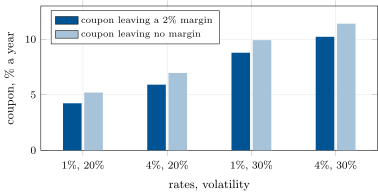
An illustrative note on one equity index: five years, annual observations, autocall when the index is at or above its initial level, a coupon of 6 per 100 a year paid when the index is at or above 70% (with memory), capital repaid unless the index ends below 60% of its initial level, when the holder takes the loss. Dividend yield 2%, flat volatility, 200 000 paths. At 6% the margin is per 100 with rates at 1% and volatility 20% (the bank would lose), 1.83 with rates at 4% and volatility 20%, 6.91 at 1% and 30%, and 9.13 at 4% and 30%. The coupon that leaves a 2% margin is 4.23% at 1% and 20%, 5.91% at 4% and 20%, 8.79% at 1% and 30%, and 10.22% at 4% and 30% (Figure 23.1).
| rates; volatility | 1%; 20% | 4%; 20% | 1%; 30% | 4%; 30% |
|---|---|---|---|---|
| margin at a 6% coupon, per 100 | 1.83 | 6.91 | 9.13 | |
| coupon for a 2% margin, % a year | 4.23 | 5.91 | 8.79 | 10.22 |
| coupon for no margin, % a year | 5.20 | 6.97 | 9.92 | 11.41 |
| autocalled at year one, % | 44.0 | 50.0 | 42.7 | 46.7 |
| capital loss at maturity, % | 15.8 | 9.4 | 25.1 | 19.3 |
Two lessons are the structurer’s daily material. Higher rates buy a higher coupon for the same margin: the note is a bond plus options sold by the investor, and a bond discounted at 4% is cheaper than at 1%. Higher volatility buys a higher coupon too, because the investor is short the downside and paid for it; but the chance of losing capital rises with it, from 15.8% to 25.1% of paths at 1% rates. A client comparing coupons across notes compares, without seeing it, the volatility sold.
in_structurer.margins, from firm.roles.structuring_margin on firm.autocall.23.3 Institutional sales and coverage
Definition 23.5 (Institutional salesperson)
An institutional salesperson is a person who covers a set of professional clients (asset managers, hedge funds, pension funds, insurers, corporates) for a bank or broker: brings them the firm’s ideas, prices and products, takes their interest to the desks, and is credited with the revenue the clients generate.
The salesperson owns the relationship and the franchise that client tiering of Book 9, chapter 24, formalises. Where markets trade electronically, the quantitative side of the job is the client’s execution analysis, the desk’s pricing and the risk a trade leaves with the bank, and a salesperson who can discuss all three is more useful to the client. The role is judged on client revenue and share of the client’s business, which the bank measures and the salesperson’s pay follows (chapter 13).
23.4 The sales-trader
The sales-trader of Book 1, chapter 2, stands between clients’ orders and the market: takes a portfolio manager’s order, decides with the client how to work it, runs it through the firm’s algorithms or its traders, and reports the result against the client’s benchmark. The high-touch trading of Book 10, chapter 20, is this job. Its quantitative content is execution: transaction cost analysis, the choice of algorithm and venue, the market impact of large orders (Book 10), and the sales-trader who can explain a fill against arrival price keeps the client.
23.5 Quantitative skills in client-facing roles
The three roles use quantitative skill differently.
- The structurer prices and designs: stochastic calculus and Monte Carlo (Book 5), the sensitivities of a payoff to volatility, correlation and rates, and the hedging cost the desk will bear.
- The salesperson translates: turns a desk’s view or a product into a client’s problem and back, and needs enough of the model to know when a price is wrong.
- The sales-trader measures: execution quality against benchmarks, in numbers the client can check.
In all three, the audience is a client who may know less, and the skill includes saying what the client is buying.
23.6 The rules for client-facing work
People who sell financial products are licensed and supervised in ways that quants inside a trading firm are not.
As of September 2026 — Rules for people who design and sell products
European Union: MiFID II (Directive 2014/65/EU) Article 16(3) requires a manufacturer’s product approval process with “an identified target market of end clients”; Article 24(2) requires products “designed to meet the needs of an identified target market” and a compatible distribution strategy; Article 25(1) requires staff who advise or inform clients to “possess the necessary knowledge and competence”. ESMA’s guidelines on MiFID II product governance (ESMA35-43-3448, 3 August 2023) set out how Articles 16(3) and 24(2) apply. United States: a general securities representative passes FINRA’s Series 7, which “assesses the competency of an entry-level registered representative”, with the Securities Industry Essentials exam as a corequisite; the Series 63, a NASAA exam administered by FINRA, covers state securities law.
For a quant moving into a client-facing role, the rules change the job in three ways. The product must be approved before it is sold and reviewed while it lives; the person must be qualified for the activity; and the firm’s records include “the recording of telephone conversations or electronic communications” relating to client orders (MiFID II, Article 16(7)). Chapter 24 covers the compliance function that enforces them.
As of March 2026 — The market for structured products
EUSIPA’s report for the first quarter of 2026: sales of investment and leverage products on trading venues in the reporting markets, 74 billion euros (investment products 19 billion); outstanding volume of structured investment products at the end of March, 486 635 million euros (Switzerland 286 264 million, Germany 99 890, Italy 66 788, Austria 17 462, Belgium 11 678, Luxembourg 4 553); 465 721 investment products listed; 163 413 launched in the quarter.
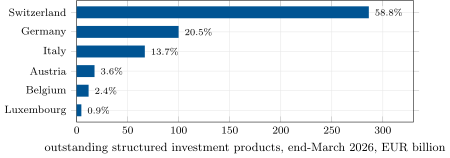
in_structurer.eusipa_shares.The market is concentrated: Switzerland holds 58.8% of the six markets’ outstanding volume and Germany 20.5% (Figure 23.2). A desk that issues one to five billion euros of notes a year at a 2% margin earns 20 to 100 million euros of structuring revenue; spread over ten structurers, 2 to 10 million euros each. Both the issuance and the team are illustrative; the arithmetic shows why a structurer’s pay follows the margin and the volume the desk can place.
As of May 2025 — What sales agents are paid: the survey
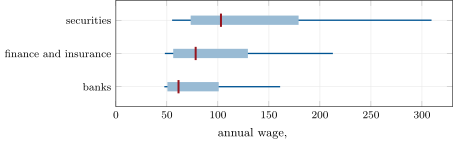
Occupational survey, May 2025, securities, commodities and financial services sales agents (41-3031), which includes institutional salespeople, sales-traders and brokers: securities industry 173 040 employed, median $103 030, 10th–90th percentile $55 130–309 440; banks 257 110 employed, median $61 440. The filings’ structurer and sales titles are too few to publish separately. Wages only.
data/industry/oews_roles.csv, through in_structurer.survey.23.7 Tutorial: the margin in the note
Goal. Price an autocallable, find its margin and the coupon that leaves a target margin, and put the desk’s revenue per structurer beside the market’s size. End state: Figures 23.1 and 23.2 and the margin table.
- Term sheet. Book 5’s
firm.autocall.TermSheetwith annual observations, a Phoenix coupon with memory and protection at maturity. Value and margin.
firm.roles.note_valuesimulates the index and discounts the cash flows;structuring_marginuses the note’s linearity in the coupon to find the coupon for any margin (Listing 23.1).def structuring_margin(make_sheet, coupon, target, r, q, vol, n=100_000, seed=23, steps=12): """Margin per 100 sold at par at `coupon`, and the coupon that leaves `target`: the value is linear in the coupon along common random numbers, so two valuations (coupon 0 and `coupon`) give both.""" v0, _ = note_value(make_sheet(0.0), r, q, vol, n, seed, steps) v1, cf = note_value(make_sheet(coupon), r, q, vol, n, seed, steps) slope = (v1 - v0) / coupon return {"value": v1, "margin": 100.0 - v1, "fair_coupon": (100.0 - target - v0) / slope, "zero_margin_coupon": (100.0 - v0) / slope, "called_first": float(np.mean(cf["called_at"] == 0)), "ki": float(cf["ki"].mean())}Listing 23.1. The structuring margin and the coupon that leaves a target margin. code/firm/roles/firm_roles.py - Grid. Two rate levels and two volatilities, the same paths for each coupon.
- Scale. Revenue per structurer from an illustrative issuance range and team.
For the example’s grid the table above results; at the 6% coupon, moving rates from 1% to 4% adds 3.48 points of margin at 20% volatility.
What to change next. Add the issuer’s funding spread, which the note’s buyer also pays; price under local volatility (Book 5, chapter 18) and compare; make the note a worst-of on three indices and watch the coupon and the loss probability rise together.
23.8 Build: client-facing cards and the structuring margin
Purpose. Add the client-facing roles to the registry and compute the margin in a note.
Interface. firm.roles: the cards structurer, institutional salesperson, sales-trader; note_value(sheet, r, q, vol, n, seed, steps); structuring_margin(make_sheet, coupon, target, r, q, vol, n, seed, steps); on firm.autocall.
Rules. Values per 100 sold at par; the same random numbers for every coupon, so that the coupon for a margin is exact along the paths; volatility flat unless the caller passes a function.
Acceptance tests. code/firm/roles/tests/: the note repriced at the returned coupon has exactly the target margin; the coupon for no margin is above the coupon for a positive one.
Stretch. Worst-of notes; the margin’s sensitivity to each parameter; a term sheet generator that searches the protection level for a coupon target.
Sources and further reading
- EUSIPA, Market Report on Structured Investment and Leverage Products Q1/2026.
- Directive 2014/65/EU (MiFID II), Articles 16, 24 and 25; ESMA35-43-3448, Guidelines on MiFID II product governance.
- FINRA, Series 7 and Series 63 qualification exams.
- Bureau of Labor Statistics, occupational survey, May 2025; Book 5, chapters 18 and 19.
23.9 Exercises
Exercise 23.1 ★
What share of the six markets’ outstanding structured investment products did Switzerland and Germany hold together at the end of March 2026?
Solution
Solution of Exercise 23.1.
.
Exercise 23.2 ★
At rates of 4% and volatility of 20%, what is the margin of the 6% note, and what coupon would leave no margin?
Solution
Solution of Exercise 23.2.
A margin of 1.83 per 100; a coupon of 6.97% a year would leave none.
Exercise 23.3 ★
Which article of MiFID II requires a manufacturer’s product approval process, and what must it specify?
Solution
Solution of Exercise 23.3.
Article 16(3): a process for approving each financial instrument before it is marketed, specifying an identified target market of end clients, assessing the risks to it and checking the distribution strategy against it, with regular review.
Exercise 23.4 ★★
Why does a higher interest rate allow a higher coupon for the same margin?
Solution
Solution of Exercise 23.4.
The note is a bond plus options the investor sells. At a higher rate the bond part costs less today for the same repayment, which frees value for the coupon; the forward of the index also rises, which makes the autocall more likely.
Exercise 23.5 ★★
A client prefers the 10.22% note (rates 4%, volatility 30%) to the 5.91% note (rates 4%, volatility 20%). What is he buying with the extra coupon?
Solution
Solution of Exercise 23.5.
He sells more volatility: at 30% the chance that the index ends below 60% and he loses capital rises from 9.4% to 19.3% of paths, and the coupon pays for that.
Exercise 23.6 ★★
Why is a structurer’s pay tied to the desk’s margin and volume rather than to the note’s later performance?
Solution
Solution of Exercise 23.6.
The desk books the margin when the note is sold and hedges the note’s risk from then on; what the client later earns or loses depends on the market, which the structurer does not control. The link to the client’s outcome runs instead through product governance, the desk’s reputation and future sales.
Exercise 23.7 ★★★
Coding. Price the 6% note at rates of 4% and volatility of 20% with 50 000 paths and seeds 1 to 20. What is the standard deviation of the margin across seeds, and is the margin’s sign in any doubt?
Solution
Solution of Exercise 23.7.
Across the 20 seeds the margin averages 1.84 per 100 with a standard deviation of 0.06 (range 1.74 to 1.97): its sign is not in doubt, but the second decimal is.
Exercise 23.8 ★★★
Find the flaw. “The note pays 10% a year and protects capital down to 60%, so it is safer than holding the index and pays more than its dividends.”
Solution
Solution of Exercise 23.8.
The protection holds only if the index ends above 60%; below it the holder bears the whole fall from the start, so the note has the index’s worst outcomes without its best (it is called away when the index rises). The coupon is not guaranteed either (it needs the index above 70%), and the holder forgoes the dividends. Compare the loss probability and the distribution, not the headline coupon.
23.10 Problem: The Margin in the Note
Problem 23.1
Weekend problem — the margin in the note
A quantitative analyst is offered a move to a structuring desk and wants to understand where its revenue comes from and what the job’s rules are.
Part I — The roles.
- Define the structurer, the institutional salesperson and product governance.
- Whom does a structurer work between?
- What does a sales-trader do, and what is high-touch trading?
- What quantitative skill does each role use?
- Which book teaches the autocallable?
Part II — The margin.
- State the note of the example.
- Define the structuring margin and derive the coupon for a target margin.
- Give the margin at 6% in the four cases.
- Give the coupon for a 2% margin in the four cases.
- Why does volatility raise the coupon, and what else does it raise?
Part III — The market and the rules.
- Give the market’s size and its concentration by country.
- What revenue per structurer does the example’s desk earn?
- State the MiFID II product governance and competence rules.
- What do FINRA’s Series 7 and 63 cover?
- What do the survey’s wages show?
Part IV — The verdict.
- State the named result: the structuring margin of the chapter’s autocallable at 1% and 4% rates, and the revenue per structurer for a desk’s issuance in the chapter’s range.
- What would a funding spread change?
- What does a structurer owe the end client?
- What would the analyst’s quantitative skills add to the desk, and what would they not?
- In two sentences, advise the analyst.
Solution
Solution of Problem 23.1.
- As in the chapter’s definitions.
- The client or distributor, the trading desk that hedges the note, and the bank’s margin.
- Works clients’ orders in the market and reports against their benchmark; order handling with a person in the loop (Book 10, chapter 20).
- Pricing and sensitivities; translation of views and products; execution measurement.
- Book 5, chapter 18.
- Five years, annual observations, autocall at 100%, 6% coupon at 70% with memory, capital lost below 60% at maturity.
- ; because the value is linear in the coupon.
- , 1.83, 6.91 and 9.13 per 100.
- 4.23%, 5.91%, 8.79% and 10.22%.
- The investor sells the downside and is paid for it; the probability of losing capital rises too.
- 486 635 million euros in six markets; Switzerland 58.8%, Germany 20.5%.
- 2 to 10 million euros a year at a 2% margin on 1 to 5 billion euros of issuance and ten structurers.
- Articles 16(3) and 24(2) (approval and target market) and 25(1) (knowledge and competence), with ESMA’s 2023 guidelines.
- The Series 7 qualifies a general securities representative, with the SIE; the Series 63 covers state securities law.
- Sales agents’ median $103 030 in the securities industry (90th percentile $309 440), $61 440 at banks.
- At 6%: at 1% and 1.83 at 4% (20% volatility); 6.91 and 9.13 at 30%; 2 to 10 million euros per structurer.
- It raises the margin at a given coupon, or the coupon at a given margin, and is also paid by the buyer.
- A product that fits the target market, a description of its risks the client can understand, and a fair price.
- Pricing, risk and sensitivity to parameters the client does not see; not the relationships and distribution that decide volume.
- The desk’s revenue is margin times volume, and the margin depends on rates and volatility as much as on design. Take the job if you want to work with clients and products; your models will matter most in saying what a note really sells.
23.11 Interview questions
Interview question 23.1 ★ bank
Decompose a capital-protected note into a bond and an option.
Solution
Solution of Interview question 23.1.
A zero-coupon bond paying 100 at maturity plus a call option on the index (participation), bought with the difference between 100 and the bond’s price; the issuer’s margin comes out of that difference.
What the interviewer is looking for: bond plus option and the budget.
Interview question 23.2 ★ bank, trader
A client asks why this year’s autocallable pays more than last year’s. Give three reasons.
Solution
Solution of Interview question 23.2.
Higher rates (a cheaper bond part), higher implied volatility (the downside sold is worth more), and a different design (a lower barrier or a worst-of); the margin may also differ.
What the interviewer is looking for: rates, volatility and design.
Interview question 23.3 ★★ bank
Is the investor in an autocallable long or short volatility, and long or short correlation in a worst-of?
Solution
Solution of Interview question 23.3.
Short volatility (short the downside put); in a worst-of, short correlation: lower correlation makes the worst performer worse and the note cheaper, so the coupon is higher.
What the interviewer is looking for: the sign of each exposure and why.
Interview question 23.4 ★★ bank, trader
A client’s 5% participation order finished 20 basis points worse than arrival. How do you explain it?
Solution
Solution of Interview question 23.4.
Compare against the market’s move during the order and the expected impact for its size: adverse drift, spread paid, impact of 5% participation; then show whether the algorithm behaved as designed, with the transaction cost analysis.
What the interviewer is looking for: decomposing slippage into market move, spread and impact.
Interview question 23.5 ★★ bank, risk
What goes into a target-market statement for a note like the chapter’s?
Solution
Solution of Interview question 23.5.
Client type, knowledge and experience, ability to bear loss (up to the whole capital below 60%), risk tolerance, objectives (income with conditional protection), horizon (up to five years), and the negative target market.
What the interviewer is looking for: the MiFID target-market categories applied to the note.
Interview question 23.6 ★★★ bank, researcher
The desk has sold many autocallables on the same index. What risk does the desk hold, and when does it hurt?
Solution
Solution of Interview question 23.6.
The desk is long volatility near the barriers and long the downside the investors sold; it holds concentrated barrier and dividend risk. It hurts when the index falls towards the barriers together, when gamma flips and hedging becomes expensive (Book 5, chapter 27).
What the interviewer is looking for: concentration of barrier risk and the desk’s side of the trade.