The Industry: Firms, Roles and Careers · Careers
28Career Paths and Moves
A trader who resigns at the start of February, a few days before the previous year’s award is paid, may serve three months of notice, spend three more on garden leave and then sit out a six-month non-compete, and forfeit on the way the award for last year, the award accruing for this one and the deferred pay not yet vested. In this chapter’s illustrative package that is $659 167 forfeited and a year out of the market. A new employer’s buyout is therefore part of the offer, and the timing of a resignation is worth as much as a large raise. This chapter describes how people enter the industry and move within it, puts a price on a move, and follows a career as a chain of states.
28.1 Entry routes: internships, graduate programmes, lateral hires, doctorates
Definition 28.1 (Internship, return offer, graduate programme, lateral hire)
An internship is a paid work placement of a few weeks or months for a student, designed by the firm as a trial for a permanent job. A return offer is the offer of a permanent job made to an intern at the end of the internship. A graduate programme is a firm’s structured entry route for new graduates, with training and often rotations before a permanent placement. A lateral hire is an experienced person hired from another employer into a role at their level.
For graduates the internship is the main door. The firms describe it as such: one market maker states that “Our internship program is built to prepare you for a full-time role”; another offers internships in quantitative trading, research, machine learning and software engineering across its New York, London and Hong Kong offices. The hiring process that leads to an internship or a graduate job (screening, assessments, interviews and the decision) is the subject of Book 18.
As of September 2026 — How two firms describe their entry routes
Optiver: “Our internship program is built to prepare you for a full-time role”; “Our graduate roles are built around learning through real work.” Jane Street: internships in “quantitative trading, machine learning, software engineering, quantitative research, strategy and product”, across its New York, London and Hong Kong offices.
A doctorate is an entry route of its own for research roles (chapter 17): the researcher joins after the doctorate, sometimes after a research internship during it, at a level above a new graduate. Lateral hires fill the rest: an experienced trader, researcher or engineer moving between firms, whose move this chapter prices. Chapter 29 follows the pipelines from education.
28.2 Bank to buy side and back
Moves can run along any edge of the industry’s map. From banks to the buy side: a desk strategist or structurer (chapters 18 and 23) to a hedge fund, a trader to a platform (chapter 22). From the buy side to banks, for example when a platform closes a pod or a fund shuts. Between buy-side firms, a researcher or a team moving with a strategy, which is where non-competes and trade-secret law matter most (Book 16, chapter 11). Between technology firms and trading (chapter 20), in both directions. No public data count these moves; what can be measured is their cost.
Definition 28.2 (Notice period)
A notice period is the time between a resignation or dismissal and the end of employment, set by the contract within the statutory minimum; the employee is paid and bound by the contract throughout, and may be placed on garden leave for all or part of it.
Method 28.3 (The cost of a move)
Let a job pay a base and an expected award paid in month for the previous year, a share deferred into annual tranches. In the steady state the unvested deferrals are worth . Resigning in month forfeits them, the previous year’s award if , and the current year’s accrual . Out of the market for months (notice, garden leave, non-compete), the mover loses of award, and the base for any unpaid months. A buyout replaces a share of the forfeited awards with probability . The move is neutral when a raise on base plus award over years repays the net cost : .
Example 28.4 (Move now or wait for the payment?)
Illustrative terms: base $250 000, expected award $350 000, 40% deferred over three years, awards paid in February; three months’ notice, three of garden leave and a six-month paid non-compete; a buyout of all forfeited awards with probability one-half; a three-year horizon. Unvested deferrals are $280 000. Resigning at the start of February forfeits $659 167 and costs, net of the expected buyout, $694 167: a raise of 38.6% on the $600 000 package. Waiting one month, until the award is paid, cuts the forfeiture to $338 333 and the neutral raise to 30.5%. Without a buyout the February move needs 56.1%; with a certain one, 21.1% (Figure 28.1).
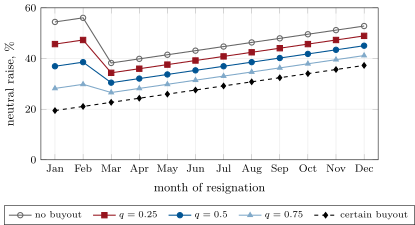
in_career.surface, from firm.careerpath.breakeven_raise.The shape of Figure 28.1 is the practical lesson. The cost falls sharply once an award is paid and then rises through the year as the next one accrues; a buyout flattens the payment-day cliff, because it replaces forfeited awards but not the accrual or the time out. The year out of the market costs $350 000 of award in every month: the non-compete is the largest single item.
28.3 Non-competes and garden leave in practice
Book 16, chapter 11, sets out the law: non-compete clauses, garden leave, non-solicitation and confidentiality, and how courts treat them. The practice depends on where the job is.
As of September 2026 — Notice and non-compete law
United Kingdom: statutory minimum notice from the employer of one week a year of service up to twelve weeks, and from the employee one week (Employment Rights Act 1996, s. 86); a contract may set longer periods. The government’s working paper of 26 November 2025 consulted, until 18 February 2026, on options including a statutory limit on the length of non-competes, a ban, or a ban below a salary threshold; the previous government had announced a three-month limit on 10 May 2023 that was not enacted. United States: the FTC’s non-compete rule was stopped by a district court on 20 August 2024, and on 5 September 2025 the Commission voted to dismiss its appeals and accede to the vacatur; the rule is not in force. California: a non-compete void under its law “is unenforceable regardless of where and when the contract was signed” (Business and Professions Code s. 16600.5).
The employer’s side of the calculation is Book 16’s firm.gardenleave: paying someone to stay out of the market is worth it while the strategy knowledge they carry decays more slowly than the pay costs. With the chapter’s illustrative inputs (a strategy earning $5 million a year, 20% of it lost to a competitor who learns it, a one-year half-life of the edge, and $600 000 a year of pay during the leave) the best length is 0.74 years, about nine months, which is the order of the leaves the example assumes. A firm that pays for a leave is buying time for its strategies to change.
28.4 Going independent and starting a firm
Some moves are out of employment altogether: a portfolio manager launches a fund, a group of traders starts a proprietary firm, an engineer starts a vendor. Book 16, chapter 25, covers launching a fund and raising capital, with the emerging-manager programmes and seed investors that back new funds, and the portability of a track record that decides whether investors believe it. Chapter 3’s lineage of trading firms records how several options market makers began on exchange floors; it has no sourced spin-out edge, because the public record rarely documents who left which firm to found another. The move’s economics are those of the partner in chapter 25 without the salary: capital at risk from the first day and income only from profits.
28.5 Exits
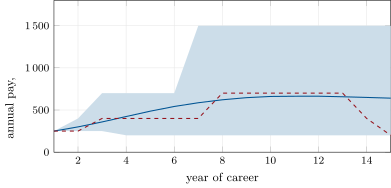
Careers also leave the industry: to technology firms, to academia, to the official sector (regulators and central banks, chapter 9), to corporate treasury and risk, or to retirement after a short career. The illustrative career chain of Figure 28.2 gives each year a 5% chance of leaving; with its other assumptions, 36.7% of graduates have left by year ten and 21.5% run a portfolio. Its pay paths spread widely: the median rises to a senior researcher’s pay by year eight and falls back as exits accumulate, while the 90th percentile reaches a portfolio manager’s from year seven.
in_career.career, from firm.careerpath.simulate.28.6 Tutorial: move now or wait for the vest?
Goal. Price a move by its month and its buyout, and follow a career as a Markov chain. End state: Figures 28.1 and 28.2.
- The package.
firm.careerpath.Job(base, award, deferral, vest_years, pay_month);forfeitedgives the three forfeited items by month. The move.
move_costandbreakeven_raise(Listing 28.1).def move_cost(job, month, notice_m, garden_m=0, noncompete_m=0, paid_noncompete=True, q=0.0, s=1.0): f = forfeited(job, month) out_m = notice_m + garden_m + noncompete_m lost_award = job.award * out_m / 12.0 lost_base = 0.0 if paid_noncompete else job.base * noncompete_m / 12.0 buyout = q * s * (f["deferred"] + f["unpaid"]) total = f["total"] + lost_award + lost_base - buyout return {"forfeited": f["total"], "out_months": out_m, "lost_award": lost_award, "lost_base": lost_base, "buyout": buyout, "net": total} def breakeven_raise(job, month, horizon_y, **move): return move_cost(job, month, **move)["net"] / ((job.base + job.award) * horizon_y)Listing 28.1. The net cost of a move and the raise that makes it neutral. code/firm/careerpath/firm_careerpath.py - The employer’s view. Book 16’s
firm.gardenleave.best_length. - The career.
Chain(states, P, pay),simulateandpay_paths; the lineage graph’s spin-outs throughspinouts.
The surface’s corners: resigning at the start of February needs 56.1% without a buyout and 21.1% with a certain one; resigning at the start of December, 52.8% and 37.3%.
What to change next. Discount the raise and let the award vary; let the buyout cover only deferred pay; add a good-leaver clause (chapter 13); estimate a chain’s transition probabilities from public profiles, with their bias.
28.7 Build: firm.careerpath
Purpose. Price a move between employers, and model a career as a chain of states with labelled assumptions.
Interface. firm.careerpath: Job; unvested; forfeited(job, month); move_cost(job, month, notice_m, garden_m, noncompete_m, paid_noncompete, q, s); breakeven_raise(job, month, horizon_y, …); Chain(states, P, pay); simulate(chain, start, years, n, rng); pay_paths; spinouts(graph); with firm.gardenleave and firm.lineage.
Rules. Bad-leaver forfeiture; no award accrues out of the market; rows of the chain sum to one or the simulation refuses; every parameter labelled by the caller.
Acceptance tests. code/firm/careerpath/tests/: the unpaid award is forfeited only before its payment month; the worst month is the one before payment; a certain buyout offsets the forfeited awards; a deterministic chain moves as specified.
Stretch. Discounting and award uncertainty (with firm.payoffer); a chain with duration-dependent promotion; team moves.
Sources and further reading
- Employment Rights Act 1996, s. 86; UK Department for Business and Trade (2025), working paper on non-compete reform.
- Federal Trade Commission (2025), press release on the non-compete rule; California Business and Professions Code s. 16600.5.
- Optiver and Jane Street, students and internships pages.
- Book 16, chapters 11 and 25; Book 18 on hiring.
28.8 Exercises
Exercise 28.1 ★
With the example’s package, what are the unvested deferrals, and what does resigning at the start of March forfeit?
Solution
Solution of Exercise 28.1.
unvested. Resigning at the start of March, after the February payment, forfeits those and two months of accrual, : $338 333.
Exercise 28.2 ★
What is the UK statutory minimum notice for an employer to give someone with seven years of service?
Solution
Solution of Exercise 28.2.
Seven weeks: one week for each year of service between two and twelve years.
Exercise 28.3 ★
How much award does a year out of the market cost in the example?
Solution
Solution of Exercise 28.3.
Twelve months without an award: $350 000.
Exercise 28.4 ★★
A certain buyout makes a February move cheaper than a March move without one. Why is it still not free?
Solution
Solution of Exercise 28.4.
The buyout replaces the forfeited deferrals and the unpaid award ($630 000), but not the month’s accrual ($29 167) or the year out of the market ($350 000): the February move still costs $379 167, a 21.1% raise, against 38.2% for a March move without a buyout.
Exercise 28.5 ★★
A new employer offers a 25% raise and a 50% chance of a buyout. In which months is the move worth it?
Solution
Solution of Exercise 28.5.
In none: with a 50% buyout chance the neutral raise is at least 30.5% (March) and up to 45.0% (December).
Exercise 28.6 ★★
Why would a candidate care whether a non-compete is paid?
Solution
Solution of Exercise 28.6.
An unpaid non-compete adds the base for its months to the cost ($125 000 for six months here); a paid one costs only the award that does not accrue. Some legal systems also look at payment when deciding whether a clause is reasonable.
Exercise 28.7 ★★★
Coding. Make the non-compete unpaid. What is the neutral raise for a February resignation with a 50% buyout chance?
Solution
Solution of Exercise 28.7.
The cost rises by $125 000 to $819 167, and the neutral raise to 45.5%.
Exercise 28.8 ★★★
Find the flaw. “The model shows that a fifth of graduates become portfolio managers within ten years.”
Solution
Solution of Exercise 28.8.
The chain’s transition probabilities are the chapter’s assumptions, not estimates: 21.5% is what those assumptions imply, and says nothing about real careers. The model is useful for the shape of the fan and for sensitivity to the assumptions.
28.9 Problem: Move Now or Wait for the Vest?
Problem 28.1
Weekend problem — move now or wait for the vest?
A trader on the example’s package receives an offer in late January and asks when to resign.
Part I — The routes.
- Define an internship, a return offer, a graduate programme and a lateral hire.
- How do the firms describe their internships and graduate roles?
- Where does a doctorate lead?
- Name the common edges of moves between employers.
- What public data count them?
Part II — The cost.
- Define the notice period and state the UK statutory minimum.
- State the method.
- Compute the forfeiture and the net cost for a February and a March resignation.
- Compute the neutral raise for each with a 50% buyout chance.
- What is the largest single item, and why?
Part III — The law and the employer.
- What is the status of the FTC’s non-compete rule?
- What has the UK government proposed, and when?
- What does California’s s. 16600.5 add?
- What garden-leave length does the employer’s model give, and from what?
- What does a spin-out need that a move does not?
Part IV — The verdict.
- State the named result: the raise that makes the move neutral as a function of the month of leaving and the buyout probability, and its value on the day before the award is paid.
- What should he ask the new employer to buy out?
- How would a good-leaver clause change the answer?
- What does the career chain say, and not say?
- In two sentences, advise him.
Solution
Solution of Problem 28.1.
- As in the chapter’s definition.
- As trials for full-time roles, and graduate roles built around learning through real work, in several offices.
- To research roles, above a new graduate’s level.
- Bank to buy side and back, between buy-side firms, between technology and trading.
- None; only the cost of a move can be measured.
- As in the definition; one week a year of service up to twelve weeks from the employer, one week from the employee.
- As in the method.
- February: $659 167 forfeited, $694 167 net with a 50% buyout chance. March: $338 333 forfeited, $548 333 net.
- 38.6% and 30.5%.
- The year out of the market, $350 000 of award, because it is lost in every month and no buyout replaces it.
- Stopped in August 2024 and vacated; the FTC dismissed its appeals in September 2025.
- A three-month limit announced in May 2023 and not enacted; a working paper of November 2025 on limits, a ban or a salary threshold.
- Such clauses are unenforceable in California wherever they were signed, and trying to enforce them is a civil violation.
- About nine months (0.74 years), from the strategy’s profit, the share lost, the edge’s half-life and the pay.
- Capital, investors, a track record they believe, and the freedom from restrictive covenants to use what one knows.
- Between 21.1% and 56.1% at the start of February depending on the buyout; 38.6% at a 50% chance, against 30.5% a month later.
- The forfeited deferrals and the unpaid award, and ideally the accrual, in cash or in the new firm’s deferred pay.
- It would keep the deferrals vesting, removing $280 000 from the cost.
- The shape of a career under stated assumptions: a widening fan and a large share of exits; not real frequencies.
- Wait until the award is paid unless the new firm buys out all of it, and ask for the accrual too. The year out of the market is the largest cost, so negotiate its length and whether it is paid.
28.10 Interview questions
Interview question 28.1 ★ trader, researcher
Why do you want to leave your current firm?
Solution
Solution of Interview question 28.1.
Say what you want to do that the new firm offers, not what is wrong with the old one; be specific and consistent.
What the interviewer is looking for: a forward-looking reason.
Interview question 28.2 ★ researcher
What can you tell us about your current strategies, and what can you not?
Solution
Solution of Interview question 28.2.
The kind of work, the markets and horizons, the methods in general terms and your role; never the signals, parameters, code, data or positions, which belong to your employer.
What the interviewer is looking for: respect for confidentiality.
Interview question 28.3 ★★ trader
You have a six-month non-compete. How would you use the time?
Solution
Solution of Interview question 28.3.
Study, rest and prepare in ways the clause allows: courses, public research, tools unrelated to the old employer’s strategies; not trading or working for a competitor.
What the interviewer is looking for: knowing what the clause forbids.
Interview question 28.4 ★★ researcher, trader
How would you show us your track record without disclosing your employer’s information?
Solution
Solution of Interview question 28.4.
With the employer’s permission or with aggregates that reveal nothing proprietary (Sharpe ratio, drawdown, capacity, turnover), references, and a description of the process; never with the employer’s data.
What the interviewer is looking for: evidence without disclosure.
Interview question 28.5 ★★ bank, researcher
Why move from a bank to a fund, and what will you miss?
Solution
Solution of Interview question 28.5.
Closer ownership of results and faster feedback; you would miss the breadth of products, the client flow and the bank’s infrastructure.
What the interviewer is looking for: an honest trade-off.
Interview question 28.6 ★★★ trader, researcher
Price the deferred pay you would forfeit by joining us, and propose a buyout.
Solution
Solution of Interview question 28.6.
List the unvested tranches with their vesting dates and current value, the unpaid award, and the accrual; propose a buyout in the new firm’s deferred pay on a matching schedule, so that both sides keep the incentive.
What the interviewer is looking for: a concrete schedule and aligned incentives.