The Industry: Firms, Roles and Careers · Careers
4Quantitative Hedge Funds and Systematic Managers
The most secretive funds in the business still file one public form. Every investment adviser registered with the SEC answers, at least once a year and under penalty of law, the same questions: how many people it employs, how many of them do investment work, how much it manages, and how many private funds it runs, with their gross assets. The SEC publishes the answers as a single file, one row per adviser. In January 2026 that file held 2 577 advisers that run hedge funds. Read together, their rows make firms that publish nothing else comparable: the median one employs eleven people, and among those with ten or more staff the middle half manage between $58 million and $221 million per employee. This chapter reads the quantitative managers among them.
4.1 Three families
Quantitative investment managers are usually described in three families, which differ in method, horizon and the kind of research job they offer.
- Research-driven multi-strategy funds run many signals across asset classes and horizons, often alongside discretionary teams, on large research platforms.
- Trend followers, the commodity trading advisors of Book 1 (chapter 3), trade futures on the persistence of price moves (Book 8, chapter 19), at horizons of weeks to months.
- Statistical-arbitrage houses trade large, market-neutral books of shares on short-horizon relative signals (Book 8, chapter 1).
The families overlap, and firms do not always use these words for themselves. What separates the managers of this chapter from others is how decisions are made.
Definition 4.1 (Systematic manager, discretionary manager)
A systematic manager is an investment manager whose trading decisions are taken by rules implemented in software, from models fitted to data; people design, test, monitor and change the rules, not the trades. A discretionary manager is one whose portfolio managers decide the trades, with whatever analysis supports them.
The managers named in this chapter describe themselves in those terms: an investment firm that “employs mathematical and statistical methods in the design and execution of its investment programs”, “a quantitative investment and trading firm”, “quantitative investors” for whom “a systematic and disciplined approach is the best way”, “one of the longest running systematic managers”, a firm that approaches investment “through the prism of machine learning”. One says it “launched in 1988 as a pioneer in systematic investing” and then built fundamental and discretionary expertise: many large firms are both.
4.2 What Form ADV reveals
Definition 4.2 (Regulatory assets under management)
An adviser’s regulatory assets under management (RAUM) are the securities portfolios over which it provides continuous and regular supervisory or management services, at their gross value: the adviser does not deduct any outstanding indebtedness or other liabilities of the portfolios.
RAUM is not the assets under management of Book 1 (chapter 1) as funds report them to investors. It counts gross positions, so a fund that borrows or holds derivatives reports more than its net asset value; and it counts only securities portfolios. A manager with modest capital and high gross leverage has large RAUM. For a job seeker the gap matters when comparing firms: RAUM measures what the adviser runs, not what investors have entrusted.
Definition 4.3 (Exempt reporting adviser)
An exempt reporting adviser is an investment adviser exempt from SEC registration – for example because it advises only private funds and manages less than $150 million of private-fund assets in the United States – that must still file a short report on Form ADV.
Four items of the form carry most of what a reader wants:
- 5.A the approximate number of employees;
- 5.B(1) how many of them “perform investment advisory functions (including research)”;
- 5.F regulatory assets under management;
- 7.B the private funds advised: whether any is a hedge fund, how many, and their total gross assets.
Remark 4.4 (What the form does not show)
The form describes one registered adviser. A group can split its staff and assets across several advisers and affiliates, some registered elsewhere: the US adviser of a global firm may employ a few dozen of its thousands of staff. The form does not report returns, fees, pay or revenue. And answers are updated once a year at least, so a row may be most of a year old.
4.3 Assets, gross assets and concentration
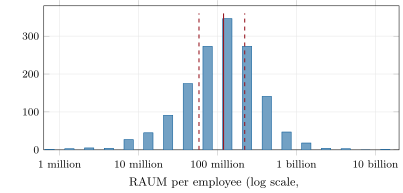
Among the 1 458 hedge-fund advisers with ten or more employees in the January 2026 file, RAUM per employee has a median of $119 million, a middle half from $58 million to $221 million, and a tenth of advisers above $399 million (Figure 4.1). Half of a typical adviser’s staff do investment work (the quartiles of the advisory share are 37% and 62%). The industry is not concentrated: the ten largest advisers by private-fund gross assets hold 21% of the $17.6 trillion reported by all hedge-fund advisers, and the Herfindahl–Hirschman index (Book 16, chapter 30) of those gross assets is 78 on a scale of 10 000.
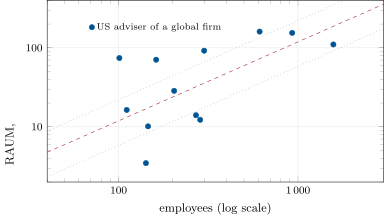
in_quantfunds.hist.As of January 2026 — Thirteen quantitative advisers in the SEC file
| adviser (as registered) | employees | advisory | RAUM ($ bn) | private-fund gross ($ bn) |
|---|---|---|---|---|
| Squarepoint (US adviser) | 71 | 51 | 182.2 | 162.5 |
| AQR Capital Management | 611 | 238 | 160.5 | 87.6 |
| D. E. Shaw & Co. | 928 | 476 | 154.6 | 161.1 |
| Two Sigma Investments | 1 575 | 749 | 110.3 | 139.7 |
| Renaissance Technologies | 300 | 160 | 92.0 | 81.3 |
| Two Sigma Advisers | 101 | 68 | 74.3 | 107.8 |
| AHL Partners (Man Group) | 162 | 131 | 70.7 | 56.5 |
| Graham Capital Management | 204 | 98 | 28.5 | 28.5 |
| Voleon Capital Management | 111 | 18 | 16.4 | 17.3 |
| PDT Partners | 270 | 92 | 14.0 | 14.4 |
| Capital Fund Management | 285 | 79 | 12.3 | 12.4 |
| Winton Capital Management | 146 | 35 | 10.1 | 4.6 |
| Aspect Capital | 142 | 60 | 3.5 | 3.4 |
Latest Form ADV filings between March and December 2025, as published in the SEC’s file of January 2026. Each row is one registered adviser, not the firm: groups file through several advisers and employ staff outside them.
The table puts firms of very different shapes side by side (Figure 4.2). One adviser reports $182 billion of RAUM with 71 employees, $2.6 billion each: its staff work for affiliates outside the registered entity, so the ratio measures the entity, not the firm. Two advisers of one group file separately, with 1 575 and 101 employees. Adding them would count twice any portfolio one sub-advises for the other. At the other end, a trend-following manager reports $24 million per employee and a machine-learning manager has 18 of its 111 employees in advisory functions: the rest build and run systems. The advisory share is the form’s closest answer to a candidate’s question, how many of the staff do research.
in_quantfunds.named.Method 4.5 (Reading a manager’s Form ADV)
- Find every adviser of the group (the file’s legal names, the firm’s own disclosures) and read their rows separately.
- Compare RAUM with private-fund gross assets: a ratio far below one means managed accounts or registered funds outside the private funds; far above one, private funds counted in another adviser’s RAUM.
- Read the advisory share (5.B(1) over 5.A) as the share of staff in research and portfolio work.
- Check the filing date; treat every figure as a dated range.
4.4 Secrecy and publication
Systematic managers are secretive about their models and open about their methods. What they publish falls into three kinds: research papers and commentary on factors, trends and risk premia, written for investors; academic papers by their researchers, often on statistics and machine learning; and descriptions of method on their own pages, such as one firm’s statement that it uses “scientific and academic methods including the latest machine learning techniques to find trading signals in global financial and alternative data”. None of this reveals a signal. It tells a candidate what the firm values and what kind of research job it offers: a manager that publishes factor research hires researchers who write; one that publishes nothing but a sentence hires people who will not.
4.5 Tutorial: assets per head from the SEC’s adviser file
Goal. Compute the distribution of RAUM per employee of hedge-fund advisers and place thirteen named quantitative advisers in it. End state: Figure 4.1 and the ranks of exercise 5.
- The file. Download the SEC’s adviser file for a month (about 5 MB zipped, one CSV of about 16 600 rows and 448 columns) to a scratch directory; it is public, and it is not committed.
Read it.
firm.formadv.read(path)streams the CSV from the zip and keeps, for advisers of hedge funds, the items of section 2 (Listing 4.1).def read(src, hedge_only=True): r = _rows(src) h = next(r) ix = {k: h.index(v) for k, v in COLS.items() if v in h} if hedge_only and "any_hedge" not in ix: raise ValueError("this file has no hedge-fund columns: read it with hedge_only=False") def get(row, k): return row[ix[k]] if k in ix and ix[k] < len(row) else "" out = [] for row in r: if hedge_only and get(row, "any_hedge").strip().upper() not in ("Y", "YES"): continue out.append(Adviser(get(row, "crd").strip(), get(row, "name").strip(), _num(get(row, "employees")), _num(get(row, "advisory")), _num(get(row, "raum")), _num(get(row, "pf_gav")), _num(get(row, "n_hedge")), get(row, "filed").strip())) return outListing 4.1. Stream the adviser file and keep hedge-fund advisers. code/firm/formadv/firm_formadv.py - Derive.
in_adv_derive.pywrites three small tables todata/industry/: the distribution statistics, the named advisers’ rows, and a histogram; the chapter’s figures and tests read only these. - Place.
in_quantfunds.percentile_rank(x)gives the share of advisers with ten or more employees below a RAUM per employee of .
What to change next. Repeat with the file of a year earlier and compare the named advisers’ employees (chapter 5 does this for multi-manager platforms); restrict to advisers whose private-fund gross assets exceed their RAUM and see how the distribution moves.
4.6 Build: the adviser file reader
Purpose. One reader for the SEC’s Form ADV file, used by chapters 4, 5, 8 and 12.
Interface. firm.formadv: COLS; Adviser(crd, name, employees, advisory, raum, pf_gav, n_hedge, filed); read(path_or_fileobj, hedge_only); per_head(a); quantiles(values, qs); concentration(values, k), which wraps firm.moats.
Rules. Streams the file and never writes raw rows back; a blank answer is None, never zero; per-head ratios are undefined without a positive headcount.
Acceptance tests. code/firm/formadv/tests/: a three-row fixture in the file’s own format; the hedge-fund filter; per-head ratios and a missing advisory count; the top- share and index on known shares.
Stretch. Read the monthly files of several years into a panel keyed by the adviser’s CRD number; read Schedule D’s private-fund rows from the full Form ADV data set.
Sources and further reading
- SEC, Information about registered investment advisers, adviser file of January 2026 (
ia010226.zip), Internet Archive copy. - SEC, Form ADV Part 1A and General Instructions; 17 CFR 275.203(m)-1 and 275.204-4.
- The managers’ own pages for their descriptions (ledger F7–F18).
4.7 Exercises
Exercise 4.1 ★
Compute the RAUM per employee and the advisory share of the adviser with 300 employees, 160 advisory employees and $92.0 billion of RAUM.
Solution
Solution of Exercise 4.1.
million of RAUM per employee; of staff in advisory functions.
Exercise 4.2 ★
A fund has net assets of $2 billion and gross long and short securities positions of $7 billion. Roughly what RAUM does its adviser report for it, and why?
Solution
Solution of Exercise 4.2.
About $7 billion: RAUM counts the securities portfolio at gross value and does not deduct the fund’s borrowing or other liabilities, so gross positions, not net assets, are reported.
Exercise 4.3 ★
An adviser manages only private funds, with $120 million of assets in the United States. Must it register with the SEC, and what must it file?
Solution
Solution of Exercise 4.3.
No: an adviser solely to qualifying private funds with less than $150 million of private-fund assets in the United States is exempt from registration. It is an exempt reporting adviser and files a report on Form ADV.
Exercise 4.4 ★★
For the thirteen advisers of the dated box, which have private-fund gross assets below half of RAUM, and what does that suggest?
Solution
Solution of Exercise 4.4.
Only Winton Capital Management (); AQR is close (). Much of their RAUM sits outside private funds: managed accounts or registered funds, which a hedge-fund count alone would miss.
Exercise 4.5 ★★
Using percentile_rank, where in the distribution of RAUM per employee do the smallest and the largest of the thirteen advisers by that measure fall, and why is the largest not a fact about its firm?
Solution
Solution of Exercise 4.5.
Aspect Capital, $24.4 million per employee, is at about the 9th percentile; Squarepoint’s US adviser, $2.57 billion, at about the 99.6th. The latter is a registered entity of 71 people through which assets are advised while the firm’s staff work for affiliates elsewhere: the ratio divides a group’s assets by an entity’s headcount.
Exercise 4.6 ★★
From Figure 4.1, estimate the share of advisers with RAUM per employee above $1 billion.
Solution
Solution of Exercise 4.6.
The bins at $1 billion and above hold of 1 457 advisers: 1.8%.
Exercise 4.7 ★★★
Coding. Compute the top-ten share and the Herfindahl–Hirschman index of ten equal advisers and of a thousand equal advisers. Where does the file’s index of 78 lie between them, and what does it say?
Solution
Solution of Exercise 4.7.
Ten equal advisers: top-ten share 100%, index 1 000. A thousand equal: 1% and 10. An index of 78 is what about equal-sized advisers would give: a large, unconcentrated industry with some big firms.
Exercise 4.8 ★★★
Find the flaw. “The adviser with 71 employees manages $182 billion: it is the most productive quantitative manager in the world.”
Solution
Solution of Exercise 4.8.
The row is one registered adviser; the group’s thousands of staff are employed by affiliates that are not in the row. RAUM per employee of an entity is not the firm’s productivity, and RAUM is gross assets, not revenue or profit.
4.8 Problem: Assets per Head
Problem 4.1
Weekend problem — assets per head
A researcher weighing offers from three systematic managers wants to know how large each is and how research-heavy, from public records only.
Part I — The families and the form.
- Define a systematic and a discretionary manager, and describe the three families.
- Which four items of Form ADV carry most of what a reader wants?
- Define RAUM and say how it differs from assets under management.
- Define an exempt reporting adviser and give the threshold of the private-fund exemption.
- What three limits of the form does Remark 4.4 name?
Part II — The distribution.
- How many hedge-fund advisers are in the January 2026 file, and how many have ten or more employees?
- Give the median and the quartiles of RAUM per employee for the latter.
- Give the quartiles of the advisory share.
- Give the ten largest advisers’ share of private-fund gross assets and the Herfindahl–Hirschman index.
- What is the median number of employees of a hedge-fund adviser?
Part III — The named advisers.
- Compute RAUM per employee for the thirteen named advisers and rank them.
- Which lie inside the middle half of the distribution?
- Which have the lowest and the highest advisory share?
- Which two rows belong to one group, and why must they not be added?
- Which ratio of RAUM to private-fund gross assets is furthest below one?
Part IV — The verdict.
- State the named result: the middle half of RAUM per employee for hedge-fund advisers, the range across the named quantitative advisers, and the concentration measures.
- Why is the largest named ratio a fact about an entity, not a firm?
- What does an advisory share of 16% tell a researcher about a firm?
- What would the researcher need that the form does not report?
- In two sentences, how should the researcher use the three rows?
Solution
Solution of Problem 4.1.
- Systematic: trades decided by rules in software; discretionary: by portfolio managers. Research-driven multi-strategy funds; trend followers; statistical-arbitrage houses.
- 5.A employees; 5.B(1) advisory employees; 5.F RAUM; 7.B private funds.
- Securities portfolios under continuous supervision at gross value, with no deduction of indebtedness; AUM as reported to investors is usually net.
- An adviser exempt from registration that files a short Form ADV report; the private-fund exemption applies below $150 million of US private-fund assets.
- One adviser is not the group; no returns, fees, pay or revenue; answers may be most of a year old.
- 2 577; 1 458.
- $119 million; $58 million and $221 million.
- 37% and 62% (median 50%).
- 21%; 78.
- Eleven.
- Squarepoint (US) $2 567m, Two Sigma Advisers $735m, AHL Partners $436m, Renaissance $307m, AQR $263m, D. E. Shaw $167m, Voleon $147m, Graham $140m, Two Sigma Investments $70.0m, Winton $69.5m, PDT $51.9m, CFM $43.1m, Aspect $24.4m.
- D. E. Shaw, Voleon, Graham, Two Sigma Investments and Winton.
- Voleon (16%) and AHL Partners (81%).
- Two Sigma Investments and Two Sigma Advisers: one may advise portfolios the other also reports, so their RAUM can overlap, and their staff are split across entities.
- Winton, 0.46.
- Middle half $58–221 million per employee (median $119 million); named advisers from $24 million to $2.6 billion; top-ten share 21% and index 78.
- It divides assets advised through a US entity by that entity’s small staff.
- That most of its staff build and run systems rather than hold advisory roles: a research job there sits in a large engineering organisation.
- Revenue, returns, pay, where the rest of the group’s staff are, and how the entities relate.
- As dated ranges of size and research share for the registered entities, read against their filing dates and group structure; never as productivity or pay.
4.9 Interview questions
Interview question 4.1 ★ researcher
What is the difference between a systematic and a discretionary fund, from the point of view of a researcher who works there?
Solution
Solution of Interview question 4.1.
At a systematic fund the researcher’s output is a rule that trades without them, judged by out-of-sample performance and its interaction with the portfolio; at a discretionary fund the researcher supports a portfolio manager’s decisions, and is judged by the manager.
What the interviewer is looking for: who decides the trade, and so what the researcher ships.
Interview question 4.2 ★ researcher, risk
Why can a fund’s gross assets exceed its net asset value by several times?
Solution
Solution of Interview question 4.2.
Leverage: borrowing, short positions and derivatives add gross exposure without adding capital; a market-neutral book may hold longs and shorts each larger than its net assets.
What the interviewer is looking for: gross against net.
Interview question 4.3 ★★ researcher
A manager has $100 billion of RAUM and 1 000 employees, of whom 400 do investment work. How would you describe it, and what would you want to know before comparing it with a firm of 300 people and $90 billion?
Solution
Solution of Interview question 4.3.
$100 million of RAUM per employee (near the median of the file), 40% in investment work. Before comparing: whether both rows are the whole firm or one entity, how much RAUM is leverage, the RAUM against private-fund gross assets, the filing dates, and the business mix.
What the interviewer is looking for: ratios, their scope and their denominators.
Interview question 4.4 ★★ researcher, mle
Why do systematic managers publish research at all, when their edge depends on secrecy?
Solution
Solution of Interview question 4.4.
To raise money (investors want to understand the process), to hire (researchers want to publish and to see the culture), and because method is not the edge: published factor research and statistics help sell and recruit without revealing specific signals.
What the interviewer is looking for: secrecy of signals, openness of method.
Interview question 4.5 ★★ researcher
The ten largest of 2 577 advisers hold a fifth of the assets. Is the industry concentrated? What would change your answer?
Solution
Solution of Interview question 4.5.
No: a top-ten share of 21% and an index of 78 are low. The answer would change within a strategy (a few firms may dominate one market or style), by the measure used (net assets, revenue), or if private-fund assets outside the United States were counted.
What the interviewer is looking for: the market’s definition drives the answer.
Interview question 4.6 ★★★ researcher, risk
A trend-following programme and a statistical-arbitrage book each have a Sharpe ratio of one. Which can take more capital, and what limits each?
Solution
Solution of Interview question 4.6.
Usually trend following: futures markets are deep and positions are held for weeks, so costs grow slowly with size; its limit is the market-impact cost of the largest contracts and crowding in the same trends. The statistical-arbitrage book turns over fast in many small positions: impact grows with size and its capacity is lower (Book 7, chapter 28).
What the interviewer is looking for: capacity as turnover times impact.