The Industry: Firms, Roles and Careers · Careers
25Leadership Roles
In the United Kingdom, the most senior people at a regulated firm hold senior management functions, need the regulator’s approval before they start, and each has a written statement of their responsibilities. The regulator’s guide explains why: they “are the most senior people in a firm with the greatest potential to cause harm or impact upon market integrity”. At the top of a trading firm, a job title is also a legal accountability. This chapter describes the leadership roles a quantitative career can reach (head of desk, the chief officers, partner, chief executive and founder), the accountability regimes that attach to them, and the economics of making partner.
| Role cards: leadership | ||||
|---|---|---|---|---|
| head of desk | chief risk officer | partner | chief executive | |
| answers for | a desk’s P&L, risk and people | the firm’s risk framework | the firm, as an owner | the whole business |
| paid by | salary and a bonus on the desk | salary and a control bonus | a share of profit by points | salary, bonus and ownership |
| UK function | (certified, not SMF) | SMF4 (enhanced firms) | SMF27 | SMF1 |
| taught in | Book 16, ch. 6 | Book 16, ch. 12 | Book 16, ch. 2 | Book 16, ch. 1 |
25.1 Head of desk
Definition 25.1 (Head of desk)
A head of desk is the person who runs one trading desk: sets its strategy within the firm’s risk appetite, allocates its limits and capital among its traders, answers for its profit and loss, its risk and its people, and agrees its revenue budget with the business’s management.
The head of desk is the first leadership role most traders and quantitative researchers reach. The revenue budget and the risk appetite of Book 16, chapter 6, are the terms of the job; hiring, pay recommendations and the desk’s controls are its content. A head of desk still trades at many firms, but the job’s measure changes from one’s own result to the desk’s. In the UK scheme, a head of desk who holds no senior management function is not a senior manager, and may fall under the certification regime of chapter 16 instead.
25.2 Chief risk, technology and operating officers
The chief officers run functions rather than books. The chief risk officer (Book 16, chapter 12) owns the risk framework and reports to the board as well as the chief executive; the chief technology officer owns the systems that trade (chapters 19 and 20); the chief operating officer owns operations and often finance and the firm’s infrastructure (chapter 24). Each can be the destination of a quantitative career that has broadened: a risk quant can become head of market risk and then chief risk officer; an engineer, chief technology officer. In enhanced UK firms each of these roles is a named senior management function: SMF4 for the chief risk officer, SMF24 for the chief operations function, SMF2 for the chief finance function.
25.3 Partner
Some proprietary trading firms are partnerships (Book 16, chapter 2): a limited liability partnership whose members own the firm, contribute capital, share its profit by points and leave part of it in the firm. Chapter 11 read one such firm’s accounts, where members’ remuneration is a share of profit rather than a salary. Making partner changes three things: pay becomes a share of the firm’s profit rather than of one’s own; part of it stays in the firm as capital at risk; and the partner answers for the whole firm.
Method 25.2 (A new partner’s first years)
Let the firm’s profit in year be , and let the new partner hold of the partnership’s points, with rising when others are admitted. The partner’s share is ; the partner draws and retains the rest of a positive share in their capital account; a loss reduces the capital account by . Starting capital is the contribution on admission.
Example 25.3 (Making partner)
Illustrative terms: firm profit normal with mean $300 million and standard deviation $200 million a year; 30 partners with 100 points each; the new partner receives 30 points and contributes $1 million; 60% of each positive share is drawn; three more partners of 30 points are admitted in year three. Over five years the new partner’s expected draws are $8.93 million (10th–90th percentile $5.79–12.14 million), and their capital account is expected to reach $6.67 million, with a 5th percentile of $3.32 million. In 9.4% of paths the capital account falls below the contribution at some year-end. Against a salaried head of desk at $1.2 million a year, the draws alone break even at about 20 points, 0.66% of the partnership (Figure 25.1).
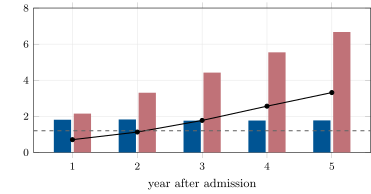
in_leader.summary, from firm.roles.partner_path on firm.partnership.The comparison needs care. The draws are income; the capital account is wealth that the partner will receive back only on leaving, in instalments (Book 16, chapter 2), and can lose. A partner who counts the capital as pay is taking the firm’s risk with a large part of their savings, which is the partnership’s purpose: the owners’ money is the first to absorb a loss.
25.4 Chief executive and founder
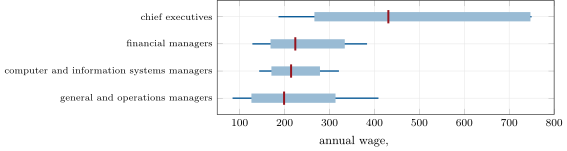
At the top the roles can merge: a founder may be chief executive, chief investment officer and the largest partner or shareholder at once. Book 16, chapter 1, sets out the economics of the trading firm the founder builds, and chapter 25 of that book the launch of a fund. For a quantitative career the route there is rarely through titles: it runs through a strategy or a technology that works and the capital and people to scale it. The survey’s chief executives in the securities industry earned a median wage of $431 020 in May 2025, with a 90th percentile of $749 840; for founders and partners wages are a small part of pay, which the survey does not measure.
As of May 2025 — What leaders are paid: the public evidence
Occupational survey, May 2025, securities industry: chief executives 4 700 employed, median wage $431 020 (10th–90th percentile $186 460–749 840); computer and information systems managers 18 630, median $214 460; general and operations managers 39 880, median $198 900; financial managers median $223 860. EBA high earners 2024: 586 members of credit institutions’ management bodies (management function) paid over one million euros, average 2.10 million, variable 0.73 of fixed; 61 at investment firms, average 1.99 million, variable 2.07 of fixed. Wages and aggregates only; no individual’s pay.
data/industry/oews_roles.csv, through in_leader.survey.25.5 Accountability regimes
Definition 25.4 (Senior manager function, statement of responsibilities)
A senior manager function is a role that the UK regulators designate as one whose holder must be approved before starting and can be held personally accountable for failures in their area. A statement of responsibilities is the single document that sets out what a senior manager is responsible and accountable for.
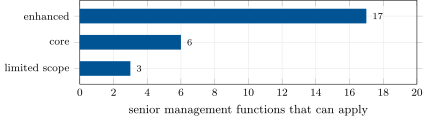
The regime scales with the firm. The FCA’s guide lists three functions for limited-scope firms, six for core firms and seventeen for enhanced firms (Figure 25.3). For a trading firm the core set is typical: a chief executive (SMF1), executive directors (SMF3) or partners (SMF27), a chair (SMF9), and the required compliance oversight (SMF16) and money-laundering reporting (SMF17) functions. In the United States, supervisors at a broker-dealer register as principals; the Series 24 exam “assesses the competency of an entry-level principal”.
As of September 2026 — Senior managers and principals
United Kingdom: FCA guide for solo-regulated firms (July 2019 update): approval before starting for every senior management function; a statement of responsibilities for every senior manager; 3 functions in the limited-scope tier, 6 in the core tier, 17 in the enhanced tier. The FCA’s PS26/6 (first published 21 April 2026) began a reform of the regime: most phase 1 changes took effect on 24 April 2026, reporting and process changes from 10 July 2026; a second phase needs legislation. United States: FINRA Series 24, the General Securities Principal exam.
firm.roles.SMF_TIERS.What the regime changes for the person is accountability: in the guide’s words a senior manager “could be held accountable if they didn’t take reasonable steps to prevent or stop” a breach in their area, and the statement of responsibilities says which area is theirs. A quant who becomes a chief risk officer or head of a trading business signs up to that.
25.6 Tutorial: making partner
Goal. Value a new partner’s first five years and compare them with a salaried job; map the regulator’s functions to the firm’s roles. End state: Figures 25.1 and 25.3.
- Capital accounts. Book 16’s
firm.partnership.Partnershipallocates each year’s profit by points, pays the drawn share and retains the rest. The path.
firm.roles.partner_pathruns it over simulated profits with a later admission (Listing 25.1).def partner_path(mean, sd, partners, points, new_points, contribution, payout, admit_year, admit, years, n, rng): """n five-year paths (or `years`) of a new partner in a partnership of `partners` members with `points` each: firm profit each year normal(mean, sd); profit allocated by points, `payout` of a positive share drawn and the rest retained in the capital account, a loss allocated by points against capital; in year `admit_year` (1-based) `admit` more partners join with new_points each. Returns the new partner's draws and year-end capital.""" import pathlib import sys sys.path.insert(0, str(pathlib.Path(__file__).resolve().parents[1] / "partnership")) import firm_partnership as fp profits = rng.normal(mean, sd, (n, years)) draws, capital = np.zeros((n, years)), np.zeros((n, years)) for i in range(n): p = fp.Partnership([fp.Member(f"p{k}", points) for k in range(partners)] + [fp.Member("new", new_points, contribution)]) for t in range(years): if t + 1 == admit_year: p.members += [fp.Member(f"a{k}", new_points) for k in range(admit)] draws[i, t] = p.allocate(profits[i, t], payout)["new"] capital[i, t] = next(m.capital for m in p.members if m.name == "new") return {"draws": draws, "capital": capital, "profits": profits}Listing 25.1. A new partner’s draws and capital account over the first years. code/firm/roles/firm_roles.py - Break-even.
in_leader.break_evenbisects the points at which expected draws equal the salaried alternative, on the same paths. - Accountability.
SMF_TIERSandsmf_countgive the functions by tier.
For the example: expected draws $1.81 million in year one, $1.76 million in year three after the admissions; capital account $2.15 million at the end of year one and $6.67 million at the end of year five.
What to change next. Let points grow with seniority; repay a departing partner’s capital in instalments and compare staying and leaving in year three; make the firm’s profit depend on its capital (Book 16, chapter 2’s treadmill).
25.7 Build: leadership cards, accountability and partner economics
Purpose. Add the leadership roles to the registry, the UK functions by tier, and the new partner’s economics.
Interface. firm.roles: the cards head of desk, chief risk officer, partner, chief executive; SMF_TIERS; smf_count(tier); partner_path(mean, sd, partners, points, new_points, contribution, payout, admit_year, admit, years, n, rng) on firm.partnership.
Rules. Profit shares by points; a loss reduces capital and pays nothing; admissions dilute from their year; terms are the caller’s, labelled illustrative.
Acceptance tests. code/firm/roles/tests/: the tiers have 3, 6 and 17 functions; with a certain profit the draw is exactly the payout times the share; an admission lowers the share.
Stretch. Seniority-weighted points; departures and capital repayment; the partner’s certainty equivalent with the capital at risk (chapter 13).
Sources and further reading
- Financial Conduct Authority (2019), The Senior Managers and Certification Regime: Guide for FCA solo-regulated firms; FCA (2026), PS26/6.
- FINRA, Series 24; EBA, high earners 2024; BLS occupational survey, May 2025.
- Book 16, chapters 1, 2, 6 and 12.
25.8 Exercises
Exercise 25.1 ★
What share of the partnership’s points does the new partner hold in year one, and after the admissions?
Solution
Solution of Exercise 25.1.
in years one and two; after three partners of 30 points join.
Exercise 25.2 ★
How many senior management functions can apply to a core firm, and which two are required functions?
Solution
Solution of Exercise 25.2.
Six: SMF1, SMF3, SMF9, SMF27 and the required functions SMF16 (compliance oversight) and SMF17 (money laundering reporting).
Exercise 25.3 ★
In a year when the firm makes $300 million, what does the new partner draw and retain?
Solution
Solution of Exercise 25.3.
A share of million: $1.78 million drawn and $1.19 million retained in the capital account.
Exercise 25.4 ★★
Why does the expected draw fall in year three although nothing else changes?
Solution
Solution of Exercise 25.4.
Three partners join in year three and the same profit is divided among more points: the share falls from 0.99% to 0.96%.
Exercise 25.5 ★★
A head of desk is offered partnership at 20 points or a raise to $1.5 million a year. What else must he know?
Solution
Solution of Exercise 25.5.
The firm’s expected profit and its variability, the payout ratio and how capital is repaid on leaving, the contribution required, how points grow with seniority, future admissions, what he gives up in bonus and in freedom to leave, and the responsibilities (SMF27) he takes on.
Exercise 25.6 ★★
Why does a partnership keep part of each partner’s profit as capital?
Solution
Solution of Exercise 25.6.
To give the firm loss-absorbing capital owned by the people who take its risks, to meet its capital requirement (Book 16, chapter 2), and to tie partners to the firm’s long-run result.
Exercise 25.7 ★★★
Coding. Raise the payout ratio from 60% to 80%. What happens to the expected five-year draws, the year-five capital account and the probability that capital falls below the contribution?
Solution
Solution of Exercise 25.7.
Expected draws rise from $8.93 to $11.91 million; the year-five capital account falls from $6.67 to $3.69 million; the probability that capital falls below the contribution at some year-end rises from 9.4% to 13.1%.
Exercise 25.8 ★★★
Find the flaw. “Over five years the partner earns $8.93 million plus $6.67 million of capital, $15.6 million in all: more than twice the head of desk.”
Solution
Solution of Exercise 25.8.
The capital account is not income: it includes the $1 million contribution, stays in the firm, is repaid only on leaving and in instalments, and can be lost. Only the draws compare with a salary: $8.93 million against $6 million, with a wide spread.
25.9 Problem: Making Partner
Problem 25.1
Weekend problem — making partner
A head of desk at a proprietary trading partnership is offered admission as a partner on the example’s terms.
Part I — The roles.
- Define the head of desk, a senior manager function and a statement of responsibilities.
- What does a head of desk answer for?
- Which functions do chief officers hold in an enhanced UK firm?
- What changes when one makes partner?
- How does a founder’s route to the top differ from a manager’s?
Part II — The model.
- State the partner’s share, draw and retention.
- State the example’s terms.
- Give the expected five-year draws and their spread.
- Give the capital account’s path and its 5th percentile.
- How often does the capital fall below the contribution?
Part III — Accountability.
- How many functions apply in each tier?
- What does a senior manager need before starting?
- What began in April 2026?
- What is the US counterpart for supervisors at a broker-dealer?
- What do the survey and the EBA show about leaders’ pay?
Part IV — The verdict.
- State the named result: the new partner’s expected five-year income and capital at risk, and the break-even share of profit against staying a salaried head of desk.
- How should the capital account be counted?
- What does accepting SMF27 add to his responsibilities?
- What should he negotiate?
- In two sentences, advise him.
Solution
Solution of Problem 25.1.
- As in the chapter’s definitions.
- The desk’s P&L, risk and people, within the firm’s risk appetite and the agreed revenue budget.
- SMF4 (chief risk officer), SMF24 (chief operations), SMF2 (chief finance), among others.
- Pay becomes a share of the firm’s profit, part of it becomes capital at risk, and the partner answers for the firm.
- Through a strategy or technology that works and the capital and people to scale it, rather than through titles.
- ; draw ; retention ; a loss reduces capital.
- Profit normal with mean $300 million and standard deviation $200 million; 30 partners of 100 points; 30 points and $1 million for the new partner; 60% payout; three more partners in year three.
- $8.93 million, 10th–90th percentile $5.79–12.14 million.
- $2.15 million after year one rising to $6.67 million after year five; 5th percentile $3.32 million.
- In 9.4% of paths at some year-end.
- 3, 6 and 17.
- The regulator’s approval, and a statement of responsibilities.
- The FCA’s PS26/6 reforms of the regime: most phase 1 changes from 24 April 2026.
- Registration as a principal, with the Series 24 exam.
- Chief executives’ median wage $431 020 in the securities industry; 586 management-body members of EU banks paid over one million euros, variable 0.73 of fixed.
- Expected draws of $8.93 million over five years and a capital account of $6.67 million at risk; break-even at about 20 points, 0.66% of the partnership, against $1.2 million a year.
- As wealth at risk, repaid on leaving, not as income.
- The partner function: approval, a statement of responsibilities, and accountability for failures in his area.
- The points and how they grow, the contribution, the payout ratio, admissions, and capital repayment on leaving.
- At 30 points the draws alone beat his salary by about half in expectation, and the capital builds a stake in the firm. Accept if he can carry the capital at risk and the accountability; negotiate the points and the repayment terms.
25.10 Interview questions
Interview question 25.1 ★ trader
Your desk is 20% below its revenue budget in October. What do you do?
Solution
Solution of Interview question 25.1.
Understand why (opportunity, risk taken, capacity, a failing strategy), protect the desk’s risk discipline rather than chase the budget with more risk, and tell management early with a plan and a revised estimate.
What the interviewer is looking for: not taking more risk to meet a budget.
Interview question 25.2 ★ risk
As a chief risk officer, how would you set a desk’s loss limit?
Solution
Solution of Interview question 25.2.
From the firm’s risk appetite and capital: allocate a share of the firm’s loss tolerance to the desk by its expected profit and volatility, check it against stress losses and the desk’s history, and review it on a fixed schedule.
What the interviewer is looking for: top-down from appetite, checked bottom-up.
Interview question 25.3 ★★ trader, researcher
Two traders on your desk made the same profit with very different risk. How do you split the bonus pool between them?
Solution
Solution of Interview question 25.3.
Reward risk-adjusted contribution: profit relative to the risk and capital used, the quality of the process, and the behaviour; say so in advance, so that traders know risk is priced.
What the interviewer is looking for: risk-adjusted pay and stated rules.
Interview question 25.4 ★★ developer
As a new chief technology officer, what would you measure in your first month?
Solution
Solution of Interview question 25.4.
Incidents and their causes, deployment frequency and failure rate, latency and capacity headroom, the bus factor of critical systems (Book 16, chapter 21), and cost.
What the interviewer is looking for: reliability and risk before new projects.
Interview question 25.5 ★★ trader
When should a head of desk stop trading personally?
Solution
Solution of Interview question 25.5.
When managing the desk’s risk and people takes the attention trading needs, or when trading personally creates a conflict in allocating limits and credit; many desks keep a small book for the head to stay close to the market.
What the interviewer is looking for: attention and conflicts.
Interview question 25.6 ★★★ trader, risk
A partner proposes raising the payout ratio to 80% after a good year. Argue both sides.
Solution
Solution of Interview question 25.6.
For: partners are rewarded and retained, and the firm may not need the capital. Against: less loss-absorbing capital, a higher chance that capital falls below requirements after a bad year (the chapter’s model: 13.1% against 9.4%), and less capacity to invest.
What the interviewer is looking for: payout against capital resilience.