Rates, Credit, XVA and Risk · Rates, credit & risk
22Stress Testing and Scenarios
In March 2021 price falls in the most concentrated positions of Archegos Capital Management, a family office, triggered margin calls it could not meet. It had grown in a year from about 1.5 billion dollars of capital and 10 billion of exposure to more than 36 billion of capital and 160 billion of exposure, much of it through total return swaps with several prime brokers, each of which saw only its own part. Its default caused over 10 billion dollars of losses across several large banks; one of them, Credit Suisse, lost close to 5.5 billion. The losses came from a move that a risk measure calibrated on the recent past, applied to one broker’s slice of the book, would not have called likely. This chapter is about the tools that ask the other question: not how much the book loses on a bad day, but what happens in a particular bad world, which worlds would break the firm, and what supervisors require banks to survive.
22.1 What value at risk cannot see
Definition 22.1 (Stress test)
A stress test revalues a portfolio, or a whole firm, under a specified severe but plausible scenario of risk-factor moves, and reports the loss and its consequences (capital, liquidity, limits), without attaching a probability to the scenario.
VaR and ES summarise a distribution estimated from a window of history; they miss moves the window does not contain, changes in correlation, the concentration and illiquidity of a position (which lengthen the time to exit), and the losses of counterparties who hold the same positions. A stress test replaces the distribution by a story, told in numbers.
22.2 Historical scenarios
Definition 22.2 (Historical scenario)
A historical scenario applies to today’s positions the moves the risk factors made over a past period: differences for rates and spreads, relative changes for prices.
Example 22.3 (Three episodes on one book)
Chapter 21’s book (long ten-year Treasuries, short two-year, long euros, short yen, short a EURUSD straddle), revalued in full under three periods of Treasury and ECB data:
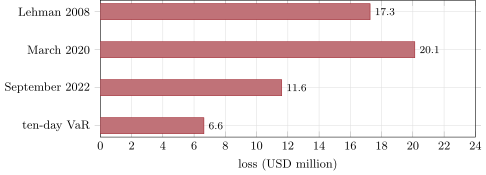
- Lehman, 12 September to 10 October 2008: two-year yield basis points, ten-year , EURUSD , USDJPY ; a loss of USD 17.26 million;
- March 2020, 6 to 20 March: and basis points, EURUSD , USDJPY ; a loss of USD 20.13 million;
- September 2022, 21 to 28 September: and basis points, EURUSD , USDJPY ; a loss of USD 11.61 million.
The ten-day 99% historical VaR scaled from chapter 21 is USD 6.63 million: every episode loses two to three times as much (Figure 22.1). The short straddle, harmless on normal days, dominates the losses in all three.
As of September 2026 — October 1987 and September 2022
On 19 October 1987 the Dow Jones Industrial Average fell 508 points, 22.6%, in one session, the largest one-day decline in its history. In late September 2022 the thirty-year UK gilt yield rose 160 basis points in a few days, with an intraday range of 127 basis points on one day, as liability-driven investment funds met margin calls.
22.3 Hypothetical scenarios and their consistency
Definition 22.4 (Hypothetical scenario)
A hypothetical scenario is a set of moves designed rather than observed: a story (a rate spike, a devaluation, a default) translated into shocks to some risk factors, with the rest of the factors set consistently.
Definition 22.5 (Scenario conditioning)
Scenario conditioning fills the factors a scenario does not specify with their expectation given the specified ones. Under a joint normal model with covariance , shocks to the specified factors give for the others.
def condition(cov: np.ndarray, shocked: Sequence[int], values: Sequence[float]) -> np.ndarray:
    """Full move vector: the given shocks, the other factors at their conditional expectation."""
    n = cov.shape[0]
    s = list(shocked)
    u = [k for k in range(n) if k not in s]
    x = np.zeros(n)
    x[s] = values
    x[u] = cov[np.ix_(u, s)] @ np.linalg.solve(cov[np.ix_(s, s)], np.asarray(values, dtype=float))
return xExample 22.6 (A ten-year shock)
Shock the ten-year yield up 100 basis points. Alone, it costs the book USD 14.80 million. Filled in with the ten-day covariance of daily moves since 2020, the scenario also moves the two-year up 80 basis points, the euro down 0.36% and USDJPY up 2.25%; the loss is USD 10.04 million, because the two-year short gains. The scenario sits 5.3 standard deviations from the centre of the ten-day distribution.
22.4 Reverse stress tests
Definition 22.7 (Reverse stress test)
A reverse stress test starts from an outcome, a loss that would break a limit, the capital or the firm, and searches for the scenarios that produce it; its quantitative form finds the most plausible one, the move of smallest Mahalanobis distance with loss at least .
Proposition 22.8 (The most plausible loss scenario of a linear book)
For P&L and covariance , the move of smallest Mahalanobis distance with loss is , at distance : the loss measured in standard deviations of the book’s P&L.
Proof. Minimise subject to : the Lagrange condition gives , so , and the constraint fixes . ∎
For a non-linear book the method iterates: take the direction at the current point, move along it until the loss is reached, recompute the gradient there.
Example 22.9 (Breaking a USD 10 million limit)
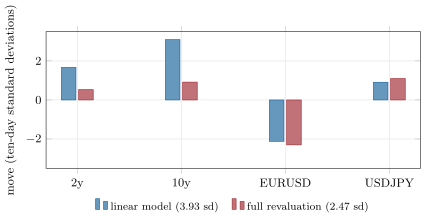
With the ten-day covariance, the linear model’s most plausible scenario for a USD 10 million loss raises the two-year yield 33 basis points and the ten-year 58, lowers the euro 3.18% and raises USDJPY 1.78%, at 3.93 standard deviations; revalued in full, that scenario loses USD 14.00 million. The full-revaluation search finds a nearer one, at 2.47 standard deviations: the euro down 3.45%, USDJPY up 2.15%, yields up 10 and 17 basis points (Figure 22.2). The short straddle makes large currency moves in either direction the cheapest way to lose.
22.5 Supervisory stress tests
Definition 22.10 (Supervisory stress test)
A supervisory stress test is a stress test whose scenarios are set by the supervisor and applied to many banks at once, to size capital buffers and compare the banks’ resilience.
The US Federal Reserve’s scenarios combine macroeconomic and financial paths with, for banks with large trading operations, a global market shock applied to their trading and other fair-valued positions and, for some, a counterparty-default component. The European Banking Authority runs EU-wide tests on a common methodology.
As of September 2026 — Supervisory scenarios
The Federal Reserve’s final 2026 severely adverse scenario (published in February 2026) is a severe global recession triggered by a fall in risk appetite: the unemployment rate rises 5.5 percentage points to a peak of 10% in the third quarter of 2027, equity prices fall about 58% through the third quarter of 2026, house prices 30% and commercial real estate prices 39%, and the VIX peaks at 72. In the European Banking Authority’s 2025 EU-wide stress test (64 banks, 75% of EU banking assets) the adverse scenario cost 370 basis points of common equity tier 1, leaving an aggregate ratio of 12%; the draft methodology of the 2027 exercise was published on 11 June 2026.
22.6 Tutorial: a scenario library
Goal. Apply historical scenarios to chapter 21’s book, complete a hypothetical scenario by conditioning, and find the most plausible scenario behind a given loss. End state: the numbers of Examples 22.3, 22.6 and 22.9 and the charts.
- Library:
scenarios()builds the three episodes withhistorical. - Run:
historical_table(); compare withvar10(). - Condition:
hypothetical(100). - Reverse:
reverse(10e6);fig_rc_stress.pywrites the charts.
What to change next. Condition on the stressed covariance of March 2020 instead; set the straddle to zero and repeat the reverse stress test.
22.7 Build: the stress-testing engine
Purpose. The firm’s scenario library and stress calculations, run nightly by the risk engine of chapter 29 alongside VaR.
Interface. Scenario(name, moves); historical(name, dates, levels, start, end, log_cols); condition(cov, shocked, values); mahalanobis; reverse_linear(delta, cov, loss); reverse_nonlinear(pnl, cov, loss, x0); run(pnl, scenarios).
Rules. Moves in the model’s units (yields in decimals, prices in log returns); plausibility by Mahalanobis distance under the chosen covariance.
Acceptance tests. code/firm/stresstest/tests/: historical moves; conditioning equals the regression; the linear reverse scenario lies on the loss plane and is closer than any other point on it; the non-linear search recovers it for a linear book.
Stretch. Stressed covariances and fat-tailed plausibility; scenario libraries by regime; liquidity-adjusted horizons per position; firm-wide reverse stress including funding.
Sources and further reading
- US Securities and Exchange Commission, press release 2022-70, 27 April 2022.
- Paul, Weiss, report to the Special Committee of the Board of Credit Suisse Group on Archegos Capital Management, 29 July 2021.
- Federal Reserve History, “Stock market crash of 1987”.
- Board of Governors of the Federal Reserve System, 2026 Stress Test Scenarios, 2026.
- Bank of England, letter from Sir Jon Cunliffe to the Treasury Committee, 5 October 2022.
22.8 Exercises
Exercise 22.1 ★
Why can a stress loss be many times the VaR without the VaR model being wrong?
Solution
Solution of Exercise 22.1.
VaR is a quantile of a distribution estimated from a window; a stress scenario is a single severe path from a different period, beyond the quantile and outside the window’s regime. A correct 99% VaR is exceeded, by any amount, on 1% of days.
Exercise 22.2 ★
In a two-factor normal model with volatilities 10 and 5 basis points and correlation 0.6, the first factor is shocked by 40 basis points. What is the conditional move of the second?
Solution
Solution of Exercise 22.2.
basis points.
Exercise 22.3 ★
A linear book has a ten-day P&L standard deviation of USD 2.5 million. At what Mahalanobis distance does it lose USD 10 million?
Solution
Solution of Exercise 22.3.
standard deviations.
Exercise 22.4 ★★
Why did the hypothetical ten-year shock cost less once completed by conditioning?
Solution
Solution of Exercise 22.4.
The two-year yield, correlated with the ten-year, rises too (80 basis points), and the book is short two-year bonds: that leg gains and offsets part of the ten-year loss. A shock to one factor alone ignores the hedges that the other factors’ co-movement brings.
Exercise 22.5 ★★
Why is the linear reverse stress scenario not the most plausible one for this book?
Solution
Solution of Exercise 22.5.
The linear model ignores the short straddle’s gamma: its most plausible scenario spreads the loss over rates and currencies at 3.93 standard deviations, and in full revaluation loses USD 14.00 million, more than the target. The straddle loses on large currency moves in either direction, so a nearer scenario, 2.47 standard deviations away, concentrated on EURUSD, reaches USD 10 million.
Exercise 22.6 ★★
What does a historical scenario assume about today’s positions and markets that may be false?
Solution
Solution of Exercise 22.6.
That the moves would be the same in today’s markets (levels, volatilities, correlations, the structure of the market), that today’s positions are held through the period without rebalancing, and that the book could be liquidated at those prices.
Exercise 22.7 ★★★
Coding. Run the reverse stress test for a loss of USD 10 million without the straddle and compare the distance.
Solution
Solution of Exercise 22.7.
Without the straddle the linear distance is 3.84 standard deviations and the full-revaluation one 3.95: the bonds’ positive convexity makes a loss slightly harder to reach than the linear model says, the opposite of the straddle’s effect.
Exercise 22.8 ★★★
Find the flaw. “Our reverse stress scenario is 4 standard deviations away, so it happens once in 30 000 ten-day periods and we can ignore it.”
Solution
Solution of Exercise 22.8.
The probability uses a normal distribution and the recent covariance; real moves are fat-tailed and correlations jump in crises, so four-sigma ten-day moves happen far more often (the historical episodes of this chapter cost two to three times the ten-day VaR). The distance ranks scenarios; it is not a probability.
22.9 Problem: The Family Office from the Broker’s Side
Problem 22.1
Weekend problem — when the margin runs out
A prime broker faces a client through total return swaps on five concentrated stocks, USD 20 billion of notional weighted 30, 25, 20, 15 and 10%, hedged by holding the stocks. The client posts margin of 7.5% of notional. If the client defaults, the broker needs five days to sell. In an illustrative one-factor model each stock has a beta of 1.2 to a market with 1.2% daily volatility and 3% daily idiosyncratic volatility.
Part I — The book.
- Give the margin in dollars.
- Give the standard deviation of the stocks’ value over five days.
- Why is the broker’s risk the client’s default, not the stocks?
- What would a one-day 99% VaR of the swaps say while the client pays its margin?
- What did the broker not see that the client’s other brokers held?
Part II — Reverse stress.
- Give the most plausible five-day moves that consume the margin.
- Give their Mahalanobis distance and the normal probability of a move at least that far.
- Why do the largest positions fall the most in that scenario?
- What uniform fall consumes the margin?
- What changes with a margin of 20%?
Part III — Beyond the model.
- Why would five days be optimistic?
- How do other brokers’ sales change the scenario?
- Why was the swap margin rate itself a risk?
- What information would a dynamic margin require?
- What single-name concentration limit would you set?
Part IV — Judgement.
- Why is this a stress-testing problem and not a VaR problem?
- How should the reverse stress result enter the broker’s decisions?
- What would you ask the client before extending more capacity?
- State the named result: the moves at which the book exhausts its margin, and their distance.
- In one sentence: what does a reverse stress test tell a risk committee?
Solution
Solution of Problem 22.1.
1. USD 1.5 billion. 2. USD 905 million. 3. While the client pays, the broker is hedged (it holds the stocks against the swaps); on default the swaps vanish and the broker is left long the stocks, with the margin as its only cushion. 4. Almost nothing: the swaps and the hedges offset, and margin covers daily moves. 5. The client’s total position across brokers: the same names, many times the size, whose forced sale would move prices against every broker. 6. Falls of 8.7, 7.9, 7.1, 6.3 and 5.4% in the five stocks, from the largest position to the smallest. 7. 1.66 standard deviations; a normal probability of 4.9% over five days. 8. The scenario loads on the direction : stocks with larger weights contribute more to the loss per unit of move, and the common factor moves all of them together. 9. 7.5% on every stock. 10. The distance rises to 4.42 standard deviations, a normal probability of . 11. The positions were many days of trading volume; the broker competes with other brokers selling the same names, and prices gap before any selling. 12. They add a common, correlated fall in exactly these stocks, which the covariance of normal days does not contain: the scenario is both larger and likelier. 13. It was set low and static, while the concentration and volatility of the positions grew: the cushion shrank relative to the risk. 14. The client’s whole position (or at least its concentration in each name at this broker), liquidity in days of volume, and volatility, re-set daily. 15. A limit on each name as a share of its daily volume and of the broker’s capital, with margin rising steeply with concentration. 16. The loss comes from a joint event (default and a concentrated fall) in a crowded position, outside any window of normal days. 17. As a trigger for margin, limits and exits: when the distance falls under a threshold, act. 18. Its total exposure across brokers, its leverage, and its liquidity. 19. Named result: the family office from the broker’s side: falls of 8.7, 7.9, 7.1, 6.3 and 5.4% over five days exhaust the 7.5% margin, only 1.66 standard deviations away. 20. Which plausible worlds would break the firm, and how near they are.
22.10 Interview questions
Interview question 22.1 ★ risk
What is the difference between VaR and a stress test? When would you trust each?
Solution
Solution of Interview question 22.1.
VaR: a probabilistic statement about ordinary losses, estimated from recent data, good for day-to-day limits. Stress test: the loss in a specified severe scenario, no probability, good for tail, concentration and regime changes. Use both.
What the interviewer is looking for: complementary roles.
Interview question 22.2 ★★ risk, researcher
How do you make a hypothetical scenario internally consistent?
Solution
Solution of Interview question 22.2.
Specify the story’s key shocks, fill the other factors by conditional expectation under a (possibly stressed) covariance or a structural model, check signs and magnitudes against history, and review with the desks.
What the interviewer is looking for: conditioning and expert review.
Interview question 22.3 ★★ researcher
Derive the most plausible scenario for a given loss of a linear portfolio.
Solution
Solution of Interview question 22.3.
Minimise subject to : , distance .
What the interviewer is looking for: the Lagrangian and the result.
Interview question 22.4 ★★ bank, risk
What does the Federal Reserve’s global market shock test, and how does it differ from VaR?
Solution
Solution of Interview question 22.4.
An instantaneous, severe shock to many market factors applied to trading and fair-valued positions of large banks, sized by the supervisor; VaR is a bank’s own statistical estimate over a day or ten.
What the interviewer is looking for: supervisor-set, instantaneous, broad.
Interview question 22.5 ★★★ risk, trader
How would you stress test a prime brokerage book?
Solution
Solution of Interview question 22.5.
By client: default plus a concentrated fall of its largest positions over a realistic liquidation horizon, with crowding across brokers; reverse stress to the margin; limits on concentration and days of volume; dynamic margin.
What the interviewer is looking for: default-conditional, concentration and liquidity.
Interview question 22.6 ★★★ developer
Design a scenario library for a bank’s nightly stress run. What goes in it, and how is it governed?
Solution
Solution of Interview question 22.6.
Historical episodes by asset class and regime, hypothetical scenarios for current risks, reverse stress results, supervisory scenarios; versioned definitions, owners, review cycles, factor mappings for new products, and reconciliation of results with VaR and P&L.
What the interviewer is looking for: content and governance.