Rates, Credit, XVA and Risk · Rates, credit & risk
27P&L Explain and Independent Price Verification
Every evening a product controller must explain each dollar a desk made or lost: so much from the move in rates, so much from volatility, so much from the passage of time, and a remainder that nobody can account for. On most days the remainder is small. On the day a swaption book made 4.57 million dollars after a 30 basis point jump in rates and a rise in volatility, the desk’s own explain accounted for 4.17 million, and 400 thousand dollars were unexplained. An unexplained P&L is either a missing risk, a wrong mark, or a booking error, and product control must find out which. This chapter builds the tools: attribution by sensitivities and by revaluation, the verification of marks against independent prices, the reserves and the prudent-valuation adjustments that reflect what the marks cannot know, and the control functions that run them. One Quant Book 1 introduced P&L attribution for a trading firm; here it is applied to a derivatives book, where the risks interact.
27.1 Attribution: risk-based and revaluation-based
Definition 27.1 (Risk-based attribution)
Risk-based attribution explains the day’s P&L by a Taylor expansion in the risk-factor moves, using the start-of-day Greeks: .
Definition 27.2 (Revaluation-based attribution)
Revaluation-based attribution moves the risk factors from their start-of-day to their end-of-day values one at a time, revaluing in full after each, and assigns each step’s change to its factor. The steps add up to the P&L exactly; their split depends on the order.
Definition 27.3 (Unexplained P&L)
The unexplained P&L is the difference between the actual P&L and the sum of the attributed parts. Controllers set thresholds on it, in money and as a share of the P&L, beyond which it must be investigated.
Example 27.4 (A risk reversal on a quiet day)
An illustrative book is long USD 320 million of one-year-into-ten-year payer swaptions struck at 4.50% and short the same notional of receivers at 3.50%, a risk reversal around a forward of 4.00%, marked at a normal volatility of 95 basis points (0.75 years to expiry, annuity 8.0). The two legs are worth the same, so the book is worth zero, and by symmetry its gamma, vega and theta are zero too: it is a pure delta position, 139 103 dollars per basis point. Its cross sensitivity is not zero: the vanna is 1 086 dollars per basis point of rate and basis point of volatility, because a higher rate moves the long payer towards the money and the short receiver away from it.
def greeks(value: Callable[[dict], float], state: dict, bumps: dict) -> dict:
    """Central finite-difference Greeks of `value` at `state` for factors f (rate) and s (vol), and theta."""
    def v(**kw):
        return value({**state, **kw})

    f, s, hf, hs = state["f"], state["s"], bumps["f"], bumps["s"]
    v0 = v()
    out = {"delta": (v(f=f + hf) - v(f=f - hf)) / (2 * hf),
           "gamma": (v(f=f + hf) - 2 * v0 + v(f=f - hf)) / hf ** 2,
           "vega": (v(s=s + hs) - v(s=s - hs)) / (2 * hs),
           "volga": (v(s=s + hs) - 2 * v0 + v(s=s - hs)) / hs ** 2,
           "vanna": (v(f=f + hf, s=s + hs) - v(f=f + hf, s=s - hs) - v(f=f - hf, s=s + hs)
                     + v(f=f - hf, s=s - hs)) / (4 * hf * hs),
           "theta": v(t=state["t"] - bumps["t"]) - v0}          # per bump of time (one day)
    return out


def risk_based(g: dict, df: float, ds: float, days: float = 1.0, cross: bool = True) -> dict:
    out = {"delta": g["delta"] * df, "gamma": 0.5 * g["gamma"] * df * df, "vega": g["vega"] * ds,
           "volga": 0.5 * g["volga"] * ds * ds, "theta": g["theta"] * days,
           "vanna": g["vanna"] * df * ds if cross else 0.0}
    out["explained"] = sum(out.values())
return out27.2 Unexplained P&L and what it reveals
Example 27.5 (The big-move day)
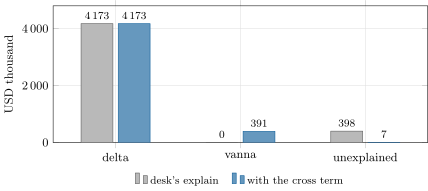
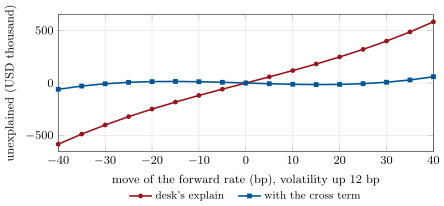
The forward rises 30 basis points and the volatility 12. The book makes USD 4 571 501. The desk’s explain, delta, gamma, vega and theta, gives 4 173 095, all from delta: 398 406 dollars are unexplained, 9% of the day. Adding the vanna term, , explains 391 087 of them; 7 319 remain, higher-order terms (Figure 27.1). The unexplained P&L grows with the product of the rate and volatility moves, which is why it appears on big days (Figure 27.2).
Example 27.6 (The same day by revaluation)
Moving the forward first, then the volatility, then time: the forward contributes USD 4 240 447, the volatility 336 046, time . Moving the volatility first: the volatility contributes nothing (the book’s vega is zero at the start), the forward 4 576 493. Both add up to the P&L; the cross effect lands in whichever factor moves second.
Definition 27.7 (Product control)
Product control is the finance function, independent of the desks, that produces and explains the daily P&L, verifies the marks, sets reserves and reconciles the trading books with the general ledger.
27.3 Independent price verification
Definition 27.8 (Independent price verification)
Independent price verification (IPV) is the process by which the market prices and model inputs used by a desk are verified against sources independent of it (broker quotes, trades, consensus services) and the marks corrected when they fall outside a tolerance.
In a consensus service, dealers submit their mid marks for a list of contracts once a month and receive the average of the accepted submissions; a dealer whose submission is rejected does not receive the consensus. The leading service, Totem, began in 1997 with six dealers and had about 120 participants and some 30 submitters per contract, according to a 2020 study of its data.
def ipv(marks: Sequence[float], consensus: Sequence[float], tolerance: Sequence[float]) -> list[tuple[float, float]]:
    """(verified mark, adjustment) per position: marks outside consensus +/- tolerance move to the boundary."""
    out = []
    for m, c, tol in zip(marks, consensus, tolerance, strict=True):
        v = min(max(m, c - tol), c + tol)
        out.append((v, v - m))
return outExample 27.9 (Verifying the volatility marks)
The desk marks both strikes at 95 basis points; an illustrative consensus gives 97 for the 4.50% payer and 91 for the 3.50% receiver, the market’s skew, with a tolerance of 2 basis points. The payer’s mark sits on the boundary and stands; the receiver’s is moved to 93, which lowers the value of the short receivers and adds USD 146 482. The flat marks also explain the vanna: a desk that marks no skew sees no reason for its vega to change when rates move.
As of September 2026 — Marks at the boundary
JPMorgan’s 2013 task force report describes its Chief Investment Office’s price testing: each trader mark was compared with a mid price computed by the valuation control group and a threshold reflecting the bid–offer spread, and marks outside were to be moved to the nearest boundary. In the March 2012 testing many positions were marked at or near the boundary of the bid–offer spread; being within the thresholds, they were accepted.
27.4 Reserves and the fair-value hierarchy
Definition 27.10 (Fair-value hierarchy)
The fair-value hierarchy classifies fair-valued positions by the observability of their inputs (IFRS 13): level 1, unadjusted quoted prices in active markets for identical instruments; level 2, other directly or indirectly observable inputs; level 3, unobservable inputs. Level 3 positions need the most verification and carry the largest reserves.
Reserves adjust fair values for what a mid mark ignores: the bid–offer cost of exiting, the uncertainty of the model and its parameters, and day-one profits that cannot yet be recognised (One Quant Book 5, chapter 27). They are part of fair value; regulators ask for more.
27.5 Prudent valuation
Definition 27.11 (Prudent valuation, additional valuation adjustment)
Prudent valuation values fair-valued positions at the price at which the bank is 90% confident it could exit them. The additional valuation adjustments (AVAs) are the differences between fair value and prudent value, by category (market price uncertainty, close-out costs, model risk and others); they are deducted from common equity.
Example 27.12 (The AVA of the book)
With contributors’ volatilities dispersed by 2.0 and 2.5 basis points around the consensus, the market price uncertainty AVA, fair value less the 90% confidence exit value, is USD 190 578 for the payers and 232 964 for the receivers; summed after the 50% aggregation factor, 211 771. The simplified approach, 0.1% of the absolute fair values (USD 6.87 million), would give 6 872: for an option book whose value is small against its risk, the simplified figure understates the uncertainty.
As of September 2026 — Prudent valuation in the EU
Under the EU’s prudent valuation standard (Delegated Regulation 2016/101), the prudent value is the value at which a bank is 90% confident of exiting; institutions with less than EUR 15 billion of absolute fair-valued assets and liabilities may use the simplified approach (0.1% of that sum), others the core approach, in which the market price uncertainty, close-out cost and model risk AVAs are summed after a 50% aggregation factor (temporarily 66% after the 2020 amendment for extreme volatility). Total AVAs are deducted from common equity tier 1.
27.6 Tutorial: explaining a day
Goal. Explain the risk reversal’s big-move day by Greeks and by revaluation, verify its marks and compute its prudent-valuation adjustment. End state: the numbers of Examples 27.4, 27.5, 27.6, 27.9 and 27.12 and the charts.
- Greeks:
greeks(value, START, BUMPS). - Explain:
day()with and without the cross term;revaluation()in two orders. - IPV and AVA:
ipv_table(),ava_table(). - Charts:
fig_rc_pnlexplain.py.
What to change next. Mark the skew from the consensus and redo the day: the vanna becomes a vega that the explain sees; add a second forward and a correlation cross term.
27.7 Build: the P&L explain
Purpose. The firm’s daily explain, price verification and prudent valuation, fed by the P&L of the position keeper of One Quant Book 1 (firm.pnl) and by the Greeks of the pricing library.
Interface. greeks(value, state, bumps); risk_based(g, df, ds, days, cross); revaluation_based(value, start, end, order); ipv(marks, consensus, tolerance); mpu_ava; aggregate_ava; simplified_ava.
Rules. Greeks at the start of day; explain thresholds in money and share; IPV moves marks to the tolerance boundary; 90% confidence and 50% aggregation for AVAs.
Acceptance tests. code/firm/pnlexplain/tests/: a quadratic book is explained exactly with the cross term and not without; revaluation steps add up and depend on the order; IPV boundaries; AVA of a normal dispersion; aggregation and simplified figures.
Stretch. Explain by trade and by risk factor across a whole book; alerting on unexplained P&L; close-out cost and model-risk AVAs; consensus data ingestion.
Sources and further reading
- European Banking Authority, final draft RTS amending the RTS on prudent valuation, EBA/RTS/2020/04, 2020.
- Basel Committee on Banking Supervision, Supervisory guidance for assessing banks’ financial instrument fair value practices, April 2009.
- JPMorgan Chase & Co., Report of the Management Task Force Regarding 2012 CIO Losses, 2013.
- IFRS 13 Fair Value Measurement, paragraphs 76, 81 and 86, as adopted in Commission Regulation (EU) No 1255/2012.
- L. M. Ergun and A. Uthemann, “Higher-order uncertainty in financial markets: evidence from a consensus pricing service”, Systemic Risk Centre Discussion Paper 98, June 2020.
27.8 Exercises
Exercise 27.1 ★
Compute the vanna term of the big-move day from the book’s vanna of 1 086 dollars per basis point squared.
Solution
Solution of Exercise 27.1.
(with the unrounded vanna).
Exercise 27.2 ★
Why are the risk reversal’s gamma, vega and theta zero at the start of the day?
Solution
Solution of Exercise 27.2.
The strikes are symmetric around the forward and the model is normal: the long payer and the short receiver have equal and opposite gamma, vega and theta, and equal delta of the same sign.
Exercise 27.3 ★
A mark is 38 against a consensus mid of 35 with a tolerance of 2. What is the verified mark?
Solution
Solution of Exercise 27.3.
The band is 33 to 37; the mark moves to the boundary, 37, an adjustment of .
Exercise 27.4 ★★
Why does revaluation-based attribution depend on the order of the factors, and how would you remove the dependence?
Solution
Solution of Exercise 27.4.
Each step is revalued at the factors already moved, so cross effects are credited to whichever factor moves later. Averaging over all orders (the Shapley allocation) removes the dependence at the cost of more revaluations; reporting the cross effect separately is the practical alternative.
Exercise 27.5 ★★
Scale the unexplained P&L to a day with a 15 basis point rate move and the same volatility move.
Solution
Solution of Exercise 27.5.
The cross term is proportional to the rate move: about half, USD 181 thousand for a 15 basis point move.
Exercise 27.6 ★★
Why is the market price uncertainty AVA of an option book large compared with its fair value?
Solution
Solution of Exercise 27.6.
Its fair value nets the long and short legs (zero here), but the uncertainty of each leg’s price does not net: each depends on a volatility whose consensus is dispersed. The AVA scales with the gross risk.
Exercise 27.7 ★★★
Coding. Compute the AVA of the book with the contributors’ dispersion doubled.
Solution
Solution of Exercise 27.7.
The individual AVAs double (382 470 and 468 316) and the aggregated figure to USD 425 393; the simplified figure does not change.
Exercise 27.8 ★★★
Find the flaw. “All our marks are within the IPV thresholds, so our valuation is fine.”
Solution
Solution of Exercise 27.8.
Thresholds allow marks anywhere inside the band; systematic marks at its favourable edge pass every test, as in 2012. IPV also covers only instruments with independent prices; level 3 positions and model inputs need other checks, and reserves and AVAs are still required.
27.9 Problem: The Unexplained 400 Thousand
Problem 27.1
Weekend problem — the missing cross term
The product controller of the risk reversal desk sees USD 398 406 unexplained on the big-move day and must report by morning.
Part I — The numbers.
- Give the actual P&L and the desk’s explain.
- Give the unexplained part and its share of the P&L.
- Give the delta and vanna of the book.
- Give the vanna term and the residual after it.
- What is the residual made of?
Part II — Diagnosis.
- Which three causes of unexplained P&L would you check first, and in what order?
- How does revaluation-based attribution locate the cross effect?
- What does the volatility-first order show?
- Why did the unexplained P&L not appear on quiet days?
- What does the desk’s flat volatility mark have to do with it?
Part III — Controls.
- Give the IPV adjustment and its effect on the book’s value.
- Give the market price uncertainty AVA, as core and simplified approaches would compute it.
- Where would you set the unexplained-P&L threshold for this desk?
- Should the desk be allowed to explain the day by revaluation only?
- What would you report to the risk committee?
Part IV — Judgement.
- When is an unexplained P&L a sign of a booking error rather than a missing risk?
- Why must product control be independent of the desk?
- How does this connect with the FRTB attribution test of chapter 23?
- State the named result: the missing cross term and the attribution after it is added.
- In one sentence: what does an unexplained P&L tell you?
Solution
Solution of Problem 27.1.
1. USD 4 571 501 actual; 4 173 095 explained. 2. USD 398 406, 9% of the P&L. 3. USD 139 103 per basis point; 1 086 per basis point of rate and of volatility. 4. USD 391 087; a residual of 7 319. 5. Third-order terms: the change of vanna with the rate and the volatility over such a large move. 6. Booking and data (missing trades, stale market data), then missing risks (cross terms, unmarked factors), then marks (IPV breaks); the first two are quickest to rule in or out. 7. Moving the factors one at a time shows that the second factor moved carries an effect that depends on the first: a cross effect. 8. The volatility step contributes nothing, because the vega is zero at the start; all the cross effect shows up in the rate step. 9. The cross term is a product of two moves; on quiet days both are small and so is their product. 10. A flat mark implies no skew; with the market’s skew, a rise in rates changes the volatility at each strike, and the explain would carry the effect as vega; without it, it appears as vanna that the desk does not report. 11. The receiver’s volatility is moved from 95 to 93 basis points: the book’s value rises by USD 146 482. 12. USD 211 771 under the core approach (190 578 and 232 964 aggregated at 50%); 6 872 under the simplified one. 13. A money threshold tied to the desk’s typical daily P&L and a share (say a few per cent), with automatic investigation on big-move days. 14. No: revaluation adds up by construction and hides missing risks; the risk-based explain tests whether the desk’s risk measures describe its P&L. 15. The unexplained P&L, its cause, the missing vanna in the desk’s risk reports, and the fix (skew marks and cross-Greek reporting). 16. When it does not scale with market moves, appears on quiet days, or reverses the next day: a trade booked late, a wrong notional, a stale fixing. 17. Because the desk’s pay depends on the P&L it would explain and the marks it would verify. 18. The attribution test compares the risk model’s P&L with the pricing systems’; a desk whose risk model lacks the cross term would show the same gap there. 19. Named result: the unexplained 400 thousand: the missing vanna term, 1 086 dollars per basis point squared times 30 and 12, explains USD 391 087 of the 398 406 unexplained, leaving 7 319. 20. Which risk, data or mark the desk’s picture of itself is missing.
27.10 Interview questions
Interview question 27.1 ★ risk, bank
Explain a day’s P&L on an option book. What goes into the explain?
Solution
Solution of Interview question 27.1.
Delta, gamma, vega (and volga), theta, the cross terms that matter (vanna, cross-gamma between curves), carry and funding, new trades and amendments, reserves and fees; the remainder is unexplained.
What the interviewer is looking for: Greeks, time, new business and the remainder.
Interview question 27.2 ★★ trader, risk
What are the usual causes of unexplained P&L?
Solution
Solution of Interview question 27.2.
Missing or stale market data, booking errors, missing risk factors or cross terms, model changes, large moves beyond the expansion, reserves and fees not included, and marks that changed without market moves.
What the interviewer is looking for: data, booking, model and marks.
Interview question 27.3 ★★ bank
What is independent price verification, and where does it get hard?
Solution
Solution of Interview question 27.3.
Verifying marks and model inputs against independent sources and adjusting those outside tolerance. It is hard for illiquid instruments and unobservable inputs, when consensus is thin or stale, and when thresholds invite marks at their edges.
What the interviewer is looking for: the process and its weak points.
Interview question 27.4 ★★ researcher, bank
What is prudent valuation and how does it differ from fair value?
Solution
Solution of Interview question 27.4.
Fair value is an exit price with market participants’ assumptions; prudent valuation takes a conservative point (90% confidence) of the range of plausible exit values and deducts the difference from capital.
What the interviewer is looking for: the confidence level and the capital deduction.
Interview question 27.5 ★★★ developer
Design a daily P&L explain system for a large derivatives book.
Solution
Solution of Interview question 27.5.
Start-of-day Greeks by trade and factor from the pricing library, end-of-day market data snapshots, attribution by factor with thresholds and drill-down, revaluation fallback for large moves, alerts, audit trail, and reconciliation with the general ledger.
What the interviewer is looking for: data, computation, thresholds and controls.
Interview question 27.6 ★★★ risk, bank
How would you detect marks that are systematically favourable to a desk?
Solution
Solution of Interview question 27.6.
Compare marks with consensus over time: the distribution of the mark’s position within the band, its correlation with the desk’s P&L targets, jumps at month end, and differences between month-end and intramonth marks.
What the interviewer is looking for: statistical tests on the position of marks.