Strategies II: Volatility, Relative Value, Macro and the Bank Desks · Strategies
17Discretionary Macro
A macro manager with a view that rates will fall has a dozen ways to express it. The view is the easy part; the instrument, the size and the stop decide whether being right pays. This chapter holds one view fixed and changes everything else. The manager expects a rate to fall 50 basis points over six months, and on the synthetic paths the rate ends lower 73.4% of the time. Expressed through futures with a stop 25 basis points away, the view is stopped out on 26.5% of the paths where it turns out right. With a stop 50 basis points away that falls to 5.6%. Expressed through an at-the-money option, 17.2% of correct views still lose the premium. The build is firm.macrobook. The chapter has no strategy files: its subject is how any macro view becomes a position.
17.1 From view to trade
Definition 17.1 (Trade expression)
A trade expression is the instrument, strike, maturity and size chosen to turn a market view into a position; different expressions of the same view pay differently depending on how far, how fast and along which path the market moves.
A view that “rates will fall” has a size (how much), a horizon (by when), a path (steadily or after a rise) and a confidence. Each expression bets on a different combination. A futures position bets on the size, whatever the path. An option bets on the size and caps the loss at its premium. A futures position with a stop bets that the path does not first go the wrong way. A spread bets on a move up to a point and gives up the rest.
firm.macrobook makes this concrete (Listing 17.1). The manager’s view is a 50 basis-point fall over six months. The rate’s true drift is drawn around the view with a dispersion of 50 basis points, so the view is right on average but by a varying amount. The rate moves with a normal volatility of 90 basis points a year. Over 20 000 paths it ends lower on 73.4% of them.
17.2 Instrument choice and convexity
Definition 17.2 (Convexity budget)
A convexity budget is the premium a manager is willing to spend on options to express views, whose most it can lose; spending it buys positions whose loss is known in advance and whose gain grows with the size of the move.
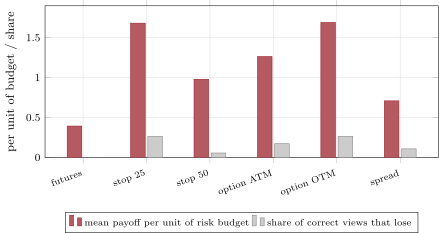
Each expression is sized to the same risk budget. For options the budget is the premium. For futures with a stop it is the stop distance. For futures without a stop it is a two-standard-deviation loss over the horizon. Options are priced by the normal model at the rate’s volatility plus 10%. An at-the-money receiver option costs 27.9 basis points, one struck 25 basis points below costs 17.2, and an option spread between the two strikes 0 and costs 18.2 (Figure 17.1).
| 20 000 paths, per unit of risk budget | mean | sd | P(profit) | P(loss right) | 5th percentile |
|---|---|---|---|---|---|
| futures, no stop | 0.39 | 0.63 | 73% | 0.0% | |
| futures, stop 25 bp | 1.68 | 2.98 | 54% | 26.5% | |
| futures, stop 50 bp | 0.98 | 1.55 | 69% | 5.6% | |
| option at the money | 1.26 | 2.23 | 61% | 17.2% | |
| option 25 bp out of the money | 1.69 | 3.20 | 54% | 26.5% | |
| option spread (0 to ) | 0.71 | 1.22 | 65% | 10.8% |
The ranking depends on what the budget is. Per unit of a two-standard-deviation loss, futures earn 0.39 and never lose when the view is right. Per unit of premium, the out-of-the-money option earns 1.69. That figure is mostly leverage, with the same 26.5% of correct views ending worthless as the tight stop. The option spread is the most conservative option: it gives up the large moves, which the view expects less of, and wins more often (65%). No expression is better than another in general. Each is right for a different belief about how the view will come true.
s2_macrobook.table.17.3 Sizing and stops
Definition 17.3 (Stop discipline)
Stop discipline is the rule, set when a position is opened, for cutting it after a given loss or adverse move, and the practice of following the rule; it limits the loss on wrong views at the price of cutting some right ones before they pay.
A stop turns the path into the risk. The rate can rise 25 basis points on the way to falling 50, and a stop at 25 closes the position before the fall. The share of correct views stopped out falls steeply with the stop’s distance (Figure 17.2): 55.6% at 10 basis points, 26.5% at 25, 5.6% at 50, 0.7% at 75 and 0.1% at 100. Kaminski and Lo gave a framework for when stop-loss rules add or subtract expected return and volatility. In their empirical analysis of index futures, some stop-loss policies raised expected return while cutting volatility at longer sampling frequencies. In the synthetic market the drift is the view, so the stop pays only when the view is wrong.
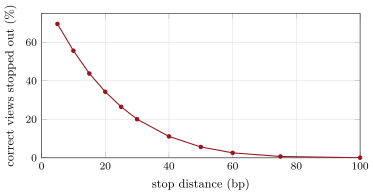
s2_macrobook.stops.Sizing follows from the budget and the stop. With the same budget, a tighter stop means a larger position: the stop at 25 basis points holds twice the position of the stop at 50. That is why its mean payoff per unit of budget is higher (1.68 against 0.98) while it is stopped out far more often. A manager whose budget is a monthly loss limit (Book 8, chapter 28, on drawdown limits) must choose between a small position with a wide stop and a large one with a tight stop. The first survives noise; the second is right less often but pays more when it is.
17.4 Keeping score
A discretionary book is judged on outcomes, but its decisions are made on views. Separating the two is the point of keeping score. Record each view when it is formed: size, horizon, confidence. Record the expression chosen and the reason. When the trade closes, record whether the view came true, whether the expression paid, and whether the stop or the horizon ended it.
Over many trades the record shows whether the manager’s views are better than chance, and whether the expressions make the most of them. In the synthetic market with the view known exactly (a dispersion of zero), the rate ends lower on 78.6% of the paths: the rest is noise within six months. Even a perfectly informed view is right only that often at this horizon. The tight-stop futures then earn 1.45 per unit of budget and the at-the-money option 1.07. A score of right and wrong alone would miss that.
17.5 Tutorial: right and still losing
Goal. Simulate a view’s paths, express it six ways, and measure how often a correct view loses and how stops cut it short. End state: the table and the two figures.
Expressions.
def expressions(paths, cfg: ViewConfig | None = None, stops=(25.0, 50.0)) -> dict:
    cfg = cfg or ViewConfig()
    end = paths[:, -1]
    tau = cfg.days / 252
    vol = cfg.vol_bp * cfg.vol_premium
    sd_h = cfg.vol_bp * math.sqrt(tau)
    out = {"futures": -end / (2 * sd_h)}                                 # budget: a two-sd loss over the horizon
    for s in stops:                                                      # budget: the stop distance
        hit = (paths >= s).any(axis=1)
        out[f"futures, stop {s:.0f}"] = np.where(hit, -1.0, -end / s)
    for name, k in (("option at the money", 0.0), ("option out of the money", -cfg.otm_bp)):
        prem = bachelier_receiver(k, vol, tau)
        out[name] = np.maximum(k - end, 0.0) / prem - 1.0                 # budget: the premium
    lo = -cfg.spread_bp
    prem = bachelier_receiver(0.0, vol, tau) - bachelier_receiver(lo, vol, tau)
    out["option spread"] = (np.maximum(-end, 0.0) - np.maximum(lo - end, 0.0)) / prem - 1.0
    return out


def stopped_correct(paths, cfg: ViewConfig | None = None, stop: float = 25.0) -> float:
    right = paths[:, -1] < 0
    hit = (paths >= stop).any(axis=1)
    return float((hit & right).sum() / right.sum())
Listing 17.1. Each expression’s payoff per unit of risk budget, and correct views stopped out. code/firm/macrobook/firm_macrobook.py The table.
def table(view_sd: float = 50.0):
    """Per expression: mean and sd per unit of risk budget, chance of profit, chance of losing when the view is right,
    and the 5th percentile."""
    cfg, p = paths(view_sd)
    right = p[:, -1] < 0
    out = {}
    for k, v in expressions(p, cfg).items():
        out[k] = {"mean": float(v.mean()), "sd": float(v.std()), "p_profit": float((v > 0).mean()),
                  "lose_when_right": float((v[right] <= 0).mean()), "p05": float(np.percentile(v, 5))}
    return out | {"share_right": float(right.mean())}
Listing 17.2. Mean, spread, chance of profit and of losing when right. code/strategies-2/17-discretionary-macro/python/s2_macrobook.py - Run
table(),stops(),premiums()andfig_macrobook.py.
What to change next. Make the view’s timing uncertain (the fall comes in the second half); add a trailing stop; express the view as a curve trade in a two-factor model.
17.6 Build: macro book
Purpose. A view’s distribution of paths, expressions sized to a common risk budget, and stop rules with their cost.
Interface. ViewConfig(…), rate_paths(cfg), bachelier_receiver(strike, vol, tau), expressions(paths, cfg, stops), stopped_correct(paths, cfg, stop).
Rules. Options priced at the path’s volatility times a premium; each expression’s payoff divided by its own risk budget.
Acceptance tests. code/firm/macrobook/tests/: the normal-model price at the money and put–call parity; expressions and stops on hand-made paths.
Stretch. Uncertain timing; trailing stops; two-factor curves.
Sources and further reading
- K. M. Kaminski and A. W. Lo, “When do stop-loss rules stop losses?”, Journal of Financial Markets 18, 2014.
17.7 Exercises
Exercise 17.1 ★
A receiver option at the money on a rate with normal volatility 99 basis points a year has six months to run. What is its price?
Solution
Solution of Exercise 17.1.
basis points.
Exercise 17.2 ★
A budget of one unit buys futures with a 25 basis-point stop or with a 50 basis-point stop. How do the two positions compare in size?
Solution
Solution of Exercise 17.2.
The position with the 25 basis-point stop is twice the size of the one with the 50 basis-point stop: each loses one unit when stopped.
Exercise 17.3 ★
The rate falls 80 basis points. What does the option spread (0 to ) pay per unit of its 18.2 basis-point premium?
Solution
Solution of Exercise 17.3.
The spread pays its full width, 50 basis points: units of budget, net of the premium.
Exercise 17.4 ★★
Why is the share of correct views stopped out so sensitive to the stop’s distance?
Solution
Solution of Exercise 17.4.
The chance that a path first touches a level falls quickly with the level’s distance measured in the path’s standard deviation: at six months the rate’s standard deviation is about 64 basis points, so a 10 basis-point stop is touched on most paths and a 100 basis-point one almost never.
Exercise 17.5 ★★
Why does the out-of-the-money option have a higher mean payoff per unit of budget and a lower chance of profit than the at-the-money one?
Solution
Solution of Exercise 17.5.
It costs less (17.2 against 27.9 basis points), so the budget buys more of it and a large fall pays more per unit; but the rate must fall more than 25 basis points for it to pay at all, so it ends worthless more often.
Exercise 17.6 ★★
Why is a view that is exactly right still wrong on 21% of paths at six months?
Solution
Solution of Exercise 17.6.
Over six months the rate’s own noise (about 64 basis points of standard deviation) is larger than the 50 basis-point fall expected, so on about 21% of paths the noise wins even when the drift is exactly as the view says.
Exercise 17.7 ★★★
Coding. Run table(0.0), a view with no dispersion. How do the chances and payoffs change, and what does that say about the value of precision?
Solution
Solution of Exercise 17.7.
With no dispersion the rate ends lower on 78.6% of paths instead of 73.4%, but most payoffs per unit of budget fall: the tight-stop futures from 1.68 to 1.45, the at-the-money option from 1.26 to 1.07, the out-of-the-money option from 1.69 to 1.32, the stop-50 futures from 0.98 to 0.91; only the capped spread rises, from 0.71 to 0.79. Dispersion in the drift creates the large moves that convex expressions pay most for; precision helps the expressions that give up large moves.
Exercise 17.8 ★★★
Find the flaw. “I was right about rates this year and still lost money, so my views are fine and the market was wrong.”
Solution
Solution of Exercise 17.8.
Being right about the direction is not the same as being right about the size, the timing and the path; and a year of outcomes is too few to tell skill from noise. The trade journal should show whether the expression, the size or the stop turned a right view into a loss.
17.8 Problem: Right and Still Losing
Problem 17.1
Weekend problem — expressing a macro view
The chapter’s synthetic paths and the public record.
Part I — The view.
- Define a trade expression.
- What does each expression bet on?
- Describe the synthetic view and its paths.
- How often is the view right?
Part II — Instruments.
- Define a convexity budget.
- How is each expression sized?
- Give the options’ prices.
- Why does the ranking depend on the budget?
Part III — Stops.
- Define stop discipline.
- Give the share of correct views stopped out by stop distance.
- What did Kaminski and Lo study and find?
- How do stop and size interact?
Part IV — The verdict.
- State the named result: the expected payoff of each expression of the same view and the share of correct views stopped out early.
- Which expression suits a view about size, and which one about path?
- What changes when the view is exact?
- What should a manager record for each trade?
- How would you judge a discretionary manager?
- Why does this chapter have no strategy files?
- How does this chapter relate to chapter 16?
- In one sentence: what decides whether a right view pays?
Solution
Solution of Problem 17.1.
- The instrument, strike, maturity and size that turn a view into a position.
- Futures: the size; options: the size with a capped loss; stops: the path; spreads: a move up to a point.
- A 50 basis-point fall in six months, drift dispersion 50, volatility 90 a year.
- On 73.4% of paths.
- The premium one is willing to spend on options.
- Options by their premium; stopped futures by their stop; unstopped futures by a two-standard-deviation loss.
- 27.9, 17.2 and 18.2 basis points.
- Each definition of risk scales positions differently.
- A rule for cutting a position, set in advance and followed.
- 55.6%, 26.5%, 5.6%, 0.7% and 0.1% for 10, 25, 50, 75 and 100 basis points.
- A framework for the value of stop-loss rules; some raise expected return while cutting volatility at longer frequencies.
- A tighter stop means a larger position for the same budget.
- Named result. Per unit of risk budget, futures earn 0.39, futures with a 25 or 50 basis-point stop 1.68 and 0.98, options 1.26 (at the money) and 1.69 (out of the money) and the spread 0.71; a 25 basis-point stop cuts 26.5% of correct views short, a 50 basis-point stop 5.6%.
- Size: futures or options; path: options rather than tight stops.
- The view is right more often; convex expressions earn less.
- The view, its horizon and confidence, the expression and its reason, and the outcome of each.
- Separate the views’ hit rate from the expressions’ payoff, over many trades.
- It is about expressing any view, not a strategy with a source of return.
- Chapter 16 replaces the manager’s views with rules.
- The expression, the size and the stop.
17.9 Interview questions
Interview question 17.1 ★ trader
You think the Fed will cut rates in six months. How would you express it?
Solution
Solution of Interview question 17.1.
Receive fixed in short-dated swaps or buy the relevant futures (for example, SOFR futures for the meeting dates), or buy receiver options or calls on the futures; choose by how sure one is of the timing and how much one can lose.
Interview question 17.2 ★★ trader
When would you use options rather than futures for a macro view?
Solution
Solution of Interview question 17.2.
When the path is uncertain (the market may move against the view first), when the loss must be capped in advance, or when the view is about a large move whose size is uncertain.
Interview question 17.3 ★★ risk
How would you set stops for a discretionary macro book?
Solution
Solution of Interview question 17.3.
From the expected path’s noise over the horizon: wide enough that noise rarely triggers them, sized so that a triggered stop costs a set share of the book’s loss limit; review them against the record of views stopped out.
Interview question 17.4 ★★ researcher
How would you measure whether a manager’s views have skill?
Solution
Solution of Interview question 17.4.
Record views when formed and score them against outcomes over many trades, relative to a base rate and to a random expression; separate hit rate from payoff per trade.
Interview question 17.5 ★★ developer
Design a trade journal that records views, expressions and outcomes.
Solution
Solution of Interview question 17.5.
Each entry: time, view (direction, size, horizon, confidence), expression and size, stop and target, then exits with reason and P&L; tagged so views and expressions can be scored separately.
Interview question 17.6 ★★★ researcher
For a driftless Brownian motion with volatility , derive the probability of touching before time , and use it to explain the shape of the chapter’s stop-out curve.
Solution
Solution of Interview question 17.6.
By the reflection principle, . It falls fast once exceeds one standard deviation (about 64 basis points here), which is why the stop-out curve drops steeply between 10 and 50 basis points; the view’s drift makes it fall faster still.