Strategies II: Volatility, Relative Value, Macro and the Bank Desks · Strategies
18Credit Relative Value
A company’s bond and its credit default swap insure the same default. Buying the bond and buying protection should earn nothing but the risk-free rate, so the basis, the CDS spread minus the bond’s spread, should be zero. Bai and Collin-Dufresne found it deviating most for bonds with the highest frictions: illiquid, expensive to fund, exposed to counterparties, poor as collateral. In 2008 the basis went deeply negative when the trade that should close it needed funding nobody had. On this chapter’s synthetic market the basis sits at basis points until a funding crisis takes it to . A negative-basis book levered ten times loses 60% of its capital on the way down and, if it survives, recovers 76% after the low. Entered at the low, the same trade earns 70% in a year. The build is firm.creditrv.
18.1 The bond-CDS basis
A bond’s spread (Book 2, chapter 21, the z-spread over the risk-free curve) and a credit default swap on the same issuer (Book 2, chapter 23) both price the issuer’s default. A long bond hedged with CDS protection has no default risk: on a credit event the protection pays par less the bond’s recovery. In frictionless markets the bond spread equals the CDS spread. In practice the bond must be financed, the CDS posts collateral, and the two sides are traded by different investors.
Definition 18.1 (Negative basis trade)
A negative basis trade buys a bond whose spread exceeds its issuer’s CDS spread, finances it in repo, and buys CDS protection on the same issuer; it earns the gap between the two spreads less its funding, holds no default risk, and loses on its marks when the gap widens further.
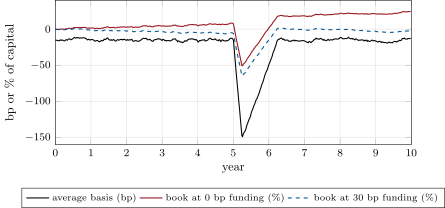
firm.creditrv builds forty synthetic issuers with CDS spreads near 120 basis points, averaging 136 over the sample. Each bond’s spread is its CDS spread plus a funding premium common to all bonds (15 basis points in normal times) plus noise. The basis is therefore minus the funding premium. In year 5 a planted crisis lifts the premium to 150 basis points over a quarter and brings it back over a year (Figure 18.1). The average basis falls from to basis points, at year 5.25.
18.2 Index against constituents
Definition 18.2 (Credit index arbitrage)
Credit index arbitrage trades a CDS index against the basket of its constituents’ single-name CDS when the index spread differs from the average of the members’ spreads (the index skew): selling protection on the cheaper side and buying it on the dearer.
The index trades more than its members and moves first. The gap between them, the skew, reflects that liquidity, and it closes as the names catch up. The synthetic skew is a mean-reverting noise of 4 basis points with a 20-day half-life. Trading it once it passes one standard deviation, and holding until it crosses zero, earned 55 basis points of notional a year with a Sharpe ratio of 0.97. The book was in a position 60% of the time and paid 1 basis point of spread (4.5 of notional) to trade each unit, since the single-name leg is costly.
18.3 Credit curve trades
Definition 18.3 (Credit curve trade)
A credit curve trade buys protection at one maturity and sells it at another on the same issuer or index, in amounts that offset their spread durations, betting on the slope of the credit curve rather than its level.
A flattener sells protection at the short end and buys it at the long end, gaining when the long spread falls relative to the short one. It carries default risk between the maturities: a default before the short contract matures pays both legs, but one after it pays only the long leg. The synthetic ten-year minus five-year slope averages 40 basis points and reverts with a 60-day half-life. The banded trade earned 49 basis points a year, a Sharpe ratio of 0.75, in a position 62% of the time.
18.4 Funding and the negative basis
The negative-basis book holds every bond against protection on its issuer, finances the bonds with a 10% haircut, and pays its own funding spread on the financed part (Listing 18.1). Capital is the haircut, so the book is levered ten times.
| on capital, ten times | before (%/yr) | to the low (%) | after the low (%) | ten years (%) |
|---|---|---|---|---|
| own funding 0 bp | 1.6 | 76.0 | 24.4 | |
| own funding 30 bp | 63.2 | |||
| own funding 60 bp | 50.4 |
Before the crisis the trade barely pays. A basis of basis points covers little funding, and a trader who funds at 30 basis points loses money holding it. When the crisis widens the basis by 135 basis points, a spread duration of 4.5 turns that into a 6.1% loss on the notional: 61% of the capital at ten times (Figure 18.1). Nothing defaulted and the hedge worked. The loss is marks, and a book that must meet margin calls sells at the low and never sees the recovery. Mitchell and Pulvino described how that happened in 2008. The imminent failure of prime brokers cut hedge funds’ leverage suddenly, and arbitrageurs who should have bought cheap bonds had to sell them.
The other side of the crisis is the best trade in the book. Entered at the basis’s low and held a year, the negative-basis book earned 69.8% of its capital with no funding cost and 67.1% at 30 basis points. Carry provided 8.4 and 5.7 points of that, and the basis’s return to normal the other 61.4. The capital that can buy at the low is the capital that was not levered to the limit before it.
s2_creditrv.market.18.5 Strategy files
Strategy file 18.1 — Negative basis trade
Who pays you, and why. Holders forced to sell bonds when funding is scarce; the basis pays for the balance sheet that holds them.
Instruments and venues. Corporate bonds in repo; single-name CDS.
Signal. The basis against one’s own funding and haircut.
Sizing and execution. Leverage set for a crisis widening, not the normal basis; term funding.
Costs. Funding, haircuts, CDS spreads and collateral.
How it dies. A funding crisis that widens the basis while leverage is withdrawn.
Horizon, capacity, infrastructure. Months to years; repo lines and CDS documentation.
Backtest honestly. Funding and haircuts as they changed; forced sales at the low.
Sources. Bai and Collin-Dufresne (2019); Mitchell and Pulvino (2012); this chapter: of capital at ten times in the crisis, in the year after its low.
Strategy file 18.2 — Index versus single-name arbitrage
Who pays you, and why. Index traders who move the index before the single names.
Instruments and venues. CDS indices; the members’ single-name CDS.
Signal. The index skew against its history.
Sizing and execution. Banded entry, exit on convergence.
Costs. Single-name spreads, the largest cost.
How it dies. Illiquid names; members’ credit events between rolls.
Horizon, capacity, infrastructure. Weeks; a basket execution system.
Backtest honestly. Single-name costs for the whole basket.
Sources. This chapter: 55 basis points a year, Sharpe ratio 0.97 (planted skew).
Strategy file 18.3 — Credit curve flattener
Who pays you, and why. Demand for protection at one maturity (short-dated hedging in stress, long-dated from structured products).
Instruments and venues. CDS at two maturities, on names or indices.
Signal. The slope against its history and the issuer’s credit quality.
Sizing and execution. Spread-duration matched.
Costs. Two legs.
How it dies. Default between the maturities; a curve that inverts in distress.
Horizon, capacity, infrastructure. Months.
Backtest honestly. Jump-to-default on the mismatched leg.
Sources. This chapter: 49 basis points a year, Sharpe ratio 0.75 (planted slope).
Strategy file 18.4 — Senior versus subordinated
Who pays you, and why. Mispricing between claims of different seniority on one issuer.
Instruments and venues. Senior and subordinated bonds or CDS.
Signal. The ratio of their spreads against implied recovery assumptions.
Sizing and execution. Hedged to the issuer’s default risk.
Costs. Illiquid subordinated paper.
How it dies. Bail-in or restructuring rules that change recoveries.
Horizon, capacity, infrastructure. Months.
Backtest honestly. Recoveries from actual resolutions.
Sources. No performance figure verified.
Strategy file 18.5 — Cross-currency credit
Who pays you, and why. Issuers’ bonds priced differently in two currencies after swapping.
Instruments and venues. Bonds of one issuer in two currencies; cross-currency swaps.
Signal. The swapped spread difference.
Sizing and execution. Currency and rate risk swapped away.
Costs. The cross-currency basis (chapter 14).
How it dies. The basis itself moves.
Horizon, capacity, infrastructure. Months; swap lines.
Backtest honestly. Swap costs at the time.
Sources. No performance figure verified.
18.6 Tutorial: same default, two prices again
Goal. Simulate bonds and CDS with a funding premium, run the negative-basis book through a funding crisis, and trade the index skew and the curve. End state: the table and the figure.
The books.
def negative_basis(sim: dict, cfg: CreditConfig | None = None, own_funding: float = 30.0) -> dict:
    """Hold one unit of every bond (equal weights) and CDS protection on each from day 0: daily carry is the bond spread
    less the CDS spread less the trader's funding spread on the financed part; marks are minus the spread duration
    times the change of (bond spread - CDS spread). Capital is the haircut."""
    cfg = cfg or CreditConfig()
    gap = (sim["bond"] - sim["cds"]).mean(axis=1)                        # minus the average basis, bp
    carry = (gap[:-1] - own_funding * (1 - cfg.haircut)) / 1e4 / YEAR
    marks = -cfg.duration * np.diff(gap) / 1e4
    return {"carry": carry, "marks": marks, "total": carry + marks, "on_capital": (carry + marks) / cfg.haircut}


def _banded(x, sd, band):
    """+1 or -1 once |x| passes band x sd, held until x crosses zero; 0 before the first signal."""
    pos, cur = np.zeros(len(x)), 0.0
    for t, v in enumerate(x):
        if abs(v) > band * sd:
            cur = float(np.sign(v))
        elif cur != 0 and np.sign(v) != cur:
            cur = 0.0
        pos[t] = cur
    return pos


def _trade(x, sd, cfg, sign):
    """Daily P&L (bp of notional) of trading x's reversion: short x when high (sign -1), costs on each unit traded."""
    pos = sign * _banded(x[:-1], sd, cfg.band)
    pnl = pos * cfg.duration * np.diff(x)
    return pnl - cfg.cost_bp * cfg.duration * np.abs(np.diff(np.concatenate([[0.0], pos])))
Listing 18.1. The negative-basis book and the banded relative-value trades. code/firm/creditrv/firm_creditrv.py The crisis.
def basis_book(own_funding: float = 30.0):
    """Returns on capital: annual before the crisis, the loss from the crisis start to the book's low, the recovery
    after the low, and ten years."""
    cfg, s = market()
    x = negative_basis(s, cfg, own_funding)["on_capital"]
    a = cfg.stress_start
    cum = np.cumsum(x[a:])
    low = int(np.argmin(cum))
    return {"before": float(x[:a].mean() * YEAR), "to_low": float(cum[low]), "low_day": a + low,
            "recovery": float(cum[-1] - cum[low]), "ten_years": float(x.sum()),
            "sr_before": float(x[:a].mean() / x[:a].std() * math.sqrt(YEAR))}


def at_the_trough(own_funding: float = 30.0, hold: int = YEAR):
    """Enter the negative-basis book at the basis's low and hold for a year: return on capital, carry and marks."""
    cfg, s = market()
    nb = negative_basis(s, cfg, own_funding)
    t0 = basis_stats()["trough_day"]
    w = slice(t0, t0 + hold)
    return {"total": float(nb["on_capital"][w].sum()), "carry": float(nb["carry"][w].sum() / cfg.haircut),
            "marks": float(nb["marks"][w].sum() / cfg.haircut)}
Listing 18.2. The book through the crisis, and the trade entered at the low. code/strategies-2/18-credit-relative-value/python/s2_creditrv.py - Run
basis_stats(),basis_book(),at_the_trough(),rv_trades()andfig_creditrv.py.
What to change next. Add a margin rule that cuts the book when capital falls below its haircut and measure the loss locked in; make the funding premium differ by bond liquidity; add a default.
18.7 Build: credit relative value
Purpose. A bond-CDS basis driven by funding, the negative-basis book, index-constituent and curve trades.
Interface. CreditConfig(…), simulate_credit(cfg), negative_basis(sim, cfg, own_funding), index_arbitrage(sim, cfg), curve_trade(sim, cfg).
Rules. The basis is minus the funding premium plus noise; marks at the spread duration; banded trades with costs per unit traded.
Acceptance tests. code/firm/creditrv/tests/: the basis equals minus the funding premium without noise; carry and marks by hand; the banded position rule.
Stretch. Defaults; margin calls; liquidity-dependent funding.
Sources and further reading
- J. Bai and P. Collin-Dufresne, “The CDS-bond basis”, Financial Management 48(2), 2019.
- M. Mitchell and T. Pulvino, “Arbitrage crashes and the speed of capital”, Journal of Financial Economics 104(3), 2012.
18.8 Exercises
Exercise 18.1 ★
The basis is basis points, a trader funds at 30 over the risk-free rate, and the haircut is 10%. What is the carry on capital, a year?
Solution
Solution of Exercise 18.1.
Per unit of notional, basis points a year; on capital of 10% that is a year.
Exercise 18.2 ★
The basis widens from to basis points with a spread duration of 4.5. What does a book levered ten times lose on capital?
Solution
Solution of Exercise 18.2.
of the notional, of capital at ten times.
Exercise 18.3 ★
What is the highest leverage a 10% haircut allows?
Solution
Solution of Exercise 18.3.
times.
Exercise 18.4 ★★
Why is the negative-basis trade free of default risk but not of loss?
Solution
Solution of Exercise 18.4.
On a default the protection pays par less recovery and the bond pays recovery: the position is made whole. Before that, the bond and the CDS are marked at their spreads, and when the basis widens the bond loses more than the protection gains; with leverage, the marks can force a sale.
Exercise 18.5 ★★
Why did Bai and Collin-Dufresne find the basis more negative when the bond’s lending fee is high?
Solution
Solution of Exercise 18.5.
A high lending fee means many investors are short the bond; arbitrageurs are reluctant to hold a bond others are betting against, even hedged, so the basis must be more negative to attract them.
Exercise 18.6 ★★
What default risk does a credit curve flattener keep?
Solution
Solution of Exercise 18.6.
A default between the two maturities: a flattener sells short-dated protection and buys long-dated protection, so a default before the short contract matures pays both legs, which roughly offset, while the notionals, sized by spread duration, are unequal and leave a net jump-to-default exposure.
Exercise 18.7 ★★★
Coding. Add a rule that sells the negative-basis book whenever its cumulative loss reaches 50% of capital. What does it lock in, and what does it miss?
Solution
Solution of Exercise 18.7.
With no funding cost, selling at a cumulative loss of 50% of capital locks in at year 5.24, days before the basis’s low; holding to the end earned . The rule saves the book from ruin in a worse crisis and forfeits the recovery in this one; it is a leverage decision made after the fact.
Exercise 18.8 ★★★
Find the flaw. “The negative basis is an arbitrage: we hold to maturity and cannot lose.”
Solution
Solution of Exercise 18.8.
Holding to maturity requires funding to maturity. The bond is financed in short-term repo with a haircut that can rise, and margin calls on marks force sales before maturity; the arbitrage is real only for capital that cannot be withdrawn.
18.9 Problem: Same Default, Two Prices Again
Problem 18.1
Weekend problem — credit relative value
The chapter’s synthetic issuers and the public record.
Part I — The basis.
- Define the bond-CDS basis and the negative basis trade.
- Why should the basis be zero, and why is it not?
- What did Bai and Collin-Dufresne find?
- Describe the synthetic funding premium and crisis.
Part II — Other trades.
- Define credit index arbitrage and give its synthetic result.
- Define a credit curve trade and give its synthetic result.
- What risks do these two trades carry?
- Why is the single-name leg the costly one?
Part III — The crisis.
- Give the book’s returns before the crisis for each funding cost.
- Give the loss to the low and the recovery.
- What did Mitchell and Pulvino describe?
- What did the trade earn when entered at the low?
Part IV — The verdict.
- State the named result: the negative-basis trade’s carry and its mark-to-market loss when funding costs jump.
- Why does the trade barely pay in normal times?
- Who can buy at the low?
- How would you size a negative-basis book?
- How would you backtest it honestly?
- Which strategy file depends on the cross-currency basis?
- How does this chapter relate to chapters 8 and 11?
- In one sentence: what does the negative basis price?
Solution
Solution of Problem 18.1.
- CDS spread minus the bond’s spread; buying the bond with protection when the bond spread is higher.
- The hedged bond is risk-free; frictions (funding, liquidity, counterparty, collateral) keep it from being arbitraged.
- Deviations largest for high-friction bonds, more negative with high lending fees.
- A premium of 15 basis points, lifted to 150 in year 5 over a quarter, back over a year.
- Index against members’ CDS when the skew is wide; 55 basis points a year, Sharpe ratio 0.97.
- Two maturities, duration-matched; 49 basis points a year, Sharpe ratio 0.75.
- Costs, names’ credit events, jump-to-default between maturities.
- It needs forty single-name trades.
- , and a year at 0, 30 and 60 basis points of funding.
- About of capital to the low; , , after.
- Leverage withdrawn by failing prime brokers; arbitrageurs forced to sell.
- with no funding cost, at 30 basis points, in a year.
- Named result. In normal times the negative-basis book carries 1.6% a year on capital at zero funding cost and loses money at 30 basis points; when funding costs jump and the basis widens from to , it loses about 60% of its capital at ten times, all of it marks.
- A basis of covers little funding.
- Capital that was not levered to the limit before the crisis.
- For a crisis widening at the leverage the lender will still allow then.
- Funding and haircuts as they were, forced sales, the crisis in the sample.
- Cross-currency credit.
- All three are funded arbitrages whose losses come from the financing, not the hedge.
- The cost of the balance sheet that holds the bond.
18.10 Interview questions
Interview question 18.1 ★ trader
What is the CDS-bond basis, and what does a negative basis mean?
Solution
Solution of Interview question 18.1.
The CDS spread minus the bond’s spread on the same issuer; negative means the bond pays more than the CDS premium, so buying the bond with protection earns a positive spread, which persists because funding and holding the bond are costly.
Interview question 18.2 ★★ trader
Walk through a negative basis trade and its cash flows, including a credit event.
Solution
Solution of Interview question 18.2.
Buy the bond, finance it in repo, buy protection; receive the bond’s coupons, pay repo and the CDS premium; on a credit event deliver the bond (or cash settle) and receive par: the loss on the bond is covered and the position closes.
Interview question 18.3 ★★ risk
A negative-basis book is levered ten times. What would you stress?
Solution
Solution of Interview question 18.3.
A widening of the basis with higher haircuts and repo rates, a counterparty failure on the CDS, a delivery squeeze, and the loss of the book’s financing; at ten times, the crisis widening of the chapter.
Interview question 18.4 ★★ researcher
How would you compute a CDS index’s intrinsic value, and why does it differ from the index?
Solution
Solution of Interview question 18.4.
The intrinsic spread is the members’ spreads weighted so that the index’s premium leg matches the basket’s (roughly the duration-weighted average); the index differs because it is more liquid, trades first and is used for hedging.
Interview question 18.5 ★★ developer
What reference data does a CDS book need, and what goes wrong at index rolls?
Solution
Solution of Interview question 18.5.
Reference entities and obligations, index series and versions, recovery conventions, coupons and roll dates; at rolls the on-the-run index changes members and maturity, and positions must be mapped to the right series.
Interview question 18.6 ★★★ researcher
Show that a bond hedged with CDS protection to maturity has, ignoring funding and the delivery option, the cash flows of a risk-free bond plus the spread difference, and name what breaks the equivalence in practice.
Solution
Solution of Interview question 18.6.
Before default the position receives the bond spread over the risk-free rate and pays the CDS premium; at default it receives par from the protection plus nothing from the bond beyond its recovery, which it delivers. Funding, collateral, the cheapest-to-deliver option and counterparty risk break the equivalence.