Strategies II: Volatility, Relative Value, Macro and the Bank Desks · Strategies
5The Volatility-Index Complex
VIX ended 2015 2.4% above where it began. A long position in VIX futures, held at a constant maturity of about a month and rebuilt here from Cboe’s daily settlements, lost 37% over the same year. It lost in twelve of the fourteen calendar years from 2013 to September 2026, 99.99% in all. The futures curve slopes up most of the time, and a long position rolls down it: the roll-down pays the short sellers. On 5 February 2018 the short sellers learned the other side of the trade. Our constant-maturity index rose 95.9% in a day, and an inverse product on it lost the same, 95.9%. This chapter builds the complex on the synthetic variance path of chapter 1: a VIX-like index, its futures, long, inverse and leveraged products, and the futures those products must trade at every close. The build is firm.vixetp.
5.1 VIX futures and their curve
Cboe designs VIX to measure the market’s expectation of 30-day forward-looking volatility of the S&P 500. It computes it from the prices of SPX and SPXW options: a strip of out-of-the-money strikes weighted as in a variance swap’s replication, at a near and a next term, interpolated to a constant 30 days. A VIX future (Book 1, chapter 25) settles at expiry to a Special Opening Quotation of the index, computed that morning from SPX options of a single expiry 30 days away. Before then it trades at the market’s price of the index’s level at expiry, not today’s.
Definition 5.1 (VIX term-structure slope)
The VIX term-structure slope is the difference, or ratio, between a later and an earlier VIX future (often the second and the first contract) or between the first contract and the index; a positive slope (contango) means that longs pay a roll-down as each contract converges to the index.
From January 2013 to September 2026 the second contract settled above the first on 85.0% of days, by 0.89 points on average, and the first contract stood 0.63 points above VIX. Our long index is rebuilt at each close between the first two contracts, with weights in proportion to the days left, so that its maturity stays one contract cycle, about a month. A long position of constant maturity must keep selling the nearer contract and buying the further one. When the curve is upward-sloping, each future drifts down towards the index as its expiry nears. That drift is the volatility roll-down (Book 5, chapter 25). In our reconstruction the long index lost at a log rate of 66.4% a year, 99.99% over the whole period.
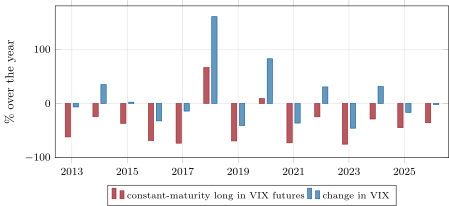
s2_fetch_vx.The index is a year-by-year illustration of what the roll-down does (Figure 5.1). In 2014 VIX rose 35% and the long position lost 25%. In 2025 VIX fell 17% and the long position lost 45%. Only in 2018 and 2020, years with a spike large enough to outrun the roll, did the long position gain.
The synthetic complex
firm.vixetp builds the same objects on chapter 1’s variance path, with a calmer volatility of variance (0.25 instead of 0.5). The index is the 21-day implied vol, the expected variance times the premium, in points. Futures expire every 21 trading days. Each is priced at the index level expected at expiry, reverting to its mean at the variance’s speed, times for years to expiry: a term premium that longs pay (Listing 5.1). The index averaged 19.6, with a median of 17.7. The second contract stood above the first on 81% of days, and the first above the index by 0.44 points. The long constant-maturity index lost at a log rate of 74% a year, with a volatility of 88%. Without the term premium, the curve still slopes up on 65% of days, because the index spends most of its time below its mean. The long index then loses at a log rate of 26% a year, though its average daily return is close to zero ( a year): the loss comes from compounding a series this volatile.
5.2 Exchange-traded volatility products and their rebalancing
Definition 5.2 (Exchange-traded volatility product)
An exchange-traded volatility product is an exchange-traded fund or note (Book 3, chapter 19) that delivers a multiple (, , , ) of the daily return of an index of VIX futures, usually of constant maturity; it holds or hedges the futures and rebalances them at each close.
A product that promises times the daily return, with value , holds of futures. After a daily return , the value is and the futures held are worth . To hold times the new value it must buy
Definition 5.3 (ETP rebalancing flow)
The ETP rebalancing flow is the quantity of futures that leveraged and inverse volatility products must trade at the close to restore their multiples, for each product; it is zero for and has the sign of the day’s move for and , so these products buy after rises and sell after falls.
For an inverse product, . A day on which the futures index rises 50% forces it to buy futures worth its whole value at the close, and twice-leveraged longs must do the same. The flow is known in advance, as a formula in the day’s move, and it arrives at the close when liquidity is thinnest. Whaley’s warning came early: the most popular VIX products are not suitable buy-and-hold investments and are virtually guaranteed to lose money over time. Products on the short-term futures indices had lost nearly $4 billion since their launch in 2009.
5.3 Futures against options
A VIX future and SPX options price related things. The options price the S&P 500’s variance over a window, and the future prices the square root of a 30-day variance that starts at its expiry. The square root is concave, so a future on volatility is worth less than the square root of the forward variance: the difference is a convexity adjustment, which grows with the volatility of volatility. A trader who thinks the adjustment in the futures is wrong can trade the future against a forward-starting variance built from SPX options at two expiries. What they hold is the volatility of volatility, and VIX options (Book 5, chapter 14) price it directly. When the index spikes, all three move together. The relative-value book’s risk is that they then move by different amounts: the future settles at the Special Opening Quotation, the options at their own.
5.4 February 2018
The complex was tested on 5 February 2018. VIX closed at 17.31 on Friday 2 February and at 37.32 on Monday 5 February. The first future settled at 15.625, then 33.225. Our constant-maturity index rose 95.9% on the Monday and fell 25.8% on the Tuesday, its best and worst days of 2013 to 2026. An inverse product on it had lost 96.7% since the start of the year.
Credit Suisse announced on 6 February that its inverse VIX note, XIV, had suffered an acceleration event: its intraday indicative value on 5 February had been at or below 20% of the previous day’s closing indicative value, $108.3681. The note was to be redeemed at its value on the accelerated valuation date. Augustin, Cheng and Van den Bergen described the episode as a lesson in hedge and leverage rebalancing when markets are concentrated and volatile, and compared it with portfolio insurance. On our reconstruction’s move of 95.9%, an inverse product’s rebalancing flow is 1.92 times its value, all of it bought at the close.
The synthetic complex has its own February. After six years of calm the first planted crash takes the index from 17.3 to 63.6 in a day, and the long constant-maturity index rises 189%. An inverse product with the acceleration clause had grown to 16.5 times its starting value; it ends that day at zero. At that close it must buy futures worth 3.77 times its previous value, twice the day’s move, and so must a twice-leveraged long (Figure 5.2). A short-futures book is the same trade at a chosen size:
| short futures, rebalanced daily | annual return | maximum drawdown | final value (start 1) | survives |
|---|---|---|---|---|
| 0.10 of capital | 4.8% | 2.57 | yes | |
| 0.25 of capital | 9.6% | 6.26 | yes | |
| 0.50 of capital | — | 0 | no | |
| 1.00 of capital | — | 0 | no |
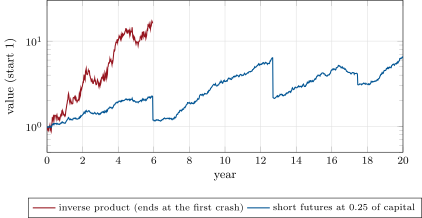
s2_vixetp.paths.Size is the whole strategy. At a quarter of its capital the book earns 9.6% a year and survives a 67% drawdown. At half, it is wiped out. The roll-down is real, but its magnitude says nothing about the size that survives the day the index triples.
5.5 Strategy files
Strategy file 5.1 — Short VIX futures roll-down
Who pays you, and why. Buyers of volatility futures, directly or through long products, who pay a term premium for protection that is there when they need it.
Instruments and venues. VIX futures on Cboe Futures Exchange; inverse products.
Signal. The slope of the curve: short when in contango, smaller or flat when inverted.
Sizing and execution. A small fraction of capital, set by a spike that triples the index; daily rebalancing of the maturity.
Costs. Futures spreads; roll costs.
How it dies. A spike: 5 February 2018 ended an inverse note whose value fell more than 80% in a day.
Horizon, capacity, infrastructure. Months to years; futures access and a daily roll.
Backtest honestly. Include 2018 and 2020; use settlements, not index levels; size on the worst day, not the Sharpe ratio.
Sources. Whaley (2013); Credit Suisse (2018); Augustin, Cheng and Van den Bergen (2021); this chapter: a long constant-maturity position lost 99.99% from 2013 to 2026, and the inverse lost 96.7% from 2 January to 5 February 2018.
Strategy file 5.2 — ETP rebalancing anticipation
Who pays you, and why. Leveraged and inverse products whose rebalancing, , is a formula in the day’s move and trades at the close.
Instruments and venues. VIX futures before and at the close.
Signal. The products’ published values and multiples, and the day’s move so far.
Sizing and execution. Small against the flow; positions taken before the close and unwound after.
Costs. Spreads at the close, where liquidity is thin.
How it dies. Products shrink or close; others anticipate the same flow. Trading ahead of a known flow is legal when it uses public information; trading on a client’s order is not (chapter 29).
Horizon, capacity, infrastructure. Hours; a live estimate of the products’ flows.
Backtest honestly. Close-price fills are optimistic on the days that matter.
Sources. Augustin, Cheng and Van den Bergen (2021) on rebalancing risk; no performance figure verified.
Strategy file 5.3 — VIX futures against SPX options
Who pays you, and why. Mispricing of the convexity adjustment between the future and forward variance from SPX options.
Instruments and venues. VIX futures; SPX options at two expiries; VIX options for the volatility of volatility.
Signal. The future against the square root of the forward variance, adjusted for convexity.
Sizing and execution. Vega-matched legs; stressed on a spike.
Costs. Two markets’ spreads; settlement differences.
How it dies. A spike in which the legs move by different amounts; settlement at different prices.
Horizon, capacity, infrastructure. Weeks; SPX surfaces and VIX futures.
Backtest honestly. Model the Special Opening Quotation at expiry.
Sources. No performance figure verified.
Strategy file 5.4 — Long volatility on an inverted curve
Who pays you, and why. Nobody pays, on average: this is insurance that costs little when the curve is inverted, because the roll then favours longs.
Instruments and venues. VIX futures or calls.
Signal. An inverted curve (first contract above the second).
Sizing and execution. Small; held while inverted.
Costs. Spreads; wider in spikes.
How it dies. The curve reverts to contango quickly and the roll turns against the long.
Horizon, capacity, infrastructure. Days to weeks.
Backtest honestly. Inversions are rare (15% of days from 2013 to 2026); results rest on a few episodes.
Sources. This chapter’s curve statistics; no performance figure verified.
5.6 Tutorial: roll-down
Goal. Build the synthetic index, its futures and products; measure the roll-down, the rebalancing flow and the first crash; rebuild the real constant-maturity index from Cboe’s settlements. End state: the table and the two figures.
Futures and the constant-maturity index.
def future(x, mean, cfg, h, premium: float = 0.5):
    """The index x expected at expiry h years ahead, reverting to its stationary mean at the variance's speed, times
    the term premium."""
    x, h = np.asarray(x, float), np.asarray(h, float)
    return (mean + (x - mean) * np.exp(-cfg.kappa * h)) * (1 + premium * h)


def curve_path(v, cfg, premium: float = 0.5, every: int = 21) -> dict:
    """Contracts expire at days every, 2 x every, ...; at each close the first two live ones and a constant-maturity
    long index held from the close before, whose expiring leg settles at the index level."""
    T = len(v)
    t = np.arange(T)
    x = vix_index(v, cfg)
    m = float(x.mean())                                     # the index's stationary mean, estimated on the path
    d1 = every - t % every                                  # days to the first expiry after today (1..every)
    f1 = future(x, m, cfg, d1 / YEAR, premium)
    f2 = future(x, m, cfg, (d1 + every) / YEAR, premium)
    w1 = d1 / every                                         # weight on the first contract
    cm = np.zeros(T)
    for i in range(1, T):
        a = w1[i - 1]
        if d1[i - 1] == 1:                                  # the first contract expires today at the index
            new1, new2 = x[i], f1[i]
        else:
            new1, new2 = f1[i], f2[i]
        cm[i] = (a * new1 + (1 - a) * new2) / (a * f1[i - 1] + (1 - a) * f2[i - 1]) - 1
    return {"f1": f1, "f2": f2, "d1": d1, "w1": w1, "cm": cm, "vix": x, "mean": m}
Listing 5.1. Futures with a term premium and a long index of constant maturity. code/firm/vixetp/firm_vixetp.py Products and their flows.
def etp(r, leverage: float, accel: float = 0.2) -> dict:
    """Value of a product returning leverage x r each day, 1 at start; ended (frozen, alive False) once a day's value
    is at or below accel of the previous close."""
    val, alive = np.ones(len(r) + 1), np.ones(len(r) + 1, bool)
    for i, x in enumerate(r):
        if not alive[i]:
            val[i + 1], alive[i + 1] = val[i], False
            continue
        val[i + 1] = val[i] * max(1 + leverage * x, 0.0)
        alive[i + 1] = val[i + 1] > accel * val[i]
    return {"value": val, "alive": alive}


def flow(product: dict, r, leverage: float):
    """Futures notional the product must buy at each close (negative: sell) to restore its multiple, on every day it
    starts alive (including the day it ends)."""
    value, alive = product["value"], product["alive"]
    return np.where(alive[:-1], value[:-1] * leverage * (leverage - 1) * np.asarray(r, float), 0.0)
Listing 5.2. A daily-multiple product with an acceleration clause, and its rebalancing flow. code/firm/vixetp/firm_vixetp.py - Run
s2_fetch_vx.pyonce (about 170 files; setOQB_CACHE), thencurve_stats(),short_book(),spike()andfig_vixetp.py.
What to change next. Scale the short book by the curve’s slope; add a VIX call hedge and price it; give the products assets and the futures an open interest, and measure the flow as a share of it.
5.7 Build: volatility index and products
Purpose. A VIX-like index, its futures, a constant-maturity index, daily-multiple products and their rebalancing flows.
Interface. vix_index(v, cfg), future(x, mean, cfg, h, premium), curve_path(v, cfg, premium, every), etp(r, leverage, accel), flow(product, r, leverage).
Rules. The expiring leg settles at the index; weights set at the previous close; a product ends when a day leaves it at or below the acceleration fraction of the previous close.
Acceptance tests. code/firm/vixetp/tests/: the flow formula by hand for ; an ended product frozen with no further flows; a flat index with no premium gives a flat curve and no roll, and with a premium a contango and a steady roll-down.
Stretch. A second, faster volatility factor; VIX options on the index; products’ assets and open interest.
Sources and further reading
- Cboe, Volatility Index Methodology: Cboe Volatility Index.
- R. E. Whaley, “Trading volatility: at what cost?”, Journal of Portfolio Management 40(1), 2013.
- P. Augustin, I.-H. Cheng and L. Van den Bergen, “Volmageddon and the failure of short volatility products”, Financial Analysts Journal 77(3), 2021.
- Credit Suisse AG, “Credit Suisse AG announces the event acceleration of its XIV ETNs”, media release, 6 February 2018 (SEC exhibit 99.1).
- Cboe Futures Exchange, VIX futures daily settlements; Cboe, VIX history.
5.8 Exercises
Exercise 5.1 ★
A product returns times the index each day and is worth 100. The index rises 30%. What must it buy at the close?
Solution
Solution of Exercise 5.1.
: it buys futures worth 60.
Exercise 5.2 ★
The same for a product returning twice the index, and for one returning the index once.
Solution
Solution of Exercise 5.2.
Twice the index: , also a purchase. Once the index: , nothing.
Exercise 5.3 ★
The first contract has 10 days to expiry and the second 38, with contracts 28 days apart. What weight does a constant 30-day position put on the first?
Solution
Solution of Exercise 5.3.
gives on the first contract.
Exercise 5.4 ★★
In 2014 VIX rose 35% and the constant-maturity long lost 25%. Explain.
Solution
Solution of Exercise 5.4.
The curve was in contango on 89% of the year’s days, so the long position paid the roll-down almost every day; VIX’s rise came in spikes that faded, and the index ended higher while the futures the long held had each converged down to it.
Exercise 5.5 ★★
Why is a future on volatility worth less than the square root of the forward variance?
Solution
Solution of Exercise 5.5.
The future prices the expected square root of a variance, and the square root is concave: by Jensen’s inequality, the expected root is below the root of the expected variance. The gap grows with the volatility of volatility.
Exercise 5.6 ★★
Why do inverse and leveraged volatility products make a spike worse at the close?
Solution
Solution of Exercise 5.6.
Their flow has the sign of the day’s move for and : after a rise in the futures they must buy more at the close, which pushes the futures up further on the day when liquidity is thinnest.
Exercise 5.7 ★★★
Coding. Run curve_stats(0.0). Without a term premium, why does the curve still slope up on most days, and why does the long index still lose?
Solution
Solution of Exercise 5.7.
The index spends most of its time below its mean (median 17.7 against a mean of 19.6), so futures expecting reversion stand above it: contango on 65% of days with no premium at all. The long index’s average daily return is close to zero ( a year), but its log return is a year: a series with 88% volatility compounds far below its average.
Exercise 5.8 ★★★
Find the flaw. “Short VIX futures made 9.6% a year at a quarter of capital, so at the full capital it would make almost 40%.”
Solution
Solution of Exercise 5.8.
Returns do not scale with size in a short-volatility book: at half the capital the book was wiped out by the first crash, and at the full capital sooner. The first crash’s index rise of 189% is more than the whole capital of a book short at 0.53 of it or more.
5.9 Problem: Roll-Down
Problem 5.1
Weekend problem — short volatility through futures
The synthetic complex, Cboe’s futures and February 2018.
Part I — The curve.
- What does VIX measure, and how is it computed?
- Define the VIX term-structure slope and give its real statistics.
- What is the roll-down, and what did it cost a constant-maturity long?
- What did the long lose in 2014, 2015 and 2025, and what did VIX do?
Part II — Products.
- Define an exchange-traded volatility product.
- Derive the rebalancing flow .
- Which products buy after rises?
- What did Whaley find?
Part III — February 2018.
- What happened to VIX and the first future on 5 February?
- What did the constant-maturity index and its inverse do?
- What did Credit Suisse announce, and why?
- How did Augustin, Cheng and Van den Bergen read the episode?
Part IV — The verdict.
- State the named result: the short-futures book’s roll-down return and the inverse product’s loss in the planted spike.
- What did the short books earn at each size?
- What flow did the inverse product face at the crash’s close?
- Why is the term premium not needed for the curve to slope up?
- How would you size a short VIX futures book?
- How would you backtest it honestly?
- Which strategy file profits from the others’ rebalancing?
- In one sentence: who pays the roll-down, and why?
Solution
Solution of Problem 5.1.
- The market’s expectation of 30-day S&P 500 volatility, from out-of-the-money SPX and SPXW options at two terms interpolated to 30 days.
- The later future against the earlier or the index; contango on 85.0% of days, the second contract 0.89 points above the first and the first 0.63 above VIX.
- Each future converging down to the index as expiry nears; the long lost 99.99% from 2013 to 2026, a log rate of 66.4% a year.
- 2014: with VIX up 35%; 2015: with VIX up 2%; 2025: with VIX down 17%.
- A fund or note delivering a multiple of the daily return of a VIX futures index, rebalanced at the close.
- Value , futures held , target ; the difference is .
- Inverse () and leveraged () products.
- The most popular VIX products are virtually guaranteed to lose over time; those on the short-term indices had lost nearly $4 billion.
- VIX 17.31 to 37.32; the first future 15.625 to 33.225.
- The index rose 95.9%; the inverse lost 95.9% on the day and 96.7% since the start of the year.
- An acceleration event on XIV: its intraday indicative value had fallen to 20% or less of the previous close.
- As a failure of hedge and leverage rebalancing in a concentrated, volatile market, like portfolio insurance.
- Named result. Short futures at a quarter of capital earned 9.6% a year with a 67% drawdown; the inverse product grew to 16.5 times its value and ended at zero when the first crash took the index from 17.3 to 63.6, facing a flow of 3.77 times its value at that close.
- 4.8% a year at 0.10 of capital, 9.6% at 0.25; wiped out at 0.50 and 1.00.
- Futures worth 3.77 times its value, twice the day’s 189%.
- The index spends most of its time below its mean, so expected reversion lifts the futures.
- By the largest one-day rise the book must survive, not by its roll-down.
- Settlements, not index levels; 2018 and 2020 included; the roll and costs; several sizes.
- ETP rebalancing anticipation.
- Buyers of volatility futures pay it, for protection that pays when they need it.
5.10 Interview questions
Interview question 5.1 ★ trader
Why do long VIX products lose money over time?
Solution
Solution of Interview question 5.1.
The futures curve is usually in contango: each future converges down to the index as it nears expiry, and a long position of constant maturity keeps selling the cheaper near contract and buying the dearer far one. Spikes are brief; the roll is constant.
Interview question 5.2 ★★ trader
The VIX curve is inverted. What does it tell you, and what trades does it suggest?
Solution
Solution of Interview question 5.2.
The market expects volatility to fall from a high level: a stress is under way. The roll now favours longs; short positions face the risk of a further spike; calendar trades and small long positions are cheap to hold.
Interview question 5.3 ★★ researcher
How would you build a constant-maturity index from futures settlements, and what can go wrong at the roll?
Solution
Solution of Interview question 5.3.
Weight the first two contracts each close by the days left so that the maturity is constant, carry yesterday’s weights through today’s settlement, and value an expiring contract at its final settlement. Errors come from expiry days, holidays, missing or zero settlements, and using index levels for futures.
Interview question 5.4 ★★ risk
You run a short VIX futures book. How do you size and stress it?
Solution
Solution of Interview question 5.4.
By the largest one-day rise it must survive, with a margin; stress on a tripling of the index and on the products’ flows at the close; limit size so that the stress loss is a fraction of capital.
Interview question 5.5 ★★ developer
Design the daily process that computes a leveraged product’s rebalancing at the close.
Solution
Solution of Interview question 5.5.
At each close: the product’s value from the index’s return, the target exposure times the new value, the futures held after the move, and the difference to trade; with checks on the settlement prices, the roll schedule and an acceleration trigger.
Interview question 5.6 ★★★ researcher
Show that a product returning times the daily return must trade at each close, and show that its value over two days is not times the index’s two-day return.
Solution
Solution of Interview question 5.6.
As derived in the chapter: . Over two days the product earns , while times the index’s two-day return is : they differ by .