Strategies II: Volatility, Relative Value, Macro and the Bank Desks · Strategies
28Hedging a Structured-Products Book
Retail investors buy autocallables in large size. The banks that sell them end up long volatility they must sell, short correlation and long dividends, and their hedging moves those markets. The Bank for International Settlements noted in September 2026 that hedging the autocallables widely sold to Korean retail investors can require large, destabilising trades near the barriers. On this chapter’s synthetic book of € 1 billion of five-year autocallables, the bank is long € 9.66 million of vega per volatility point and earns a margin of € 8.31 million. Selling that vega into a market that absorbs € 10 million per point of concession lowers long-dated implied volatility by 0.97 points and costs the bank € 4.67 million, more than half its margin. The build is firm.sphedge.
28.1 The autocallable book’s exposures
Definition 28.1 (Exotic book exposure)
An exotic book exposure is a sensitivity of a book of structured products to a market input that vanilla instruments hedge only in part (volatility at long maturities, skew, dividends, correlation), measured by revaluing the whole book with the input bumped.
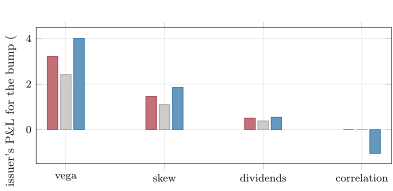
The bank has sold three notes (Listing 28.1): € 400 million on index A alone, € 300 million on index B alone, and € 300 million on the worse of the two. Each is Book 5’s autocallable (chapter 18): five years, annual observations, autocall at 100%, a Phoenix coupon of 7% (9% for the worst-of) paid above a 70% barrier with memory, and capital protected unless the index ends below 60%. The indices have 20% volatility, a local-volatility skew that adds 10 points per 100% fall, 3% dividends and a correlation of 0.7. The single notes are worth 99.12 per 100 and the worst-of 99.29: the bank’s margin is € 8.31 million.
| issuer’s P&L for the bump (€ millions) | single A | single B | worst-of | book |
|---|---|---|---|---|
| volatility point | 3.22 | 2.42 | 4.02 | 9.66 |
| skew | 1.47 | 1.10 | 1.86 | 4.42 |
| dividend yield point | 0.51 | 0.38 | 0.55 | 1.43 |
| correlation |
The investor’s note is, in large part, a short put that knocks in below 60%. The bank holds the other side: it gains when volatility, downside skew or dividends rise, all of which make the put dearer. The worst-of note adds a short position in correlation: when the indices move more alike, the worse of the two is less likely to be bad, which helps the investor and costs the bank. These exposures are the mirror image of what the investor sold, and the bank must sell them on.
As of September 2026 — Autocallables in Korea
The BIS Quarterly Review of September 2026 described autocallables as widely sold to Korean retail investors and noted that hedging them can require large, destabilising trades near the barriers. Issuance referencing Samsung Electronics and SK Hynix, which together exceed half the KOSPI 200, rose sharply in the first half of 2026.
28.2 Vega and skew
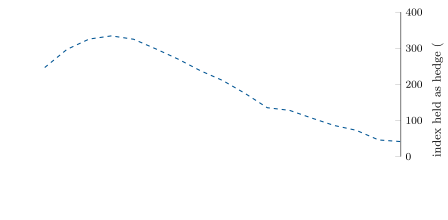
The book’s exposures move with the index (Figure 28.1). At inception, the single note on A leaves the bank long € 3.22 million of vega, and its hedge holds € 106 million of the index. If the index opened lower, the vega would rise to a peak of € 4.45 million near 80% of the strike, then fall and turn negative below about 52%: once the protection is likely lost, the note is mostly a holding of the index. The hedge grows as the index falls, to € 334 million at 55%, which means buying into a falling market. Below that it shrinks, to € 246 million at 40%, which means selling as the market falls further. That second region is the destabilising trade near the barrier. (Listing 28.2 computes both curves.)
s2_sphedge.profile.28.3 Correlation and dividends
Definition 28.2 (Recycling trade)
A recycling trade is a trade by which an issuer of structured products passes on to other investors the exposures its book cannot hedge with vanilla instruments: selling long-dated volatility, selling dividends, buying correlation, usually at a concession.
The bank’s dividend exposure, € 1.43 million per 0.1 point of dividend yield, is recycled by selling dividend futures or swaps, the supply chapter 26 modelled; Eurex describes its dividend derivatives as used to hedge dividends particularly for structured products. The short correlation, € 1.05 million per 0.05 of correlation, is recycled by buying correlation: selling index volatility against single-name volatility, the other side of chapter 2’s dispersion trade. Each recycling trade needs a buyer, and the buyers (hedge funds, dispersion traders, dividend investors) are paid for taking the other side (Figure 28.2).
s2_sphedge.table.28.4 Recycling trades
Selling € 9.66 million of vega per point moves the market that absorbs it. If buyers take € of vega for each point of concession, long-dated implied volatility falls by points; the bank pays half that move on average, and a buyer who holds until volatility returns earns all of it:
| depth (€ m of vega per point) | 5 | 10 | 20 |
|---|---|---|---|
| move of long-dated implied volatility (points) | |||
| bank’s cost (€ m) | 9.33 | 4.67 | 2.33 |
| buyer’s gain if volatility returns (€ m) | 18.67 | 9.33 | 4.67 |
The cost of recycling is of the order of the margin, € 8.31 million. When many issuers sell the same exposures, depth is shared and the move is larger. Supply that pushes long-dated volatility, dividends and correlation away from fair value is what the buyers of chapters 2, 3 and 26 are paid for. The issuer’s alternatives are to keep the risk, which its limits rarely allow, or to price the recycling cost into the notes.
28.5 Strategy files
Strategy file 28.1 — Vega recycling to hedge funds
Who pays you, and why. The issuer, who must sell the long-dated vega its notes leave it with.
Instruments and venues. Long-dated index options and variance swaps, over the counter.
Signal. Long-dated implied volatility below its fair level after issuance waves.
Sizing and execution. Buy what issuers sell; hold until volatility returns.
Costs. Wide spreads on long-dated options; funding of the premium.
How it dies. Issuance that never stops; a volatility regime that stays low.
Horizon, capacity, infrastructure. Years.
Backtest honestly. Long-dated implied volatility history as quoted, with its spreads.
Sources. This chapter: 0.97 points of implied volatility for € 9.66 million of vega at a depth of € 10 million.
Strategy file 28.2 — Dividend recycling
Who pays you, and why. Issuers long dividends from their notes’ hedges.
Instruments and venues. Index dividend futures and swaps.
Signal. Dividend futures below forecast dividends.
Sizing and execution. Held to expiry.
Costs. Futures spreads; recession cuts.
How it dies. Recessions and dividend bans.
Horizon, capacity, infrastructure. One to five years.
Backtest honestly. Include recession years.
Sources. Eurex factsheet; chapter 26; this chapter: € 1.43 million per 0.1 point of dividend yield.
Strategy file 28.3 — Correlation recycling
Who pays you, and why. Issuers of worst-of notes, short correlation.
Instruments and venues. Correlation swaps; index against single-stock volatility (dispersion).
Signal. Implied correlation against realised.
Sizing and execution. Vega-weighted dispersion (chapter 2).
Costs. Single-stock option spreads.
How it dies. Crashes, when correlation jumps.
Horizon, capacity, infrastructure. Months to years.
Backtest honestly. Correlation in crashes.
Sources. This chapter: € 1.05 million per 0.05 of correlation on a € 300 million worst-of.
Strategy file 28.4 — Skew hedge programme
Who pays you, and why. The issuer’s own risk limits; the market’s price for downside protection.
Instruments and venues. Out-of-the-money index puts and put spreads.
Signal. The book’s skew exposure by maturity and level.
Sizing and execution. Sell downside skew against the book’s long position, more as the index nears the barriers.
Costs. Put spreads; the destabilising hedge near barriers.
How it dies. A crash through the barriers.
Horizon, capacity, infrastructure. The notes’ lives.
Backtest honestly. Paths through the barriers, not only calm ones.
Sources. BIS Quarterly Review, September 2026; this chapter: € 4.42 million per 0.05 of skew.
28.6 Tutorial: long what nobody wants
Goal. Price a book of autocallables, measure its exposures by revaluation, trace one note’s vega and hedge against the index level, and cost the recycling of its vega. End state: the three tables and two figures.
The book and its exposures.
def note_value(note: Note, mkt: MarketState, paths: int = 20_000, seed: int = 197, spot: float = 1.0) -> float:
    """Five-year note, annual observations, autocall at 100%, Phoenix coupon at a 70% barrier with memory, 60%
    protection at maturity; value per 100 on monthly paths of the (worst-of the) underlyings, which start at `spot`
    times the strike."""
    ts = TermSheet(obs_times=(1.0, 2.0, 3.0, 4.0, 5.0), trigger=1.0, coupon=note.coupon, coupon_barrier=0.7,
                   protection=0.6)
    m = len(note.assets)
    corr = np.array([[1.0, mkt.corr], [mkt.corr, 1.0]]) if m == 2 else None
    times, perf = simulate(_sigma(mkt), np.ones(m), ts.maturity, mkt.rate, mkt.div, paths, seed, steps_per_year=12,
                           corr=corr)
    return float(cashflows(ts, times, spot * perf, mkt.rate)["pv"].mean())


def book_exposures(book=BOOK, mkt: MarketState | None = None, paths: int = 20_000, seed: int = 197) -> dict:
    """For each bump: the issuer's P&L (the notes' value falls are its gains), by note and in total, in currency."""
    mkt = mkt or MarketState()
    base = {n.name: note_value(n, mkt, paths, seed) for n in book}
    out = {"value": base}
    for key, (field, size) in BUMPS.items():
        bumped = replace(mkt, **{field: getattr(mkt, field) + size})
        by = {n.name: -(note_value(n, bumped, paths, seed) - base[n.name]) / 100 * n.notional
              for n in book if key != "correlation" or len(n.assets) == 2}
        out[key] = {"by_note": by, "total": sum(by.values()), "bump": size}
    return out
Listing 28.1. Notes on monthly paths; the issuer’s P&L for each bump. code/firm/sphedge/firm_sphedge.py Across the index level, and recycling.
def spot_profile(note: Note, spots, mkt: MarketState | None = None, paths: int = 20_000, seed: int = 197) -> dict:
    """The issuer's vega (currency per vol point) and delta (currency of index per 1% move) of one note, at the start of
    its life, if the index opened at each level relative to the strike. Local volatility is left as a function of the
    level relative to today's, as a sticky-moneyness market would quote it after a move."""
    mkt = mkt or MarketState()
    out = {"spot": list(spots), "vega": [], "delta": []}
    for s in spots:
        v0 = note_value(note, mkt, paths, seed, s)
        vv = note_value(note, replace(mkt, vol=mkt.vol + 0.01), paths, seed, s)
        up, dn = note_value(note, mkt, paths, seed, s * 1.02), note_value(note, mkt, paths, seed, s * 0.98)
        out["vega"].append(-(vv - v0) / 100 * note.notional)
        out["delta"].append(-(up - dn) / 4 / 100 * note.notional)          # per 1% move, central difference over 2%
    return out


def recycling_impact(vega: float, depth: float) -> dict:
    """Selling `vega` (currency per vol point) into a market that gives `depth` of vega per vol point of price
    concession lowers long-dated implied volatility by vega / depth points; with a linear concession the seller pays
    half the move on average, and a buyer who holds until volatility returns earns the whole move."""
    move = vega / depth
    return {"move": -move, "seller_cost": vega * move / 2, "buyer_gain": vega * move}
Listing 28.2. Vega and delta by level; the move and cost of selling vega. code/firm/sphedge/firm_sphedge.py - Run
table(),margin(),profile(),recycling()andfig_sphedge.py.
What to change next. Age the book a year and recompute; add a third index and a worst-of on three; let depth fall when several issuers sell at once.
28.7 Build: structured-products hedging
Purpose. Exposures of an autocallable book by revaluation, their profile across the index level, and the cost of recycling.
Interface. Note, BOOK, MarketState(…), note_value(note, mkt, paths, seed, spot), book_exposures, spot_profile, recycling_impact(vega, depth).
Rules. Book 5’s term sheet and cash flows; common random numbers for every bump; monthly steps (annual observations, knock-in at maturity).
Acceptance tests. code/firm/sphedge/tests/: the book’s signs; sensible note values; the worst-of gains from correlation; recycling by hand.
Stretch. Daily knock-in; ageing; several issuers sharing depth.
Sources and further reading
- Bank for International Settlements, BIS Quarterly Review, September 2026, Box B, “Short on memory? Leveraged ETFs and chip stock volatility”.
- Eurex, “Dividend derivatives”, factsheet, accessed 25 September 2026.
28.8 Exercises
Exercise 28.1 ★
A note is worth 99.12 per 100 and the bank sells € 400 million of it at par. What is the margin?
Solution
Solution of Exercise 28.1.
million € 3.52 million.
Exercise 28.2 ★
The book is long € 9.66 million of vega per point and the market absorbs € 5 million per point. How far does implied volatility fall, and what does the bank pay?
Solution
Solution of Exercise 28.2.
points; the bank pays half of it on average on the vega it sells: € 9.33 million.
Exercise 28.3 ★
The delta hedge holds € 106 million of the index at 100% and € 334 million at 55%. What does the bank trade as the index falls between them?
Solution
Solution of Exercise 28.3.
It buys € 228 million of the index as it falls from 100% to 55%: the hedge grows from € 106 million to € 334 million.
Exercise 28.4 ★★
Why is the issuer of an autocallable long volatility?
Solution
Solution of Exercise 28.4.
The investor is short a put that knocks in below the protection level, and the autocall caps the upside it could earn from coupons; the issuer holds the other side. A put gains value when volatility rises, so the issuer’s liability falls: it is long volatility.
Exercise 28.5 ★★
Why is the issuer of a worst-of note short correlation?
Solution
Solution of Exercise 28.5.
The worst-of pays according to the worse of two indices. The more alike they move, the less likely one of them ends far below the other, so the note is worth more to the investor; the issuer, short the note, loses when correlation rises.
Exercise 28.6 ★★
Why can hedging near the barriers destabilise the market?
Solution
Solution of Exercise 28.6.
Near the barriers the hedge’s size changes fastest with the index. Below the level where it peaks the issuer must sell the index as it falls, adding to the fall, and when many notes share barriers and underlyings, as the BIS described for Korea, the sales are large relative to the market.
Exercise 28.7 ★★★
Coding. Read the vega profile. At what index level does the single note’s vega change sign, and why?
Solution
Solution of Exercise 28.7.
Between 50% and 55% of the strike, about 52% by interpolation (vega million at 50%, million at 55%). Below it the protection is likely lost and the note is mostly a holding of the index; more volatility then raises the chance that the index recovers above 60% by maturity, which helps the investor and costs the issuer.
Exercise 28.8 ★★★
Find the flaw. “Our notes earn a 0.9% margin with the risk hedged; recycling is just an operational detail.”
Solution
Solution of Exercise 28.8.
The margin is € 8.31 million on € 1 billion; recycling the book’s vega alone costs € 4.67 million at a depth of € 10 million per point and € 9.33 million at € 5 million. The unhedgeable exposures and the concession needed to pass them on are the economics of the business, not a detail.
28.9 Problem: Long What Nobody Wants
Problem 28.1
Weekend problem — hedging a structured-products book
The chapter’s synthetic book and the public record.
Part I — The book.
- Define an exotic book exposure.
- Describe the notes and the market.
- What is the bank’s margin?
- What did the BIS observe in Korea?
Part II — Exposures.
- Give the exposures table.
- Why is the bank long volatility, skew and dividends?
- Why is it short correlation?
- How does vega change with the index level?
Part III — Recycling.
- Define a recycling trade.
- How is each exposure recycled?
- Give the recycling table.
- Who is paid, and by whom?
Part IV — The verdict.
- State the named result: the book’s net exposures and the implied-volatility move its recycling causes.
- Why is the hedge destabilising below 55%?
- How does the recycling cost compare with the margin?
- What happens when many issuers recycle at once?
- Which earlier chapters are on the other side of this book?
- Which strategy file is a trader’s, not the issuer’s?
- How would you backtest a vega-recycling buyer?
- In one sentence: what does the structured-products desk sell besides notes?
Solution
Solution of Problem 28.1.
- A sensitivity of a structured-products book to an input vanilla instruments hedge only in part, measured by revaluing the book with it bumped.
- € 400 million single on A, € 300 million single on B, € 300 million worst-of; five years, annual autocall at 100%, Phoenix coupons of 7% and 9% at 70%, 60% protection; 20% volatility with skew, 3% dividends, correlation 0.7.
- € 8.31 million: the notes are worth 99.12 and 99.29 per 100.
- Autocallables are widely sold to Korean retail investors, hedging them can require destabilising trades near barriers, and issuance on Samsung and SK Hynix rose sharply in the first half of 2026.
- Vega 3.22, 2.42, 4.02, total 9.66; skew 1.47, 1.10, 1.86, total 4.42; dividends 0.51, 0.38, 0.55, total 1.43; correlation (€ millions).
- It is long the put the investor sold, and a put gains from higher volatility, steeper downside skew and higher dividends.
- The worst-of’s investor gains when the indices move alike; the issuer holds the other side.
- From € 3.22 million at the strike to a peak of € 4.45 million near 80%, turning negative below about 52%.
- Passing on exposures the book cannot hedge with vanillas: selling long-dated volatility and dividends, buying correlation.
- Vega through long-dated options and variance swaps to hedge funds; dividends through dividend futures and swaps; correlation by buying it through dispersion trades.
- At depths of € 5, 10 and 20 million per point: implied volatility falls 1.93, 0.97 and 0.48 points; the bank pays 9.33, 4.67 and 2.33 million; a patient buyer gains 18.67, 9.33 and 4.67 million.
- The buyers of the recycled exposures, paid by the issuers through the concession.
- Long € 9.66 million of vega, € 4.42 million per 0.05 of skew, € 1.43 million per 0.1 point of dividends, short € 1.05 million per 0.05 of correlation; recycling the vega moves long-dated implied volatility by points at a depth of € 10 million.
- Below 55% the hedge shrinks as the index falls: the bank sells into the fall.
- Of the same order: € 4.67 million against a margin of € 8.31 million at a depth of € 10 million.
- They share the depth: the move and the cost grow with the total supply.
- Chapter 2’s dispersion, chapter 3’s term-structure and skew trades, and chapter 26’s dividend buyers.
- The vega-recycling buyer’s.
- On quoted long-dated implied volatility with its spreads, entering after issuance waves and holding to reversion, including the years it does not revert.
- The exposures its notes leave it with, recycled to whoever will take them at a price.
28.10 Interview questions
Interview question 28.1 ★ trader
What exposures does a bank keep after selling autocallables?
Solution
Solution of Interview question 28.1.
Long volatility (mostly long-dated), long downside skew, long dividends, short correlation for worst-of notes, and gap and barrier risk that grows as the underlying approaches the knock-in levels.
Interview question 28.2 ★★ researcher
How would you measure a structured-products book’s correlation exposure?
Solution
Solution of Interview question 28.2.
Revalue the book with the correlation matrix bumped (uniformly and pair by pair), with common random numbers, and express the result as correlation vega by pair and maturity; check it against the book’s dispersion hedges.
Interview question 28.3 ★★ trader
The index has fallen 40% and your book is near its knock-in barriers. What do you do?
Solution
Solution of Interview question 28.3.
Recompute the exposures at the new level, since vega and delta change fastest there; reduce the delta hedge carefully across the barriers, buy downside protection if it is not too expensive, and coordinate with the risk limits before the market moves further; expect others with the same books to trade the same way.
Interview question 28.4 ★★ risk
What stress tests matter most for an autocallable book?
Solution
Solution of Interview question 28.4.
Large falls through the barriers with volatility and correlation jumping, dividend cuts, and a gap move on an observation date; each with the liquidity of the hedging markets reduced.
Interview question 28.5 ★★ developer
Revaluing a book of ten thousand notes for twenty bumps takes too long. What would you do?
Solution
Solution of Interview question 28.5.
Share simulated paths across notes with the same underlyings, use adjoint (pathwise) sensitivities instead of bumps, reduce the time grid to the observation dates where the payoff allows, and run on many cores or GPUs.
Interview question 28.6 ★★★ researcher
With a linear price concession, show that selling a quantity into depth costs , and that splitting the sale into equal parts separated by full recovery costs .
Solution
Solution of Interview question 28.6.
Selling moves the price by ; the marginal price of the -th unit is , so the cost is . In parts with full recovery in between, each costs , and of them cost .