Primary & Middle School Biology · Grades 1–9
43Producing Our Food
Nothing on your breakfast table was found in the wild. The bread’s wheat was bred and farmed; the milk came from herds tended for it; the yogurt was made from that milk by billions of living workers too small to see. Humans feed themselves by managing living things — growing them, raising them, and putting some of the smallest to work. This chapter tours the food workshop.
43.1 Growing and raising
Definition 43.1 (Crops and livestock)
Human food production manages living things at two floors of the matter cycle:
- crop growing: managing producers — wheat, potatoes, vegetables, fruit — for their organic matter (Proposition 40.3);
- livestock raising: managing consumers — cattle, sheep, pigs, hens — for their production of matter (Definition 41.4): milk, meat, eggs, wool.
Farmers manage the conditions this book keeps meeting: soil minerals for the crops (Remark 22.5), feed for the animals — the whole ledger of Problem 41.1, run on purpose.
Example 43.2 (What a wheat field is)
A wheat field is a managed environment (Proposition 35.1) tuned for one producer: soil restocked and loosened for its roots, sowing timed to Proposition 9.5’s warmth, weeds — rival colonists of Chapter 39 — kept out. The harvest is the plant’s seed store: grain, the packed lunches of a million never-to-be-sown wheat plants, diverted to bakeries.
Remark 43.3 (Every food is a life-cycle stage)
Read any food biologically and it is some organism’s organ or stage: grain and beans are seed stores; potatoes, tubers; apples, fruits built to be eaten (Exercise 39.12); milk is mammal mother-care (Definition 8.1); an egg is a packed nursery. Food production is the art of managing life cycles so their provisions arrive on our tables.
43.2 The invisible workforce: food made by microbes
Definition 43.4 (Fermentation)
Some foods are made by putting living things too small to see — microbes — to work on a raw material. Their feeding transforms it: the transformation is called fermentation, and humans have run it for thousands of years, since long before anyone knew the workers existed.
Example 43.5 (Bread rises)
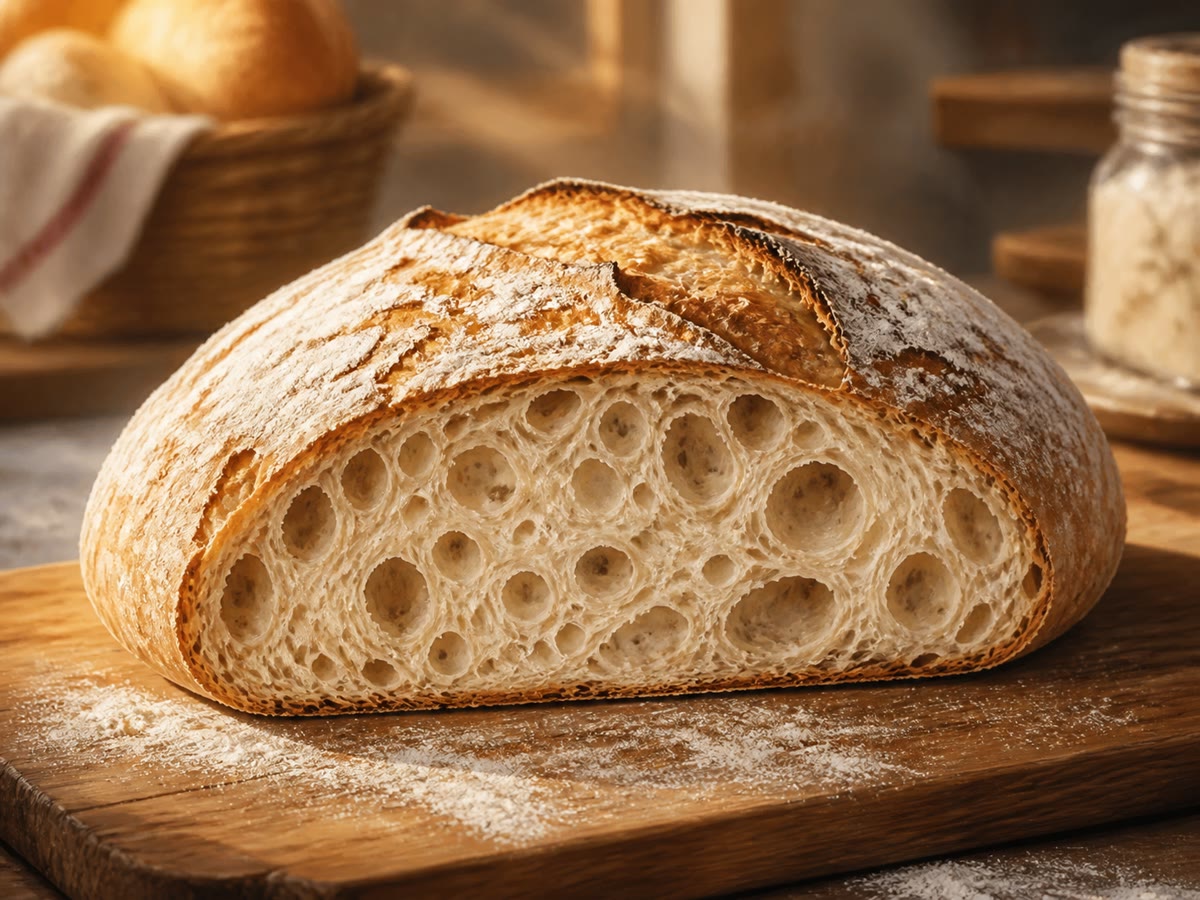
Bread’s raw dough is flour and water — plus yeast, a single-celled fungus (Remark 29.9 met such lives). The yeast feeds on the flour’s sugars and releases a gas; the gas’s bubbles, trapped in the stretchy dough, puff it up — the baker calls it rising. The oven’s heat then ends the workers’ shift and sets their work: the crumb’s holes are the yeast’s signature.
Example 43.6 (Milk becomes yogurt and cheese)
Warm milk seeded with the right microbes thickens overnight into yogurt: the workers feed on the milk’s sugar and release an acid, and the acid sets the milk — the fresh tang is the acid. Cheese starts similarly, then goes further: curds pressed, salted and ripened for months, the microbes working on through the ripening — a cheese’s holes, rind and power of smell are their long shift’s log.
Remark 43.7 (Helpful and harmful microbes)
The germs of Definition 6.1 taught caution about microbes; this chapter adds the other half: chosen microbes, working in controlled conditions, are among our oldest employees — in bread, yogurt, cheese, and the vinegar barrel. The craft is always the same: welcome the chosen workers, and keep conditions that suit them and not the spoilers. Salting, cooling, drying and cooking are all ways of refusing conditions to unwanted microbes (Proposition 42.8 works on a ham exactly as on a leaf pile).
43.3 From field to table, honestly
Proposition 43.8 (The costs on the table)
Every plate is an output of managed land and living things, and carries their arithmetic:
- plant foods arrive one floor from the light; animal foods route through a consumer first and pay Proposition 41.6’s toll (Exercise 41.12);
- lasting production must keep Proposition 35.5’s three rules — feed the soil, keep the helpers, take no faster than renewal;
- and waste undoes it all: food thrown away spent its land, water and work for no one.
Proof. Admitted at this level. ∎
Method 43.9 (Reading a food’s story)
For any food in the kitchen:
- name the organism and the organ or stage it is (Remark 43.3);
- place it on the cycle: producer’s matter, consumer’s product, or microbe-made?
- if microbe-made, name the raw material and what the workers changed;
- trace it to its leaf (Method 40.8) — the trail still always ends in the light.
Example 43.10 (The method at breakfast)
Yogurt, by the method: (1) milk — a cow’s mother-care product — transformed; (2) consumer’s product, microbe-finished; (3) raw material milk, workers soured and set it; (4) milk from the cow, cow from grass, grass from light. Three organisms and a workforce of billions, in one small pot.
43.4 Exercises
Exercise 43.1 ★
Define crop growing and livestock raising, naming the floor of the matter cycle each manages.
Solution
Solution of Exercise 43.1.
Crop growing manages producers — plants grown for their organic matter. Livestock raising manages consumers — animals raised for their production: milk, meat, eggs, wool.
Exercise 43.2 ★
For each food, name the organism and the organ or stage: grain, potato, apple, milk, egg.
Exercise 43.3 ★
What is fermentation? Name two fermented foods and their raw materials.
Exercise 43.4 ★
Tell why bread rises: the worker, its food, what it releases, and what the oven does.
Exercise 43.5 ★
What sets milk into yogurt, and where does the tang come from?
Exercise 43.6 ★
Give three ways of refusing conditions to unwanted microbes, from Remark 43.7.
Solution
Solution of Exercise 43.6.
Salting, cooling (fridge), drying — also cooking: each denies unwanted microbes a working condition (moisture, warmth), exactly as cold slows a compost heap.
Exercise 43.7 ★★
A wheat field manages every need of Proposition 22.3 on purpose. Match each need to the farmer’s action of Example 43.2.
Solution
Solution of Exercise 43.7.
Water: the farmer relies on (and sometimes brings) rain. Light: sowing in open fields, spaced so every plant gets its share. Warmth: sowing timed to the warm season. Air: open ground, loosened soil. Mineral salts: manure and restocking after harvest.
Exercise 43.8 ★★
Run Method 43.9 on cheese, step by step.
Solution
Solution of Exercise 43.8.
(1) Organism and stage: cow’s milk — a consumer’s product. (2) Cycle place: consumer’s product, microbe-finished. (3) Raw material milk; the workers sour and set it into curds, then ripen the pressed cheese for months — holes, rind and smell are their log. (4) Trail: milk from the cow, cow from grass, grass from light.
Exercise 43.9 ★★
Why does refrigeration keep food — and why does the same cold slow a compost heap? One principle, two kitchens: name it.
Solution
Solution of Exercise 43.9.
Microbes are living workers with conditions: cold nearly stops their feeding. In the fridge that protects the food (the spoilers idle); in the winter heap it delays the compost (the decomposers idle). The principle: decomposition and spoilage run at the pace conditions allow.
Exercise 43.10 ★★
Reconcile Definition 6.1 with this chapter: how can microbes be both the hand-washing enemy and the yogurt workforce?
Solution
Solution of Exercise 43.10.
“Microbe” names a vast crowd of different tiny living things. Some, in the wrong place, cause illness — those the hand-washing targets; others, chosen and managed in controlled conditions, make bread rise and milk set. Enemy or employee is not the microbe’s nature but the match of species, place and management.
Exercise 43.11 ★★
Using Proposition 43.8, explain why a thrown-away ham sandwich wastes more than the same weight of thrown-away bread.
Solution
Solution of Exercise 43.11.
The ham routed through a pig: its weight cost many times its weight in feed, plus the pig’s burned share, land and water — the consumer floor’s toll. The bread’s wheat came one floor from the light. Wasting the sandwich wastes both ledgers; the ham’s is the longer one.
Exercise 43.12 ★★★
For thousands of years, bakers and brewers ran fermentation without knowing microbes existed. What did they actually manage, in Proposition 37.6’s terms — and why did their recipes work anyway?
Solution
Solution of Exercise 43.12.
They managed the workers’ conditions: warmth for the dough’s corner, the starter kept and fed, salt and timing tuned by trial across generations. The recipes worked because keeping conditions right keeps the right living things thriving — whether or not anyone knows the living things are there. They farmed microbes blind, and well.
43.5 Problem: The Class Bakery
Problem 43.1
Weekend problem — one batch of bread, followed from seed to slice
For the school fair, the class bakes bread from scratch — and keeps its biology notebook open from the wheat field visit in July to the loaves in November.
Part I — The field (July).
- The farmer shows the ripe wheat: “the harvest is the plant’s packed lunches.” Unpack the phrase with Definition 9.1 — what is each grain, and for whom was it packed?
- In whose leaves, and with what inputs, was the grain’s organic matter manufactured?
- The farmer sows only part of the harvest next autumn and sells the rest. Name the two fates of a wheat grain, in life-cycle terms.
- The field’s soil gets manure after harvest. Which return rule is this, and which of the plant’s five needs does it serve?
Part II — The bakery (November).
- The class mixes flour, water, salt and yeast, and sets the dough in a warm corner. Why warm? Answer for the yeast as for any living worker (Proposition 42.8 has the pattern).
- An hour later the dough has doubled. Explain the rise: what did the yeast feed on, what did it release, and what trapped it?
- One team’s dough, forgotten by a drafty cold window, barely rises. Diagnose — and say which fair-test comparison the two teams have accidentally run.
- In the oven the loaves stop rising and set. What has the heat done to the workforce, and what remains as its signature in the crumb?
Part III — The accounting.
- Trace the finished slice to the light, link by link.
- The fair also sells butter and ham sandwiches. Rank slice, butter and ham by the floors their matter routed through, and state which paid the biggest toll of Proposition 41.6.
- Unsold dough is composted, not binned. Follow its organic matter one turn further around the cycle — who takes it, and toward what?
- Close the notebook with one sentence containing: producer, consumer (if any), microbe workforce, and light.
Solution
Solution of Problem 43.1.
1. Each grain is a seed: a tiny wheat plant packed with a food store, made by the parent for that plantlet’s first days — not for us, though we divert it.
2. In the wheat plants’ own green leaves, from water and mineral salts of the soil and carbon dioxide of the air, with light as the energy.
3. Sown, a grain runs its life cycle: germination to plant to new grain. Sold and milled, its life cycle ends and its food store becomes ours — lunch packed for a plantlet, eaten by a person.
4. Return what you borrow: the manure’s rotting restocks the mineral salts that the harvest carried off — serving the need for mineral salts.
5. Because yeast is a living worker: warm, it feeds and works fast; cold, it idles — the compost crew’s rule, at bakery scale.
6. It fed on the flour’s sugars and released gas; the stretchy dough trapped the gas as bubbles, and the bubbles doubled the dough.
7. The cold window idled the yeast — barely fed, barely any gas. The two teams ran an accidental fair test of warmth: same dough, same day, one condition different, two risings to compare.
8. The heat has killed the yeast, ending the shift; the set crumb keeps the bubbles’ holes — the workforce’s signature, baked in place.
9. Slice from loaf, loaf from dough, dough from flour, flour from grain, grain from the wheat plant’s leaves — manufactured there from mineral inputs with light: the trail ends in the July field’s sunshine.
10. Slice: one floor (producer to table, with a microbe finish). Butter: two floors (grass to cow to cream). Ham: two floors with the biggest toll — the pig burned and dropped most of its feed’s matter before any became ham. The slice is cheapest in matter; the ham dearest.
11. The compost’s decomposers — worms, woodlice, fungi, unseen crews — dismantle the dough’s organic matter to humus and mineral salts: one turn on from food to next year’s soil fertility.
12. For example: “Our bread was built by a producer from mineral matter and light, raised by a microbe workforce, and needed no consumer floor at all — though the ham sandwiches next door needed one.”