
সব বই

পেশাদার

1 Markets I: The Ecosystem and Exchange-Traded Marketsবাজার অনলাইন 2 Markets II: Rates, FX and Creditবাজার অনলাইন 3 Markets III: Commodities, Energy and Cryptoবাজার অনলাইন 4 Quantitative Methodsপদ্ধতি অনলাইন 5 Derivatives and Volatilityডেরিভেটিভস অনলাইন 6 Rates, Credit, XVA and Riskসুদহার, ঋণ ও ঝুঁকি অনলাইন 7 Research Craft: Predictors, Backtests, Measurement, Portfoliosগবেষণা অনলাইন 8 Strategies I: Equities and Futuresকৌশল অনলাইন 9 Strategies II: Volatility, Relative Value, Macro and the Bank Desksকৌশল অনলাইন 10 Microstructure and Executionএক্সিকিউশন অনলাইন 11 Market Making and High-Frequency Tradingমার্কেট মেকিং অনলাইন 12 Machine Learning for Marketsমেশিন লার্নিং অনলাইন 13 Low-Latency Softwareপ্রযুক্তি অনলাইন 14 Networks, Hardware and Trading Infrastructureপ্রযুক্তি অনলাইন 15 Research, Data and Risk Platformsপ্রযুক্তি অনলাইন 16 The Desk and the Firmপ্রতিষ্ঠান অনলাইন 17 The Industry: Firms, Roles and Careersক্যারিয়ার অনলাইন 18 Interviews I: Maths, Probability and Speedক্যারিয়ার অনলাইন 19 Interviews II: Markets, Trading Games and the Final Roundক্যারিয়ার অনলাইন 20 Interviews III: Codeক্যারিয়ার অনলাইন
অ্যাপ পরিচিতি Coach সাইন ইন পড়া শুরু করো

বইগুলো এখনো বাংলা ভাষায় পাওয়া যায় না — ইংরেজি সংস্করণ দেখানো হচ্ছে।

Biology · পরিভাষা

Organelle কী?

অন্য নাম: nucleus · mitochondrion · chloroplast · vacuole · cell wall · ribosome

Definition 2.8 High School Biology · অধ্যায় 2 — Cells: The Common Unit of Life

An organelle is a structure inside a cell, enclosed by its own membrane, that performs a specific task. The principal ones are:

  • the nucleus, which contains the chromosomes — the DNA of Chapter 3 — and controls the cell’s activity;
  • the mitochondria, some 1 µm1\,\text{µ}\mathrm{m} long, where organic molecules are broken down with oxygen to release usable energy (cellular respiration, Chapter 4);
  • in plant cells, the chloroplasts, green with chlorophyll, where photosynthesis takes place, and a large water-filled vacuole that keeps the cell taut.

Outside the membrane, a plant cell is boxed in a rigid cell wall of cellulose; animal cells have none. The cytoplasm of every cell also contains millions of ribosomes, particles of about 25 nm25\,\mathrm{nm} that assemble proteins, visible only with the electron microscope.
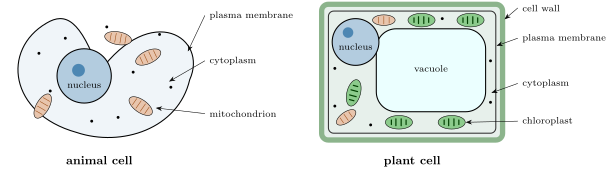
Two eukaryotic cells, schematically. Both have a membrane, a cytoplasm with mitochondria (orange) and a nucleus; the plant cell adds a cellulose wall, chloroplasts (green) and a large central vacuole. Neither is drawn to scale: a real nucleus is about a tenth of the cell’s width, and mitochondria are a hundred times smaller than the cell.

উদাহরণ

Example 2.7 (Cheek cells)

A cheek cell drawn 24 mm24\,\mathrm{mm} wide from a ×400\times 400 image is 24/400=0.06 mm=60 µm24/400 = 0.06\,\mathrm{mm} = 60\,\text{µ}\mathrm{m} across, and its nucleus, drawn 3 mm3\,\mathrm{mm}, is about 8 µm8\,\text{µ}\mathrm{m}. A red blood cell is 7 µm7\,\text{µ}\mathrm{m}; the bacteria of the mouth, 1 µm1\,\text{µ}\mathrm{m} long, appear as barely resolved dots at the same magnification.

Example 2.10 (Reading a bacterium)

An electron micrograph of the gut bacterium Escherichia coli shows a rod 2 µm2\,\text{µ}\mathrm{m} long and 0.5 µm0.5\,\text{µ}\mathrm{m} wide: a wall, a membrane just inside it, a granular cytoplasm packed with ribosomes, and a paler central region where the single circular DNA molecule lies. No nucleus, no mitochondria. Yet the cell feeds, grows and divides every twenty minutes in a rich broth: everything the cell theory demands, in a thousandth of the volume of a cheek cell.

প্রসঙ্গসহ পড়ো →