Biology · Glossary

What is Phloem, sieve tubes, source and sink?

Definition 24.6 University Biology — Year 1 · Chapter 24 — Plant Gas Exchange and Sap Transport

Sugar travels in the phloem, in sieve tubes: files of living cells that have lost their nuclei and most organelles but keep their membranes, joined end to end through perforated sieve plates, each cell nursed by a companion cell that supplies its proteins and ATP. The sap is 10 to 30%10\text{ to }30\,\% sucrose, with amino acids, ions and signalling molecules, and it flows from sources — photosynthesising leaves, or storage organs being emptied — to sinks — growing tips, roots, fruits, seeds, storage organs being filled — at 0.5 to 1m/h0.5\text{ to }1\,\mathrm{m}/\mathrm{h}, in any direction, and in different directions in different tubes.
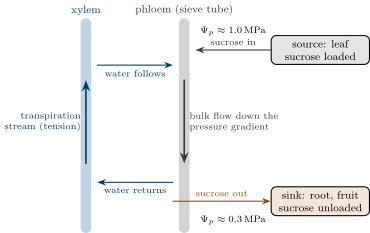
Pressure flow. Loading sucrose at the source draws water in from the xylem and raises the pressure; unloading at the sink lets water out and lowers it; the sap flows between them, and the water returns by the xylem.
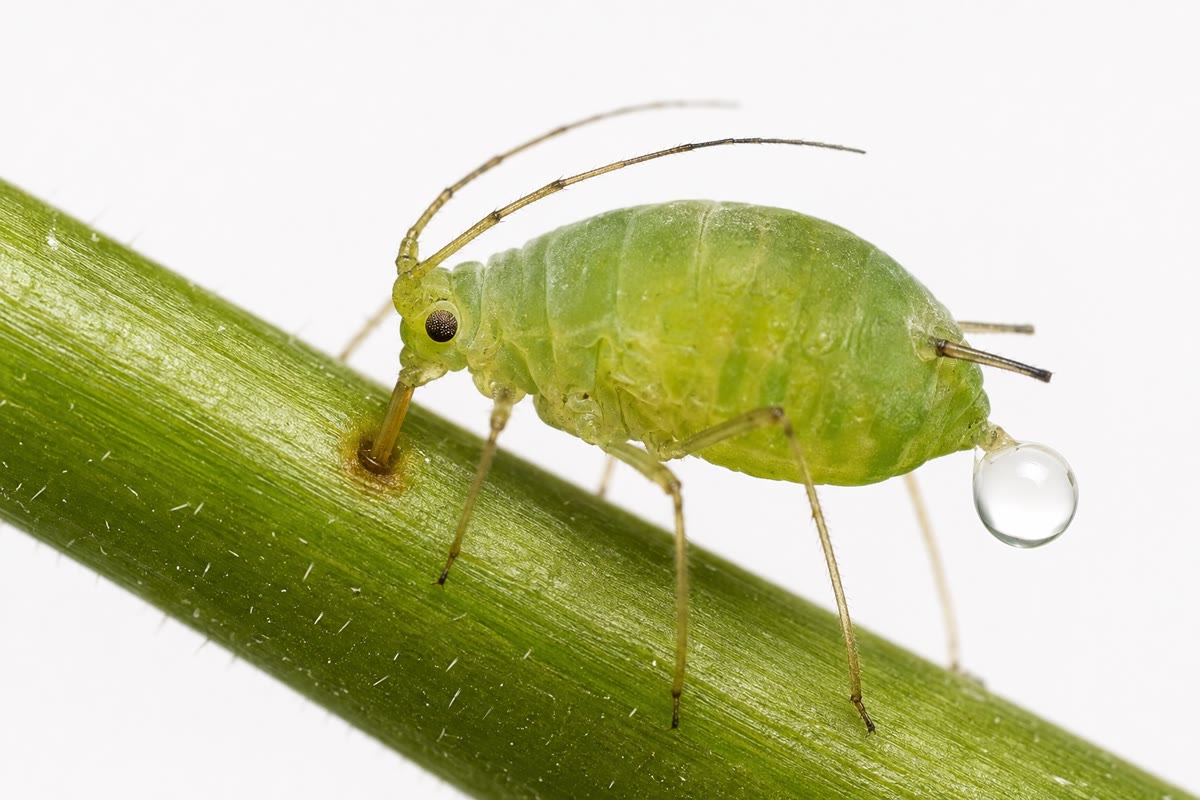
An aphid feeding on a stem: its stylet, finer than a hair, is inside one sieve tube, and the pressure of the phloem drives sap into the insect — so much that the surplus leaves it as honeydew. Cut away, the stylet becomes the plant physiologist’s tap.

Examples

Example 24.9 (A potato in two seasons)

In summer the leaves are sources and the tubers underground the sinks: sucrose flows down, is unloaded, converted to starch, and the tubers swell. In spring the tuber sprouts: its starch is turned back to sucrose, loaded into the phloem, and flows up to the growing shoot — the same tube, the opposite direction, because the source and the sink have changed places.

Read in context →