 Coach
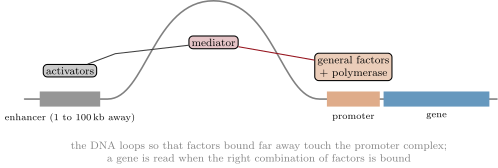
CoachIn eukaryotes the polymerase never starts by itself: the general factors at the promoter (Chapter 19) recruit it, and the rate is set by transcription factors bound to regulatory sequences — some near the promoter, many in enhancers that can lie thousands of base pairs away, upstream, downstream or in an intron, in either orientation, and act by looping the DNA so that the factors bound on them touch the promoter’s complex through mediator proteins. A transcription factor is modular: a DNA-binding domain that recognises a short sequence (helix-turn-helix, zinc finger, leucine zipper families) and an activation or repression domain that recruits or blocks the machinery. A gene is read when the right combination of factors is present: a few hundred factors, in combinations, control twenty thousand genes.
Examples
Example 20.11 (A signal becomes a pattern of expression)
Cortisol enters a liver cell and binds its receptor, a transcription factor kept inactive in the cytosol; the complex enters the nucleus, binds a fifteen-base sequence present near a hundred genes — those of gluconeogenesis among them (Chapter 16) — and recruits acetylases and mediator: within an hour the enzymes of glucose synthesis are being made. The same hormone in a lymphocyte, whose open chromatin exposes a different set of those sequences, switches on genes that kill the cell. One signal, one receptor, two responses: the difference is which genes were accessible.