সব বই

পেশাদার

1 Markets I: The Ecosystem and Exchange-Traded Marketsবাজার অনলাইনইংরেজি 2 Markets II: Rates, FX and Creditবাজার অনলাইনইংরেজি 3 Markets III: Commodities, Energy and Cryptoবাজার অনলাইনইংরেজি 4 Quantitative Methodsপদ্ধতি অনলাইনইংরেজি 5 Derivatives and Volatilityডেরিভেটিভস অনলাইনইংরেজি 6 Rates, Credit, XVA and Riskসুদহার, ঋণ ও ঝুঁকি অনলাইনইংরেজি 7 Research Craft: Predictors, Backtests, Measurement, Portfoliosগবেষণা অনলাইনইংরেজি 8 Strategies I: Equities and Futuresকৌশল অনলাইনইংরেজি 9 Strategies II: Volatility, Relative Value, Macro and the Bank Desksকৌশল অনলাইনইংরেজি 10 Microstructure and Executionএক্সিকিউশন অনলাইনইংরেজি 11 Market Making and High-Frequency Tradingমার্কেট মেকিং অনলাইনইংরেজি 12 Machine Learning for Marketsমেশিন লার্নিং অনলাইনইংরেজি 13 Low-Latency Softwareপ্রযুক্তি অনলাইনইংরেজি 14 Networks, Hardware and Trading Infrastructureপ্রযুক্তি অনলাইনইংরেজি 15 Research, Data and Risk Platformsপ্রযুক্তি অনলাইনইংরেজি 16 The Desk and the Firmপ্রতিষ্ঠান অনলাইনইংরেজি 17 The Industry: Firms, Roles and Careersক্যারিয়ার অনলাইনইংরেজি 18 Interviews I: Maths, Probability and Speedক্যারিয়ার অনলাইনইংরেজি 19 Interviews II: Markets, Trading Games and the Final Roundক্যারিয়ার অনলাইনইংরেজি 20 Interviews III: Codeক্যারিয়ার অনলাইনইংরেজি
অ্যাপ পরিচিতি Coach সাইন ইন পড়া শুরু করো

বইগুলো এখনো বাংলা ভাষায় পাওয়া যায় না — Français সংস্করণ দেখানো হচ্ছে।

Mathématiques · পরিভাষা

isométrie কী?

Définition 23.15 Mathématiques universitaires — Licence 1 · অধ্যায় 23 — Espaces euclidiens

Un endomorphisme uu d’un espace euclidien est une isométrie (ou application orthogonale) lorsqu’il conserve la norme : ∥u(x)∥=∥x∥\norm{u(x)} = \norm x pour tout xx — de façon équivalente (polarisation), il conserve le produit scalaire ; de façon équivalente, sa matrice AA dans une base orthonormale vérifie ATA=IA^{\mathsf T} A = I. Les isométries forment un groupe, le groupe orthogonal O(E)O(E).

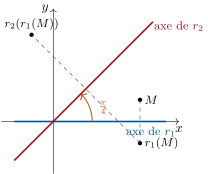
Deux réflexions font une rotation : en réfléchissant M = (2, 0.5) par rapport à l’axe des x, puis par rapport à la droite y = x, on arrive en (-0.5, 2) — l’image de M par la rotation d’angle π2 de centre l’origine, soit deux fois l’angle π4 entre les axes. Le devoir maison transforme cette image en la loi de composition de toutes les isométries planes.
Deux réflexions font une rotation : en réfléchissant M=(2,0.5)M = (2, 0.5) par rapport à l’axe des xx, puis par rapport à la droite y=xy = x, on arrive en (−0.5,2)(-0.5, 2) — l’image de MM par la rotation d’angle π2\frac\pi2 de centre l’origine, soit deux fois l’angle π4\frac\pi4 entre les axes. Le devoir maison transforme cette image en la loi de composition de toutes les isométries planes.

উদাহরণ

Exemple 23.16 (Reconnaître une isométrie à vue)

La matrice A=15(3−443)A = \dfrac15\begin{pmatrix} 3 & -4\\ 4 & 3\end{pmatrix} est-elle orthogonale ? Les colonnes : normes 159+16=1\frac15\sqrt{9 + 16} = 1 et 1516+9=1\frac15\sqrt{16 + 9} = 1 ; produit 125(3⋅(−4)+4⋅3)=0\frac1{25}(3\cdot(-4) + 4\cdot3) = 0. Oui — et det⁡A=9+1625=1\det A = \frac{9 + 16}{25} = 1, c’est donc la rotation RθR_\theta avec cos⁡θ=35\cos\theta = \frac35, sin⁡θ=45\sin\theta = \frac45 (la « rotation 33-44-55 », dont l’angle n’est aucune fraction remarquable de π\pi). En revanche B=12(1101)B = \frac{1}{\sqrt2}\begin{pmatrix} 1 & 1\\ 0 & 1\end{pmatrix} a un faux air de matrice normalisée, mais sa première colonne n’est pas unitaire (12\frac1{\sqrt2}) : elle n’est pas orthogonale — un déterminant ±1\pm1 ne certifie rien à lui seul, il faut vérifier les colonnes.

প্রসঙ্গসহ পড়ো →