University Mathematics — Year 1 · Bachelor Year 1
12Topology of the Real Line
Limits keep referring to the same geometric vocabulary: points “close to” a set, sets “without boundary leaks”, intervals in which sequences cannot escape. This chapter fixes that vocabulary — open and closed sets, interior and closure, density — on the real line, and proves the compactness of segments in its sequential form. The same notions, in normed vector spaces, are second-year material; on they are within reach and immediately useful for Chapter 13.
12.1 Open sets, closed sets
Definition 12.1 (Neighborhood, open set)
A set is a neighborhood of when it contains an interval for some . A set is open when it is a neighborhood of each of its points:
Example 12.2
Open intervals are open: for , take . Half-lines are open; and are open (the latter vacuously). is not open: no interval around stays inside.
Proposition 12.3 (Stability of open sets)
Any union of open sets is open; a finite intersection of open sets is open. Infinite intersections may fail: , not open.
Proof. Union: if , then for some , and the interval provided by sits inside the union. Finite intersection: if , take of the radii provided by each . For the counterexample: any interval around contains some (Archimedes), hence leaves the intersection. ∎
Example 12.4 (Certifying openness with explicit radii)
Is open? Yes, and the certificate can be written down: , a union of two open half-lines, open by Proposition 12.3. Alternatively, argue point by point: for with , take : every satisfies , hence ; symmetrically on the left. Both styles matter — the structural one (build from known open sets by unions and finite intersections) scales better, the -style one works when no structure is visible; and Chapter 13 will add a third, the most powerful: is the preimage of the open under the continuous .
Definition 12.5 (Closed set)
A set is closed when its complement is open. By de Morgan and Proposition 12.3: any intersection of closed sets is closed, finite unions of closed sets are closed.
Theorem 12.6 (Sequential characterization of closed sets)
is closed if and only if: for every sequence of points of converging to some , the limit belongs to . (“Closed” “stable under limits”.)
Proof. () Let be closed, , , and suppose . The complement is open: some avoids . But convergence puts in that interval for large : contradiction with .
() Suppose is not closed: the complement is not open, so some has no interval inside the complement; taking , choose with . Then , : the sequential property fails. ∎
Example 12.7 (The sequential test, both ways)
Closed: . Let with . The window contains only finitely many points of (finitely many integers, finitely many ), and beyond some rank all lie in it: the sequence then takes finitely many values, and, converging, is eventually constant (as in Exercise 12.3): . Closed — even though contains pairs of points at distance , arbitrarily close.
Not closed: . The sequence tends to , and (a sum of two positive terms): the sequential test fails, is not closed. Interestingly, each does belong to : indeed . The closing insight: to prove closedness, control all convergent sequences at once (usually via a local finiteness or a closed-formula argument); to disprove it, one well-chosen escaping sequence suffices — the asymmetry makes the negative direction the easy one, and the counterexamples of this chapter all have this one-line shape.
Example 12.8
Segments , half-lines , finite sets, (a convergent sequence of integers is eventually constant) are closed. is neither open (fails at ) nor closed ( the set): most sets are neither. and are both open and closed — and they are the only such subsets of (Exercise 12.9).
Example 12.9 (An open set assembled from infinitely many pieces)
: an infinite union of open intervals, open by Proposition 12.3 — so is closed with no sequential argument needed. Note the division of labor in the stability rules: unions of open sets may be arbitrary (each point only needs its own certificate, supplied by the one set containing it), while intersections must stay finite (certificates must be intersected, and infinitely many radii can shrink to nothing). Exercise 12.10 will show this example is the general shape: every open subset of is a countable disjoint union of open intervals.
12.2 Interior, closure, density
Definition 12.10 (Interior, closure, boundary)
Let .
- A point is interior to when is a neighborhood of ; the interior is the set of interior points.
- A point is adherent to when every neighborhood of meets ; the closure is the set of adherent points.
- The boundary is .
Then .
Proposition 12.11 (Main properties)
- is the largest open set contained in ; is open iff .
- is the smallest closed set containing ; is closed iff .
- (Sequential characterization of adherence) if and only if is the limit of a sequence of points of .
- Complementation exchanges the notions: .
Proof. (4) some neighborhood of avoids some interval around lies in is interior to .
(1) is open: if , some ; every point of that interval has a smaller interval around it inside it, hence inside : the whole interval is in . Any open consists of interior points of , so : largest. The characterization of openness follows.
(2) In detail. By (4), is the interior of , an open set by (1): so is closed, and it contains . Minimality: let be closed. Then is open and contained in , so by the maximality in (1),
and taking complements again: . Thus is the smallest closed superset. Characterization: if then is closed (just shown); if is closed, it is itself a closed superset of , so minimality forces , and equality.
(3) If , : every neighborhood of contains some , so . Conversely, if : each interval meets at some , and . ∎
Example 12.12
; ; . For : , , . For : by density (Theorem 10.14) every real is adherent to , so while (every interval contains irrationals): the boundary of is all of .
Example 12.13 (A full anatomy)
Let . We compute the three sets of Definition 12.10, piece by piece.
Interior. A point of has a whole interval inside : interior. The point : every interval around it leaks right of , where has nothing until : not interior. No point of is interior (every interval contains irrationals, Theorem 10.14); neither is the isolated . So .
Closure. Limits of points of : all of ( with ); all of (every real there is a limit of rationals of the interval, density again); and . Nothing else: a point outside has positive distance to that closed set. So .
Boundary. .
The closing insight: the three operations act locally — each piece of contributes according to its own nature (a solid interval keeps its inside, a dense-but-porous piece turns entirely into boundary, an isolated point is pure boundary), and a two-line drawing of predicts every answer before any proof is written.
Remark 12.14 (Common pitfalls in point-set reasoning)
(i) “Not open” does not mean “closed”: most sets are neither (), and two sets are both (, ) — open and closed are not opposites but duals through complementation. (ii) Interior and closure do not commute: for ,
the two iterated operators differ as much as sets can. (iii) Infinite unions of closed sets can fail to be closed: — the mirror of the intersection counterexample of Proposition 12.3. (iv) Dense does not mean big: is dense, countable, with empty interior, and its complement is dense too; density says “arbitrarily close to everything”, not “almost everything” — the weekend problem’s Cantor set (Problem 12.1) makes the opposite point, a topologically small set that is uncountably big.
Example 12.15 (A closure computed exactly)
Let (from Example 12.7). Claim:
() and : adherent by the sequential characterization. () Let ; order each pair so that . If is unbounded, a subsequence has , hence too and . Otherwise takes finitely many values, one of them, say , infinitely often; along that subsequence : if is bounded it takes some value infinitely often and ; if not, . Every case lands in the announced set. The closing insight: computing a closure is a compactness-style case analysis on indices — bounded index means finitely many values (pigeonhole), unbounded index means a limit escapes — and the answer displays the typical two-layer structure of limit points: the set, its first-generation limits, and their limit .
Definition 12.16 (Density, topological form)
is dense in when — equivalently, every nonempty open interval meets ; equivalently (by Proposition 12.11 (3)), every real is a limit of elements of . Examples: , , the dyadics (Exercise 10.8), dense subgroups (Exercise 10.9).
Example 12.17 (Density is relative)
“Dense” as defined here means dense in ; a set can instead be dense in a part of the line only. The dyadics of , i.e. (Exercise 10.8), meet every open interval included in but of course miss entirely: they are dense in , meaning . The general phrase “ is dense in ” abbreviates — always name the ambient set, since the weekend problem’s endpoints are dense in the Cantor set while being nowhere dense in : the same set, two truthful and opposite-sounding descriptions.
Example 12.18 (Handling density)
Three quick moves that recur constantly. Enlarging: if is dense and , then is dense (every interval already meets ). Transporting: if is dense, so is for — an interval meets iff the interval meets ; thus the odd multiples of , say, are dense. Intersecting fails: two dense sets can miss each other entirely ( and ): density survives unions and affine maps, never intersections.
12.3 Compactness of segments
Theorem 12.19 (Segments are sequentially compact)
Let . Every sequence of points of has a subsequence converging to a point of .
More generally, the subsets of with this property (every sequence has a subsequence converging in the set) are exactly the closed and bounded sets.
Proof. A sequence in is bounded, so Bolzano–Weierstrass (Theorem 11.16) extracts a convergent subsequence; its limit stays in because segments are closed (Theorem 12.6).
General case. (Closed bounded compact): let be closed and bounded, and a sequence in . Boundedness of bounds the sequence, so Bolzano–Weierstrass extracts ; and because is closed and the subsequence is a convergent sequence of points of (Theorem 12.6): the two hypotheses are consumed one each, boundedness for existence of the limit, closedness for its membership. (Compact closed and bounded): if is unbounded, pick with ; every subsequence is unbounded, hence divergent (Proposition 11.4): no convergent subsequence at all. If is not closed, take with (Theorem 12.6): every subsequence converges to , so no subsequence converges in . ∎
Example 12.20 (Nested compact sets)
A first workout for the theorem. Let be nonempty compact (closed bounded) subsets of . Then . Indeed, pick for each : the sequence lives in the compact , so a subsequence converges to some (Theorem 12.19). For every fixed , the terms with all lie in the closed set , so the limit lies in (Theorem 12.6); as was arbitrary, . A useful companion: if an open set contains , then for some — apply the same argument to points ; the limit would lie in , yet open forces eventually, a contradiction. Both statements fail without compactness: and . The closing insight: compactness converts an infinite chain of non-emptiness assertions into a single limit point — it is the tool that survives passage to the infinite intersection, and the weekend problem (Problem 12.1) will lean on it twice.
Remark 12.21
This is the engine behind the extreme value theorem (Chapter 13) and Heine’s theorem on uniform continuity. The name “compact” will acquire its general (covering) definition in the second year; on , sequential compactness is all we need, and “compact closed bounded” is the statement to remember.
Example 12.22 (Boundaries under unions)
Always : a point of has every neighborhood meeting (hence or , infinitely often one of them) and meeting the complement of , which lies in both complements — a short check then places the point in or . The inclusion can be spectacularly strict: with and ,
two ragged sets can glue into a seamless one, their boundaries annihilating each other. The closing insight: interiors and closures behave monotonically under unions and intersections, but boundaries do not — treat as a derived quantity (), never as an operator with algebra of its own.
Remark 12.23 (Perspectives inside this volume)
The vocabulary built here is consumed twice more in this book. In Chapter 13, every theorem is a topology statement in disguise: the intermediate value theorem says continuous maps preserve the interval property, the extreme value theorem says they preserve compactness — and the proofs call Theorems 12.6 and 12.19 by name. In Chapter 25, the same definitions are re-read in with disks in place of intervals: open sets, closures and compactness transfer word for word, and the two-variable extreme value theorem again rides on Bolzano–Weierstrass (extract on each coordinate). The one notion that does not generalize painlessly is the interval itself — in the plane, connectedness replaces convexity, a story that begins with Exercise 12.9’s “only and are open and closed”.
12.4 Exercises
Exercise 12.1 ★
For each set, say whether it is open, closed, both, or neither (with justification): ; ; ; ; .
Solution
Solution of Exercise 12.1.
: open (union of open sets), not closed ( outside).
: neither. Not open (no interval around inside); not closed ( set).
: closed (finite union of closed sets), not open (fails at ).
: open ( is closed), not closed: the sequence lies in it, but its limit belongs to , i.e. escapes the set.
: neither. Not open: every interval around a rational contains irrationals. Not closed: it contains sequences tending to the irrational (density).
Exercise 12.2 ★
Determine , and for: ; ; .
Exercise 12.3 ★
Prove that a finite set is closed, first via complements, then via the sequential characterization.
Solution
Solution of Exercise 12.3.
Complements. : the complement is the union of the open intervals , , — open by Proposition 12.3.
Sequences. Let , . With (or any if is a singleton): beyond some rank, all terms are within of , hence within of each other, which forces them to be one single from that rank on; then .
Exercise 12.4 ★
Prove that for any : . Show by example that can differ from .
Exercise 12.5 ★★
Let in . Prove that the set is closed (hence compact if we add that it is bounded — which it is).
Solution
Solution of Exercise 12.5.
Use the sequential characterization (Theorem 12.6). Let and a sequence in with ; show . Two cases. If some value is taken by infinitely often, then a constant subsequence gives . Otherwise every value is taken finitely often; in particular, for each , the term appears finitely often, and too. Then for every , the indices with are finitely many: the remaining are terms with . Given , choose with for : all but finitely many satisfy . Hence , so .
Exercise 12.6 ★★
Let be open and arbitrary. Prove that is open. Deduce that the sum of an open set and any set is open, and contrast: exhibit two closed sets whose sum is not closed. (Try and , with Exercise 10.9.)
Solution
Solution of Exercise 12.6.
, and each translate is open (translating the interval certificates). A union of open sets is open (Proposition 12.3).
Closed sets: and are closed (as : convergent sequences are eventually constant, cf. Example 12.8). Their sum is dense in (Exercise 10.9) but is not (it is countable, or simply: , else would be rational — writing forces , so unless , impossible). A dense proper subset is not closed: its closure is itself.
Exercise 12.7 ★★
A point is isolated in when some neighborhood of meets only at . Prove that every point of is isolated in , that has all its points isolated yet , and that a set whose points are all isolated has empty interior.
Solution
Solution of Exercise 12.7.
: the neighborhood of meets only at .
: around , the interval of radius (halved, say) isolates it from its neighbors — all points isolated. Yet : isolated points do not prevent adherent outsiders.
If all points of are isolated: no point of is interior, since an interior point has a whole interval of -neighbors around it (an interval is infinite), contradicting isolation. So .
Exercise 12.8 ★★
Prove that the closure of a bounded set is bounded, and that for nonempty bounded above. Deduce that : the supremum is always adherent.
Solution
Solution of Exercise 12.8.
If , the closed set contains , hence contains (smallest closed superset): is bounded.
Let (finite). Since , . Conversely, : the half-line is closed and contains ; so every element of is , giving . Equality.
: by the -characterization (Proposition 10.4), every interval contains an element of : is adherent.
Exercise 12.9 ★★★
Prove that the only subsets of that are both open and closed are and . Hint: suppose is open, closed, with and ; pick , , say , and consider ; decide whether can belong to or to its complement.
Solution
Solution of Exercise 12.9.
Suppose is open and closed, with and ; without loss of generality . The set is nonempty (), bounded: let . By Exercise 12.8, ( closed). Note , and since : . Now is open: some interval lies in , and we may take . Then belongs to and exceeds — contradicting . Hence no such pair exists: one of , is empty.
Exercise 12.10 ★★★
(Structure of open sets) Let be open, nonempty. For , let be the union of all open intervals containing and contained in . Prove that is an open interval, that two sets , are equal or disjoint, and that is a union of countably many pairwise disjoint open intervals (pick a rational in each).
Solution
Solution of Exercise 12.10.
is a union of open intervals all containing : it is open, and it is an interval, being convex — if with , then and lie in open subintervals , of , and is an interval (both contain ) inside containing ; so (Proposition 10.19).
If : is then an open interval (convex: two overlapping intervals) contained in containing and , so and by maximality of each: .
So is the disjoint union of the distinct sets (each lies in its own ). Countability: each nonempty open interval of the family contains a rational (Theorem 10.14), and distinct disjoint intervals get distinct rationals: the family injects into , which is countable (it is indexed by pairs of integers). Hence at most countably many intervals.
Exercise 12.11 ★★
A point is an accumulation point of when every neighborhood of meets ; their set is the derived set . Prove that , and that is closed if and only if . Determine for , for , and for .
Solution
Solution of Exercise 12.11.
. () always; and if , every neighborhood of meets , so is adherent. () Let . If , done. If , every neighborhood of meets : .
Consequently closed .
: is an accumulation point (, terms ); each is isolated (Exercise 12.7), so not in ; and a point has a whole interval avoiding (between the two neighbors of in , or beyond ). Hence .
: every integer is isolated, every non-integer has a neighborhood inside .
: every interval around any real contains infinitely many rationals (Theorem 10.14), in particular one different from the center.
Exercise 12.12 ★★★
For nonempty, define . Prove:
- for all ( is -Lipschitz);
- if and only if ; in particular, if is closed and , then ;
- for every , the set is open, contains , and for closed: every closed set is a countable intersection of open sets.
Solution
Solution of Exercise 12.12.
- For every : , so ; taking the infimum over : . Exchanging and gives the other inequality: .
- for every there is with every interval around meets . If is closed and , then , i.e. .
- If , set : for , part (1) gives : the interval lies in , which is therefore open; it contains since there. Finally for all . Since , every closed set is a countable intersection of open sets.
12.5 Problem: The Cantor set, small and enormous at once
Problem 12.1
Weekend problem — the Cantor middle-thirds set: length zero, uncountable, perfect, and
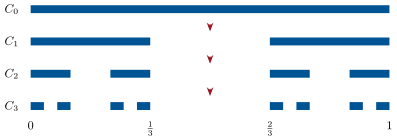
Remove from its open middle third, then the middle third of each remaining segment, and repeat forever: what survives is the Cantor set , the fundamental counterexample factory of analysis. This problem constructs it, reads it through the base- machinery of Problem 10.1, and establishes its paradoxical portrait: total length zero, yet uncountable; empty interior, yet no isolated point; totally disconnected, yet fills the whole segment . Formally: , and is obtained from by deleting the open middle third of each segment of ; finally . Throughout, a ternary code of is any digit string with whose value equals — improper codes (eventually ) are allowed; by Problem 10.1 (questions 9–11), every has one or two codes, two exactly when .
Part I — The construction.
- Describe and explicitly as unions of segments, and prove by induction: is a disjoint union of closed segments, each of length .
- Show that is closed, bounded — hence compact (Theorem 12.19) — nonempty, and that every endpoint of every segment of every belongs to .
- The total length of is . Deduce that for every , the set can be covered by finitely many segments of total length : the Cantor set has length zero.
- Show that an interval contained in has length for every , hence is a singleton or empty: . Being closed with empty interior, is nowhere dense.
Part II — The ternary code.
Prove the self-similarity recursion
the two pieces being disjoint: is two copies of itself at scale .
- Prove by induction on : if and only if has a ternary code whose first digits lie in . Deduce, using the fact that has at most two codes: if and only if has a code with no digit equal to (a -free code).
- Codes in action: give -free codes for , , , ; show and , so both belong to ; and check that is not an endpoint of any (endpoints have the form ).
- Show that each has exactly one -free code (when has two codes, prove that exactly one of the pair contains the digit ). Conclude: the value map is a bijection from -strings onto .
- (Diagonal) Let be any map . Build a -string differing at index from the code of , and conclude that is uncountable — while, by contrast, question 3 says it is metrically negligible.
Part III — Topological portrait.
- Assemble the record so far: is compact, uncountable, of length zero, nowhere dense. Which single containment carries each property?
- ( is perfect) Let with -free code . Flipping the digit () produces with . Conclude that has no isolated point: every point of is a limit of other points of .
- Show that the endpoints of question 2 form a countable dense subset of (truncate the code after digits and continue with s; countability as in Exercise 12.10). Conclude: the typical point of — like — is not an endpoint: endpoints are a countable skeleton inside an uncountable body.
- (Totally disconnected) Let in . Choose with and produce a point with . Conclude that the only nonempty intervals contained in are singletons.
Part IV — Arithmetic of .
- Show (what does do to a -free code? recall ).
- (Addition of codes) Show that if , have codes , , then where are the partial sums. Deduce: every is the midpoint of two points of — given a code of , choose digits with .
- Conclude and, with question 14, . Concrete instance: write as a sum of the two non-endpoints found in question 7.
- Reflect: a set of length zero whose difference set fills . Why is there no contradiction between “ is metrically negligible” and “ has full length”? (One sentence; think about what length controls and what it does not.)
Part V — Members, rational and irrational.
- Combine question 8 with the periodicity criterion of Problem 10.1: a point of is rational if and only if its -free code is eventually periodic. Run the base- long division to check .
- Produce an explicitly irrational member of : the value of the code with at the triangular positions and elsewhere. Justify irrationality by the growing-gaps argument of Problem 10.1 (question 20).
- (Onto a full segment) Consider mapping the point of with -free code to the value of the binary string , i.e. . Show that maps onto . So the negligible surjects onto a segment of full length — a second proof that is uncountable.
- (Self-similar length) Suppose some notion of length were defined for and its shrunken copies, respecting scaling (), translation invariance, and additivity over the disjoint decomposition of question 5. Show that then , forcing : self-similarity alone already sentences to length zero.
Part VI — A fat cousin, and the moral.
- (Fat Cantor set) Repeat the construction, but at stage () remove from each of the current segments a central open interval of length only. Show that the segment lengths obey , , that the resulting is compact with empty interior, and that the total removed length is . Admitting the (intuitive, Year 3) additivity of length for finite unions of intervals, and using both statements of Example 12.20, show that any finite family of open intervals covering has total length : is nowhere dense but not negligible. Smallness has several inequivalent meanings.
(Distances) Show that for a nonempty closed and , the infimum is attained (minimizing sequence plus Bolzano–Weierstrass). Then compute
attained exactly at the center (a point of a gap created at stage is within of the gap’s endpoints, which lie in ).
- (Every point a subsequential limit) Using questions 12 and 2, produce a single sequence in whose set of subsequential limits is all of . (Compare: for a convergent sequence that set is one point — realizes the opposite extreme among compacts.)
- Synthesis, one sentence each: (i) which theorems of this chapter did the construction actually consume (stability of closed sets, compactness, sequential characterizations)? (ii) list the four paradoxical pairings of the portrait (length zero/uncountable, closed/empty interior, perfect/totally disconnected, negligible/ full); (iii) where does resurface later (the devil’s staircase built on in the theory of continuity, and the measure theory of the Year 3 volume, where separates “countable” from “negligible”)?
Solution
Solution of Problem 12.1.
1. and
Induction: if is a disjoint union of closed segments of length , deleting the open middle third of each leaves two closed segments of length per parent: segments, pairwise disjoint (children of distinct parents are separated because the parents were; children of one parent are separated by the removed gap).
2. Each is a finite union of segments, hence closed; is an intersection of closed sets: closed (Definition 12.5); bounded (): compact by Theorem 12.19. Nonempty: lies in the leftmost segment of every . Let be an endpoint of a segment of . For , . For the later stages: the middle-third deletion never removes an endpoint, and is again an endpoint of one of the two children of (the child touching ); by induction for all : .
3. Total length of : . Given , choose with : then , a union of finitely many segments of total length .
4. Let be an interval with two distinct points. For every : , and , being convex, must lie inside a single segment of (meeting two segments would force to contain a point of the gap between them, which is outside ). Hence the length of is for all : contradiction. So the only intervals inside are empty or singletons; in particular no fits inside : . As is closed, has empty interior: is nowhere dense.
5. Write and , increasing affine bijections of onto and . Claim: . For this is question 1. Induction: an increasing affine map sends the middle third of a segment to the middle third of the image segment, so deleting middle thirds commutes with and ; applying the deletion step to yields . Intersecting over : for , for all ; likewise on ; and no point of lies in . Hence , disjointly.
6. Induction on ; the case says every has a code, which is Problem 10.1 (question 9 for ; ). Suppose the equivalence at rank . If : by question 5, with and ; if is a code of with first digits -free, then has partial sums : a code of with first digits -free. Conversely, if has a code with : the shifted string has some value , its first digits are -free, and the partial-sum computation read backwards gives ; by induction , so by question 5. Finally: a fully -free code puts in every , hence in ; conversely if , then for every one of the at most two codes of (Problem 10.1, question 11) has its first digits -free; one fixed code must work for arbitrarily large (pigeonhole between two codes), and a code whose first digits are -free for arbitrarily large is -free outright.
7. , , (the improper twin of ), . Geometric sums:
both -free: . (The infinite sums abbreviate suprema of partial sums, as in Problem 10.1.) Endpoints of segments of are of the form (induction: children endpoints are parent endpoints or differ from one by a multiple of ). If then , and : impossible. So without ever being an endpoint.
8. Suppose had two distinct -free codes. Having two codes at all means (Problem 10.1, question 11, base ) that and the two codes are: the terminating one, with last nonzero digit followed by s, and its twin, with at position followed by s. If the first contains a ; if the twin carries . Either way at most one of the pair is -free: contradiction. So each has exactly one -free code (existence by question 6), and distinct -strings have distinct values. Every -string has value in (partial sums ) with all prefixes -free, hence value in every , i.e. in : the value map is a bijection from -strings onto .
9. Let be the -free code of and set : a -string whose value lies in and has as its unique -free code (question 8). For each the codes of and differ at position , so : no map is surjective. An uncountable set of length zero: bigness in cardinality, smallness in measure — simultaneously.
10. Compactness: closedness of the infinite intersection plus boundedness (question 2) — the one property not carried by a single containment. Length zero: with total length (question 3). Nowhere density: forces intervals inside to have length (question 4). Uncountability rides on no containment at all: it needs the full intersection structure, encoded in the bijection of question 8.
11. Flip to : the new string is still a -string, so its value lies in ; the partial sums beyond rank differ by exactly , so . Thus and : every point of is a limit of other points of — is perfect, with no isolated point.
12. By the induction of question 5, the segments of are exactly the where runs over the values of length- -strings. Given with code , the truncation (digits then s) is therefore a left endpoint, and : endpoints are dense in . They form a subset of , a set indexed by pairs of integers, hence countable (as for in Exercise 12.10). Since is uncountable (question 9), all but countably many points of are not endpoints — (question 7) is the visible tip of that iceberg.
13. Pick with . Both , and they cannot lie in the same segment (length ): the removed gap between their segments provides with and . Hence any two points of are separated by the complement: the only convex subsets of are singletons — is totally disconnected.
14. If is the -free code of , the string is again a -string, with partial sums
so . Thus , and applying the map twice gives : the Cantor set is symmetric about .
15. The partial sums and (increasing sequences converge to their supremum, i.e. the value), so by Theorem 11.5. Given with code , choose according as : then , the strings , are -strings with values , and
every is the midpoint of two points of .
16. Question 15 gives , and : equality. Then, using :
Concrete instance: , a sum of two non-endpoint members of .
17. Length measures how much of the line the set itself occupies; it says nothing about the set of sums, which is the image of the two-parameter family under — the two digit strings are chosen independently, and that freedom is exactly what fills . No theorem bounds the length of a sumset by the lengths of the summands, and is the proof that none can.
18. By Problem 10.1 (question 18), is rational iff its proper expansion is eventually periodic. The -free code of is either that proper expansion or the improper twin of a terminating one; a terminating string and its twin (eventually constant s) are both eventually periodic, so periodicity of the -free code is equivalent to rationality of . Long division of in base (): , , , and the remainder returns to : digits , so , -free and periodic: a rational member of . (Check: .)
19. The string with at the triangular positions and elsewhere is a -string, so its value belongs to (question 8). It has infinitely many s with gaps between consecutive ones, so it is not eventually periodic (a period would eventually force s at gaps : the growing-gaps argument of Problem 10.1, question 20); by question 18, . And by question 9 plus the countability of , all but countably many members of are irrational: is the norm, not the exception.
20. Let : it has a binary code with (Problem 10.1, question 9, base ; takes the all-s string). Then is a -string, its value lies in , and is the value of , namely : maps onto . If were the image of a map from , composing with would list all of , contradicting the diagonal theorem of Problem 10.1 (question 22): is uncountable, again. A length-zero set surjecting onto a full segment.
21. By question 5, is the disjoint union of and , each a translate of the scaled copy . Additivity, scaling and translation invariance give
so : . Self-similarity alone sentences to length zero — question 3 merely executed the sentence.
22. A segment of length loses a central interval of length , leaving two segments of length ; from , induction confirms : indeed , and always: the construction never starves. is closed and bounded, hence compact; an interval inside lies in one segment of , of length : empty interior. Removed length: , and each has total length . Now let finitely many open intervals have union . By the companion statement of Example 12.20, for some ; admitting additivity of length on finite unions of intervals, the total length of the covering intervals is at least that of , which exceeds . So is nowhere dense, yet no cheap cover exists: topological smallness (nowhere dense) and metric smallness (length zero) are genuinely different notions, and separates them.
23. Attainment: let and pick with : the are bounded, so Bolzano–Weierstrass (Theorem 11.16) extracts , with ( closed, Theorem 12.6) and . Now the maximum: if , ; otherwise lies in a gap removed at some stage , an open interval of length whose two endpoints belong to (question 2), so , with equality requiring and at the center of the gap , i.e. ; and indeed since and . Hence , attained exactly at .
24. The endpoints form a countable dense subset of (question 12): list them as a single sequence , a sequence in . Its subsequential limits all lie in ( closed). Conversely, fix : for each , the segments of the containing () have their endpoints within of , so infinitely many distinct endpoints lie within of ; choose indices with : a subsequence converging to . So the set of subsequential limits of is exactly — one sequence clustering at uncountably many points, the opposite extreme from a convergent sequence, whose cluster set is a singleton.
25. (i) The construction consumed: stability of closed sets under arbitrary intersection (existence of as a closed set), the compactness theorem Theorem 12.19 (questions 2, 22, 23), and the sequential characterizations of closedness and adherence (the nested-compacts argument of Example 12.20 and question 23). (ii) The four pairings: length zero yet uncountable (questions 3, 9); closed yet with empty interior (question 4); perfect — no isolated point — yet totally disconnected (questions 11, 13); negligible yet with (question 16). (iii) The surjection of question 20, made continuous and nondecreasing, becomes the devil’s staircase in the theory of continuous functions; and in the Year 3 volume’s measure theory, is the standard witness that “negligible” does not mean “countable”, with its fat cousin (question 22) separating “nowhere dense” from “negligible”.