University Mathematics — Year 1 · Bachelor Year 1
17Numerical Series
Summing infinitely many numbers means taking the limit of the partial sums — nothing more, nothing less. This chapter sets up the definitions and the convergence tests usable in first year: comparison and equivalents for positive terms, the ratio test, the integral comparison giving the Riemann series, absolute convergence, and the alternating series theorem. The finer theory (products of series, summation by packets, series of functions) belongs to the second year.
17.1 Generalities
Definition 17.1
Given a sequence , the series is the sequence of partial sums . The series converges when converges; the limit is the sum , and is the remainder, which tends to .
Example 17.2 (Geometric series)
For : (). The series converges iff (Exercise 11.3), with
Example 17.3 (Periodic decimals are geometric series)
What number is ? Its very writing is a series:
by the geometric sum with . In general a block of digits repeating forever is worth — the mechanism behind the periodicity criterion of Problem 10.1, which this chapter’s language finally states in one line: a decimal expansion is a convergent series, eventually periodic exactly when its sum is rational. The digit machinery of Chapter 10, built there with bare suprema, was series theory traveling incognito.
Proposition 17.4 (First facts)
Proof. (1) . The harmonic series has yet diverges (Exercise 11.5). (2) Operations on limits. (3) . (4) The partial sums change by an eventually constant amount. ∎
Example 17.5 (Planning digits with the geometric remainder)
For the remainder of the geometric series is explicit:
This converts accuracy goals into term counts before any computation. To evaluate within : need , i.e. , i.e. (as ): twenty-three terms, known in advance. Every geometric-rate estimate of the weekend problems (the -series for , Machin’s arctangents in Problem 16.1) is this two-line budget in professional dress.
Example 17.6 (A longer telescope)
Compute . Partial fractions (Chapter 9):
where the second form — a difference of consecutive values of — is the telescoping one. Hence
The closing insight: three-term partial fractions rarely telescope as written; regroup them into a difference first — the reward is not just convergence but the exact sum, which no comparison test ever delivers.
17.2 Series with nonnegative terms
Theorem 17.7 (Bounded partial sums)
If for all , the partial sums increase, so: converges its partial sums are bounded above. Hence the comparison test: if for all (large) ,
And the equivalents test: if with , the two series have the same nature.
Proof. Monotone limit theorem (Theorem 11.9) for the first point; comparison of partial sums for the second. Equivalents: for large , (definition of with ), and comparison applies both ways. ∎
Example 17.8 (An equivalent that proves divergence)
Nature of ? Since and at :
and the equivalents test transfers the divergence of the harmonic series: divergent — even though the terms tend to . One expansion, one scale, one verdict; the same two-step pattern (equivalent, then Riemann or geometric lookup) decides all four series of Exercise 17.3.
Example 17.9 (The equivalents test in one line)
Nature of ? Conjugate the numerator:
a convergent Riemann scale (): the series converges. The whole decision took one equivalent and one lookup — provided the terms are nonnegative, which they are. The closing insight: for positive series, the entire convergence theory is a dictionary of scales (, , ) plus the license to replace a term by an equivalent; the analytic work is in the asymptotics (Chapter 16), never in the summation.
Theorem 17.10 (Integral comparison; Riemann series)
Let be continuous, nonnegative and decreasing on . Then
so converges iff is bounded. In particular, for :
and .
Proof. For , monotonicity gives ; integrating over (a segment of length ):
Summing the right inequalities for gives , hence the upper framing after adding ; summing the left ones for gives , which after reindexing is the lower framing. Convergence: the partial sums and the integrals bound each other within the constant , and both are nondecreasing, so one is bounded iff the other is (Theorem 17.7). For (): , bounded iff ; for the integral is , and the framing gives . For the terms do not tend to . ∎
Example 17.11 (The harmonic stack)
How many terms must the harmonic series accumulate to pass ? The framing answers with no summation at all: requires , i.e. , and is guaranteed once , i.e. . (The weekend problem sharpens this to via Euler’s constant.) The closing insight: the integral comparison does not merely decide convergence — it locates partial sums with logarithmic precision, turning a hopeless computation (hundreds of millions of terms) into a two-line estimate.
Theorem 17.12 (Ratio test (d’Alembert))
Let with .
- If : converges;
- if : , divergence;
- if : no conclusion ( diverges, converges).
Proof. If , fix : beyond some , , so by induction: comparison with a geometric series. If : beyond some the sequence is increasing, so it cannot tend to (its limit, if any, is ); by Proposition 17.4 (1), divergence — and in fact with gives . ∎
Example 17.13
converges for every : ratio . Its sum is : by Taylor–Lagrange (Theorem 16.7) on ,
the bound tending to because the factorial dominates (Exercise 15.9 (1) used the same fact). The same argument sums the , , , series on all of .
Example 17.14 (The ratio test is sufficient, not necessary)
Let for even and for odd . The consecutive ratios oscillate between and , so has no limit and d’Alembert is mute — yet and the comparison test settles convergence instantly. The test’s hypothesis (the ratio converges) is a real restriction: it suits terms with one dominant multiplicative structure (factorials, powers), and fails on anything that breathes. When ratios misbehave, step back to comparison against a geometric envelope — which is all the ratio test ever was, as its proof shows.
Example 17.15 (Ratio test on factorial battles)
Nature of (reciprocals of the central binomial coefficients, up to the factor )? The ratio collapses the factorials:
convergent, with room to spare — the terms decay essentially like , consistent with from Problem 15.1. The closing insight: quotients of factorials are exactly what the ratio test digests — every factorial cancels into a rational function of , whose limit is read off the leading terms.
17.3 Absolute convergence; alternating series
Theorem 17.16 (Absolute convergence)
If converges (absolute convergence), then converges, and . This holds for real or complex terms.
Proof. The partial sums satisfy, for (Cauchy criterion, Theorem 11.20):
which is small for large since the partial sums of form a Cauchy sequence. So is Cauchy, hence convergent. The inequality passes to the limit from the finite triangle inequality. ∎
Example 17.17 (Absolute convergence, real and complex)
: the terms change sign erratically (indeed is dense in , Exercise 11.12), and no alternating structure is in sight. Absolute convergence rescues everything at once: , a convergent scale, so the series converges. The same shield works over : converges because — sign patterns, even two-dimensional ones, are irrelevant once the moduli are summable. The closing insight: absolute convergence is the only tool of this chapter that never asks how the signs are organized; try it first (Method 17.21), and reserve the delicate tests for the series that fail it.
Theorem 17.18 (Alternating series test)
Let be decreasing with . Then the alternating series converges; its sum lies between any two consecutive partial sums, and
Proof. The even and odd partial sums are adjacent: (decreasing), (increasing), and . By Theorem 11.11 they share a limit , which the two subsequences criterion (Proposition 11.14) makes the limit of ; moreover is trapped between consecutive partial sums, and is at most the gap to the next one, . ∎
Example 17.19 (Alternating harmonic series)
converges (alternating test) but not absolutely (harmonic series). Its sum is : from the finite geometric identity , integrate over :
The convergence is painfully slow () — alternating series converge by cancellation, not by smallness.
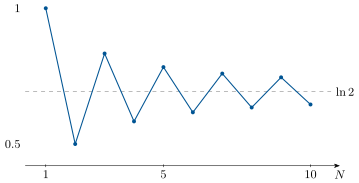
Remark 17.20 (Common pitfalls with series)
(i) The equivalents test needs a sign: let and . Then , so ; yet converges (alternating test) while diverges. Equivalence controls the size of terms, and for signed series size is not destiny — the test is stated, and true, for (eventually) nonnegative terms only. (ii) proves nothing: the harmonic series is the eternal counterexample; the converse direction (Proposition 17.4 (1)) is only a quick divergence test. (iii) Ratio limit is silence, not convergence: both and have ratio ; switch to Riemann scales or integral comparison. (iv) Alternating needs decreasing: looks alternating and is handled only by expansion (Exercise 17.5); the weekend problem of Chapter 16 (question 23 there) shows the test can fail outright without monotonicity. (v) Grouping and reordering are not free: inserting parentheses is harmless for convergent series but can create convergence from divergence ( grouped in pairs), and reordering can change the sum itself — the drama staged in this chapter’s weekend problem (Problem 17.1).
Method 17.21 (Deciding the nature of a series)
- Does ? If not, divergence, stop.
- Nonnegative terms: seek an equivalent of (expansions, Chapter 16!), compare with Riemann or geometric scales; factorials and powers call for the ratio test; decreasing calls for integral comparison.
- Signs vary: try absolute convergence first; if it fails, the alternating test (check decreasing carefully); beyond that, second-year tools.
Example 17.22 (Odd denominators, half the telescope)
Compute . Partial fractions: , so
Compare with (Exercise 17.1): same telescoping skeleton, but the consecutive terms here are two apart in the odd numbers, and the factor records the step. The closing insight: telescoping is a change of viewpoint, not a trick — whenever the general term is a difference of a sequence with a limit, the sum is , exactly Proposition 17.4 (3).
Remark 17.23 (The analysis pipeline, in retrospect)
This chapter is where the volume’s analysis converges, and each test names its ancestor. Bounded partial sums is the monotone limit theorem (Chapter 11), itself the completeness axiom of Chapter 10; absolute convergence is the Cauchy criterion; the integral test is Chapter 15’s framing of areas; equivalents of general terms are Chapter 16’s expansions; and the alternating theorem is the adjacent-sequences lemma in its Sunday clothes. Read backwards, the pipeline explains what each chapter was for — and the weekend problems threaded through it (-adic digits, Cesàro–Stolz, the irrationality machines, Euler’s constant) are the same few ideas meeting at higher and higher altitude. The linear algebra that follows changes subject, not standards: the habit of exact statements with certified error survives the move from limits to dimensions.
Remark 17.24 (Where series go next)
This chapter closes the analysis of the volume and opens three doors. In the Year 2 volume, series acquire a variable (: power series, with their radius of convergence) and then a function-valued theory (Fourier series); the dichotomy absolute-versus-conditional convergence, dramatized in the weekend problem below, becomes the cornerstone of both. In probability (Year 3 volume), expectations of discrete random variables are series, and absolute convergence is what makes them well defined. And the Riemann series , pushed to complex , becomes the zeta function — the single most studied series in mathematics.
17.4 Exercises
Exercise 17.1 ★
Nature (and sum, when telescoping) of:
Solution
Solution of Exercise 17.1.
: telescoping, . Convergent, sum .
: telescoping again, . Convergent, sum .
: two convergent geometric series, sum .
Exercise 17.2 ★
Nature of: ; ; ; . (Ratio test; recall .)
Solution
Solution of Exercise 17.2.
Ratio test throughout.
: convergent.
: convergent.
With the factor : ratio : convergent.
With : ratio : divergent (terms tend to ).
Exercise 17.3 ★
Nature of: ; ; ; (compare with ).
Solution
Solution of Exercise 17.3.
All nonnegative terms; use equivalents (Theorem 17.7).
: convergent (Riemann ).
: convergent.
: divergent.
and (Proposition 4.6): so for large : convergent.
Exercise 17.4 ★
Prove that converges with sum , using for and a telescoping bound.
Solution
Solution of Exercise 17.4.
For : . Hence
partial sums increasing and bounded by : convergence (Theorem 17.7), sum . (The exact value is a second-year celebration.)
Exercise 17.5 ★★
Nature of , of (expand: the alternating test does not apply directly — why?), and of (reduce modulo : ).
Solution
Solution of Exercise 17.5.
: alternating with : convergent (Theorem 17.18); not absolutely ().
: the sequence is not decreasing ( then alternate badly), so the test does not apply directly. Expand:
the first series converges (alternating), converges, the converges absolutely: the sum of three convergent series converges.
: write with ; then, by -periodicity of up to sign,
Set and . For large , and
eventually, so decreases to ; since is increasing on , decreases to as well. The alternating test applies: convergent — not absolutely, since .
Exercise 17.6 ★★
For which does converge? (Integral comparison; substitute .)
Solution
Solution of Exercise 17.6.
is positive, continuous, decreasing on . Substituting :
bounded as iff (Theorem 17.10’s computation). By integral comparison: convergence iff . (These Bertrand-type series show how fine the boundary of convergence is: diverges, converges.)
Exercise 17.7 ★★
Let . Prove that , that converges, and deduce the existence of Euler’s constant:
Solution
Solution of Exercise 17.7.
By the tangent-line bounds of Exercise 14.3 rewritten via expansions: for , Taylor–Lagrange for at order gives for some , so
Comparison with the Riemann series: converges. Its partial sum telescopes the logarithms:
(since ). So converges; adding , the sequence converges. Its limit is .
Exercise 17.8 ★★
Compute the sums
(For the first: partial fractions. For the second: compute in closed form and let at .)
Solution
Solution of Exercise 17.8.
: the partial sum telescopes with a lag of ,
: for , differentiating the finite geometric sum and passing to the limit (all series here converge absolutely, ratio test): from , one gets by direct computation with partial sums
(the boundary terms ). At : , so .
Exercise 17.9 ★★★
(Cauchy condensation) Let be nonnegative and decreasing. Prove that
by comparing packets of terms between consecutive powers of . Recover from it the Riemann criterion and Exercise 17.6.
Solution
Solution of Exercise 17.9.
Group the terms of in packets between powers of . Upper packets: for there are terms, each :
Lower packets: each term of the same packet is , so , whence
Both partial-sum comparisons go both ways (nonnegative terms, Theorem 17.7): the two series have the same nature.
Riemann: gives , a geometric series, convergent iff iff . Bertrand (Exercise 17.6): gives , a Riemann series in : convergent iff .
Exercise 17.10 ★★★
Using the integral identity of Example 17.19 adapted to , prove Leibniz’s formula
with the error bound .
Solution
Solution of Exercise 17.10.
Finite geometric identity with ratio :
Integrate over (the left side integrates to , Proposition 4.10):
Letting proves the formula, and the displayed bound on the integral is exactly the remainder bound: after summing up to (i.e. terms), .
Exercise 17.11 ★★
Nature of . (Compute the limit of and find an equivalent of the general term: the Riemann test needs a fixed exponent.)
Solution
Solution of Exercise 17.11.
(Proposition 4.6). Hence
and the equivalents test (Theorem 17.7) compares with the divergent harmonic series: divergent, although every exponent exceeds . The Riemann criterion concerns a fixed exponent ; an exponent sliding down to can lose all its margin, as here.
Exercise 17.12 ★★★
Let be nonnegative and decreasing with convergent. Prove that (bound by a slice and use the Cauchy criterion). Show that the converse fails, and that the monotonicity hypothesis cannot be removed.
Solution
Solution of Exercise 17.12.
Let . By the Cauchy criterion for the convergent series (Theorem 11.20 applied to the partial sums), there is with for . By monotonicity each of these terms is :
and for odd indices for : in both parities, .
Converse false: has , yet the series diverges (Exercise 17.6, ). Monotonicity necessary: let when is a perfect square and otherwise: the series converges (the square terms sum like , the rest geometrically), but along the squares.
17.5 Problem: Euler’s constant and the series that changes its sum
Problem 17.1
Weekend problem — , and rearranging to
Two stories share the harmonic series. First, the exact bookkeeping of its divergence: converges to Euler’s constant (Exercise 17.7), and this problem sharpens the statement into a two-sided law , certifying by hand. Second, the scandal of conditional convergence: the alternating harmonic series sums to (Example 17.19), yet the same terms, in a different order, sum to — or to for any , or to any real whatsoever (Riemann). The two stories are one: the rearranged sums are computed with the -law.
Part I — , bracketed. Set and .
- Using , show that decreases, increases, and that they are adjacent; their common limit is , with for every .
- Numerical first shot: from , bracket between and . How large an would this crude bracket need for four decimals?
Show the exact tail representation (limit of partial sums), where
and deduce from the integral form the two-sided bound .
Part II — The law.
Sum the bounds of question 3 (both sides telescope or compare to telescopes) and conclude the law:
- Deduce ; precisely, show that satisfies .
- Certify four decimals with : given , compute and conclude (true value ).
Two dividends of the law, both needed later: as ,
the second via , and likewise .
Part III — The alternating harmonic series, to second order.
Show (induction, or grouping) the identity , and deduce both the sum (again) and the exact speed:
- Deduce the asymptotic error of the alternating harmonic series at any index: — twice smaller than the worst-case bound of Theorem 17.18.
- (Acceleration for free) Show that the averaged sums satisfy . Check: , , , against : one average buys two decimal places.
- Explain in two sentences why no such trick can help a positive divergent-tail phenomenon like question 2’s bracket: the alternating error oscillates (sign ), so averaging cancels its leading term, while the -bracket error has constant sign. (Averaging and does help: relate to the midpoint estimate and show its error is .)
Part IV — Rigidity and its failure.
- Show that the positive part and the negative part of the alternating harmonic series both diverge — the signature of conditional convergence.
- Prove the general statement behind question 12: if converges but diverges, then the series of positive parts and of negative parts both diverge (from : if one converged, so would the other, hence ). This inexhaustible reservoir of positive and negative mass is what Riemann’s recipe will spend.
- (Rigidity) Prove: if converges absolutely and is a bijection, then converges to the same sum (for large the first rearranged terms contain ; compare partial sums through the tail ).
- (Riemann’s recipe) Let . Describe the greedy rearrangement of the alternating harmonic series: take positive terms until the partial sum first exceeds , then negative terms until it first drops below , and repeat. Show that every term is used exactly once, that after the first crossing the partial sums stay within the last used term of , and conclude that the rearranged series converges to : any prescribed sum is attainable.
Part V — The formula. Fix integers . Rearrange the alternating harmonic series in blocks: positive terms (the next odd reciprocals), then negative terms (the next even reciprocals), and repeat.
Check that this is a genuine rearrangement (every term exactly once), and that for it reads
(The exact halving) For , prove the block identity
and deduce the exact relation between the rearranged partial sums and the original ones: the halving of the sum is visible at every finite stage, not only in the limit.
Show that the partial sum after complete blocks equals , and compute its limit with question 7:
- Control the partial sums inside a block (the terms tend to ) and conclude that the -rearranged series converges to . In particular gives : verify against the first nine terms, , creeping toward .
- Sanity checks and range: recovers ; gives ; which sums are reachable by -blocks, and how does this countable menu compare with Riemann’s full carte (question 14)?
Part VI — Epilogue: at work, and synthesis.
- Identify the sum of the convergent series (Exercise 17.7): show it equals .
- Run Riemann’s recipe (question 14) for the target and list the first twelve terms produced (), computing the partial sum () — watch the algorithm breathe around its target.
- Show that some rearrangement of the alternating harmonic series diverges to (blocks of positive terms long enough to gain each time, using question 12, separated by single negative terms).
- Sharpen Example 17.11 with the -law: show that the first index with satisfies — Euler’s constant is exactly the correction the crude framing was missing.
- Synthesis, one sentence each: (i) the -law and what each of its three pieces (, , ) contributes; (ii) why conditional convergence makes the sum order-dependent while absolute convergence forbids it; (iii) how the formula was a computation with the -law rather than an abstract existence claim; (iv) where these threads continue — power series and products of series in the Year 2 volume, and the Year 3 volume’s weekend problem on Stirling’s formula, where the same sum-versus-integral bookkeeping runs at full power.
Solution
Solution of Problem 17.1.
1. because ; and because . Their gap : adjacent (Theorem 11.11), with common limit (Exercise 17.7), and .
2. and : so . The gap is and shrinks like : four decimals () would need — the brackets are correct but slow.
3. Telescoping and letting : (limit of partial sums). Moreover
On : , and : hence .
4. Upper: (telescoping). Lower: , whose sum telescopes to . With question 3:
5. Subtract : : the corrected estimate is exact to , and always from below.
6. , with : hence , i.e. (true value ) — four certified decimals from a hundred terms, against ten thousand for question 2.
7. First dividend:
Second: the even reciprocals up to sum to , so , and .
8. Splitting off the even terms twice: . By question 7 this equals : the sum is (Example 17.19 again) with its speed.
9. For : . For : , so
In both cases : half the worst-case bound , with a known, alternating sign.
10. Averaging kills the oscillating leading term:
Numerically: , , , and : the error drops from to — one addition, twenty times better.
11. The alternating error changes sign at every step, so consecutive partial sums straddle the limit and their mean cancels the first-order term; the bracket error has constant sign, so no averaging along can cancel it. Averaging the two brackets does help: , and since ,
(question 5 and ). Check at : , already within of .
12. : both the positive and the negative part of the alternating harmonic series diverge.
13. Write , so and . If converged, then would converge (difference of convergent series), hence too: contradiction with conditional convergence. By symmetry both diverge (to ): an infinite reservoir of positive and of negative mass.
14. Let , , and with (Cauchy criterion for ). Let be large enough that . For , the difference is a finite sum of distinct terms with , hence of absolute value ; and as well. So the rearranged partial sums are within of eventually: . Absolute convergence is rearrangement-proof.
15. Each phase of the greedy procedure ends after finitely many terms, because the remaining positive (respectively negative) terms alone have divergent partial sums (question 12): the running sum must eventually cross . The procedure therefore alternates infinitely many finite phases, consuming the positive terms in order and the negative terms in order: every term is used exactly once — a rearrangement. After the first crossing, between two consecutive crossings the partial sums move monotonically toward , and at a crossing they overshoot by at most the term just added; since the terms used at the -th crossing have index at least in their class, these overshoots tend to . Hence the partial sums converge to : every real number is the sum of some rearrangement.
16. The positive slots receive for in order, the negative slots in order: every term of the alternating harmonic series appears exactly once. For , the blocks are , , , … — the displayed series.
17. Since :
Summing over : : at every third partial sum, the rearranged series is exactly half the original one.
18. After complete blocks, the rearranged partial sum is , and question 7 evaluates it:
the s cancel, the s cancel, the ratio survives.
19. A partial sum inside block differs from the -block sum by at most terms, each of absolute value -ish, hence by : the full sequence of partial sums has the same limit . For : , and indeed creeps toward it: by question 17, converges with exactly half the alternating-harmonic error. Same terms, half the sum.
20. : — the original order, consistency. : . The menu reaches exactly the countable dense family , ; Riemann’s greedy recipe (question 15) reaches every real. Structure buys formulas; greed buys totality.
21. The partial sums telescope: : the series of Exercise 17.7 sums exactly to Euler’s constant.
22. Greedy for : the first positive term brings the sum exactly to , not beyond it, so a second positive is taken to cross: (sum ), then (), (), (), (), (), (), (), (), … — the sums breathe around with ever smaller amplitude, two positives now needed per cycle since the negatives are larger.
23. Build blocks: at stage , append enough unused positive terms to raise the partial sum by at least (possible: the remaining positive terms have divergent sums, question 12), then append the single negative term . Every positive term is eventually used (each stage uses at least one), every negative one too (one per stage): a rearrangement. Each stage changes the sum by : the partial sums exceed after stage and the increments within a stage are positive except the last, bounded by : divergence to .
24. By the law, : the threshold satisfies , i.e. — inside the crude window of Example 17.11, and pinned by .
25. (i) In : the is the integral, the price of replacing a sum by an integral (a genuinely new constant of analysis), and the first correction — the trapezoid’s shadow. (ii) Conditional convergence leans on cancellation between two infinite reservoirs (question 13), so reordering re-weights the reservoirs; absolute convergence has finite total mass, and question 14’s tail estimate is order-blind. (iii) The sums were computed: the -law turned each rearranged partial sum into , with itself canceling — an asymptotic bookkeeping exercise, not an abstract argument. (iv) Next: products and unconditional summability for power series in the Year 2 volume; and the Year 3 volume’s weekend problem on Stirling’s formula, where sum-versus-integral bookkeeping, pushed one order further, produces itself.