Sequences were manipulated in the High School volume with the limit concept taken half on faith. Here the theory is rebuilt on the completeness of R (Chapter 10): every classical theorem — monotone convergence, adjacent sequences, Bolzano–Weierstrass, the Cauchy criterion — is a face of that single axiom. The chapter ends with the practical study of sequences defined by un+1=f(un).
11.1 Convergence
Definition 11.1(Limit of a sequence)
A sequence (un) of reals converges to ℓ∈R when
∀ε>0,∃N∈N,∀n≥N,∣un−ℓ∣≤ε.
One writes un→ℓ or limun=ℓ. A sequence that does not converge (to any real) diverges. Divergence to +∞: ∀M,∃N,∀n≥N,un≥M (similarly −∞).
Example 11.2(An ε–N proof, written out once)
Claim: un=2n2−3n2+1→21. First isolate the error:
Then dominate it by something simple: for n≥2, 2n2−3≥n2, so the error is ≤2n25≤2n5. Given ε>0, the Archimedean property provides N≥max(2,2ε5); for n≥N the error is ≤ε. Done. The closing insight: an ε–N proof has exactly three moves — compute the error, bound it by a decreasing elementary expression, solve for the threshold — and after this chapter’s theorems (operations, squeeze) one almost never writes such a proof again: the theorems package the three moves once and for all.
Example 11.3(Divergence to infinity, certified)
Claim: un=n2−100n→+∞. Factor the dominant term: un=n2(1−n100)≥2n2 for n≥200. Given M, take N=max(200,⌈2M⌉): for n≥N, un≥2n2≥M. Two habits are on display: dominant-term factoring converts a competition (n2 against −100n) into a single scale times a factor tending to 1; and the threshold may be huge (u100=0, the sequence is even negative before n=100) — divergence to +∞ is a statement about the tail, indifferent to any finite amount of misbehavior.
Proposition 11.4(First properties)
The limit, if it exists, is unique.
A convergent sequence is bounded.
If un→ℓ, every modification of finitely many terms leaves the convergence and the limit unchanged.
Proof. (1) If un→ℓ and un→ℓ′ with ℓ=ℓ′, take ε=3∣ℓ−ℓ′∣: beyond the two thresholds, ∣ℓ−ℓ′∣≤∣ℓ−un∣+∣un−ℓ′∣≤2ε=32∣ℓ−ℓ′∣, absurd.
(2) With ε=1: beyond N, ∣un∣≤∣ℓ∣+1; the finitely many earlier terms are bounded too, so ∣un∣≤max(∣u0∣,…,∣uN−1∣,∣ℓ∣+1).
(3) In detail: suppose vn=un for n≥n0 and un→ℓ. Given ε>0, take the threshold N for (un): for n≥max(N,n0), ∣vn−ℓ∣=∣un−ℓ∣≤ε. So vn→ℓ: the definition quantifies only over n≥N, and any finite prefix can be overwritten at the cost of enlarging the threshold. (This is why hypotheses “for all large n” suffice everywhere in this chapter.) ∎
Proof.Sum:∣(un+vn)−(ℓ+m)∣≤∣un−ℓ∣+∣vn−m∣≤2ε beyond the larger threshold. Product: write
unvn−ℓm=(un−ℓ)vn+ℓ(vn−m);
(vn) is bounded by some B (Proposition 11.4), so the right side is ≤B∣un−ℓ∣+∣ℓ∣∣vn−m∣, arbitrarily small. Quotient: it suffices to treat vn1. With ε=2∣m∣: beyond some N0, ∣vn∣≥2∣m∣, so
Compute lim(n2+n−n). The two pieces separately tend to +∞: the operations theorem says nothing about their difference (an indeterminate form). Multiply by the conjugate:
n2+n−n=n2+n+n(n2+n)−n2=n2+n+nn=1+n1+11.
Now everything converges: 1+n1→1, because 0≤1+h−1=1+h+1h≤h (conjugate again, then squeeze with h=n1); then the operations theorem gives the limit 1+11=21. The closing insight: the operations theorem is not a calculator for all limits — indeterminate forms (∞−∞, 00, 0×∞, 1∞) must first be transformed by algebra (conjugates, factoring the dominant term) until every piece converges; the systematic machine for resistant cases is the asymptotic expansion of Chapter 16.
Theorem 11.7(Limits and order)
If un≤vn for all large n, and both converge, then limun≤limvn. (Strict inequalities do not pass to the limit: n1>0 but lim=0.)
(Squeeze theorem) If un≤wn≤vn for all large n and un,vn→ℓ, then wn→ℓ.
If un→ℓ>0, then un>2ℓ>0 for all large n.
Proof. (1) Suppose ℓ=limun>m=limvn; with ε=3ℓ−m, large terms satisfy vn≤m+ε<ℓ−ε≤un, contradicting un≤vn.
(i) nsinn→0: from −n1≤nsinn≤n1, both walls collapsing on 0 — no need to understand the erratic numerator at all. (ii) (2n+3n)1/n→3: frame the inside,
3n≤2n+3n≤2⋅3n⟹3≤(2n+3n)1/n≤3⋅21/n,
and 21/n=enln2→1 (as for 51/n in Exercise 11.2): the squeeze delivers 3. The closing insight: a sum of competing exponentials behaves like its largest term — the smaller ones are absorbed by a harmless constant factor, which the n-th root then erases.
11.2 Monotone sequences
Theorem 11.9(Monotone limit theorem)
An increasing sequence bounded above converges, to sup{un:n∈N}; an increasing sequence not bounded above diverges to +∞. (Mirror statements for decreasing sequences.)
Proof. Let s=sup{un} (Theorem 10.2). Given ε>0, the ε-characterization (Proposition 10.4) yields N with uN>s−ε; by monotonicity, s−ε<uN≤un≤s for all n≥N: convergence to s. If unbounded: for every M some uN>M, and monotonicity keeps all later terms above M. ∎
Example 11.10(The monotone theorem as an existence machine)
Let un=∏k=1n(1+2k1). Each factor exceeds 1, so (un) is increasing. Bounded above? Take logarithms and use ln(1+x)≤x (Example 14.20 anticipates it; or the crude 1+x≤ex from the High School volume):
lnun=k=1∑nln(1+2k1)≤k=1∑n2k1<1,
so un<e. Increasing and bounded: (un) converges to some ℓ∈(u1,e] — a perfectly well-defined real number with no closed form in sight (ℓ=2.384…). The closing insight: the monotone limit theorem is the cheapest existence machine in analysis; it named e itself (Example 11.12 below), and in Chapter 17 it will decide the convergence of every positive series by mere boundedness.
Theorem 11.11(Adjacent sequences)
Let (an) be increasing, (bn) decreasing, with bn−an→0. Then both converge, to a common limit ℓ, and an≤ℓ≤bn for all n.
Proof. First, an≤bn for all n: the sequence (bn−an) is decreasing and tends to 0, so it is ≥0 (a negative term would freeze it below 0). Then (an) is increasing and bounded above by b0: it converges to some ℓ (Theorem 11.9); likewise (bn)→ℓ′; and ℓ′−ℓ=lim(bn−an)=0. The inequalities an≤ℓ≤bn follow from monotonicity (ℓ=supak≥an, etc.). ∎
Adjacent sequences: (an) climbs, (bn) descends, and the gap between them shrinks to 0. Each interval[an,bn] contains all later ones, and the common limit ℓ is the unique point left in every interval — the picture behind the dichotomy proofs of Bolzano–Weierstrass below and of the intermediate value theorem in Chapter 13.
Example 11.12(The number e)
Set an=∑k=0nk!1 and bn=an+n⋅n!1 (n≥1). Then (an) increases; and
so (bn) decreases, and bn−an→0: adjacent. Their common limit is (by definition here) the number e≈2.71828; the inequalities an<e<bn are sharp enough to prove e∈/Q (Exercise 11.9).
11.3 Subsequences and Bolzano–Weierstrass
Definition 11.13(Subsequence)
A subsequence of (un) is a sequence (uφ(n)) where φ:N→N is strictly increasing (note φ(n)≥n, by induction).
Proposition 11.14
If un→ℓ (ℓ∈R or ±∞), every subsequence tends to ℓ. Consequently, a sequence with two subsequences of different limits diverges. Conversely, if (u2n) and (u2n+1) both converge to the sameℓ, then un→ℓ.
Proof. Beyond the threshold N for (un), all indices φ(n)≥n≥N qualify (the inequality φ(n)≥n is the induction noted in Definition 11.13: φ(0)≥0, and φ(n+1)>φ(n)≥n forces φ(n+1)≥n+1). For the converse: given ε, take the two thresholds N0 (evens) and N1 (odds); an arbitrary index n≥max(2N0,2N1+1) is either even, n=2k with k≥N0, or odd, n=2k+1 with k≥N1 — in both cases ∣un−ℓ∣≤ε: every index is covered by one of the two subsequences, and that is the whole point. ∎
Example 11.15(Subsequential limits)
For un=(−1)nn+1n: the even subsequence tends to 1, the odd one to −1, so the sequence diverges — but it does so in an organized way, clustering around the two values ±1. For un=cos32πn: the three subsequences of indices 3k, 3k+1, 3k+2 are constant, equal to 1, −21, −21; the set of subsequential limits is {1,−21}. The closing insight: a bounded sequence converges exactly when it has a single subsequential limit (Exercise 11.8); divergence of a bounded sequence always means at least two clusters, and Bolzano–Weierstrass below guarantees there is at least one.
Theorem 11.16(Bolzano–Weierstrass)
Every bounded sequence of reals has a convergent subsequence.
Proof. Let un∈[a,b] for all n. Build nested segments by dichotomy: set [a0,b0]=[a,b]; given [ak,bk] containing un for infinitely many n, one of its two halves still contains un for infinitely many n — call it [ak+1,bk+1]. The sequences (ak), (bk) are adjacent (bk−ak=2kb−a→0), with common limit ℓ (Theorem 11.11).
Extract: choose φ(0) with uφ(0)∈[a0,b0], then, inductively, φ(k+1)>φ(k) with uφ(k+1)∈[ak+1,bk+1] — possible since that segment contains infinitely many terms. Then ak≤uφ(k)≤bk, and the squeeze theorem gives uφ(k)→ℓ. ∎
Remark 11.17(What Bolzano–Weierstrass does, and does not, say)
It does say: from boundedness alone, some subsequence converges — existence with no formula, as the dichotomy proof makes clear (nothing tells us which indices survive). It does not say the limit is unique: ((−1)n) has subsequences converging to 1 and to −1, and the set of subsequential limits can even be infinite (Example 11.15, and all of the Cantor set in Problem 12.1). It does not survive unboundedness: (n) has no convergent subsequence at all — though one can always extract a subsequence tending to +∞ or −∞ from any unbounded sequence (choose φ(k) with uφ(k)≥k, say). Used correctly, the theorem is an existence pump: it appears at the crux of the Cauchy criterion below, of Heine’s theorem, and of the extreme value theorem — always to produce a point that no explicit construction offers.
11.4 Cauchy sequences and completeness
Definition 11.18
A sequence (un) is a Cauchy sequence when its terms become arbitrarily close to each other:
∀ε>0,∃N,∀p,q≥N,∣up−uq∣≤ε.
Example 11.19(Verifying the Cauchy property by hand)
Let un=∑k=0n2kcosk — no monotonicity, no guessable limit. For p>q:
∣up−uq∣=k=q+1∑p2kcosk≤k=q+1∑p2k1<2q1,
by the triangle inequality, ∣cosk∣≤1 and a finite geometric sum. Given ε>0, choose N with 2−N≤ε: all gaps beyond N are ≤ε, the sequence is Cauchy, hence converges — to a limit nobody can name in closed form, which is exactly the point. The closing insight: geometric domination of the increments is the standard way to earn the Cauchy property, and Chapter 17 will bottle the argument as “absolute convergence implies convergence”.
Theorem 11.20(Completeness of R)
A sequence of reals converges if and only if it is a Cauchy sequence.
Proof. (⇒) If un→ℓ: beyond the threshold for 2ε, ∣up−uq∣≤∣up−ℓ∣+∣ℓ−uq∣≤ε.
(⇐) Let (un) be Cauchy. It is bounded: with ε=1, beyond N all terms lie within 1 of uN, and the head is finite. Extract: by Theorem 11.16, some subsequenceuφ(n)→ℓ. Conclude: given ε>0, take N (Cauchy, for 2ε) and n≥N with uφ(n)−ℓ≤2ε and φ(n)≥N; then for every p≥N:
∣up−ℓ∣≤up−uφ(n)+uφ(n)−ℓ≤ε.
∎
Remark 11.21
The value of the criterion: it certifies convergence without naming the limit. It fails over Q (the decimal truncations of 2 form a Cauchy sequence of rationals with no rational limit): completeness is a property of R, equivalent to the upper bound axiom. It is also the workhorse behind the convergence of series (Chapter 17).
Example 11.22(A Cauchy sequence with an invisible limit)
so beyond N>ε1 all gaps are ≤ε: (Sn) is Cauchy, hence converges. Notice what just happened: we proved that a specific real number exists without having any name for it. (It is 6π2 — a celebrated identity of Euler, proved in the Year 2 volume; nothing in this chapter could tell us that.) This division of labor — existence now, identification later, if ever — is the Cauchy criterion’s whole point, and the engine of the theory of series in Chapter 17.
11.5 Recurrent sequences
Method 11.23(Studying un+1=f(un))
Given f and a starting point u0:
Stable interval: find an intervalI with f(I)⊆I containing u0: then all un∈I (by induction).
Candidate limits: if un→ℓ∈I and f is continuous at ℓ (Chapter 13), then ℓ is a fixed point: f(ℓ)=ℓ. Solve f(x)=x.
Monotonicity: if f is increasing on I, then (un) is monotonic (increasing if u1≥u0, decreasing otherwise); combined with boundedness, Theorem 11.9 concludes. If f is decreasing, study the two subsequences(u2n) and (u2n+1), which are monotonic for f∘f.
Error control: an inequality ∣f(x)−ℓ∣≤k∣x−ℓ∣ with k<1 gives ∣un−ℓ∣≤kn∣u0−ℓ∣→0 directly.
Example 11.24(Heron’s method)
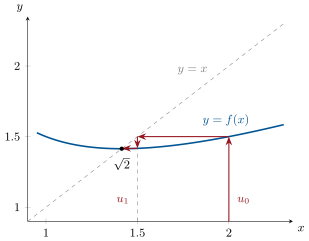
Let u0=2 and un+1=21(un+un2): the ancient algorithm for 2.
Stability: for x>0, the arithmetic–geometric mean inequality gives 21(x+x2)≥x⋅x2=2; so I=[2,+∞) is stable and contains u1 (indeed u1=23≥2).
Monotonicity: for x≥2, x−f(x)=2xx2−2≥0: the sequence decreases from u1 on, and is bounded below by 2: it converges.
Limit: the fixed points solve x=21(x+x2), i.e. x2=2: on I, ℓ=2.
Speed:un+1−2=2un(un−2)2≤22(un−2)2: the number of correct digits roughly doubles at each step (quadratic convergence).
Heron’s iteration un+1=21(un+un2), drawn as a staircase between the graph of f and the diagonal y=x: from u0=2, the iterates slide down to the fixed point 2.
Remark 11.25(Common pitfalls with limits)
Four classics. (i) Small steps do not imply convergence: un+1−un→0 is far weaker than the Cauchy property — the harmonic sums Hn have steps n+11→0 yet diverge to +∞ (Exercise 11.5); the Cauchy condition controls ∣up−uq∣ for all large pairs, not consecutive ones. (ii) Strict inequalities die in the limit: from un<vn for all n one gets only limun≤limvn (Theorem 11.7); n1>0 and yet lim=0. (iii) Bounded is not convergent: ((−1)n) is bounded and diverges; boundedness plus monotonicity converges, boundedness alone only guarantees a convergent subsequence (Theorem 11.16). (iv) The fixed-point equation comes second, not first: for un+1=f(un), solving f(ℓ)=ℓ identifies the limit only after convergence is proved. The recurrence un+1=2un has the unique fixed point ℓ=0, yet from u0=1 the sequence runs to +∞: the equation ℓ=2ℓ was never entitled to a limit. Order of operations, always: existence first (Method 11.23, steps 1–3), identification second.
Example 11.26(A decreasing f: the golden recurrence)
Let u0=1 and un+1=1+un1. Here f(x)=1+x1 is decreasing, so the sequence is not monotonic (it alternates around its limit); the contraction step of Method 11.23 is the right tool. Stability: if x∈[21,1] then 1+x∈[23,2], so f(x)∈[21,32]⊆[21,1], and u1=21 puts the whole sequence there. Fixed point: ℓ=1+ℓ1 with ℓ>0 gives ℓ2+ℓ−1=0, i.e.
ℓ=25−1=0.6180…
(the golden ratio’s inverse). Contraction: for x,y∈[21,1],
so ∣un−ℓ∣≤(94)n−1∣u1−ℓ∣→0: convergence, with geometric speed, no monotonicity needed. The closing insight: monotone methods and contraction methods split the recurrent world between them — increasing f gives monotone orbits, decreasing f gives alternating orbits tamed by a Lipschitz constant <1 (the systematic theory is Exercise 14.11).
Remark 11.27(Perspectives inside this volume)
Sequences are the measuring instrument the rest of the volume holds up to every object. In Chapter 12 they characterize closedness and compactness; in Chapter 13 they transport limits of functions; in Chapter 15 Riemann sums are sequences converging to the integral; Chapter 17is the theory of one special class of sequences, the partial sums. Even the algebra chapters consume them: the iterates of a matrix in Chapter 21 form sequences whose behavior (convergence of An) is a linear-algebra question with this chapter’s vocabulary. The two theorems to carry everywhere: monotone limit (existence from order) and Bolzano–Weierstrass (existence from boundedness) — between them, nearly every limit in this book is born.
Remark 11.28(Complex sequences)
A sequence (zn) of complex numbers converges to ℓ when ∣zn−ℓ∣→0; equivalently, when ℜ(zn)→ℜ(ℓ) and ℑ(zn)→ℑ(ℓ) (compare ∣z∣ with ∣ℜz∣+∣ℑz∣). The theorems not involving order — operations, Bolzano–Weierstrass (extract twice), Cauchy criterion — carry over verbatim.
11.6 Exercises
Exercise 11.1★
Directly from Definition 11.1, prove that n+32n+1→2, and that (un)=((−1)n) diverges.
Solution
Solution of Exercise 11.1.
n+32n+1−2=n+35. Given ε>0, take N>ε5−3 (Archimedes): for n≥N, n+35≤ε. Hence the limit is 2.
((−1)n): its subsequences(u2n)=(1) and (u2n+1)=(−1) converge to different limits, so the sequence diverges (Proposition 11.14). (Directly: any candidate ℓ fails for ε=21, since consecutive terms are at distance 2.)
Exercise 11.2★
Compute the limits:
2n2+5n2−3n+1,n+1−n,3n−n22n+n3,n5(=51/n).
Solution
Solution of Exercise 11.2.
Dividing by n2: 2+5/n21−3/n+1/n2→21.
n+1−n=n+1+n1→0 (conjugate).
3n−n22n+n3=1−n2/3n(2/3)n+n3/3n→1−00+0=0, using qn→0 for ∣q∣<1 and the polynomial-vs-geometric comparison (Proposition 4.6).
51/n=enln5→e0=1.
Exercise 11.3★
Prove the standard comparison: if ∣q∣<1 then qn→0(write ∣q∣1=1+h, h>0, and use the Bernoulli inequality (1+h)n≥1+nh, to be proved by induction). What are the behaviors for q=1, q=−1, ∣q∣>1?
Solution
Solution of Exercise 11.3.
Bernoulli: (1+h)n≥1+nh for h≥−1, by induction — (1+h)n+1=(1+h)n(1+h)≥(1+nh)(1+h)=1+(n+1)h+nh2≥1+(n+1)h.
For 0<∣q∣<1: write ∣q∣1=1+h, h>0; then ∣q∣n=(1+h)n1≤1+nh1→0, and the squeeze gives qn→0 (the case q=0 is trivial). For q=1: constant sequence, limit 1. For q=−1: diverges (Exercise 11.1). For ∣q∣>1: ∣q∣n=(1+h)n≥1+nh→+∞, so (qn) is unbounded, hence divergent (to +∞ if q>1; with alternating signs, no limit, if q<−1).
Exercise 11.4★
Let un+1=2un+3, u0=0. Find the fixed point ℓ, prove that vn=un−ℓ is geometric, and give an explicit formula and the limit of (un).
Solution
Solution of Exercise 11.4.
Fixed point: ℓ=2ℓ+3 gives ℓ=3. Then
vn+1=un+1−3=2un+3−3=2un−3=2vn:
(vn) is geometric with ratio 21, v0=−3. So un=3−2n3→3.
Exercise 11.5★★
(Harmonic series) Let Hn=∑k=1nk1. Prove that H2n−Hn≥21 for all n≥1, and conclude that (Hn) is not a Cauchy sequence, hence diverges (to +∞, being increasing).
Solution
Solution of Exercise 11.5.
H2n−Hn=∑k=n+12nk1≥n⋅2n1=21 (each of the n terms is ≥2n1). If (Hn) were Cauchy, taking ε=31 would force ∣H2n−Hn∣≤31 for large n: contradiction. An increasing non-convergent sequence diverges to +∞ (Theorem 11.9): Hn→+∞.
Exercise 11.6★★
Suppose (u2n), (u2n+1) and (u3n) all converge. Prove that (un) converges. (Find common subsequences to equate the limits.)
Solution
Solution of Exercise 11.6.
Let a=limu2n, b=limu2n+1, c=limu3n. The sequence (u6n) is a subsequence both of (u2n) and of (u3n): its limit equals a and c, so a=c. The sequence (u6n+3) is a subsequence of (u2n+1) (odd indices) and of (u3n) (indices 6n+3=3(2n+1)): so b=c. Hence a=b, and Proposition 11.14 (evens and odds with equal limits) gives the convergence of (un).
Exercise 11.7★★
Study the sequence u0=0, un+1=2+un: stability, monotonicity, limit. Then prove the error bound ∣un−2∣≤3n2(show 2−un+1=2+2+un2−un and bound the denominator below by 3).
Solution
Solution of Exercise 11.7.
Stability and bounds:I=[0,2] is stable: for x∈I, 2+x∈[2,2]⊆I; and u0=0∈I.
Monotonicity:f(x)=2+x is increasing and u1=2>u0: by induction (un) is increasing. Increasing and bounded above by 2: it converges (Theorem 11.9).
since 2+un≥2>1. By induction from 2−u0=2: 0≤2−un≤3n2.
Exercise 11.8★★
Let (un) be bounded, such that every convergent subsequence of (un) has the same limit ℓ. Prove un→ℓ. (Contradiction plus Bolzano–Weierstrass.)
Solution
Solution of Exercise 11.8.
Suppose (un) does not converge to ℓ: for some ε0>0, infinitely many indices satisfy ∣un−ℓ∣>ε0; they form a subsequence(uφ(n)). This subsequence is bounded, so by Bolzano–Weierstrass (Theorem 11.16) it has a convergent sub-subsequence, whose limit ℓ′ satisfies ∣ℓ′−ℓ∣≥ε0 (pass the inequality to the limit, Theorem 11.7). But a sub-subsequence of (un) is a convergent subsequence of (un), so by hypothesis ℓ′=ℓ: contradiction.
Exercise 11.9★★★
With the notation of Example 11.12, suppose e=qp with p,q∈N∗. Using aq<e<bq=aq+qq!1, multiply by q! and derive a contradiction between two integers. Conclude: e is irrational.
Solution
Solution of Exercise 11.9.
Suppose e=qp, q≥1. The strict inequalities aq<e<aq+qq!1 (strict since (an) is strictly increasing and (bn) strictly decreasing) multiplied by q! give
q!aq<q!qp<q!aq+q1≤q!aq+1.
Now N=q!aq=∑k=0qk!q! is an integer (each k!q! is a product of integers for k≤q), and so is q!qp=(q−1)!p. The display thus places the integer (q−1)!p strictly between N and N+q1≤N+1: an integer strictly inside (N,N+1), which is impossible. Hence e∈/Q.
Exercise 11.10★★★
(Cesàro means) For a sequence (un)n≥1, set cn=nu1+⋯+un.
Prove that un→ℓ implies cn→ℓ(cut the sum at a threshold N; bound the head by a fixed quantity over n, the tail by ε).
where C=∑k=1N∣uk−ℓ∣ is fixed. For n large, nC≤2ε: then ∣cn−ℓ∣≤ε.
un=(−1)n: diverges, yet cn→0 (partial sums bounded by 1, divided by n).
Apply (1) to the sequence vn=un+1−un→ℓ: its Cesàro mean is nun+1−u1→ℓ (telescoping), and nun+1=nun+1−u1+nu1→ℓ; renormalizing indices (nun=n−1un⋅nn−1) gives nun→ℓ.
Exercise 11.11★★★
Let (un) satisfy 0≤um+n≤um+un for all m,n (subadditivity). Prove that (nun) converges to infn≥1nun. (For fixed m, write n=qm+r and bound nun using un≤qum+ur.)
Solution
Solution of Exercise 11.11.
Let L=infn≥1nun≥0, and ε>0. Choose m with mum≤L+ε. Every n writes n=qm+r, 0≤r<m; subadditivity (iterated) gives un≤qum+ur, so
using qm≤n. For n large, nCm≤ε: thus L≤nun≤L+2ε for all large n, which is the convergence to L.
Exercise 11.12★★★
Using the density of the subgroupZ+2πZ of (R,+) (Exercise 10.9), prove that the sequence (sinn)n∈N is dense in [−1,1] — in particular it diverges.
Solution
Solution of Exercise 11.12.
The subgroupG=Z+2πZ of (R,+) is dense: it is not αZ, since 1=pα, 2π=qα would make 2π=pq rational — and π∈/Q (admitted here; a proof is sketched in Chapter 15). By Exercise 10.9, G is dense in R.
Let now y∈[−1,1] and θ=arcsiny. By density, for every ε>0 there are n∈Z, k∈Z with ∣(n+2πk)−θ∣≤ε, i.e. n is within ε of θ−2πk; then, sin being 2π-periodic and 1-Lipschitz (∣sina−sinb∣≤∣a−b∣, from the mean value inequality of Chapter 14),
∣sinn−y∣=∣sin(n+2πk)−sinθ∣≤∣n+2πk−θ∣≤ε.
One detail: n ranges over Z, but sin(−n)=−sinn and y was arbitrary in [−1,1], so nonnegative indices suffice (replace (n,y) by (−n,−y) if needed). Hence {sinn:n∈N} is dense in [−1,1]; a dense-in-a-segment sequence has subsequences approaching distinct values, so it diverges.
11.7 Problem: Cesàro, Stolz, and the slow fall of the sine
Problem 11.1
Weekend problem — the Cesàro–Stolz theorem and the asymptotics un∼3/n for un+1=sinun
The Cesàro–Stolz theorem is the discrete l’Hospital rule: to find the limit of a quotient an/bn, it suffices to find the limit of the quotient of increments(an+1−an)/(bn+1−bn). This problem proves the theorem, harvests classical limits with it, and then aims it at a famous target: the sequence un+1=sinun, which creeps to 0 at the exactly computable speed un∼3/n. Two facts from the High School volume are granted here and re-proved honestly later in this volume: the tangent-line inequality
eu≥1+u(u∈R),(G1)
re-proved by convexity in Chapter 14, and the sine bracketing
Prove the +∞ variant: if bn+1−bnan+1−an→+∞ (same hypotheses on (bn)), then bnan→+∞.
Take bn=n: recover the Cesàro mean theorem of Exercise 11.10. Then show the converse of Cesàro–Stolz fails: for an=(−1)n, bn=n, the quotient an/bn converges while the quotient of increments does not. Stolz is a one-way street.
Part III — First dividends.
Prove (1+h)3/2−1=(1+h)3/2+13h+3h2+h3 by conjugation, deduce n((1+n1)3/2−1)→23, and conclude with Cesàro–Stolz:
Tn=k=1∑nk∼32n3/2,
resolving the cliffhanger of question 2.
From (G1) alone, derive the logarithm bracketing
1+tt≤ln(1+t)≤t(t>−1)
(apply (G1) at u=ln(1+t) and at u=−t/(1+t)).
Show that bn=lnn is strictly increasing with lnn→+∞, and prove with Cesàro–Stolz and question 9 that
Hn=k=1∑nk1∼lnn.
(The finer structure Hn=lnn+γ+o(1) is the weekend problem of Chapter 17.)
(From ratios to roots) Let un>0 with unun+1→L>0. Using question 9, show lnunun+1→lnL; apply Cesàro to conclude nlnun→lnL, then, with (G1), that un1/n→L. Application: compute lim(n2n)1/n.
Part IV — The slow fall of the sine. Let u0∈R and un+1=sinun.
From (G2), show 0<sinx<x for 0<x≤1. Deduce: u1∈[−1,1]; if u1=0 the sequence is zero from rank 1; and if u1>0 (the case u1<0 being symmetric, sin odd), then (un)n≥1 is strictly decreasing, positive, and converges to 0(identify the limit via ℓ=sinℓ, using ∣sina−sinb∣≤∣a−b∣, itself a consequence of (G2) and the product-to-sum formula).
Assume from now on u1∈(0,1]. Show by squeezing, using (G2):
Conclude with Exercise 11.10 (increments version) that nun21→31, then, by a conjugation argument for the square root, the headline:
nun⟶3,i.e.un∼n3.
Quantify the slowness: show that eventually 2/n≤un≤2/n, so that reaching un≤10−2 requires more than 20000 iterations (about 30000, by the asymptotics). Contrast with Heron’s method (Example 11.24) and explain the structural reason: at the fixed point 0, the slope of sin is 1 (a neutral fixed point), while error-halving iterations need a slope of modulus<1.
Show that for every starting point u0∈R, either un=0 from rank 1 on, or ∣un∣∼3/n — the fall is universal, only the sign remembers u0.
Part V — The general principle. The sine is one instance of a machine.
Let un>0, un→0, and un2un−un+1→a>0. Prove successively: unun+1→1; then un+11−un1→a; then nun→a1.
(Exact model) For un+1=1+unun, u0>0: show un1 is arithmetic, solve exactly, and check question 18’s conclusion against the exact formula.
For un+1=une−un, u0>0: show un→0, use (G1) to squeeze t1−e−t between 1+t1 and 1 for t>0, and conclude un∼n1.
(Cubic contact, squared telescope) Let un>0, un→0, un3un−un+1→a>0. Adapt question 14’s factorization to show un+121−un21→2a, and conclude nun2→2a1. Check that a=61 recovers Part IV.
Part VI — Limits of the method, and morals.
Show that the hypothesis bn→+∞ cannot be dropped: for an=2−2−n and bn=1−2−n, the increment quotient tends to 1 while bnan→2. Point to the exact line of question 5’s proof that breaks.
(Stolz twice) Prove ∑k=1nHk∼nlnn(one application of Cesàro–Stolz, then question 10; bound (n+1)ln(n+1)−nlnn using question 9).
(Geometric means) If un>0 and un→ℓ>0, show (u1u2⋯un)1/n→ℓ; if un→+∞, show (u1⋯un)1/n→+∞. Deduce (n!)1/n→+∞.
Synthesis, one sentence each: (i) where exactly did completeness enter this problem; (ii) in what sense is Cesàro–Stolz a discrete l’Hospital rule (its differential twin rests on the mean value theorem of Chapter 14); (iii) state the heuristic linking the contact order of f at a neutral fixed point to the decay exponent of un+1=f(un); (iv) trace the constant 3 of 3/n back through the pipeline 61→31→3.
Solution
Solution of Problem 11.1.
1.n2n(n+1)/2=21+1/n→21, and n3n(n+1)(2n+1)/6=6(1+1/n)(2+1/n)→31.
2. Upper: each of the n terms is ≤n, so Tn≤nn. Lower: the terms with k>2n number at least 2n, and each is ≥n/2:
Tn≥2n2n=22n3/2.
3. For k≥N, since bk+1−bk>0: m(bk+1−bk)≤ak+1−ak≤M(bk+1−bk). Summing for k=N,…,n−1, both sides telescope:
m(bn−bN)≤an−aN≤M(bn−bN),
and dividing by bn−bN>0 gives the claim.
4. By definition of the limit there is N with ℓ−ε≤bk+1−bkak+1−ak≤ℓ+ε for all k≥N; question 3 with m=ℓ−ε, M=ℓ+ε transfers the bracketing to bn−bNan−aN.
By question 4 the second factor of the product is bounded by ε in absolute value, and 0<1−bnbN≤1 for large n, so
bnan−ℓ≤bn∣aN−ℓbN∣+ε≤2ε
as soon as bn≥ε∣aN−ℓbN∣, which happens eventually since bn→+∞. Hence bnan→ℓ: the Cesàro–Stolz theorem.
6. Given M, choose N with bk+1−bkak+1−ak≥M for k≥N; the lower half of question 3 gives an−aN≥M(bn−bN), so
bnan≥bnaN+M(1−bnbN)⟶M.
Beyond some rank, bnan≥M−1; as M was arbitrary, bnan→+∞.
7. With bn=n and an=u1+⋯+un: the increment quotient is un+1→ℓ, so the Cesàro mean nan tends to ℓ: part (1) of Exercise 11.10. With an=un: the increment quotient is un+1−un, giving part (3). Converse: an=(−1)n, bn=n has bnan→0, yet an+1−an=±2 alternates: the increment quotient has no limit.
8. Conjugation:
((1+h)3/2−1)((1+h)3/2+1)=(1+h)3−1=3h+3h2+h3.
For h=n1: n((1+n1)3/2−1)=(1+1/n)3/2+13+3/n+1/n2, and 1≤(1+n1)3/2≤(1+n1)2→1 (squeeze), so the denominator tends to 2 and the expression to 23. Now Stolz with an=Tn, bn=n3/2 (strictly increasing, →+∞):
hence Tn∼32n3/2. (The bracketing of question 2 had trapped the constant in [0.35,1]; Stolz pins it.)
9. (G1) at u=ln(1+t): 1+t=eln(1+t)≥1+ln(1+t), so ln(1+t)≤t. (G1) at u=−1+tt: e−t/(1+t)≥1−1+tt=1+t1>0; taking ln (increasing): −1+tt≥−ln(1+t), i.e. ln(1+t)≥1+tt.
10.ln is strictly increasing (Proposition 4.1), and ln(2k)=kln2 is unbounded, so lnn→+∞. Increments: with t=n1 in question 9,
so the increment quotient ln(n+1)−lnnHn+1−Hn tends to 1; Stolz gives Hn∼lnn.
11. Set xn=unun+1→L and tn=Lxn−1→0. Question 9: 1+tntn≤ln(1+tn)≤tn, so lnxn−lnL=ln(1+tn)→0 by squeezing. Cesàro (question 7) applied to (lnxk):
n1k=0∑n−1lnxk=nlnun−lnu0⟶lnL,
so nlnun→lnL. With hn=nlnun−lnL→0: un1/n=Lehn, and (G1) squeezes 1+hn≤ehn≤1−hn1 (for hn<1), so ehn→1 and un1/n→L. Application: un=(n2n) gives
12. For 0<x≤1, (G2) gives sinx≥x(1−6x2)≥65x>0 and
x−sinx≥6x3−120x5=x3(61−120x2)≥12019x3>0:
thus 0<sinx<x on (0,1]. Always u1=sinu0∈[−1,1]. If u1=0, then un=0 for n≥1. If u1∈(0,1]: by induction 0<un+1=sinun<un≤1, so (un)n≥1 is strictly decreasing and bounded below by 0: it converges to some ℓ∈[0,1) (Theorem 11.9). The product-to-sum formula and (G2) give ∣sina−sinb∣=2cos2a+bsin2a−b≤∣a−b∣, so un+1=sinun→sinℓ: ℓ=sinℓ. If ℓ>0 then sinℓ<ℓ: impossible. So un→0.
13. Dividing (G2) by un>0:
1−6un2≤unsinun≤1−6un2+120un4≤1,
and un→0 squeezes unsinun→1. Dividing x−sinx by x3:
(check the powers of un: 3+1+(−4) against the un2 downstairs and un4 upstairs). By question 13 the three factors tend to 61, 2, 1: wn→31.
15.vn=un21 has increments vn+1−vn=wn→31, so nvn→31 by Exercise 11.10 (3): nun2→3. Then
nun−3=nun+3nun2−3≤3nun2−3⟶0:
nun→3, i.e. un∼3/n.
16. Since nun2→3, eventually 2≤nun2≤4, i.e. 2/n≤un≤2/n. If un≤10−2 with n in that range, then 2/n≤10−4: n≥20000; and 3/n=10−2 at n=30000. Heron’s method squares the error at each step — the digit count doubles — because at its fixed point the relevant slope is <1 in modulus (indeed the iteration is contracting). Here sin′0=cos0=1: the fixed point is neutral, no geometric contraction exists, and the decay is governed by the first nonlinear term −6x3, hence polynomial. One step of Heron gains more accuracy than ten thousand steps of the sine.
17. For arbitrary u0: u1=sinu0∈[−1,1]. If u1=0 the sequence vanishes from rank 1. If u1>0, Part IV applies verbatim. If u1<0, set vn=−un: oddness of sin gives vn+1=−sinun=sin(−un)=sinvn with v1∈(0,1], so vn∼3/n, i.e. un∼−3/n. In all cases ∣un∣∼3/n (or the sequence is eventually 0): the fall is universal, only the sign remembers the start.
18. First unun+1=1−un2un−un+1un→1−a⋅0=1. Then
19.vn=un1: vn+1=un1+un=vn+1, so vn=v0+n and
un=1+nu0u0,nun=1+nu0nu0⟶1.
Lemma check: un−un+1=1+unun2, so un2un−un+1=1+un1→1=a, and question 18 predicts nun→1: exact agreement.
20. Positivity by induction (e−u>0); decreasing since e−un<1 for un>0; hence un→ℓ≥0 (Theorem 11.9). Continuity bridge: with hn=ℓ−un→0, e−un=e−ℓehn→e−ℓ by the (G1) squeeze 1+hn≤ehn≤1−hn1; so ℓ=ℓe−ℓ, and ℓ>0 would force e−ℓ=1, false: ℓ=0. For t>0, (G1) gives e−t≥1−t and e−t≤1+t1, so
1+t1≤t1−e−t≤1.
With t=un: un2un−un+1=un1−e−un→1. Question 18 with a=1: nun→1, so un∼n1.
21. As in question 18, unun+1=1−un3un−un+1un2→1. Then
and Exercise 11.10 (3) gives nun21→2a: nun2→2a1. For the sine, a=61 (question 13): nun2→3, exactly Part IV.
22. Increments: an+1−an=2−n−2−n−1=2−n−1=bn+1−bn, so the increment quotient is constantly 1. Yet bnan=1−2−n2−2−n→2=1. The proof of question 5 breaks at the boundary term: bnaN−ℓbN→0 needed bn→+∞; here (with ℓ=1) aN−bN=1 and bn→1, so the term tends to 1 — precisely the residual gap 2−1.
23. Stolz with An=∑k=1nHk and Bn=nlnn: Bn+1−Bn=ln(n+1)+nln(1+n1)>0 and Bn→+∞. By question 9, n+1n≤nln(1+n1)≤1, so Bn+1−Bn=ln(n+1)+θn with 21≤θn≤1. Hence
(question 10 for the first factor; θn bounded and ln(n+1)→∞ for the second). Stolz concludes: ∑k=1nHk∼nlnn.
24. If un→ℓ>0: as in question 11, lnun→lnℓ (question 9 squeeze on lnℓun), so the Cesàro means n1∑k=1nlnuk→lnℓ, and the exponential bridge of question 11 gives (u1⋯un)1/n=exp(n1∑lnuk)→ℓ. If un→+∞: for any M, eventually un≥eM, so lnun≥M: lnun→+∞; the +∞ Cesàro (question 6, bn=n) gives n1∑lnuk→+∞, and (G1) (es≥1+s) sends the geometric mean to +∞. With un=n: (n!)1/n→+∞.
25. (i) Completeness entered only through the monotone limit theorem, to produce the limits in questions 12 and 20; the Cesàro–Stolz theorem itself is pure ε-management, valid over Q. (ii) Stolz replaces limbnan by lim of the quotient of increments, exactly as l’Hospital replaces limgf by limg′f′ — the differential twin rests on the mean value theorem of Chapter 14. (iii) Heuristic: if f(x)=x−axp+1+o(xp+1) at the neutral fixed point 0, then un+1p1−unp1→pa and un∼(pan)−1/p: contact of order p+1 yields decay n−1/p — the flatter the graph against the diagonal, the slower the fall. (iv) The constant: (G2) supplies the cubic coefficient 61; the factorization of question 14 doubles it into the telescope increment 31; Cesàro turns un21 into 3n; inverting and taking roots delivers 3/n.
![Adjacent sequences: (a_n) climbs, (b_n) descends, and the gap between them shrinks to 0. Each interval [a_n, b_n] contains all later ones, and the common limit is the unique point left in every interval — the picture behind the dichotomy proofs of Bolzano–Weierstrass below and of the intermediate value theorem in .](/images/onecourse/chapters/math-3/b1-seq/fig-3a699c2487eb.svg)