Markets I: The Ecosystem and Exchange-Traded Markets · Markets
16Stock Loan and Short Selling in Practice
A fund is short a stock it believes is worth half its price, and pays 1% a year to borrow it. Others reach the same view; the shares that lenders offer run out; within a week the fee is 80%. The fund is now paying two tenths of a percent of the position every day to keep a trade that may take a year to work. Then a lender sells its shares and recalls the loan, the broker cannot find replacements, and the fund must buy in a rising market along with every other short. A long position can be wrong for years at no cost but patience. A short position is rented, the rent is set daily by an auction the tenant cannot see, and the landlord can end the lease overnight. Chapter 6 defined the loan; this chapter is about living with it.
16.1 The lending chain
Definition 16.1 (Lendable supply and utilisation)
The lendable supply of a security is the quantity that its owners have made available to lend through their agents. Utilisation is the fraction of it currently on loan.
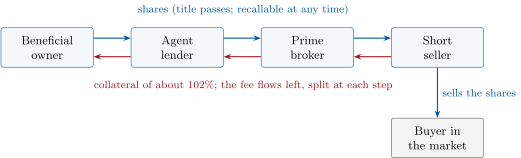
The owners are pension funds, index funds, insurers and sovereign funds: holders who will not sell next week and welcome a few basis points of income. They lend through agent lenders, usually their custodians, to the prime brokers of Definition 6.10, who lend on to their clients. Prime brokers also lend from their own clients’ margin accounts (rehypothecation) and borrow from one another. Long holders who have not agreed to lend (most retail cash accounts, many active managers) are not in the supply at all: for a typical large stock the lendable supply is a fraction of the float, and what is actually on loan a small fraction of that.
Definition 16.2 (Short interest and days to cover)
The short interest of a stock is the number of its shares sold short and not yet covered, often quoted as a percentage of the float. Days to cover is short interest divided by the average daily volume.
Because the buyer of a shorted share can lend it again, the same share can be shorted more than once, and short interest can exceed 100% of the float without any failure to deliver: the longs simply hold, between them, the float plus the short interest.
16.2 Fees, rebates and specials
Definition 16.3 (General collateral and special)
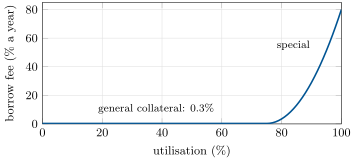
A security is general collateral when supply so exceeds demand that it lends at a minimal fee, a few tenths of a percent a year. It is special (or hard to borrow) when the fee is materially higher; a special’s rebate rate is often negative: the borrower receives no interest on its cash collateral and pays on top.
The fee is the difference between the market interest rate and the rebate (Definition 6.8). It is set loan by loan, can be changed by the lender on any day, and accrues on the current market value of the shares: when a short goes wrong the rent rises with the price. Fees are negotiated bilaterally; no tape publishes them. Desks work from their prime brokers’ indications and from data vendors who pool the loan books of lenders and brokers.
Proposition 16.4 (The break-even holding period)
A short seller expects the price to fall by a fraction . With a borrow fee a year, the fee consumes the whole expected gain after
to first order (fee charged on the initial value, interest on the proceeds ignored).
Example 16.5 (Right, and unprofitable)
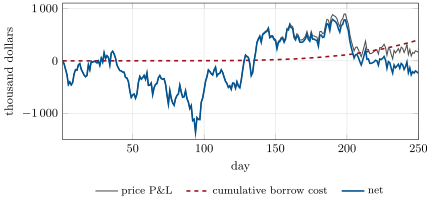
A thesis worth a 25% fall has days at a fee of 40% and 112 days at 80%. Figure 16.3 follows a short of 100 000 shares at $40 over a simulated year in which utilisation climbs from 60% to 99%. The stock first rises to $53.52 on day 94, a loss of $1.36 million. On day 190 it is at $31.20 and the position is $789 000 ahead. By day 250 the stock has recovered to $38.36, still below the entry, and the borrow has cost $399 000, three quarters of it in the last sixty days: the trade has lost $235 000.
16.3 Recalls, buy-ins and the rules
Definition 16.6 (Recall and buy-in)
A recall is the lender’s demand for the return of lent securities, typically because it has sold them or wants to vote. If the borrower’s broker cannot replace the loan from another lender and the borrower does not return the shares in time, the lender (or the broker) executes a buy-in: it buys the shares in the market at the borrower’s expense.
Definition 16.7 (Naked short sale)
A naked short sale is a short sale made without having borrowed, or arranged to borrow, the security in time for settlement, so that the seller fails to deliver (Chapter 5).
As of September 2026 — The rules on each side of the Atlantic
United States, Regulation SHO. Locate (Rule 203(b)(1)): before effecting a short sale a broker-dealer must have reasonable grounds to believe the security can be borrowed and delivered on the due date. Close-out (Rule 204): a fail from a short sale must be closed out by the beginning of regular trading hours on the settlement day following the settlement date; fails from long sales and from bona fide market making have until the third settlement day following it. Threshold securities: fails of at least 10 000 shares and 0.5% of the shares outstanding for five consecutive settlement days; fails persisting for 13 consecutive settlement days must be closed out at once. Price test (Rule 201): after a fall of 10% in a day, short sales are restricted to prices above the national best bid for the rest of that day and the next. The regulator’s own summary notes that naked short selling is not in itself a violation.
European Union, Short Selling Regulation. Net short positions in shares are notified to the national authority from 0.1% of the issued share capital and at each further 0.1%, and published from 0.5%. Uncovered short sales of shares and of sovereign debt are prohibited, and national authorities may impose temporary bans in a crisis.
Both regimes make an exception for market making: in the United States a broker-dealer engaged in bona fide market making need not locate before selling, since a firm that must quote both sides continuously cannot consult a stock-loan desk before each sale; the exception does not cover speculative selling or one-sided quoting. The exception, and the longer close-out, are part of the economics of the market makers of Chapter 1.
16.4 Squeezes
Definition 16.8 (Short squeeze)
A short squeeze is a rise in price amplified by the purchases of short sellers who cover because of losses, margin calls, recalls or risk limits, each purchase pushing the price further against those who remain.
Proposition 16.9 (The covering cascade)
Let the shorts’ covering thresholds, expressed as returns from today’s price, be spread uniformly between and , and let be the price impact, as a return, of all of them covering. After an exogenous shock the price settles at the return
and at , with every short covered, otherwise. The multiplier is unbounded as .
Proof. The fraction covered at return is on , and the price satisfies . Solve the linear equation. If each cover triggers at least one more and the iteration stops only at . ∎
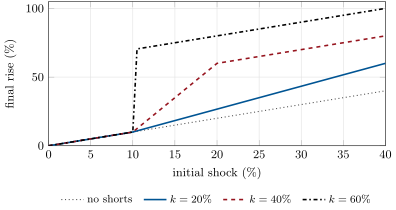
The impact grows with short interest relative to the shares that can actually be bought: days to cover, and short interest over the free float, are the two numbers to watch. Two episodes mark the extremes.
Example 16.10 (Wolfsburg, October 2008)
On Sunday 26 October 2008 a carmaker announced that it held 42.6% of another carmaker’s ordinary shares and cash-settled options on a further 31.5%. A German state held 20%. About 13% of the shares were sold short, and 5.9% remained in the float. The price, € 211 on the Friday, passed € 1 005 on Tuesday 28 October, briefly making the company the most valuable listed company in the world. The options were the point: being cash-settled they fell outside the disclosure rules of the time, and whatever shares their writers held as hedges were not for sale.
Example 16.11 (January 2021)
Short interest in a US video-game retailer reached 122.97% of its float in January 2021. From an intraday low on 8 January to an intraday high of $483 on 28 January the price rose about 2 700%, then fell more than 86% by the end of the first week of February. The regulator’s staff report found that short sellers’ covering coincided with parts of the rise but was a small fraction of total buying, and concluded that positive sentiment, not buying-to-cover, sustained the rise: a squeeze was part of the story and not the whole of it.
16.5 Dividends and tax
The borrower of a share owes the lender a manufactured dividend for every dividend paid during the loan. The lender is economically whole; but it is no longer the legal owner on the record date, and where a withholding tax applies, the tax position of owner, borrower and buyer can differ. Lending shares over the dividend date to a holder with a better tax position, and sharing the saving, is an old and in many jurisdictions contested trade.
Its criminal extreme was cum-ex: short sales arranged around the dividend date so that the withholding tax paid once appeared to have been paid to two owners, both of whom reclaimed it. On 28 July 2021 Germany’s Federal Court of Justice confirmed that claiming refunds of tax that had never been paid is tax evasion, a criminal offence. For a desk the lesson is narrow and absolute: a dividend trade whose profit is a tax refund is a legal question before it is a trading question.
16.6 Tutorial: the cost of a short as the stock goes special
Goal. Carry a short through a year in which the borrow tightens, and reproduce the covering cascade. End state: the three data figures of this chapter.
A fee curve. Flat, then convex.
def fee_from_utilisation(u: float, gc: float = 0.003, kink: float = 0.75, max_fee: float = 0.80) -> float:
    """Annual borrow fee: general collateral below the kink, then convex up to `max_fee` at u = 1."""
    if u <= kink:
        return gc
    x = (min(u, 1.0) - kink) / (1.0 - kink)
    return gc + (max_fee - gc) * x**2
Listing 16.1. An illustrative borrow fee as a function of utilisation. code/markets-1/16-stock-loan-and-short-selling/python/short_cost.py Carry. The fee accrues on the day’s market value, actual/360.
def carry_short(prices: np.ndarray, fees: np.ndarray, shares: float, day_count: int = 360):
    """Daily marked short: price P&L and cumulative borrow cost, charged on the day's market value."""
    price_pnl = shares * (prices[0] - prices)
    cost = np.cumsum(shares * prices * fees / day_count)
    return price_pnl, cost
Listing 16.2. Price P&L and cumulative borrow cost of a short. code/markets-1/16-stock-loan-and-short-selling/python/short_cost.py The cascade. A closed form and an iteration that must agree.
def squeeze_return(shock: float, k: float, a: float, b: float) -> float:
    """Equilibrium return x = shock + k F(x), F uniform between stop levels a < b (as returns).
    k is the price impact of all shorts covering. Smallest equilibrium, reached from below."""
    if shock <= a:
        return shock
    if k >= b - a:                                   # each cover triggers more than one cover
        return shock + k
    x = (shock - k * a / (b - a)) / (1.0 - k / (b - a))
    return x if x < b else shock + k
Listing 16.3. The equilibrium of the covering cascade. code/markets-1/16-stock-loan-and-short-selling/python/short_cost.py
What to change next. Make utilisation respond to the price (shorts add when the stock rises on no news, lenders sell into strength and recall). Replace the uniform thresholds by a distribution concentrated near round losses and look at what happens to the multiplier.
16.7 Build: the borrow book
Purpose. The financing calculator of Chapter 6 takes borrow fees as an input. This component produces them, answers locate requests, and tells the firm what it must buy in when a lender recalls.
Interface. FeeCurve(gc, kink, max_fee).fee(utilisation); BorrowBook.locate(sym, qty), borrow, give_back, recall(sym, qty) returning the firm’s buy-in quantity, utilisation(sym) and borrow_fees(), a dictionary accepted as is by firm_financing.accrue.
Rules. The firm’s own borrow counts in utilisation: a large short moves its own fee. A recall that leaves loans above supply is shared pro rata between the firm and the rest of the market, rounded against the firm. A locate for an unknown symbol returns zero, never an error: no locate, no short.
Acceptance tests. code/firm/borrow/tests/: locates and fee levels; the firm’s borrow moving the fee; a recall with a pro-rata buy-in; the hand-off to the financing accrual.
Stretch. Term loans at a fixed fee against overnight loans at a floating one: the choice every stock-loan desk faces before an event.
Sources and further reading
- US Securities and Exchange Commission, Key Points About Regulation SHO, investor publication.
- US Securities and Exchange Commission, Staff Report on Equity and Options Market Structure Conditions in Early 2021, 14 October 2021.
- European Securities and Markets Authority, Short selling, policy page; Regulation (EU) No 236/2012.
- F. Allen, M. Haas, E. Nowak and A. Tengulov, “Market efficiency and limits to arbitrage: evidence from the Volkswagen short squeeze”, Journal of Financial Economics 142 (2021); “The case of Volkswagen”, The Hedge Fund Journal.
- Bundesgerichtshof, press release 146/2021 on judgment 1 StR 519/20 of 28 July 2021.
- D. Duffie, N. Gârleanu and L. H. Pedersen, “Securities lending, shorting, and pricing”, Journal of Financial Economics 66 (2002).
16.8 Exercises
Exercise 16.1 ★
The overnight rate is 4.3% and a prime broker quotes a rebate of on a stock. Give the borrow fee and the daily cost of a $3 million short.
Solution
Solution of Exercise 16.1.
Fee . Daily cost .
Exercise 16.2 ★
A stock has 12 million shares of lendable supply, 10.2 million of them on loan. Give the utilisation and the fee on the chapter’s curve.
Exercise 16.3 ★
A stock has a float of 60 million shares, a short interest of 18 million and an average volume of 2.4 million a day. Give the short interest as a percentage of float and the days to cover. Which of the two matters more to a short seller worried about a squeeze, and why?
Solution
Solution of Exercise 16.3.
30% of the float; 7.5 days to cover. Days to cover matters more for the squeeze itself: it measures how long the shorts, all buying, would need to get out, hence the impact of their covering. Short interest over float says how crowded the borrow is, and so predicts the fee and the recalls.
Exercise 16.4 ★★
An analyst expects a 25% fall. Give the break-even holding period at fees of 40% and 80%. She expects the fall to happen “some time in the next two years” with uniform probability. Roughly what fraction of her scenarios make money at 40%?
Solution
Solution of Exercise 16.4.
year days; days. With the date of the fall uniform over 720 days, only the scenarios in which it comes before day 225 make money: about 31%. A trade that is right with certainty about the destination loses in two scenarios out of three.
Exercise 16.5 ★★
A company has a float of 100 shares, all held by A, who lends them. Construct a sequence of loans and sales after which short interest is 123% of the float and nobody has failed to deliver. How many shares do the longs hold in total? Who votes?
Solution
Solution of Exercise 16.5.
A lends 100 to S, who sells them to B. B’s broker lends the 100 to S, who sells them to C. Short interest is 200. For 123: S borrows and sells only 23 of B’s shares. Every sale was delivered. Longs: A has a claim to 100, B owns 100 of which 23 are lent, C owns 23: economic long positions of 223 shares, the float plus the short interest. Only legal owners on the record date vote: B for 77 shares and C for 23; A and B cannot vote the shares they have lent unless they recall them.
Exercise 16.6 ★★
A short sale executed on Monday 14 September 2026 fails to settle. Using Box 16.1 and one-day settlement, give the deadline for the close-out. What would it be for a long sale that failed?
Solution
Solution of Exercise 16.6.
Settlement date: Tuesday 15 September. Close-out by the beginning of regular trading hours on the following settlement day: the open of Wednesday 16 September. For a failed long sale: the third settlement day after the settlement date, the open of Friday 18 September.
Exercise 16.7 ★★★
Coding. From carry.csv (or by running the figure script) report the net P&L at its maximum with its day, the final price P&L, the final cumulative borrow cost, and the share of that cost incurred after day 190.
Solution
Solution of Exercise 16.7.
Maximum net P&L: $789 000 on day 190. Final price P&L: . Final cumulative borrow cost: $399 000, of which $308 000, or 77%, after day 190. Final net: .
Exercise 16.8 ★★★
Find the flaw. “Short interest is 140% of the float. More shares have been sold than exist. This proves illegal naked shorting with counterfeit shares.” Explain why the inference fails, and say what data would be evidence of naked shorting.
Solution
Solution of Exercise 16.8.
Short interest counts short positions, not missing shares. Each short sale was settled with a borrowed share; its buyer became a full owner, and its broker may lend that share again. The chain can be traversed more than once, so short interest above 100% is arithmetic, as the regulator’s staff report on early 2021 explains with the same example. Evidence of naked shorting is a failure to deliver: persistent fails at the clearing agency, the stock’s presence on the threshold list, close-outs under Rule 204. Those are published, and they are a different data set from short interest.
16.9 Problem: The Squeeze
Problem 16.1
Weekend problem — a crowded short meets good news
A fund is short 2 million shares of Z at $20. Z has a float of 50 million shares, a short interest of 20 million and an average volume of 4 million a day. The fund expects a fall of 30%. The borrow fee is 12%.
Part I — The carry.
- Give the short interest as a percentage of float, the days to cover, and the fund’s share of the short interest.
- Give the daily borrow cost.
- Give the break-even holding period.
- The fee reprices to 60%. Give the new daily cost and break-even.
- The fund’s average holding period for such trades is nine months. What does question 4 imply?
Part II — The news. Z rises 25% on a takeover rumour. The shorts’ covering thresholds are uniform between and .
- With , where does the price settle, and what fraction of the shorts has covered?
- With ?
- For , find the smallest shock after which every short covers.
- Give the fund’s mark-to-market loss at the price of question 7.
- Its prime broker raises the margin on the short from 30% to 100% of market value. Give the additional margin at that price.
Part III — The recall.
- A lender recalls; the broker cannot replace 500 000 of the fund’s shares and buys them in at $33. Give the realised loss.
- Why do recalls cluster exactly when the price has risen?
- The fund had the choice, a month earlier, of a three-month term borrow at a fixed 20%. Give its cost for three months and the argument for paying it.
- Propose a position in listed options with the same view as the short and no borrow. What does it cost instead, and where has the borrow fee gone?
Part IV — Judgement.
- Which of the numbers of question 1 would have warned the fund?
- A colleague says the squeeze “proves manipulation”. Using the staff report of Example 16.11, explain why that needs evidence of its own.
- The rumour proves false and Z falls to $13 within a quarter. Was the fund right?
- How should short positions be sized, given Parts II and III?
- State the named result: the break-even holding period of the short after the fee repriced.
- In one sentence: what does a short seller rent, and from whom?
Solution
Solution of Problem 16.1.
1. 40% of the float; 5 days to cover; the fund is 10% of the short interest. 2. . 3. years: 900 days. 4. $66 667 a day; 180 days. 5. The average trade lasts 270 days and the fee now consumes the whole expected gain in 180: at this fee the position has negative expected value unless the fund has a reason to expect the fall sooner than usual. The decision to stay short is a new decision, to be made at the new price of the borrow. 6. ; half of the shorts have covered. 7. The formula gives : every short covers and . 8. reaches 60% when : . 9. Price $33: million, 65% of the initial value of the position. 10. Market value $66 million; margin goes from 30% to 100%: $46.2 million more, on the day the position has lost $26 million. 11. million. 12. Lenders are long holders: a 65% rise is when they sell, and a sale is a recall. Some recall to lend again at the new, higher fee. And a takeover means a vote, for which shares must be recalled. 13. million, against $1.2 million at the floating 12%. The extra $0.8 million buys three months without recall and without repricing: insurance against exactly Parts II and III, cheap beside a $6.5 million buy-in. 14. Buy puts, or a put spread to reduce the premium. The loss is bounded by the premium, there is no recall and no margin spiral. The borrow fee has not disappeared: the market maker who sells the puts hedges by shorting the stock and pays it, so it is inside the put’s price, as a forward price below spot (interview question 6). 15. Short interest at 40% of the float with five days to cover: crowded, and slow to exit. The fund’s own 10% share of the short interest means that it cannot leave without moving the price. 16. The staff report on January 2021 found that covering by short sellers was a small fraction of the buying and that sentiment, not covering, sustained the rise. A violent rise in a heavily shorted stock is what the cascade of Proposition 16.9 produces from an ordinary shock; manipulation is a claim about intent and coordination. 17. Right about value: from $20 to $13 is a fall of 35%, worth $14 million on 2 million shares. It collected none of it on the 500 000 shares bought in at $33, and would have collected the rest only if it could meet a $46 million margin call. Being right about the destination is a necessary condition for a short, far from a sufficient one. 18. For the squeeze scenario, not the volatility: size so that a move to the top of the covering range ( here) and the associated margin increase can be met without selling anything else; limit the share of any stock’s short interest and the days of volume held; prefer term borrow or options where short interest is high. 19. 180 days. 20. The share itself, from long-term holders who may ask for it back on any day, at a rent that rises when the trade is popular and when it is losing.
16.10 Interview questions
Interview question 16.1 ★ trader, researcher
Walk me through what happens, operationally, when a fund shorts a stock.
Solution
Solution of Interview question 16.1.
The fund asks its prime broker for a locate; the broker confirms that it can source the shares. The fund sells in the market. For settlement the broker borrows the shares, from its own clients’ margin holdings or from an agent lender, posting cash collateral of slightly more than their value, and delivers them to the buyer. Each day the loan is marked to market, the fund pays the fee (receives the rebate) and owes any dividend. To close, the fund buys the shares; the broker returns them and gets its collateral back. At any time the lender may recall, and the fee may change.
What the interviewer is looking for: locate before sale, the collateral, daily marking, recall risk.
Interview question 16.2 ★ trader, researcher
How can short interest exceed 100% of the float?
Solution
Solution of Interview question 16.2.
The buyer of a shorted share is a full owner and can lend it again; the same share can support several short positions. Total long positions equal the float plus the short interest. It requires no failure to deliver.
What the interviewer is looking for: the re-lending chain in two sentences, and the identity longs float shorts.
Interview question 16.3 ★★ researcher, mle
Your backtest shorts the bottom decile of a signal and earns 9% a year on the short leg. What is missing?
Solution
Solution of Interview question 16.3.
Borrow costs and availability. The bottom decile of many signals is populated by small, heavily shorted stocks: fees of tens of percent can exceed the 9%, some names cannot be located at all, and positions are recalled at the worst moments. The backtest needs historical fee and availability data, and a rule for buy-ins. Also check whether the short-leg return survives dropping the specials: often it is the fee in disguise.
What the interviewer is looking for: the idea that the anomaly may be the borrow fee.
Interview question 16.4 ★★ trader, researcher
A stock’s borrow fee has gone from 2% to 45% in a week. What does that tell you, and what does it not?
Solution
Solution of Interview question 16.4.
That demand to borrow has outrun lendable supply: either many new shorts, often informed, or a withdrawal of supply, for instance holders recalling before a vote or selling. It does not say which, nor that the stock will fall soon enough to pay 45%. It does say that a squeeze and recalls have become more likely, and that option prices will shift to reflect the fee.
What the interviewer is looking for: demand versus supply, and the distinction between information and timing.
Interview question 16.5 ★★ trader, bank
Why are market makers exempt from the locate requirement, and what stops them from abusing it?
Solution
Solution of Interview question 16.5.
A market maker must sell on demand, including stock it does not hold, to keep a two-sided quote; a locate before each sale is impossible at that speed. The exception is bounded: it covers bona fide market making only, not speculative positions or one-sided quoting; fails must still be closed out, on a slightly longer clock; and regulators examine firms whose activity does not look like market making.
What the interviewer is looking for: why the exception exists and that the close-out obligation remains.
Interview question 16.6 ★★★ researcher, trader
Put options on a hard-to-borrow stock look expensive against calls: put-call parity seems violated. Is there an arbitrage?
Solution
Solution of Interview question 16.6.
No. Parity is only if the stock can be shorted at no cost. To exploit “expensive” puts one sells the put, buys the call and shorts the stock: the short pays the borrow fee . The correct forward is , and the apparent violation is the market’s implied borrow fee, often a better indication of the fee than any broker’s quote. The remaining risks are recall and a change in the fee, which is why the implied fee can stay above the quoted one.
What the interviewer is looking for: the fee as a dividend-like yield in the forward; implied borrow.