Markets I: The Ecosystem and Exchange-Traded Markets · Markets
3The Buy Side
Four hundred dollars leave a teacher’s payslip on the last day of the month and arrive at her pension fund. The fund’s board has decided that sixty percent of its money tracks a world equity index, that a quarter is given to managers paid to beat one, and that a twentieth goes to hedge funds. By the time her four hundred dollars are invested they have been split between a machine that must buy whatever the index holds, a stock picker who is measured every quarter, and a partnership that keeps a fifth of what it earns. None of the three decided to trade today because of a view on prices. This chapter is about the people on the other side of the dealer’s phone: who they are, what they are paid for, and — the question a trader cares about — why they trade.
3.1 Asset owners and asset managers
Definition 3.1 (Buy side)
The buy side is the set of institutions that invest money for a return and buy trading services to do so: asset owners (pension funds, insurers, sovereign funds, endowments, households), who bear the final result, and the asset managers and funds they hire.
Definition 3.2 (Mandate)
A mandate is the contract by which an asset owner hands a portfolio to a manager. It fixes the investable universe, the benchmark, the risk limits, the fee, and what the manager may not do (leverage, short sales, derivatives, concentration).
Remark 3.3 (Public funds are mandated by law)
A fund sold to the general public carries a mandate written by the legislator. A US fund that calls itself diversified under the Investment Company Act of 1940 must keep 75% of its assets such that no issuer exceeds 5% of the fund or 10% of that issuer’s voting securities. A European UCITS fund may put at most 10% in one issuer, and its positions above 5% may not total more than 40%. These rules, not opinions about prices, explain a good part of why the largest funds hold what they hold — and why they must sell a stock that has simply risen too much.

3.2 Benchmarks and tracking error
Definition 3.4 (Benchmark, active return, tracking error)
A benchmark is the reference portfolio, usually a published index, against which a mandate is measured. If and are the returns of the portfolio and the benchmark, the active return is , and the tracking error is the annualised standard deviation of .
Definition 3.5 (Passive and active management)
Passive management aims at a tracking error of zero: the manager holds the benchmark and is paid a few basis points for doing it cheaply. Active management accepts a tracking error in the hope of a positive mean active return.
Proposition 3.6 (Tracking error from active weights)
Let be the weight vectors of portfolio and benchmark and the annualised covariance matrix of the assets’ returns. With active weights (which sum to zero), the tracking error is .
Proof. , whose variance is . ∎
Example 3.7 (Twenty overweight bets)
A manager overweights 20 stocks by 1% each and underweights 20 others by 1% each. If stock-specific returns are independent with volatility 25% and the common factors cancel, . A mandate that caps the tracking error at 3% leaves room for little more than this: an “active” portfolio is mostly the index.
Definition 3.8 (Information ratio)
The information ratio of a mandate is the mean annual active return divided by the tracking error: .
Proposition 3.9 (How long it takes to prove skill)
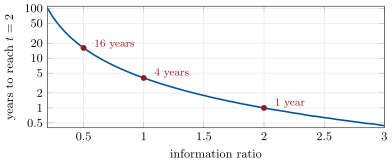
With independent, identically distributed active returns and a true information ratio , the -statistic of the mean active return after years is, in expectation, . Reaching takes years.
Proof. Over years the sample mean of the annual active return has standard error , so . ∎
Example 3.10 (Sixteen years)
A long-only manager with a genuinely good of 0.5 needs 16 years before its record is distinguishable from luck at the usual threshold; with , 64 years. A market-making strategy with a daily Sharpe ratio equivalent to needs about three weeks. This one line explains why long-horizon managers are hired on stories and fired on noise, while short-horizon firms can be run on statistics (Figure 3.2).
As of September 2026 — How passive the market has become
At the end of 2025, index mutual funds and index exchange-traded funds held 52% of the assets of US long-term funds, a majority for the second year, by the fund industry association’s count.
3.3 Hedge funds and their fees
A hedge fund (Definition 1.5) escapes the public-fund rules by being offered only to professional and wealthy investors; it may borrow, sell short and use derivatives, and it is paid differently.
Definition 3.11 (Management fee, performance fee, high-water mark)
A management fee is a fixed annual percentage of the assets. A performance fee is a percentage of the profit of the period. Under a high-water mark the performance fee is charged only on the amount by which the investor’s net asset value exceeds its highest previous fee-paying level: losses must be recovered before the manager is paid on gains again.
Definition 3.12 (Commodity trading advisor)
A commodity trading advisor (CTA) is, in US law, a firm registered to advise on futures trading; in industry usage, a fund that trades futures systematically across asset classes, most often following trends (One Quant Book 8).
Method 3.13 (Computing fees under a high-water mark)
Start with net asset value and mark . Each year, with gross return , management rate and performance rate :
- charge the management fee ;
- compute ;
- charge the performance fee ;
- set less that fee, and .
Conventions differ (fee on opening or average assets, quarterly crystallisation, hurdle rates): read the offering document.
Remark 3.14 (A performance fee is an option)
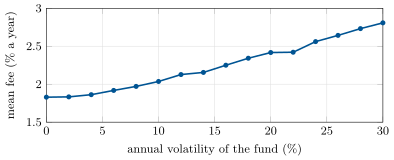
The payoff is that of call options on the fund’s value struck at the high-water mark, given to the manager every year for free. An option is worth more when volatility is higher: a manager with no skill at all earns a larger expected fee by taking more risk (Figure 3.3), and a manager far below its mark holds an option so far out of the money that closing the fund and starting another is the rational move. Investors answer with risk limits, with clawbacks, and by demanding that the manager’s own money sit in the fund.
As of September 2026 — The size of the hedge-fund industry
Hedge funds managed about $5.6 trillion at the end of the second quarter of 2026, after passing $5 trillion for the first time at the end of 2025, according to the most quoted industry database. That is under 4% of professionally managed assets (Box 1.1), but a far larger share of trading volume, because the capital is leveraged and turns over many times a year.
3.4 Why each of them trades
A market maker’s first question about an order is whether the sender knows something (Definition 1.11). The buy side’s motives sort themselves along that line.
Example 3.15 (Motives, and what they tell the other side)
| Who | Why the order exists | What it carries |
|---|---|---|
| Index fund | cash came in or out; the index changed | no view; size and date predictable |
| Pension fund, insurer | rebalancing to target weights; hedging liabilities | no view on the stock; sells what rose |
| Active long-only | a view over months | some information, slow to matter |
| Hedge fund, fundamental | a view over weeks; an event | information; urgency around news |
| Hedge fund, systematic | a signal over hours to days | short-lived information; many small orders |
| Any leveraged fund | a margin call or a risk limit | no view — but forced, large, and correlated with others’ |
| Retail | savings, opinions, entertainment | almost none |
The third column is why a dealer treats identical orders from different clients differently, and why brokers sell retail flow (Chapter 10).
Remark 3.16 (Predictable flow is a strategy for someone else)
Flows that are uninformed and predictable — index changes, month-end rebalancing, the daily reset of leveraged funds — are the raw material of the event strategies of One Quant Book 8. The buy side’s mandates are public; so, to a good approximation, are its trades.
3.5 Tutorial: three funds, ten years
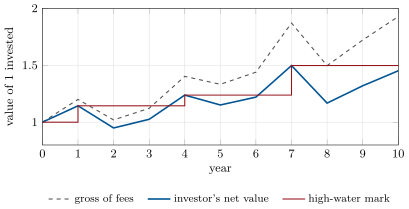
Goal. Measure tracking error on simulated returns, then run a hedge fund’s fees year by year. End state: the chart below and the table of the weekend problem.
Tracking error and information ratio.
def tracking_error(fund: np.ndarray, bench: np.ndarray, periods_per_year: int = 12) -> float:
    """Annualised standard deviation of the active return."""
    active = np.asarray(fund) - np.asarray(bench)
    return float(active.std(ddof=1) * math.sqrt(periods_per_year))


def information_ratio(fund: np.ndarray, bench: np.ndarray, periods_per_year: int = 12) -> float:
    active = np.asarray(fund) - np.asarray(bench)
    return float(active.mean() * periods_per_year / tracking_error(fund, bench, periods_per_year))


def years_to_significance(ir: float, t_stat: float = 2.0) -> float:
    """Years of data for an information ratio `ir` to reach a given t-statistic."""
    return (t_stat / ir) ** 2
Listing 3.1. Tracking error, information ratio and the years needed to establish skill. code/markets-1/03-the-buy-side/python/buyside.py - Check on simulated funds. The figure script draws ten years of monthly benchmark returns, an index fund (5 basis points of fee) and an active fund built with 1% of gross alpha, a 0.75% fee and 4% of tracking error. Measured: tracking errors of 0.11% and 3.78%, and a realised active return of a year for the active fund against a true after fees. Ten years say almost nothing about which is which — as Proposition 3.9 predicts.
Fees with a high-water mark.
def run_fees(gross: list[float], mgmt: float = 0.02, perf: float = 0.20) -> FeeResult:
    """Annual fees with a high-water mark.

    Each year: the management fee is charged on opening NAV; the performance
    fee is `perf` times the amount by which NAV after the management fee
    exceeds the high-water mark; the mark then rises to the closing NAV.
    """
    nav, hwm = 1.0, 1.0
    out = FeeResult([1.0], [], [], [1.0])
    for g in gross:
        m = mgmt * nav
        before_perf = nav * (1.0 + g) - m
        p = perf * max(0.0, before_perf - hwm)
        nav = before_perf - p
        hwm = max(hwm, nav)
        out.nav.append(nav)
        out.mgmt_fees.append(m)
        out.perf_fees.append(p)
        out.high_water.append(hwm)
    return out
Listing 3.2. The method of this chapter, line for line. code/markets-1/03-the-buy-side/python/buyside.py - Run the ten-year path of the weekend problem. The fund earns performance fees in only three years out of ten; the other seven are spent under the mark.
What to change next. Move the management fee to 1% and the performance fee to 30%: who gains? Then add a hurdle: no performance fee on the first 4% of annual return.
3.6 Build: the fee engine
Purpose. The miniature firm will run a fund. It needs to compute what its investors owe, per investor and per period.
Interface. FeeTerms(mgmt, perf, hurdle=0.0, periods_per_year=1) and accrue(terms, state, gross_return) returning a new InvestorState(nav, high_water) and the two fees.
Rules. One state per investor and subscription date: two investors in the same fund have different marks. The management fee is charged on opening value, pro rata per period. A hurdle raises the mark by the hurdle rate each period before the performance fee is computed. Fees are never negative.
Acceptance tests. code/firm/fees/tests/: reproduces the tutorial’s path; no performance fee under the mark; with quarterly periods and zero volatility the annual fee equals the annual rule’s.
Stretch. Post fees to the ledger of Chapter 1 as revenue of the management company.
Sources and further reading
- Investment Company Institute, 2026 Investment Company Fact Book, chapter 2.
- HFR, Global Hedge Fund Industry Report, second quarter 2026, and the accompanying market commentaries.
- US Securities and Exchange Commission staff, Report to Congress regarding threshold limits applicable to diversified companies, February 2022 (the 75–5–10 test of the Investment Company Act of 1940).
- Directive 2009/65/EC (UCITS), article 52, and ESMA, Questions and answers on the application of the UCITS Directive.
- R. Grinold and R. Kahn, Active Portfolio Management, 2nd ed., McGraw-Hill, 2000, chapters 4 and 5 (information ratio, tracking error).
- W. Goetzmann, J. Ingersoll and S. Ross, “High-water marks and hedge fund management contracts”, Journal of Finance 58 (2003).
3.7 Exercises
Exercise 3.1 ★
A fund returned 9.1%, 3.4%, , 12.0% in four years when its benchmark returned 8.0%, 4.0%, , 10.5%. Compute the active returns, their mean, the tracking error (sample standard deviation) and the information ratio.
Solution
Solution of Exercise 3.1.
Active returns , , , ; mean ; sample standard deviation ; — on four observations, which Proposition 3.9 says is worth nothing yet.
Exercise 3.2 ★
How many years of record does it take to reach with an information ratio of 0.4? of 1.5? How many trading days with an annualised ratio of 6?
Solution
Solution of Exercise 3.2.
years; years; of a year, 28 trading days.
Exercise 3.3 ★
A $50 billion index fund charges 4 basis points; a $2 billion hedge fund charges 2 and 20 and earns 10% gross. Which manager earns more this year?
Solution
Solution of Exercise 3.3.
Index fund: million. Hedge fund: management $40 million, performance million, $72 million in total on a twenty-fifth of the assets.
Exercise 3.4 ★★
A UCITS fund holds one stock at 9.5%, three at 6% each and two at 5.5% each; every other position is below 5%. Does it respect the 5/10/40 rule? The 9.5% stock rises 30% while the rest of the fund is flat: what is its new weight, and what must the manager do?
Solution
Solution of Exercise 3.4.
Positions above 5% total and none exceeds 10%: compliant. After the rise the stock weighs : above 10%. The manager must sell about a sixth of the position, whatever it thinks of the company — an order with no information in it.
Exercise 3.5 ★★
A manager runs 50 overweights and 50 underweights of 0.5% each; stock-specific volatility is 30% and specific returns are independent. Compute the tracking error. It wants 3%: what active weight per position achieves it?
Solution
Solution of Exercise 3.5.
. For 3%, double the active weights: 1.0% per position.
Exercise 3.6 ★★
A fund under a “2 and 20” contract with a high-water mark returns , , gross. Apply Method 3.13 and give, for each year, the two fees and the closing net value.
Solution
Solution of Exercise 3.6.
Year 1: management 2.00, , performance , close 122.40 (per 100). Year 2: management 2.45, , below the mark of 122.40: no performance fee, close 95.47. Year 3: management 1.91, , still below 122.40: no fee, close 103.11.
Exercise 3.7 ★★★
Coding. With run_fees, compare “2 and 20” with “1 and 30” on the weekend problem’s ten-year path. Report total fees under each contract and the investor’s final value. Which contract does an investor who believes in the manager prefer, and why might the manager prefer the other?
Solution
Solution of Exercise 3.7.
“2 and 20”: fees 35.9 per 100 invested, final value 145.2. “1 and 30”: fees 33.2, final value 149.8. The investor who believes in the manager prefers “1 and 30”: it pays less in total here and pays mostly when it has been made richer. The manager may prefer “2 and 20” because two thirds of its income (23.4 of 35.9) then does not depend on performance at all, and pays the salaries in the seven years spent under the mark.
Exercise 3.8 ★★★
Find the flaw. A consultant ranks 400 active funds by their five-year active return, selects the top 20, and reports that “the selected managers have a demonstrated information ratio above 1”. The typical fund in the sample has a tracking error of 4%. Assume that no manager has any skill. Estimate the active return of the twentieth-best fund and its apparent information ratio, and state the flaw.
Solution
Solution of Exercise 3.8.
With no skill, a five-year mean active return is . The twentieth of 400 is the 95th percentile, a year, an apparent information ratio of ; the top handful exceed 1. The flaw is selection: the ranking guarantees impressive records among pure noise, and these records have no bearing on the next five years. The honest test is the performance of the selected funds after selection.
3.8 Problem: Two and Twenty
Problem 3.1
Weekend problem — ten years in a hedge fund
An endowment invests $100 million in a hedge fund charging a 2% management fee on opening value and a 20% performance fee with a high-water mark (Method 3.13). Over ten years the fund’s gross returns are
Part I — The first three years.
- Year 1: compute the management fee, the performance fee, the closing net value and the new mark.
- Year 2: the same. Why is there no performance fee?
- Year 3: the fund gains 10% gross. Is a performance fee due?
- After three years, what has the investor earned, and what has the manager been paid?
Part II — The whole path (use the tutorial’s code or a spreadsheet).
- In which years is a performance fee paid?
- Give the total management fees and the total performance fees over the ten years, in millions.
- Give the investor’s final value and annualised net return.
- Give the gross final value of $100 million and the annualised gross return.
- Fees paid plus the investor’s profit do not add up to the gross profit. Compute the difference and explain it.
Part III — Who got what.
- What fraction of the gross profit was paid to the manager? What fraction did the investor keep?
- An index fund charging 5 basis points returned 6% a year gross over the same decade. Compare the investor’s outcome.
- The hedge fund’s returns were uncorrelated with equities. Give one reason the endowment might still be satisfied.
- The fund’s annual gross returns have a standard deviation of 17%. Estimate its gross Sharpe ratio taking the mean gross return and a zero risk-free rate. How many years would establish it at ?
Part IV — Incentives.
- At the end of year 8 the net value is far below the mark. By how much must the fund rise, net of the management fee, before the manager earns a performance fee again?
- Explain why the manager might then (a) raise risk or (b) close the fund, and who loses in each case.
- A second investor subscribes at the start of year 9. What is its high-water mark, and what performance fee does it pay in year 9?
- Why does this make per-investor accounting (Section 3.6) unavoidable?
- Using Figure 3.3, estimate the annual fee an unskilled manager collects at 20% volatility, and the excess over the management fee alone.
- State the named result: the manager’s share of the gross profit over the ten years, in percent.
- In two sentences, say what an investor should negotiate first: the 2, the 20, or something else.
Solution
Solution of Problem 3.1.
Per $100 invested. 1. Management 2.00; ; performance ; close 114.40; mark 114.40. 2. Management 2.29; ; below the mark, so no performance fee; mark stays 114.40. 3. Management 1.90; : no fee. 4. The investor has ; the manager has been paid . 5. Years 1, 4 and 7. 6. Management 23.4; performance 12.4; total $35.9 million. 7. $145.2 million; 3.8% a year. 8. $192.8 million; 6.8% a year. 9. : the growth that the fees would have earned had they stayed invested. Fees are paid early and compound against the investor. 10. The manager received 39% of the gross profit; the investor kept 49%; 12% was the lost compounding. 11. million against $145.2 million. 12. Diversification: a stream uncorrelated with its equities lowers the volatility of the whole endowment, and it lost less in years 2 and 8 if those were bad equity years. Whether that is worth 33 percentage points over a decade is the board’s question. 13. Mean gross return 8%; Sharpe ratio ; years. 14. Net value 116.8 against a mark of 149.7: a rise of 28%. 15. (a) The option is far out of the money and gains value with volatility; extra risk costs the manager nothing more if it fails, while the investors bear the loss. (b) A new fund starts with a mark at par: the manager escapes the 28% gap, and the old investors lose the “free” years they had paid for with their losses. 16. Its mark is its subscription value. In year 9: management 2.00, , performance per 100 — while the first investor pays no performance fee that year. 17. The two investors hold the same portfolio and owe different fees; a single fund-level mark would either charge the first investor twice for the same gains or let the second ride free. 18. About 2.4% a year at 20% volatility against 1.8% at zero volatility: some 0.6% a year for bearing risk with no skill. 19. 39%. 20. Neither number first: the terms that shape behaviour — the high-water mark and its reset conditions, a hurdle, the manager’s own capital in the fund and risk limits — and then the management fee, which is the part paid for nothing.
3.9 Interview questions
Interview question 3.1 ★ trader, researcher, bank
What is tracking error, and why would a manager who is confident in a stock still refuse to make it 15% of the portfolio?
Solution
Solution of Interview question 3.1.
Tracking error is the volatility of the difference between the portfolio’s return and the benchmark’s. A 15% position in a stock that is 2% of the index is a 13% active weight: with 30% specific volatility it alone adds about 4% of tracking error, probably more than the mandate allows, and one bad quarter in that stock loses the mandate however right the view is in the long run. For a public fund a 10% legal cap applies anyway.
What the interviewer is looking for: active weight, not absolute weight, and career risk as a real constraint.
Interview question 3.2 ★ researcher, mle
A strategy has a Sharpe ratio of 1. How long a backtest do you need before you believe it is not zero?
Solution
Solution of Interview question 3.2.
, so needs 4 years, under ideal conditions. In practice more: returns are not independent or normal, and if the strategy was chosen among many the threshold must be far higher than 2.
What the interviewer is looking for: the formula immediately, then the multiple-testing caveat unprompted.
Interview question 3.3 ★★ trader, researcher
You receive two identical orders to sell 500 000 shares, one from an index fund and one from a fundamental hedge fund. Do you price them the same?
Solution
Solution of Interview question 3.3.
No. The index fund trades because of flows or an index change: no information about the stock, so the mechanical discount applies (Proposition 2.8). The hedge fund may be selling on a view or ahead of news: add an adverse-selection charge estimated from what happened after its previous orders. Relationship value can cut the other way.
What the interviewer is looking for: pricing the client, not just the order.
Interview question 3.4 ★★ researcher, bank
Explain the high-water mark to a non-specialist, then explain what it does to the manager’s appetite for risk.
Solution
Solution of Interview question 3.4.
“You pay the manager a share of profits, but only on new profits: if the fund falls, it must climb back to its old peak before you pay that share again.” For the manager it is a call option struck at the peak: near the mark it behaves normally; far below, the option is nearly worthless and gains from volatility, so the manager is tempted to gamble or to close the fund and reopen with a fresh mark.
What the interviewer is looking for: a plain first sentence, then the option argument.
Interview question 3.5 ★★ researcher, trader
Index funds hold more than half of US fund assets. Name two predictable trading flows this creates and who might profit from each.
Solution
Solution of Interview question 3.5.
Index reconstitutions: every tracker must buy additions and sell deletions at the effective close; whoever buys after the announcement and sells into that close earns the concession, at the trackers’ expense. Periodic rebalancing and leveraged-fund resets: month-end and end-of-day flows of known sign and size; liquidity providers position ahead of them. Also closing auctions themselves, which concentrate this volume.
What the interviewer is looking for: flows that are predictable in sign, size and timing.
Interview question 3.6 ★★★ researcher, mle
Out of 1 000 strategies with no skill, how good does the best one look after three years? Give an order of magnitude for its Sharpe ratio.
Solution
Solution of Interview question 3.6.
After three years an unskilled strategy’s estimated Sharpe ratio is about . The maximum of 1 000 independent normals is about 3.2 standard deviations: a Sharpe ratio near 1.9. A backtested Sharpe of 2 chosen among a thousand trials is what nothing looks like.
What the interviewer is looking for: the expected maximum of normals, roughly , and the conclusion about research practice.