Markets I: The Ecosystem and Exchange-Traded Markets · Markets
24Options Market Structure
A retail customer taps “buy 10 calls at the market”. The order never reaches an order book in the ordinary sense. Her broker sends it to a wholesaler; the wholesaler submits it to an exchange together with its own order to take the other side at a guaranteed price; the exchange broadcasts a request for responses and waits, for a period that may be as short as a tenth of a second, while the largest market-making firms in the world decide whether to offer a cent better. Then the order is divided: part to those who improved, a reserved part to the firm that brought it, the rest shared by size. Every step of this is written in an exchange rule. The options market is where the mechanisms of the last five chapters (wholesaling, pro-rata allocation, market-maker privileges, fee models) are combined most densely, and where a firm’s position in the structure decides more of its profit than its models do.
24.1 A quote-driven market
Definition 24.1 (Options market maker and quoting obligation)
An options market maker is a firm registered with an exchange to quote options classes. It accepts a quoting obligation, typically to quote two sides in a set percentage of the series of its classes, for a set percentage of the trading day, within a maximum width, and receives privileges in return: lower fees, allocation entitlements, the right to send quotes in bulk.
With two thousand series on one share (Chapter 23), most of which trade a few times a day or not at all, natural buyers and sellers almost never meet. Nearly every displayed price is a market maker’s quote, computed from the share price and a volatility surface and refreshed whenever either moves. The book is a projection of a model, and the economic questions are who may quote, what they must quote, and how an incoming order is divided among them.
Definition 24.2 (Quote protection)
Quote protection denotes the exchange-provided mechanisms that limit a market maker’s exposure across its many quotes: a risk monitor that cancels all of a firm’s quotes in a class when its fills within a short window exceed a set number, bulk cancel messages, and kill switches.
A market maker quoting two thousand series is, economically, offering one bet on the share in two thousand forms. An informed trader who lifts a hundred of them in a millisecond has traded a hundred times against the same stale opinion. Without protection, quotes would be a fraction of their size.
24.2 Allocation: customers first, then size
Definition 24.3 (Customer priority)
Under customer priority resting orders of priority customers (broadly, the public, as opposed to broker-dealers and professional traders) at the best price are filled before any professional interest at that price, whatever their time of arrival. The remainder is allocated among professionals, usually pro rata on size, often after an entitlement for a designated market maker.
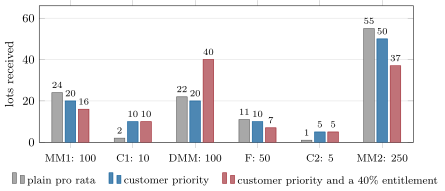
The rule is a transfer. Customers, whose orders carry the least information, are worth the most to trade against; giving them priority attracts them to the exchange, and their flow is then the prize that the professionals’ allocation rules divide. Exchanges that want to attract market makers’ quotes offer entitlements and pro rata; exchanges that want to attract takers offer price-time priority and rebates. The same series trades under both at once, on different exchanges of the same group.
24.3 Price-improvement auctions
Definition 24.4 (Price-improvement auction)
In a price-improvement auction a member submits a customer’s order (the agency order) together with its own contra order guaranteeing execution of the whole at a stop price at or better than the best displayed price. The exchange announces the auction, collects responses for a short fixed period, and executes the agency order against the best-priced responses first. At the final price the initiating member retains a guaranteed share.
As of September 2026 — One exchange’s auction, from its rule filings
The auction period is set by class, no shorter than 100 milliseconds and no longer than 3 seconds. If the auction produces no better price, priority customers resting on the book at the stop price are filled first; the initiating order then receives up to 50% of the agency order if one other participant is at that price, or 40% if there are two or more; the rest is shared among the responders. The initiator’s share at the final price can never exceed those percentages of the original order.

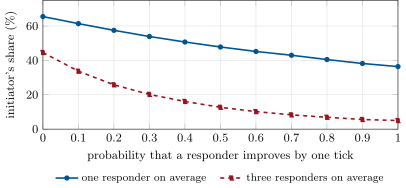
The auction gives the customer a price no worse than the stop, sometimes better; it gives the initiating firm a guaranteed share of flow it selected; and it gives everyone else a chance to take the order by improving. Whether it is competitive is an empirical matter that turns on two numbers: how many firms respond, and how often they improve (Figure 24.3).
24.4 Complex orders
Definition 24.5 (Complex order book)
A complex order book is a book for multi-leg strategies (spreads, straddles, combinations with the share) quoted at one net price and executed as a unit. A complex order can trade against other complex orders or, leg by leg, against the simple books, the exchange ensuring that every leg prints at a permitted price.
It is the options counterpart of the calendar spread and its implied orders (Definition 19.7): a vertical spread whose legs are each ten cents wide can be quoted and traded a cent or two from its fair value as a package, because the package carries a fraction of the risk of either leg. A large share of institutional options volume is in such packages, and a market maker who quotes only single series sees only part of the flow.
24.5 Increments, fees and the tape
Definition 24.6 (Penny program)
The penny program is the industry-wide rule that sets the minimum quoting increment of listed options by class: a cent for the most active classes, five and ten cents for the rest.
Definition 24.7 (Marketing fee)
A marketing fee is a charge levied by an exchange on market makers’ trades with customers and pooled to pay brokers for routing customer orders to that exchange: payment for order flow collected and distributed through the exchange itself.
Definition 24.8 (OPRA)
OPRA, the Options Price Reporting Authority, is the securities information processor of US listed options: it consolidates the quotes and trades of all options exchanges into one feed and publishes the national best bid and offer of every series.
As of September 2026 — Pennies and messages
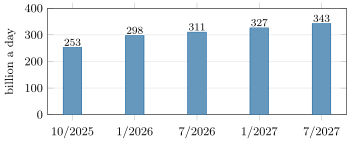
Increments. The penny pilot became the permanent Penny Interval Program in 2020. All series of three of the most active fund options quote in cents at any price; other classes in the programme quote in cents below $3.00 and in five-cent steps from $3.00; a class stays in the programme while it is among the 425 most active. The feed. The processor’s capacity notice of September 2025 projects, for July 2026, 311 billion messages a day and a peak of 13.6 million messages per 100 milliseconds on one stream, 4.4 gigabits in that tenth of a second, to be doubled for the redundant stream and raised by a tenth for retransmissions; median latency through the processor is under 18 microseconds.
A tick of five cents on a three-dollar option is 1.7% of its price: the increment is a floor under the spread, a source of market makers’ revenue, and the reason price-improvement auctions have something to improve. The fee side is as varied as in equities (Chapter 4), with one more dimension: fees depend on who is trading (customer, professional customer, firm, market maker) as much as on whether the order makes or takes. A market maker’s net price on a trade is known only after the counterparty’s capacity is.
24.6 Tutorial: dividing an order
Goal. Allocate an incoming order under customer priority with a designated-maker entitlement; run a price-improvement auction; measure how competition erodes the initiator’s guarantee. End state: the three data figures of this chapter.
At the quote. Customers, then the designated maker, then the other professionals by size.
def customer_priority_pro_rata(book: list[Quote], qty: int, entitlement_pct: int = 0) -> dict[str, int]:
    """`book` is the best price level in time priority.
    1. Priority customers, in time order, in full.
    2. The designated market maker: the larger of its entitlement and its pro-rata share of what is left.
    3. The other professionals pro rata on size over the remainder; leftovers by time."""
    fills: dict[str, int] = {}
    left = min(qty, sum(q.qty for q in book))
    for q in book:
        if q.capacity == "customer":
            left = _give(fills, q, q.qty, left)
    pros = [q for q in book if q.capacity != "customer"]
    total = sum(q.qty for q in pros)
    if left <= 0 or total <= 0:
        return fills
    pool = left
    for q in pros:                                             # the designated maker is served first
        if q.designated:
            share = max(pool * q.qty // total, pool * entitlement_pct // 100)
            left = _give(fills, q, share, left)
    others = [q for q in pros if not q.designated] if any(q.designated for q in pros) else pros
    rest, size = left, sum(q.qty for q in others)
    for q in others:
        left = _give(fills, q, rest * q.qty // size if size else 0, left)
    for q in pros:
        left = _give(fills, q, q.qty, left)
    return fills
Listing 24.1. Customer priority, an entitlement, and pro rata for the rest. code/firm/match/firm_optmatch.py In the auction. Better prices first; at the stop, customers, then the initiator’s share, then the responders; the initiator takes what is left, since it guaranteed the order.
    improved = left < agency_qty
    initiator = 0
    if left > 0:
        last_price = stop_price
        cust = min(book_customers, left)
        if cust:
            fills["book customers"] = cust
            left -= cust
        at_stop = [(who, q) for who, p, q in responses if p == stop_price]
        others = len(at_stop) + (1 if cust else 0)
        if others == 0:
            initiator, left = left, 0
        else:
            pct = one_other_pct if others == 1 else many_others_pct
            initiator = min(left, agency_qty * pct // 100)
            left -= initiator
            total = sum(q for _, q in at_stop)
            pool = min(left, total)
            for who, q in at_stop:
                share = pool * q // total if total else 0
                fills[who] = fills.get(who, 0) + share
                left -= share
            initiator += left                                   # the guarantee: the initiator takes the rest
            left = 0
    return AuctionResult(last_price, fills, initiator, improved)
Listing 24.2. The end of a price-improvement auction: what happens at the stop price, after better-priced responses have been filled. code/firm/match/firm_optmatch.py - Many auctions. Poisson responders, each improving with a given probability.
What to change next. Let responders bid for part of the order, in proportion to their confidence, and let the initiator choose a stop price inside the spread: find the stop that maximises its expected profit when its edge is six cents at the displayed price.
24.7 Build: options allocation
Purpose. The options venue of the miniature firm’s simulated exchange needs the two mechanisms that distinguish it from the futures venue of Section 19.6.
Interface. A resting Quote(oid, qty, capacity, designated); the function customer_priority_pro_rata(book, qty, entitlement_pct); price_improvement_auction(agency_qty, stop_price, side, responses, book_customers, one_other_pct, many_others_pct) returning the final price, the fills, the initiator’s quantity and whether the price improved.
Rules. Integers only; conservation (fills plus the initiator’s quantity equal the order); customers never receive less than under any other rule; the initiator’s share at the final price never exceeds its percentage of the original order when others are present, and is the whole order when nobody responds.
Acceptance tests. code/firm/match/tests/test_firm_optmatch.py: customers first whatever their time; the entitlement against the pro-rata share; auctions with no, one and several responders; improvement taking the order away; a selling customer; conservation.
Stretch. A complex order book for two-leg spreads with leg prices constrained by the simple books.
Sources and further reading
- Cboe Exchange, rules of the Automated Improvement Mechanism, as filed with the SEC (SR-CBOE-2019-045 and later filings, Exhibit 5).
- US Securities and Exchange Commission, orders on the Penny Interval Program, 2020 (for example Release 34-89167, Exhibit 5); The Options Industry Council, “Why certain options trade in penny increments”.
- OPRA, Revised OPRA Capacity Projections, notice to multicast data subscribers, 15 September 2025.
24.8 Exercises
Exercise 24.1 ★
The level of Figure 24.1 receives an order for 12 lots under customer priority. Give the fills.
Solution
Solution of Exercise 24.1.
C1 receives 10 and C2 receives 2: customers in time order, and the order is exhausted before any professional is reached.
Exercise 24.2 ★
Same level, 115 lots, customer priority and a 40% entitlement for the designated maker. Reproduce the figure’s numbers by hand.
Solution
Solution of Exercise 24.2.
Customers: 10 and 5, leaving 100. The designated maker’s pro-rata share would be ; its entitlement is 40. The remaining 60 are shared over the 400 lots of MM1, F and MM2: , , ; the odd lot goes to the oldest, MM1: 16, 7, 37.
Exercise 24.3 ★
In a class of the penny programme that is not one of the three all-penny funds, which of these limit prices are valid: 2.43, 2.99, 3.02, 3.05, 12.10, 12.12? What is the minimum spread, in percent of price, of an option quoted around 3.10?
Solution
Solution of Exercise 24.3.
Valid: 2.43, 2.99 (cents below $3.00), 3.05 and 12.10 (five-cent steps from $3.00). Invalid: 3.02 and 12.12. Around 3.10 the minimum spread is 0.05, that is 1.6% of the price.
Exercise 24.4 ★★
From Box 24.2: give the average message rate per second over a 6.5-hour day, the peak rate per second, and their ratio. Give the bandwidth a firm must provision to take both streams with the retransmission margin.
Solution
Solution of Exercise 24.4.
million messages a second on average. Peak: 13.575 million per 100 milliseconds, a rate of 135.8 million a second, 10.2 times the average. Bandwidth: 4.403 gigabits per 100 milliseconds is 44 gigabits a second for one stream; two streams with 10% for retransmissions: 97 gigabits a second.
Exercise 24.5 ★★
A 100-lot agency order is auctioned with a stop of 2.50. Give the initiator’s fill when: nobody responds; one firm responds at 2.50 for 100; three firms respond at 2.50 for 100 each; one firm responds at 2.49 for 60 and two at 2.50.
Solution
Solution of Exercise 24.5.
Nobody: the initiator fills all 100. One responder at the stop: 50. Three at the stop: 40, the responders sharing 60. One at 2.49 for 60 and two at 2.50: the 60 improved lots go to the improver; at the stop the initiator may take up to 40% of the original order, which is the whole remaining 40.
Exercise 24.6 ★★
The 50 call is quoted 2.40 at 2.50 and the 55 call 0.90 at 1.00. Give the net price of buying the 50–55 call spread leg by leg at displayed prices, its midpoint value, and the width of the package’s market. Why can a complex book quote it much tighter than 0.20?
Solution
Solution of Exercise 24.6.
Leg by leg: pay 2.50, receive 0.90: 1.60. Midpoint: . The package’s displayed market is 1.40 at 1.60, 0.20 wide. The spread’s delta and vega are a fraction of either leg’s, so a market maker’s risk in quoting it is small; and the errors in its two leg valuations largely cancel. A complex book lets that be expressed as one price, a cent or two from 1.50.
Exercise 24.7 ★★★
Coding. With simulate_auctions(4000, m, 0.5, 24) report the initiator’s share and the share of the order that received a better price, for and responders on average. What does the customer gain from the third responder?
Solution
Solution of Exercise 24.7.
One responder on average: the initiator keeps 47.8% and 39.7% of the order is improved. Three: 12.7% and 77.5%. The third responder almost doubles the share of the customer’s order that receives a better price, and takes three quarters of what the initiator was keeping.
Exercise 24.8 ★★★
Find the flaw. A proprietary firm that is not a registered market maker writes: “Our 5-lot bid joined the best bid first, ahead of 450 lots of market-maker quotes. We will be filled first.” The exchange uses customer priority and pro rata. What will happen when 100 lots are sold at that price?
Solution
Solution of Exercise 24.8.
Time priority does not exist among professionals here. Any customers at the price are filled first; then the 100 lots are shared by size: the 5-lot bid’s share is lot, plus possibly the odd lot left by rounding: 2 lots at best, the market makers 98. To be filled in such a market a professional must show size, improve the price, or respond to auctions; arriving first earns nothing.
24.9 Problem: The Auction
Problem 24.1
Weekend problem — what a guaranteed share is worth
A wholesaler receives a customer’s order to buy 100 calls. The market is 2.40 at 2.50; the wholesaler values the call at 2.44. It can start a price-improvement auction with a stop of 2.50, under the rules of Box 24.1. From experience: nobody responds in 10% of auctions; one firm responds at the stop in 25%; several respond at the stop in 35%; in 20% responders improve to 2.49 for 60 lots, the rest trading at the stop with several participants; in 10% responders improve for the whole order.
Part I — The share.
- Give the wholesaler’s fill in each of the five cases.
- Give its expected fill.
- Give its edge per lot at 2.50, in dollars per contract.
- Give its expected gross profit per auction.
- Give the customer’s expected price improvement per contract.
Part II — The alternatives.
- If the wholesaler simply routed the order to the exchange’s book, what would the customer pay, and what would the wholesaler earn?
- The wholesaler pays the broker 30 cents per contract for the order. Give its net expected profit per auction.
- It could instead choose a stop of 2.48. What changes for the customer, for the wholesaler’s edge, and for the responders’ incentive to improve?
- A responder values the call at 2.45. At what prices is responding worth its while, and what does it need to respond in time?
Part III — The market maker on the book. A market maker was offering 50 lots at 2.50 on the book when the auction began.
- Does its resting quote take part in the auction’s allocation at 2.50? What must it do to take part?
- Why might it prefer not to respond, and keep its quote for the orders that are not auctioned?
- Which orders are not auctioned, and what does that imply about the flow that reaches the displayed quotes?
- How should that change the width of its displayed quotes?
- Relate this to Chapter 10.
Part IV — Judgement.
- Is a 100-millisecond auction competitive? Give the argument on each side.
- Who pays for the marketing fee, in the end?
- Why do exchange groups operate several options exchanges with different allocation rules?
- What would a move to cent increments in every class do to auctions?
- State the named result: the expected allocation to the initiating firm.
- In one sentence: what is a customer’s option order worth, and to whom?
Solution
Solution of Problem 24.1.
1. 100, 50, 40, 40 (60 improved lots go elsewhere and the initiator takes the remaining 40, its 40% of the original) and 0. 2. lots. 3. It sells at 2.50 what it values at 2.44: 6 cents a share, $6 a contract. 4. . 5. One cent on 60 lots in 20% of cases and on 100 lots in 10%: lots improved by $1 each, $0.22 per contract on average over the order. 6. 2.50, the displayed offer, if 100 lots are there. The wholesaler would earn nothing on the trade itself. 7. . 8. The customer pays at most 2.48: two cents of improvement for certain. The wholesaler’s edge falls to 4 cents a share. Responders now need to bid 2.47 to improve, which few will at a value of 2.44 to 2.45: the wholesaler keeps a larger share of a thinner margin. The stop price is the wholesaler’s choice and its main instrument. 9. At 2.50 and 2.49 (edges of 5 and 4 cents); at 2.46 it has a cent. In time means receiving the auction message, recognising the series, repricing it from the current share price and volatility, checking risk and answering, all well inside 100 milliseconds less two network trips: an automated, co-located pricing engine. 10. Not as a resting quote competing with responses on equal terms: priority customers on the book are honoured, professional quotes are not guaranteed a share of an order that was brought to the auction already paired. To take part it must send a response. 11. Responding reveals its price for that series to the initiator and to every participant who sees the auction, a hundred times a second; and the orders brought to auctions are selected. It may still respond, because auctioned flow is the best flow there is. 12. Orders from professionals, large institutional orders worked by algorithms, and orders of firms reacting to news: the flow that reaches displayed quotes unaccompanied is, on average, better informed. 13. Wider. A displayed quote is an option given to the fastest and best-informed participants; it should be priced for them. 14. It is the segmentation of Chapter 10 carried out on an exchange: uninformed flow is separated, priced tightly and shared among those with a claim on it; the lit quote is left to serve everyone else. 15. For: several well-capitalised firms see every auction and respond by machine; a tenth of a second is long for them; improvement does occur. Against: only co-located firms can respond; the initiator chooses the stop and keeps up to half whatever happens; a responder that merely matches gets a minority share, so the incentive to improve is weak unless it expects to win the whole order. 16. Whoever trades against the market makers’ quotes. The fee is a cost of market making in customer flow, recovered in the spread; customers receive it back, in part, through their brokers’ commission-free pricing. 17. To serve both constituencies at once, makers on one exchange and takers on another, to obtain more entitlements and more market-data and connectivity revenue, and because each exchange licence is a separate place in every broker’s routing table. 18. Less to improve: with a spread of one or two cents the stop is already near fair value, auctions would improve by less, and wholesalers’ margins would fall, as would displayed size. 19. 44.5 lots of the 100. 20. A few dollars a contract to the firm that fills it, which is why brokers are paid for it, exchanges build mechanisms around it, and the displayed market is what remains.
24.10 Interview questions
Interview question 24.1 ★ trader, researcher
How does the US options market differ in structure from the US equity market?
Solution
Solution of Interview question 24.1.
One clearing house and many exchanges, as in equities, but: hundreds of times more instruments, almost all liquidity from market makers’ quotes rather than natural orders; customer priority and pro-rata allocation with market-maker entitlements on many exchanges; fees that depend on the trader’s capacity; price-improvement auctions as the main channel for retail flow instead of off-exchange internalisation; complex order books; and a consolidated feed of hundreds of billions of messages a day.
What the interviewer is looking for: quote-driven, capacity-dependent rules, auctions.
Interview question 24.2 ★ trader, developer
What is customer priority, and why do exchanges grant it?
Solution
Solution of Interview question 24.2.
Public customers’ resting orders at the best price are filled before any professional’s, regardless of time. Exchanges grant it to attract customer orders, which professionals value because they are uninformed; the customer flow then attracts the market makers, whose quotes make the exchange’s market.
What the interviewer is looking for: the two-sided-platform logic.
Interview question 24.3 ★★ trader, researcher
Walk me through a price-improvement auction from the point of view of the initiator and of a responder.
Solution
Solution of Interview question 24.3.
Initiator: choose which customer orders to auction and at what stop; the lower the stop on a buy, the better for the customer and the thinner the edge, but the larger the share kept. Submit the pair; the exchange guarantees the customer the stop. Outcome: better-priced responses first; at the stop, customers on the book, then up to 50% or 40% to the initiator, then the rest. Responder: receive the message, price the series now, decide between matching (a pro-rata share of what the initiator leaves) and improving (first claim), and answer within the period.
What the interviewer is looking for: the stop price as the strategic variable; match versus improve.
Interview question 24.4 ★★ developer
You must consume the consolidated options feed. What are the engineering problems?
Solution
Solution of Interview question 24.4.
Volume and burstiness: hundreds of billions of messages a day with peaks ten times the average within 100 milliseconds, tens of gigabits a second per stream, two streams to arbitrate, gap detection and retransmission. Filtering as early as possible (most series are irrelevant to any one strategy), ideally in hardware or kernel-bypass receivers; symbol mapping for over a million series that change daily; building books per series per exchange; and conflation policies for slow consumers that never reorder or invent prices.
What the interviewer is looking for: peak-to-average design, early filtering, line arbitration.
Interview question 24.5 ★★ trader, researcher
Why do options market makers need quote protection, and what does it cost the rest of the market?
Solution
Solution of Interview question 24.5.
All of a maker’s quotes in a class are one opinion about the underlying; if that opinion is stale, an informed trader can hit hundreds of them before the maker reprices. Protection caps the damage by cancelling everything after a number of fills in a window. The cost: displayed size is partly illusory, since it disappears after the first few fills, so a taker of size sees quotes fade; and the mechanisms can themselves withdraw liquidity abruptly in fast markets.
What the interviewer is looking for: correlation of quotes as the reason; fading as the cost.
Interview question 24.6 ★★★ researcher, trader
You make markets in options on a displayed book. How does the existence of auctions and wholesalers change the flow you see, and what do you do about it?
Solution
Solution of Interview question 24.6.
The least informed flow is diverted into auctions and allocated by entitlement, so what reaches my displayed quote unaccompanied is adversely selected: professionals, algorithms, news. I should quote the book wider than my fair spread for average flow, size it for toxic flow, protect it with fast underlying-driven repricing and risk limits, and compete for the benign flow where it actually goes: respond to auctions, obtain a designated-maker role where the entitlement pays for the obligations, or negotiate directed flow. Measure each channel’s markouts separately.
What the interviewer is looking for: adverse selection of the residual lit flow; going to where the flow is.