Markets I: The Ecosystem and Exchange-Traded Markets · Markets
26Zero-Day Options, Weeklies and Retail Options Flow
At two in the afternoon the most actively traded option on the most important equity index in the world has two hours to live. It was listed a few weeks ago, traded little until this morning, and by the close it will be worth either nothing or the distance between the index and its strike. In 2025 options expiring the same day averaged 2.3 million contracts a day in the S&P 500 index options, 59% of all their volume. An option that close to expiry is a different instrument from the three-month contract of Chapter 25: almost insensitive to implied volatility, extremely sensitive to the path of the underlying in the next minutes, and hedged, by whoever is on the other side, with a quantity of shares that can swing from nothing to everything on a move of half a percent. This chapter measures that swing.
26.1 From monthlies to dailies
Definition 26.1 (Weekly and zero-day options)
A weekly option is a listed option series with an expiry other than the standard monthly one, listed a few weeks before it expires. A zero-day option (0DTE, zero days to expiry) is any option on the day it expires: not a separate product, but the last day in the life of a weekly, a monthly or a quarterly series.
As of September 2026 — How an expiry every day came about
Weekly S&P 500 index options at first expired on Fridays only; Monday and Wednesday expiries followed. In 2022 the exchange added Tuesday expiries, from 18 April, and Thursday expiries, from 11 May: since then one series has expired every trading day. In 2025 same-day options averaged 2.3 million contracts a day, 59% of the index options’ volume, in a US options market that traded 15.2 billion contracts in the year, 26% more than in 2024.
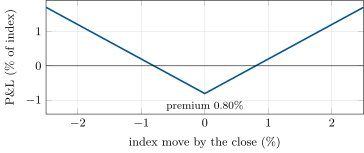
The appeal is arithmetic. An at-the-money option with a day to run costs about of the underlying, some 0.8% for an index at 16% volatility: a small premium for a position that doubles or vanishes by the close. Buyers use it for an event (a data release at 08:30, a central-bank decision at 14:00) or as a cheap intraday stop; sellers collect a premium that decays to zero in hours, systematically, in size. Figure 26.1 shows the buyer’s side.
26.2 Gamma near expiry
Definition 26.2 (Delta hedging and gamma)
The delta of an option is the change of its value per unit change of the underlying; delta hedging is holding the opposite quantity of the underlying so that the combined position is insensitive to small moves. Gamma is the change of delta per unit change of the underlying: the rate at which the hedge must be adjusted. A position that is long options is long gamma: its hedger sells as the price rises and buys as it falls. A short-option position’s hedger does the opposite.
Proposition 26.3 (At-the-money gamma grows like )
In the Black–Scholes model with zero rates the gamma of an option with strike is , with and the normal density. At the money, : halving the time to expiry multiplies gamma by , and gamma is concentrated within about one of the strike.
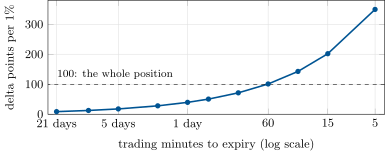
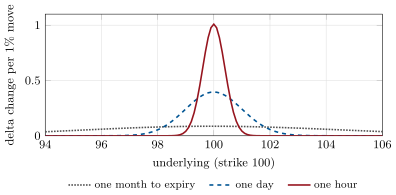
Near expiry gamma is all or nothing. The hedger of an option struck at the current price must trade its entire notional back and forth as the underlying crosses the strike; the hedger of an option struck 1% away holds a fixed position and waits. The pin risk of Definition 23.5 is the limit of this picture at the closing bell.
26.3 Dealer hedging and the underlying
Definition 26.4 (Dealer gamma)
Dealer gamma is the aggregate gamma of the positions held by options market makers, who hedge, as opposed to their customers, most of whom do not. When dealers are long gamma their hedging sells rises and buys falls and tends to damp moves in the underlying; when they are short gamma it buys rises and sells falls and tends to amplify them.
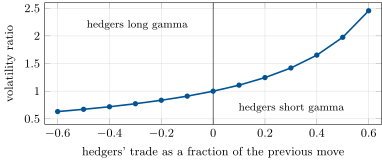
The mechanism is not in dispute; its size and sign on a given day are. Three cautions before any “gamma exposure” number is believed. First, open interest does not say who is long: the usual estimate assumes that customers buy puts and sell calls, so that dealers are short the puts and long the calls, and its sign is that assumption. Second, same-day options barely appear in open interest at all, which is published once a day from the previous night’s positions: volume that opens and closes within the session leaves no trace. Third, customer flow in same-day options is often two-sided, buyers and sellers of the same strikes partly offsetting each other, so that the dealers’ net position can be a small fraction of the volume. A desk that wants this number must estimate it from signed trades, not from open interest.
26.4 Retail options flow
Individual investors are a large share of options volume, above all in short-dated options on a handful of indices, funds and large shares. Their orders reach the market through the wholesalers and auctions of Chapter 24, and their characteristics are those of retail equity flow (Chapter 10) with the leverage turned up: small size, mostly opening purchases of out-of-the-money calls and puts held for hours or days, concentration in the nearest expiry, and little information about the next few minutes. For a market maker this flow is valuable for the same reason and risky for a new one: it is correlated. When a crowd buys the same calls on the same share, the makers who sold them are short gamma together and buy the share together as it rises, the dynamic of Proposition 16.9 with options in place of short covering.
26.5 Tutorial: gamma into the close
Goal. Compute delta and gamma in trading time, watch at-the-money gamma grow as expiry approaches, translate a position into shares to trade per 1% move, and simulate the feedback of hedging on the underlying. End state: the four data figures of this chapter.
Gamma. One formula, the same for calls and puts.
def gamma(spot: float, strike: float, years: float, vol: float) -> float:
    """Change of delta per one unit of spot. The same for a call and a put."""
    if years <= 0.0:
        return 0.0
    s = vol * math.sqrt(years)
    d1 = math.log(spot / strike) / s + 0.5 * s
    return _pdf(d1) / (spot * s)
Listing 26.1. Black–Scholes gamma with zero rates. code/firm/gex/firm_gex.py From contracts to shares. Linear, for small moves; and exact, by revaluing the delta.
def gamma_shares_per_pct(book: list[Holding], spot: float) -> float:
    """Shares the holder's delta changes by when spot rises 1%. A hedger trades the opposite:
    long gamma (positive) sells into a rise and buys into a fall; short gamma does the reverse."""
    return sum(h.contracts * h.multiplier * gamma(spot, h.strike, h.years, h.vol) for h in book) * spot * 0.01


def hedge_trade(book: list[Holding], spot_before: float, spot_after: float) -> float:
    """Exact shares a delta-neutral hedger must trade after the move (negative = sell)."""
    return -(net_delta_shares(book, spot_after) - net_delta_shares(book, spot_before))
Listing 26.2. Shares per 1% move, and the exact hedge trade for a given move. code/firm/gex/firm_gex.py The sign assumption, made explicit so that it cannot be forgotten.
def dealer_book_from_open_interest(open_interest: list[tuple[float, str, int]], years: float, vol: float,
                                   dealer_side: dict[str, int]) -> list[Holding]:
    """The market's open interest seen from the dealers' side under an ASSUMPTION about who is long:
    dealer_side = {'C': +1, 'P': -1} says dealers are long all calls and short all puts. The output
    is only as good as that assumption, which open-interest data cannot test."""
    return [Holding(k, r, years, vol, dealer_side[r] * oi) for k, r, oi in open_interest]
Listing 26.3. Open interest seen from the dealers’ side, under a stated assumption. code/firm/gex/firm_gex.py - Feedback. An autoregressive return whose coefficient is the hedgers’ trade per unit of move.
What to change next. Make the feedback coefficient depend on the distance between the price and a strike with large open interest, positive on one side of a threshold and negative on the other, and look for pinning.
26.6 Build: the gamma-exposure estimator
Purpose. The miniature firm’s options market maker must know, at any moment, how many shares its own book will force it to trade for the next 1% move; its research side wants the same estimate for the market, with the assumptions labelled.
Interface. delta(spot, strike, years, vol, right); gamma(spot, strike, years, vol); Holding(strike, right, years, vol, contracts, multiplier); net_delta_shares(book, spot); gamma_shares_per_pct(book, spot); hedge_trade(book, spot_before, spot_after); dealer_book_from_open_interest(open_interest, years, vol, dealer_side).
Rules. Time in trading minutes (252 days of 390 minutes), since calendar time misprices an option with two hours to live. Expired options have a delta of one or zero and no gamma. The linear number is reported with the exact hedge for a stated move beside it, because near expiry the two differ by a factor of two or more. The market-wide estimate takes its sign convention as an explicit argument and has no default.
Acceptance tests. code/firm/gex/tests/: gamma as the numerical derivative of delta, equal for calls and puts; the law; the direction of hedging for long and short gamma; expired options; two sign conventions giving opposite answers on the same open interest.
Stretch. Signed-trade classification from the options tape to replace the assumption, by customer and market-maker capacity codes where the feed provides them.
Sources and further reading
- Cboe, The State of the Options Industry: 2025; Cboe press release, “Cboe to Add Tuesday and Thursday Expirations for SPX Weeklys Options”, 13 April 2022.
26.7 Exercises
Exercise 26.1 ★
Using , price the at-the-money straddle expiring today on an index at 16% volatility, as a percentage of the index. Same at 32%.
Solution
Solution of Exercise 26.1.
of the index; at 32%, 1.61%. (The exact value at 16% is 0.80%.)
Exercise 26.2 ★
A desk is long 500 at-the-money calls (multiplier 100) on a share at 100 with one day to expiry and 16% volatility. The call’s delta is 0.50 and its gamma 0.396 per dollar. Give the hedge, and the linear estimate of the shares to trade if the share rises 1%. In which direction?
Exercise 26.3 ★
From Proposition 26.3, by what factor does at-the-money gamma grow between one month (21 days) and one day to expiry? Between one day (390 minutes) and 15 minutes?
Solution
Solution of Exercise 26.3.
; . Gamma multiplies by about twenty-three between a month out and the last quarter of an hour.
Exercise 26.4 ★★
For the position of exercise 2 the exact delta of the call at 101 is 0.84. Give the exact hedge trade for the 1% rise and compare it with the linear estimate. Why does the linear estimate overshoot?
Solution
Solution of Exercise 26.4.
Delta goes from 0.50 to 0.84: sell shares (16 873 exactly), against 19 790 by the linear estimate. Gamma is the slope of delta at 100; at 101, one dollar being 1.0 standard deviations of the remaining day, the option is already well in the money and its gamma has fallen: delta saturates at one.
Exercise 26.5 ★★
Same-day index options trade 2.3 million contracts a day with a multiplier of $100 and the index near 6 000. Give the notional traded. A commentator concludes that “1.4 trillion dollars of hedging hits the market every day”. Give two reasons why that is wrong by orders of magnitude.
Solution
Solution of Exercise 26.5.
trillion of notional. Hedging flow is delta and gamma, not notional: most of these options are out of the money with small deltas, and a hedger trades only the change in delta. And it is the dealers’ net position that is hedged: customers both buy and sell the same strikes, contracts are opened and closed many times in the day, so the net is a small fraction of the volume. Two or three orders of magnitude separate the two numbers.
Exercise 26.6 ★★
An options market maker’s book in one share is short gamma after a day of retail call buying. Describe its hedging trades if the share rises 3% in the last hour, then falls back 3% the next morning. What has it earned or lost from hedging alone, qualitatively, and what was it paid for that?
Solution
Solution of Exercise 26.6.
Short gamma: it buys shares as the price rises 3% in the last hour (its short calls’ delta is rising) and sells them as the price falls back the next morning. It bought high and sold low: a hedging loss roughly proportional to gamma times the square of the move. In exchange it collected the options’ premium, that is, implied volatility; it earns if the realised moves it has to chase are smaller than those the premium paid for.
Exercise 26.7 ★★★
Coding. With simulate_with_hedgers(4000, 78, 0.001, f, 26) report the volatility ratio for , 0 and . Derive the ratio for a long horizon analytically from the autoregression and compare.
Solution
Solution of Exercise 26.7.
0.77, 1.00 and 1.42. For the sum of returns over a long horizon is approximately , so the ratio is : 0.77 for and 1.43 for . The asymmetry is that of : the ratio diverges as .
Exercise 26.8 ★★★
Find the flaw. A service publishes each morning: “Dealer gamma is billion per 1%: volatility will be suppressed today.” It computes the number from last night’s open interest assuming dealers are long every call and short every put. Name three reasons why the number may have the wrong size or sign for same-day options.
Solution
Solution of Exercise 26.8.
(i) Same-day options opened and closed during the session are not in last night’s open interest at all; the number describes longer-dated positions. (ii) The sign is assumed: if customers sell calls (overwriting) and also sell puts (premium collection), dealers are long both and the true figure is larger; if customers buy calls, as retail does, dealers are short them and the sign flips. (iii) Gamma near expiry depends violently on where the index is relative to each strike and on the hour: a number computed at 09:00 for “today” is stale by 10:00. One may add that customer flow in these options is often two-sided, so the net dealer position is far smaller than open interest or volume suggest.
26.8 Problem: The Last Hour
Problem 26.1
Weekend problem — two million shares per percent
A dealer is short 20 000 calls (multiplier 100) on an index fund trading at 600, struck at 600 and expiring at today’s close. Volatility is 16%; time is measured in trading minutes, 390 to a day and 252 days to a year. The dealer is delta hedged.
Part I — The hedge now.
- Give the notional of the position in shares and in dollars.
- With 60 minutes left the call’s delta is about 0.50. Give the hedge.
- Give the one-standard-deviation move of the fund over the remaining hour, in percent.
- The gamma is 0.168 per dollar. Give the linear number of shares to trade per 1% move, with its direction.
- Compare with the notional. What does the comparison say about the linear number?
Part II — Exact trades. The build gives the exact hedge trades: for , buy 472 000 shares; for , buy 987 000.
- Give the delta of the call after each move.
- Why is the second trade only about twice the first, for a move four times larger?
- At the open (390 minutes left) the linear number was 792 000 shares per 1%. With 15 minutes left it is 4.04 million. Verify the ratio to the 60-minute figure with the law.
- The fund trades 60 million shares a day. Express the 60-minute linear number as a fraction of an hour’s average volume.
Part III — The close. The fund is at 600.30 with five minutes left.
- Describe the dealer’s hedging over the next five minutes if the price oscillates between 599.70 and 600.30.
- What does each oscillation cost the dealer?
- What was the dealer paid for bearing this, and by whom?
- The options are physically settled. What else must the dealer think about at 16:00?
- Had the dealer been long the 20 000 calls, describe its trades and their effect on the fund’s price near 600.
Part IV — Judgement.
- Are same-day options a threat to market stability? Give the mechanism by which they could be, and the fact about customer flow that limits it.
- Why is open interest a poor guide to same-day positioning?
- A seller of same-day straddles earns the premium on three days in five. What does the P&L distribution look like, and what sizes the position?
- Why do exchanges like daily expiries?
- State the named result: the shares to trade per 1% move with an hour left, by the linear estimate.
- In one sentence: what is different about an option on its last day?
Solution
Solution of Problem 26.1.
1. 2 million shares, $1.2 billion. 2. Short 20 000 calls with a delta of 0.50: long 1 million shares. 3. . 4. million shares per 1%. Short gamma: the dealer buys as the price rises and sells as it falls. 5. It exceeds the whole notional, which is impossible: delta can only go from 0.50 to 1. The linear number is valid for moves small compared with one standard deviation, 0.40%, and a 1% move is two and a half of them. 6. and . 7. After , six tenths of a standard deviation, delta has already covered half of its remaining range; beyond one standard deviation there is little left to hedge. 8. ; . 9. An average hour trades million shares: the linear number is 22% of it, for one dealer and one strike. 10. At 600.30 the calls are just in the money and the dealer is long most of the 2 million shares; at 599.70 it should hold few. With five minutes left each crossing of the strike asks it to sell, then buy back, a large part of 2 million shares. 11. It sells near 599.70 and buys near 600.30: up to 60 cents on the shares it turns over, per oscillation, plus spread and impact. This is the realised volatility it is short, paid in cash. 12. The premium of the 20 000 calls, from the customers who bought them that morning: about 0.4% of $1.2 billion, some $5 million, if sold at the open. 13. Assignment: if the fund closes at or near 600 it does not know how many calls will be exercised, hence how many of its hedge shares it must deliver (Problem 23.1). 14. It would sell above 600 and buy below: its hedging supplies liquidity on both sides of the strike and tends to hold the price there, the pinning of Problem 23.1, question 16. 15. They could be if dealers were heavily short gamma near the money: their buying of rises and selling of falls, growing as expiry approaches, would feed on itself (Figure 26.4). What limits it is that customers both buy and sell these options, so that dealers’ net gamma is a small fraction of the volume, and of either sign. 16. It is measured once a day from the previous night’s positions; same-day trading opens and closes inside the session. 17. Many small gains and rare losses several times the premium: a distribution with a long left tail. Position size must come from the loss on a day when the index moves three or four daily standard deviations, not from the average. 18. Volume: every expiry is a new product that needs no new listing, attracts event-driven and retail demand, and is exclusive to the exchange that holds the index licence. 19. 2.02 million shares per 1%, that is $1.2 billion of shares, the whole notional. 20. Its delta is no longer a slowly moving number but a switch that the underlying can flip.
26.9 Interview questions
Interview question 26.1 ★ trader, researcher
What is gamma, and what does being long or short gamma mean for how you hedge?
Solution
Solution of Interview question 26.1.
Gamma is the rate of change of delta with the underlying. Long gamma (long options): delta rises with the price, so the hedger sells into rises and buys into falls, earning from movement and paying time decay. Short gamma: the reverse; the hedger chases the market and is paid premium for it.
What the interviewer is looking for: the direction of hedging trades and the decay-for-movement exchange.
Interview question 26.2 ★ trader, researcher
How does the gamma of an at-the-money option behave as expiry approaches? And of an out-of-the-money one?
Solution
Solution of Interview question 26.2.
At the money it grows like and becomes unbounded at expiry: delta jumps between zero and one at the strike. Out of the money it first rises, as the distribution narrows towards the strike’s neighbourhood, then collapses to zero once the strike is several away. Gamma concentrates in a band of width around the strike.
What the interviewer is looking for: both behaviours and the band.
Interview question 26.3 ★★ trader, researcher
Price a same-day at-the-money straddle in your head. What is its break-even?
Solution
Solution of Interview question 26.3.
: at 16% volatility a day is , so the straddle costs about 0.8% of the index, 48 points at 6 000. It breaks even if the index closes more than 0.8% away, about 0.8 daily standard deviations, which has a probability of roughly 42%.
What the interviewer is looking for: the rule of sixteen and a probability.
Interview question 26.4 ★★ researcher, mle
How would you estimate dealers’ gamma positioning, and how would you test whether your estimate predicts anything?
Solution
Solution of Interview question 26.4.
Classify each option trade as customer buy or sell from the tape (capacity codes where available, otherwise quote rule and size), accumulate dealer-side positions by strike through the day, revalue gamma at the current spot and time. Test: regress subsequent realised volatility, or the autocorrelation of short-horizon returns, on the estimate, out of sample, controlling for implied volatility and time of day; check that the sign flips when the estimate does. Be ready to find that the effect is small.
What the interviewer is looking for: signed trades rather than open interest; a falsifiable test.
Interview question 26.5 ★★ trader
You are short gamma into the close with the underlying at your strike. What are your choices?
Solution
Solution of Interview question 26.5.
Buy the options back and pay the last of the premium: the clean exit. Buy other options at nearby strikes to cap the gamma. Keep hedging, accepting the cost of each crossing, with a wider hedging band to avoid being whipsawed. Or stop hedging and carry the binary outcome, sized so that it is affordable. The worst choice is hedging continuously with a tight band.
What the interviewer is looking for: closing as the default; bands; sizing.
Interview question 26.6 ★★★ researcher, trader
Do same-day options increase or decrease the volatility of the index? Build the argument, then say what data would settle it.
Solution
Solution of Interview question 26.6.
Mechanism: dealers who are net short same-day gamma amplify moves, net long damp them; gamma per contract is enormous near the strike. Against a large effect: customer flow is two-sided and much of it is spreads, so dealer net gamma is small; positions are flat by the close; hedging is done in futures with deep liquidity. Evidence needed: dealer net gamma by minute from signed trades; its relation to intraday return autocorrelation and volatility; event studies on days with large one-sided flow; comparison of intraday volatility before and after daily expiries were introduced, controlling for the level of volatility.
What the interviewer is looking for: net versus gross; the right data.