Markets I: The Ecosystem and Exchange-Traded Markets · Markets
17Delta-One Instruments
Five investors want the same thing: the return of one equity index on a hundred million for a year. The first buys the shares, the second a fund, the third futures, the fourth signs a swap with a bank, the fifth opens a contract for difference with a broker. At the end of the year the index has returned what it returned, and the five have earned five different amounts. The most expensive route cost more than five times the cheapest, and which route is cheapest depends on who the investor is: whether it has the cash, what tax it pays on dividends, how long it holds. None of the five instruments contains an option, a view or a model. They differ in financing, in tax and in plumbing, which is to say in everything the first sixteen chapters were about.
17.1 What delta-one means
Definition 17.1 (Delta-one)
An instrument is delta-one on an underlying when its value changes by one unit for a one-unit change in the value of the underlying: it carries the exposure without optionality. Shares, funds, futures and forwards, total return swaps, contracts for difference, depositary receipts and certificates that track an asset one for one are delta-one. A delta-one desk prices, hedges and arbitrages the differences between them.
Since all wrappers deliver the same exposure, only their costs can differ. There are five kinds of cost, and every wrapper is a vector of five numbers.
Method 17.2 (The five costs of a wrapper)
- Trading: commissions, spread and impact to enter and leave, and to roll for instruments that expire.
- Transaction tax on the purchase, where one exists.
- Running fees: a fund’s management fee.
- Funding: the spread over the benchmark rate paid on the money that is borrowed, explicitly (a margin loan) or inside the price (a future, a swap).
- Dividends: the fraction lost to withholding tax, which depends on the holder and on the wrapper.
Express each in basis points of notional over the intended holding period, and add.
17.2 Swaps, contracts for difference and the funding spread
Definition 17.3 (Equity swap and funding spread)
An equity swap is a total return swap (Definition 6.14) on a share, a basket or an index, with periodic resets at which the accrued performance is paid and the notional is reset to the current price. Its funding spread is the margin over the benchmark rate in the financing leg: the price of the dealer’s balance sheet, and the number on which swaps compete.

Definition 17.4 (Contract for difference)
A contract for difference (CFD) is an open-ended equity swap offered by a broker to its clients, usually retail, on margin: the client receives the change in price, is credited or debited dividends, and pays daily financing on the full notional for as long as the position is open.
A swap and a CFD are the same contract at two price points. The institution negotiates a funding spread of tens of basis points with several dealers; the retail client takes the broker’s rate, commonly a few percent over the benchmark. Both exist for the same two reasons: leverage without a margin loan, and the fact that the client never owns the share.
Definition 17.5 (Withholding tax and dividend enhancement)
A withholding tax is a tax deducted at source from dividends paid to a non-resident holder, at a statutory rate that a tax treaty may reduce. Dividend enhancement is any arrangement in which the exposure is held, over the dividend date, by the party with the lowest tax cost, who passes part of the saving to the economic holder, typically through the share of the dividend paid in a swap.
As of September 2026 — Two taxes that shape wrappers
United Kingdom. Buying UK shares electronically costs 0.5% in Stamp Duty Reserve Tax; transferring shares into some depositary-receipt schemes or clearance services costs 1.5%; foreign shares bought outside the UK are normally not charged. Recognised intermediaries such as market makers are relieved of the tax on their purchases, which is what lets a dealer hedge a swap or a CFD, on which no share changes hands, without paying it.
United States. Section 871(m) of the tax code treats dividend-equivalent payments on derivatives over US shares as US-source dividends, subject to the same withholding as the dividends themselves. It applies to delta-one contracts; under Notice 2024-44 contracts that are not delta-one and are issued before 1 January 2027 remain outside it. For a non-US holder, a swap on a US stock no longer improves on the stock.
17.3 Futures as delta-one
A future (Part III) is the most standardised wrapper: no counterparty to negotiate with, margin of a few percent, and the financing inside the price. If the index is at , the benchmark rate is and the dividend yield , the future for date is fair at ; the rate that makes the market price fair is the future’s implied financing rate, and its excess over the benchmark is the funding spread of the futures market. It is set by supply and demand for leverage: when many investors want to be long through futures and dealers’ balance sheets are scarce, as at year-ends, the spread rises. The holder also pays a roll, four times a year, whose cost is that spread for the next quarter plus the trading cost of the calendar spread (Chapter 21).
Example 17.6 (Reading the spread from a price)
Index 6 000, , , three months: fair value . The future trades at 6 048. Its implied financing rate is : a spread of 30 basis points. An investor with cash who buys the future and keeps the cash at the benchmark pays 30 basis points a year for the exposure; an investor who would otherwise borrow from a prime broker at the benchmark plus 50 saves 20.
17.4 Depositary receipts and dual listings
Definition 17.7 (Depositary receipt)
A depositary receipt is a security issued by a depositary bank that represents a fixed number (the ratio) of shares of a foreign company held in custody in the home market. It trades and settles in the host market’s currency and system; American depositary receipts (ADRs) are the US form. Receipts can be issued against a deposit of ordinary shares and cancelled for delivery of the shares, for a fee per receipt.
Definition 17.8 (Dual listing)
A company has a dual listing when the same class of share is listed on exchanges in two countries and can be moved between the two registers. Unlike a receipt there is no intermediate security, only two places where the same share trades.
As of August 2012 — What the regulator’s bulletin says about ADR costs
Depositary banks charge holders a custody fee (depositary services fee), commonly subtracted from the gross dividend; fees are typically assessed per ADR, the bulletin’s example being $20 to $50 for 1 000 ADRs. The fee schedule of each programme is in its Form F-6. Sponsored programmes have three levels: Level 1 trades over the counter, Level 2 is exchange-listed, Level 3 can raise capital. Unsponsored ADRs are set up without the company’s cooperation.
Proposition 17.9 (The conversion band of a receipt)
Let be the parity price of a receipt with ratio , ordinary price and exchange rate . With trading costs (both legs and the currency trade, as a fraction), issue and cancellation fees and per receipt, and a tax on depositing shares, conversion is profitable only when the receipt’s premium to parity lies outside
A fee fixed in cents makes the band wider for low-priced receipts, and a deposit tax makes it asymmetric.
Proof. Above parity: buy ordinaries, pay and , receive a receipt, sell it; the profit per receipt is . Below: buy the receipt, pay , receive and sell the ordinaries. ∎
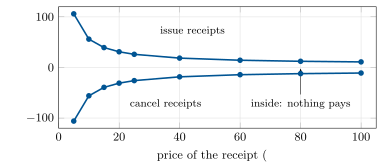
Parity is only observable while both markets are open. When the home market is closed the receipt is the only live price, and its “premium” to the stale home close is information, as for the ETFs of Proposition 14.7. Some pairs never converge at all: where conversion is restricted by capital controls or ownership limits, two lines of the same company can trade tens of percent apart for years, and the spread is a position, not an arbitrage.
17.5 Comparing wrappers
Figure 17.3 applies Method 17.2 to the chapter’s five investors for one year, with the illustrative terms of the tutorial: a market with a 50 basis point purchase tax, a dividend yield of 2% of which a foreign holder loses 15%, a prime-broker spread of 50 basis points, a futures spread of 30, a swap at 40 with 95% of the dividend, a fund charging 7, and a retail CFD at 250.
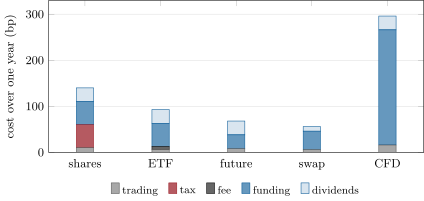
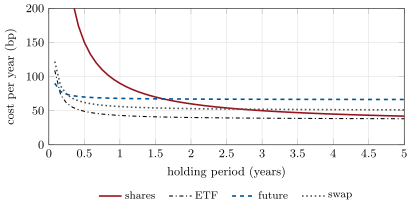
The comparison is mechanical once the five numbers are known; the work is in knowing them. Three are quoted (trading, fees, the funding spread); the tax cost depends on the investor’s domicile and status; and the dividend share of a swap is the dealer’s private estimate of what the shares earn in its hands. A delta-one desk makes its living from differences of a few basis points in these numbers between clients, and a quantitative investor loses a comparable amount by never asking.
17.6 Tutorial: five wrappers, one exposure
Goal. Compute the all-in cost of five wrappers for two investors and any horizon, and the conversion band of a receipt. End state: the three data figures of this chapter.
Terms. One record per wrapper, five kinds of cost.
WRAPPERS = (
    Wrapper("shares", 5.0, 5.0, 50.0, 0.0, 50.0, 0.0, 0, 0.15),
    Wrapper("ETF", 3.0, 3.0, 0.0, 7.0, 50.0, 0.0, 0, 0.15),
    Wrapper("future", 1.0, 1.0, 0.0, 0.0, 30.0, 1.5, 4, 0.15),
    Wrapper("swap", 3.0, 3.0, 0.0, 0.0, 40.0, 0.0, 0, 0.05),
    Wrapper("CFD", 8.0, 8.0, 0.0, 0.0, 250.0, 0.0, 0, 0.15),
)
Listing 17.1. Illustrative terms: entry, exit, purchase tax, running fee, funding spread, roll cost, rolls per year, dividend leakage. code/markets-1/17-delta-one-instruments/python/wrappers.py The breakdown. Synthetic wrappers finance the whole notional inside their price, whoever holds them.
def breakdown(w: Wrapper, years: float, div_yield_bp: float, financed: float) -> dict[str, float]:
    """Cost in basis points of notional over the whole holding period.
    `financed` is the fraction of the notional the investor borrows (1 = fully leveraged).
    Synthetic wrappers finance the whole notional inside their price whatever the investor does;
    an investor with cash earns the benchmark on it, so only the spread is a cost."""
    synthetic = w.name in ("future", "swap", "CFD")
    funded_fraction = 1.0 if synthetic else financed
    return {
        "trading": w.entry_bp + w.exit_bp + w.roll_bp * w.rolls_per_year * years,
        "tax": w.purchase_tax_bp,
        "running": w.running_bp * years,
        "funding": w.funding_spread_bp * funded_fraction * years,
        "dividends": w.dividend_leak * div_yield_bp * years,
    }
Listing 17.2. The five costs over a holding period. code/markets-1/17-delta-one-instruments/python/wrappers.py The receipt band.
def dr_band_bp(ordinary_price: float, fx: float, terms: DrTerms) -> tuple[float, float]:
    """(lower, upper) premium of the receipt over parity, in bp, beyond which conversion pays.
    Above the upper bound: buy ordinaries, deposit, sell receipts. Below the lower: the reverse."""
    p = parity(ordinary_price, fx, terms)
    upper = terms.trading_bp + terms.entry_tax_bp + terms.issue_fee / p * 1e4
    lower = -(terms.trading_bp + terms.cancel_fee / p * 1e4)
    return lower, upper
Listing 17.3. Premiums beyond which issuing or cancelling receipts pays. code/markets-1/17-delta-one-instruments/python/wrappers.py
What to change next. Add the short side: a short future earns the rich financing, a short fund earns the fee and pays a borrow. Then make the futures spread seasonal, higher over the year-end roll, and see for which horizons the future stops being competitive.
17.7 Build: the wrapper comparator
Purpose. Before the miniature firm puts on any index or single-stock exposure, long or short, it asks which wrapper is cheapest for its horizon and tax position, and records why.
Interface. WrapperTerms(…) with a synthetic flag and a shortable flag; Investor(financed, dividend_leak_override); cost(wrapper, investor, years, div_yield_bp, side, borrow_fee_bp) returning a total and its parts; rank(…) returning the quotes sorted by total.
Rules. Long: purchase tax, funding on the financed fraction (everything, for synthetics), dividend leakage. Short: no purchase tax, the short-side spread plus the borrow fee from Section 16.7, fund fees change sign, and wrappers that cannot be shorted are excluded, with an error if one is requested explicitly. Ties are broken by name.
Acceptance tests. code/firm/wrappers/tests/: the chapter’s two rankings; a tax-exempt holder over five years; the short side.
Stretch. Replace each point estimate by a range and report the wrappers that are cheapest somewhere in the box: usually two, which is the honest answer.
Sources and further reading
- US Securities and Exchange Commission, Investor Bulletin: American Depositary Receipts, August 2012.
- HM Revenue & Customs, Tax when you buy shares, gov.uk; Stamp Taxes on Shares Manual, STSM042050 (intermediary relief).
- Internal Revenue Service, Notice 2024-44 (section 871(m) phase-in).
- A. Madhavan, U. Marchioni, W. Li and D. Y. Du, “Equity ETFs versus index futures: a comparison for fully funded investors”, Journal of Index Investing, 2014.
17.8 Exercises
Exercise 17.1 ★
A fund receives the total return of an index on $50 million and pays the benchmark, 4.2%, plus 40 basis points, actual/360. Over a 91-day period the index returns 6% with dividends. Give the two payments and the net.
Solution
Solution of Exercise 17.1.
The fund receives and pays : a net receipt of $2 418 611.
Exercise 17.2 ★
Reproduce Example 17.6 and give the future’s price at which its funding spread would be zero, and the price at which it would be 50 basis points.
Solution
Solution of Exercise 17.2.
Zero spread: the fair value, 6 043.5. Fifty basis points: . Each index point on a three-month future is worth about 6.7 basis points of annual financing.
Exercise 17.3 ★
An ADR represents 2 ordinary shares. The ordinary trades at € 42.10, the euro at $1.17, the ADR at $98.90. Give the parity price and the premium in basis points.
Solution
Solution of Exercise 17.3.
Parity ; premium basis points.
Exercise 17.4 ★★
With the chapter’s terms, an investor with cash compares shares and the CFD. Below what holding period is the CFD cheaper? (The dividend leakage is the same for both.)
Solution
Solution of Exercise 17.4.
Shares: 10 of trading plus 50 of tax, no funding. CFD: 16 of trading plus 250 a year. gives year: the CFD is cheaper for holding periods under 64 days.
Exercise 17.5 ★★
A US stock yields 1.5%. Give the annual cost of withholding for a foreign holder at the statutory 30% and at a treaty rate of 15%. A dealer offers a swap paying 100% of the dividend. Using Box 17.1, explain why the offer should make the holder suspicious.
Solution
Solution of Exercise 17.5.
basis points a year; at 15%, 22.5. Since section 871(m) treats the dividend-equivalent payment of a delta-one swap on a US stock as a US-source dividend, the dealer must withhold on it as on the dividend: a swap that pays 100% is either not delta-one, or mispriced elsewhere (a wider funding spread), or relies on a tax position the holder should want to understand before it is challenged.
Exercise 17.6 ★★
For the investor with cash, verify the two crossovers quoted in Figure 17.4 (shares against the swap, fund against the future) from the terms in the tutorial.
Solution
Solution of Exercise 17.6.
Per year, with cash: shares cost 30 (dividends); the swap ; the future ; the fund . Fixed: shares 60, swap 6, future 2, fund 6. Shares against swap: , years. Fund against future: , year, fifty days.
Exercise 17.7 ★★★
Coding. Run the comparator for the leveraged investor over three months. Report the five totals and their annualised values. Which wrappers tie, and what would break the tie in practice?
Solution
Solution of Exercise 17.7.
Shares 80, fund 27.75, future 18.5, swap 18.5, CFD 86 basis points; annualised 320, 111, 74, 74 and 344. Future and swap tie. In practice: the future needs no documentation and has no counterparty exposure beyond the clearing house, but exists only on the index and in fixed sizes and expiries; the swap can be on a custom basket and pays more of the dividend, but needs an agreement, a credit line and a dealer willing to quote.
Exercise 17.8 ★★★
Find the flaw. A broker’s page says: “CFDs: no commission, no stamp duty. The cheapest way to hold UK shares.” A client holds for three years, with the chapter’s terms. Compute both costs and name what the page left out.
Solution
Solution of Exercise 17.8.
CFD: basis points. Shares: . The page omitted the financing, charged every day on the whole notional even to a client who has the cash, and, by quoting “no commission”, the spread in which the commission now lives. The claim is true for holding periods under about two months.
17.9 Problem: The Receipt and the Ordinary
Problem 17.1
Weekend problem — one company, two tickers, one ocean
A UK company’s ordinary share trades in London at 500p. Its ADR represents 4 ordinaries and trades in New York. Sterling is at $1.25. The depositary charges 5 cents per ADR to issue or to cancel. Depositing UK shares into the ADR programme costs the 1.5% charge of Box 17.1. Trading both legs and the currency costs 6 basis points in all.
Part I — Parity and band.
- Give the parity price of the ADR.
- Give the upper bound of the conversion band in basis points.
- Give the lower bound.
- The ADR trades at $25.30. Give its premium. Does any conversion pay?
- Explain in one sentence why the band is asymmetric, and what that predicts about the sign of the average premium.
Part II — Two conversions.
- The ADR is at $25.50. A firm issues 100 000 ADRs. List the cash flows and give the profit in dollars and in basis points.
- The ADR is at $24.90. The firm cancels 100 000 ADRs. Same questions.
- Conversion takes two days. The firm leaves the currency unhedged; with a sterling volatility of 8% a year, give the standard deviation of the currency effect over two days, in basis points. Conclude.
- Which of the two conversions needs a stock borrow if the firm wants to sell the leg it will receive before it receives it?
Part III — After London closes. London closes at 11:30 New York time. At 15:00 the ADR trades at $25.45 while the last London price still gives a parity of $25.00. The US market has risen 1.5% since 11:30, and the stock’s beta to it is 1.1.
- Give an updated estimate of parity.
- Give the ADR’s premium to the stale parity and to your estimate.
- A colleague wants to “sell the 180 basis point premium”. What is he actually selling, and against what?
- How would you test, on history, whether the ADR’s afternoon move predicts the next London open?
- Why is that predictability not free money for a London opening auction trader?
Part IV — Judgement.
- For a US investor wanting this company for five years, list what the ADR costs that the ordinary would not, and the reverse.
- The company moves its primary listing to New York and the ADR is replaced by the share itself. What happens to the band?
- Two classes of the same company trade 30% apart in two countries between which conversion is forbidden. What kind of trade is “buy the cheap one, sell the dear one”?
- Who are the natural operators of the conversions of Part II?
- State the named result: the conversion band, in basis points of parity.
- In one sentence: what does a delta-one desk sell?
Solution
Solution of Problem 17.1.
1. . 2. basis points. 3. basis points. 4. basis points: inside the band, nothing pays. 5. Creating receipts costs 1.5% and destroying them does not, so supply responds to discounts at once and to premiums only beyond 1.76%: the receipt should trade at a small premium on average, whenever US demand grows. 6. Buy 400 000 ordinaries: £2 000 000 $2 500 000. Deposit charge $37 500, issue fee $5 000, trading $1 500: $44 000. Sell 100 000 ADRs: $2 550 000. Profit $6 000, 24 basis points (). 7. Buy ADRs $2 490 000, cancel fee $5 000, trading $1 500, sell the ordinaries for $2 500 000: profit $3 500, 14 basis points (). 8. basis points, several times either profit: the currency must be sold forward at the moment of the trade. The conversion is an arbitrage only with three legs. 9. Both. Issuing: the firm sells ADRs it will receive in two days and must borrow ADRs to deliver. Cancelling: it sells ordinaries it will receive in two days and must borrow them in London. The borrow fee and availability belong in the band. 10. . 11. 180 basis points to the stale parity; 15 to the estimate. 12. He sells the ADR and buys nothing: London is closed. He is short the stock overnight against a hedge in US index futures at best; what he has sold is 15 basis points of premium and the whole of the stock’s idiosyncratic risk until 08:00 London time. 13. Regress the ordinary’s return from the London close to the next London open on the ADR’s return (currency-adjusted) from 11:30 to 16:00 New York time, over a few years, controlling for the US index; the coefficient should be close to one and the high. 14. Because everyone in the opening auction has seen the ADR: the indicative price already contains it. The predictability is of the open relative to yesterday’s close, not relative to any price at which one can trade. 15. The ADR costs the depositary’s custody fee, a few cents per receipt a year, and (since it was created once) embeds the 1.5% only if she is the one creating it; it spares her a UK custody account, sterling settlement, and currency conversion of each dividend. The ordinary costs 0.5% on purchase and the foreign plumbing, and has the deeper market. 16. There is no conversion left, so no band: one share, one register, with London trading becoming a secondary listing or disappearing. 17. A relative-value position with no mechanism of convergence: it profits only if the restriction is lifted or if investors in the two markets change their minds. It should be sized as a directional bet on a spread. 18. Dealers with an account at the depositary, custody in both markets, intermediary status for the tax, stock borrow in both lines and a currency desk: banks’ delta-one desks and a few trading firms. 19. From to basis points. 20. The same exposure in the wrapper that is cheapest for the client, priced from differences in funding, tax and access that the desk can bear more cheaply than the client can.
17.10 Interview questions
Interview question 17.1 ★ trader, bank, researcher
What does “delta-one” mean, and what does a delta-one desk do?
Solution
Solution of Interview question 17.1.
Delta-one instruments carry an exposure without optionality: shares, funds, futures, swaps, receipts. They all give the same return before costs, so the desk’s business is the costs: it quotes swaps and funds clients’ positions, makes markets in funds and receipts, arbitrages futures against baskets, and manages the dividend, borrow and financing risks left over.
What the interviewer is looking for: “same exposure, different costs”, and at least three concrete activities.
Interview question 17.2 ★ trader, bank
A client can buy an index fund or go long index futures. How do you compare the two for her?
Solution
Solution of Interview question 17.2.
Cost the five components for her horizon. The fund: spread, management fee, withholding inside the fund. The future: tiny commissions, four rolls a year, and the implied financing spread, which she pays even if she has the cash. A funded long-term holder is usually better off in the fund; a leveraged or short-term one in the future; and the answer moves with the richness of the roll.
What the interviewer is looking for: the implied financing spread as the future’s hidden fee.
Interview question 17.3 ★★ trader, researcher
Index futures are trading “rich”: the implied financing rate is 80 basis points over the benchmark. Who is hurt, who benefits, and what trade collects the spread?
Solution
Solution of Interview question 17.3.
Long holders of futures pay 80 basis points a year over the benchmark; anyone who can hold the shares and sell the future earns it. The trade is cash-and-carry: buy the basket, sell the future, finance the basket. What stops it is balance sheet: the position is large, low-yielding and consumes dealer capital, most of all at year-end, which is exactly when the spread is widest. A funded investor can also collect it passively, by replacing futures with a fund.
What the interviewer is looking for: the arbitrage and the reason it is limited.
Interview question 17.4 ★★ bank, trader
You are a dealer quoting a total return swap on a European stock to a hedge fund. What goes into your funding spread and your dividend percentage?
Solution
Solution of Interview question 17.4.
Funding spread: my own cost of financing the hedge, the capital and balance-sheet charge, the client’s credit and margin terms, any transaction tax I cannot avoid, less what the shares earn me in stock lending. Dividend percentage: my net-of-tax receipt on the dividend given where I book the hedge, less a margin. For a hard-to-borrow stock on the short side, the borrow fee. Competition sets how much of each benefit I pass on.
What the interviewer is looking for: balance sheet, tax position and lending revenue, all three.
Interview question 17.5 ★★ trader, researcher
An ADR trades 1% above its parity. Is that an arbitrage? What do you check?
Solution
Solution of Interview question 17.5.
Only if conversion is possible and cheaper than 1%. Check: is the home market open (otherwise parity is stale); the ratio and the currency rate used; issue fee per receipt; any deposit tax; whether the programme is open for issuance (some are capped or closed); borrow in the receipt; settlement timing and the currency hedge. If all pass, issue receipts against ordinaries.
What the interviewer is looking for: stale parity and the closed-programme case.
Interview question 17.6 ★★★ researcher, trader
Your equity long-short backtest assumes you hold shares. The firm would implement it on swap. What changes in the backtest?
Solution
Solution of Interview question 17.6.
Financing becomes explicit: a spread on the long notional and on the short notional, not an interest rate on net cash. No purchase tax, which can matter more than everything else in taxed markets. Dividends at the swap’s percentage, on both sides. Short availability and fees as the dealer quotes them, with recall replaced by the dealer’s right to terminate or reprice. Resets realise P&L in cash monthly. And capacity is the dealer’s balance sheet, which can be withdrawn.
What the interviewer is looking for: long and short spreads charged on gross notional.