Markets I: The Ecosystem and Exchange-Traded Markets · Markets
30Getting Access: Futures and Listed Options
Two traders buy the same E-mini contract at the same price at the same instant. One pays the exchange $1.18 for the privilege; the other, 35 cents. Before either has any skill, the second can profit from moves a third the size. The difference is a membership: an asset with a market price, which can be bought, or leased by the month from someone who owns one. Futures exchanges publish these differences openly; they are the largest single determinant of who can run a short-horizon futures strategy at all. Options exchanges add a further layer, the market-maker appointment, which buys allocation privileges as well as lower fees. This chapter prices both, and the contract that comes before either: the clearing broker’s.
30.1 The clearing broker
Definition 30.1 (Futures commission merchant and clearing member)
A futures commission merchant (FCM) is, in the United States, an entity that solicits or accepts orders for futures, options on futures or swaps and accepts money or other assets from customers to support them; it must be registered and a member of the industry’s self-regulatory body. A clearing member is a firm admitted by a clearing house to clear trades in its own name; it guarantees its customers’ trades to the clearing house and contributes to the default fund (Chapter 5).
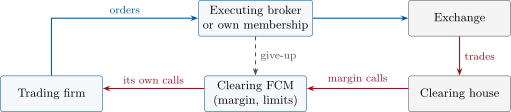
Every futures position is carried by a clearing member. A trading firm that is not one is the customer of an FCM, which collects at least the clearing house’s margin (Chapter 20) and usually more, holds the firm’s collateral in segregated accounts, charges a commission per side, and may give the firm access to its exchange memberships’ rates through its own programmes. A give-up works as in equities: trades executed through one broker are given up to the clearing FCM under a three-party agreement.
The FCM bears the firm’s default risk between margin calls and prices it: by the multiple of exchange margin it demands, by intraday limits on position and order size, by the right to liquidate. For a leveraged strategy these terms, not the commission, are the cost of the relationship. In stressed periods (Chapter 31) FCMs raise their multiples and shed customers whose tail risk they dislike; a firm’s access to futures is only as secure as its FCM’s appetite.
30.2 Membership: buy, lease or stay outside
Definition 30.2 (Exchange membership and member rate)
An exchange membership of a futures exchange is a transferable right, held by an individual or a firm, that gives access to the member rate: a schedule of exchange fees lower than the one applied to everyone else. Memberships are divided by product group, can be bought and sold at prices the exchange publishes, and can be leased by the month.
As of September 2026 — One contract, three prices
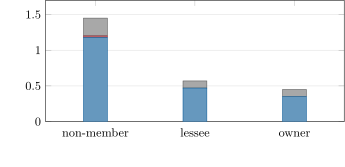
A futures broker’s published comparison gives, for the E-mini S&P 500, an exchange fee per side of $1.18 for a non-member, $0.47 for the lessee of a membership and $0.35 for an owner; for the micro contract, $0.20, $0.07 and $0.04. Non-members also pay a regulatory fee of $0.02 a side. Leasing is a two-step process: approval as an individual member of the exchange (an application fee of $2 000), then a lease agreement with the holder of a seat. The exchange has announced changes to its transaction fees effective 1 October 2026; its own fee schedule is the reference.
Proposition 30.3 (Break-even volume)
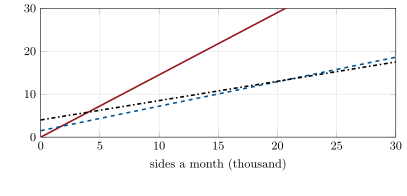
If a route to the exchange costs a side with a fixed monthly cost , and another with , the second is cheaper above
With a lease at $1 500 a month (an assumption; leases are quoted monthly and vary by division and with demand) the lessee’s 88-cent saving pays for the lease from 1 705 sides a month, about 40 round trips a day. Ownership ties up the price of the membership; at a cost of capital of $4 000 a month it beats leasing from 20 833 sides a month, a thousand a day (Figure 30.3).
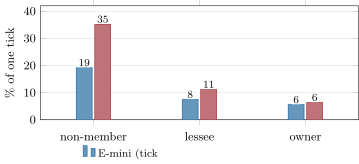
Fees matter in proportion to the tick. A round trip at non-member exchange rates is 19% of an E-mini tick and 35% of a micro tick (Figure 30.4): a strategy that aims to capture one tick keeps four fifths of it in the large contract and under two thirds in the small one, before any commission. The smaller contract is the more expensive, relative to what it can earn, for everyone; and cheap only to members.
30.3 Incentive and market-maker programmes
Definition 30.4 (Incentive programme)
An incentive programme is a schedule of fee discounts or rebates that a futures exchange offers, for a product or a group of products and for a limited period, to participants who meet volume thresholds or quoting obligations; membership is often not required.
Futures exchanges do not pay maker rebates across the board as equity exchanges do; they target them. New products, products that compete with another exchange’s, back months, and overnight hours receive market-maker programmes with obligations (maximum width, minimum size, percentage of time) and stipends or fee waivers in return; high-volume proprietary firms receive tiered discounts. The terms are filed with the regulator, but participation is by application, places can be limited, and the programme can end. A firm whose strategy is profitable only inside a programme has a business with an expiry date.
30.4 Options market-maker appointments
Definition 30.5 (Market-maker appointment)
A market-maker appointment is the registration of a member, on an options exchange, as market maker in a set of option classes. It carries the quoting obligations and the privileges of Definition 24.1, and is paid for through trading permits and appointment fees that grow with the number and the activity of the classes.
On an options exchange the fee gap between market makers and everyone else is wider than in futures, and it comes with the allocation entitlements of Chapter 24. The cost side is also larger: permits on each of a dozen or more exchanges, since the same series trades on all of them; bulk-quoting bandwidth and ports; the consolidated feed of Box 24.2; and capital for an inventory of options that cannot be flattened at the close. Options market making has a minimum efficient scale that futures proprietary trading does not, which is why it is done by a small number of firms.
30.5 Data licences
The layers are those of Chapter 29: access, display, non-display, redistribution. Futures add one distinction that catches new firms: on some exchanges real-time data fees are waived or reduced for members trading their own account and charged in full to non-members and to any use that looks like a service to others. The status that lowers the transaction fee lowers the data bill as well, and the break-even of Proposition 30.3 should include both.
30.6 Tutorial: when does a lease pay?
Goal. Compute the all-in cost of a side under three routes, the break-even volumes between them, the effect of a volume incentive, and the cost of a round trip in ticks. End state: the three data figures of this chapter.
One side. Exchange fee and regulatory fee by status, plus the broker’s commission.
@dataclass(frozen=True)
class ProductFees:
    product: str
    exchange_fee: dict[str, float]          # status -> dollars per side: 'non_member', 'lessee', 'owner'
    regulatory_fee: dict[str, float]        # status -> dollars per side


@dataclass(frozen=True)
class Access:
    status: str                             # 'non_member', 'lessee' or 'owner'
    broker_commission: float                # clearing broker, dollars per side
    fixed_monthly: float = 0.0              # lease, or the cost of capital tied up in an owned membership


def per_side(p: ProductFees, a: Access) -> float:
    return p.exchange_fee[a.status] + p.regulatory_fee[a.status] + a.broker_commission


def monthly_cost(p: ProductFees, a: Access, sides: float) -> float:
    return sides * per_side(p, a) + a.fixed_monthly
Listing 30.1. Fees by status, routes, and the cost of a month. code/firm/futfees/firm_futfees.py Break-even.
def breakeven_sides(p: ProductFees, cheap: Access, dear: Access) -> float | None:
    """Monthly sides above which `cheap` (higher fixed cost, lower variable) beats `dear`."""
    saving = per_side(p, dear) - per_side(p, cheap)
    extra_fixed = cheap.fixed_monthly - dear.fixed_monthly
    if saving <= 0:
        return None
    return max(0.0, extra_fixed / saving)
Listing 30.2. Monthly sides above which the route with the higher fixed cost wins. code/firm/futfees/firm_futfees.py - Incentives that apply to the whole month once a threshold is passed: the cliffs of Chapter 29 again.
What to change next. Add the data bill, with a member waiver, to the fixed cost of each route. Then add a second product in another division and find whether one membership or two is cheaper for a given split of volume.
30.7 Build: the futures fee engine
Purpose. The backtester charges every simulated fill what the firm would really pay; the firm’s finance function decides each quarter whether to lease, buy or drop memberships.
Interface. ProductFees(product, exchange_fee, regulatory_fee) by status; Access(status, broker_commission, fixed_monthly); per_side, monthly_cost, breakeven_sides(product, cheap, dear); IncentiveTier(min_sides, discount) and with_incentive; cost_in_ticks(product, access, tick_value).
Rules. Fees are data with effective dates, keyed by product and status. Fixed costs include the lease or the cost of capital of a purchased membership. A route that is dearer per side never has a break-even: the function returns nothing, not a negative number. Tick values come from the contract master (Section 18.7).
Acceptance tests. code/firm/futfees/tests/: cost per side and per month; break-even in both directions; an incentive that applies to the whole month at its threshold; fees against the tick.
Stretch. Options on futures and listed options, with fees by capacity (customer, professional, firm, market maker) and by whether the order added or removed liquidity.
Sources and further reading
- National Futures Association, Futures commission merchant (FCM) registration.
- Optimus Futures, “CME membership seat lease” (published comparison of non-member, lessee and owner exchange fees).
- CME Group, Exchange fees for clearing and trading and Membership pricing (reference pages; not machine-readable at the time of writing).
30.8 Exercises
Exercise 30.1 ★
With the fees of Figure 30.2, give the all-in cost of 10 000 sides in a month for a non-member and for a lessee paying $1 500 for the lease.
Solution
Solution of Exercise 30.1.
Non-member: . Lessee: .
Exercise 30.2 ★
Compute the two break-even volumes quoted in the text: leasing against staying outside, and owning (at $4 000 a month of capital cost) against leasing.
Solution
Solution of Exercise 30.2.
Lease against outside: sides a month. Owning against leasing: sides a month.
Exercise 30.3 ★
Express the exchange and regulatory fees of a round trip as a percentage of one tick for the E-mini (tick $12.50) and the micro contract (tick $1.25), for each status.
Solution
Solution of Exercise 30.3.
E-mini: ; ; . Micro: ; ; .
Exercise 30.4 ★★
A strategy makes 400 round trips a day in the E-mini and earns, before fees, an average of 0.3 tick per round trip. Give its monthly P&L (21 days) as a non-member and as a lessee, with the commissions of the figure.
Solution
Solution of Exercise 30.4.
8 400 round trips earn gross. Non-member: fees : net $7 140. Lessee: : net $20 424. The same strategy is almost three times as profitable.
Exercise 30.5 ★★
An exchange offers 5 cents off per side from 50 000 sides a month and 10 cents from 200 000, on all sides of the month. A lessee has traded 46 000 sides with two days left and normally trades 1 500 a day. What are the last 1 000 sides worth?
Solution
Solution of Exercise 30.5.
At the normal pace it ends the month at 49 000, a thousand short. Reaching 50 000 earns 5 cents on all 50 000 sides: $2 500, or $2.50 for each of the last 1 000 sides, several times the fee on them. It should trade them if it can do so at a loss of less than that.
Exercise 30.6 ★★
An FCM asks for 150% of exchange margin and gives two hours to meet intraday calls. Another asks for 110% and ten minutes. For a strategy with large intraday positions and small overnight ones, which is dearer? What else would you ask both?
Solution
Solution of Exercise 30.6.
For large intraday positions the second is dearer in the way that matters: ten minutes to meet a call means holding the cash idle in advance, or being liquidated; two hours allows funding from elsewhere. The 150% applies to overnight positions, which are small. Ask both: how intraday exposure is measured and limited; what triggers liquidation and who decides; interest paid on excess collateral; which collateral is accepted; and how they behaved towards clients in the last stressed month.
Exercise 30.7 ★★★
Coding. Add a monthly data cost of $1 200 for non-members, waived for lessees and owners, to the routes of the tutorial. Recompute the break-even between staying outside and leasing. What happens to it if the lease is $1 100?
Solution
Solution of Exercise 30.7.
The outside route now has a fixed cost of $1 200: the break-even falls to sides a month. With a lease at $1 100 the lease is cheaper at any volume: its fixed cost is lower and its variable cost is lower, and the function returns zero.
Exercise 30.8 ★★★
Find the flaw. “Our market-making strategy in a newly listed future earns $180 000 a month: $30 000 from the spread and $150 000 from the exchange’s market-maker stipend. We are raising capital to scale it tenfold.” What should an investor ask?
Solution
Solution of Exercise 30.8.
Five sixths of the profit is a stipend. Ask: for how long is the programme guaranteed, and can the exchange change or end it; is the stipend per firm or does it scale with volume (tenfold capital does not earn tenfold a fixed stipend); how many firms share it; what are the obligations and what do they cost in a fast market; what is the $30 000 of spread income after the adverse selection that obligations impose. The scalable business here is the $30 000, and it may be negative without the programme.
30.9 Problem: Lease or Pay?
Problem 30.1
Weekend problem — a small firm’s first membership
A two-person firm trades the E-mini through an FCM as a non-member: 600 sides a day, 21 days a month, at the fees of Figure 30.2. Its gross trading profit before fees averages 0.25 tick per side (tick $12.50). A lease is offered at $1 500 a month; as a lessee its commission falls to 10 cents.
Part I — Today.
- Give sides per month and gross profit per month.
- Give fees per month as a non-member.
- Give net profit, and fees as a percentage of gross.
- Give the round trip’s cost in ticks.
Part II — With a lease.
- Give the break-even volume in sides per month and per day.
- Give fees per month as a lessee, lease included.
- Give the new net profit and the improvement.
- The application costs $2 000 once. How many days of savings repay it?
- What are the non-financial costs of becoming a member?
Part III — Growth.
- At what volume would owning, at $4 000 a month of capital cost, beat leasing?
- The firm adds the micro contract, 2 000 sides a day at 0.25 tick gross (tick $1.25). Give its monthly net as a non-member and as a lessee, with commissions of 10 and 5 cents.
- What does question 11 say about which products a non-member can trade at short horizons?
- An incentive programme offers 10 cents off per side above 20 000 sides a month. Give its value to the firm at its E-mini volume.
- The programme ends next quarter. How should the firm treat its value in its plans?
Part IV — Judgement.
- Why do exchanges charge non-members three times as much?
- Who owns memberships and leases them out, and why is that a business?
- The firm’s FCM raises its margin multiple from 120% to 200% after a volatile month. Which matters more to the firm, that or the lease?
- What would make the firm consider becoming a clearing member itself?
- State the named result: the break-even volume of the lease in sides per month.
- In one sentence: what does a membership buy?
Solution
Solution of Problem 30.1.
1. 12 600 sides; . 2. . 3. Net $21 105; fees are 46% of gross. 4. tick a round trip, against a gross of 0.50. 5. 1 705 sides a month, 81 a day: the firm trades seven times that. 6. . 7. Net $30 693: $9 588 a month better, 45% more. 8. a day: the application fee is repaid in 4.4 trading days. 9. An application with disclosure of background and finances, the exchange’s rules and disciplinary jurisdiction applying to the member personally, restrictions on whose account may be traded at member rates (the member’s own), and the administrative link between the lease and the account at the FCM. 10. 20 833 sides a month, about 990 a day. 11. 42 000 sides; gross $13 125. Non-member: : net . Lessee: : net (the lease is already paid for by the E-mini). 12. That in small contracts, whose fees are a third of a tick for outsiders, short-horizon strategies exist only for members. A non-member must hold positions long enough for fees to be negligible against the move. 13. Nothing: the firm trades 12 600 sides, under the threshold of 20 000. It would need 952 sides a day. 14. As zero. Income that depends on a programme the exchange can end is a bonus, not a basis for hiring or for capital commitments. 15. Price discrimination in favour of those who bring volume and liquidity, and a legacy of the exchanges’ origin as member-owned clubs: memberships were the ownership. The non-member rate is what the customer of convenience pays. 16. Former floor traders, their estates, firms that bought more seats than they use, and investors: a seat yields a lease income and may carry other rights. Lessees are firms whose volume justifies the rate but not the purchase price. 17. The margin. At 600 sides a day the lease is worth $9 588 a month; a jump from 120% to 200% of exchange margin may halve the size the firm can carry, which halves the gross of $39 375, or forces it to raise capital. 18. Volume large enough that FCM commissions and margin multiples cost more than clearing-house membership: capital requirements, default-fund contributions, operations staff, and direct exposure to other members’ defaults. For a two-person firm, never; for a large proprietary firm, a standard step. 19. 1 705 sides a month. 20. A lower price per trade, in exchange for a fixed cost and for accepting the exchange’s jurisdiction.
30.10 Interview questions
Interview question 30.1 ★ trader, developer
What is an FCM and what does it do for a trading firm?
Solution
Solution of Interview question 30.1.
A futures commission merchant accepts customers’ orders and their money. For a trading firm it is the clearing member that carries its positions at the clearing house, collects and posts margin, guarantees its trades, provides or accepts executions by give-up, and sets the firm’s real limits: margin multiple, intraday exposure, liquidation rights.
What the interviewer is looking for: the FCM as credit provider, not as order router.
Interview question 30.2 ★ trader, researcher
Why do futures exchange fees differ between members and non-members, and by how much?
Solution
Solution of Interview question 30.2.
Exchanges were member-owned; membership rates survive as a volume discount attached to a tradable or leasable seat. The gap is large: for the main equity-index contract a non-member pays roughly three times an owner’s exchange fee per side, and the gap is wider still relative to the tick in the smallest contracts.
What the interviewer is looking for: an order of magnitude for the gap, and the lease as the way in.
Interview question 30.3 ★★ researcher, trader
Your backtest of a one-tick scalping strategy in a micro contract is profitable before fees. What do you check next?
Solution
Solution of Interview question 30.3.
Fees in ticks at the rate the firm will actually pay: for a non-member a micro round trip costs a third of a tick in exchange fees alone, plus commission. Then queue position (a one-tick scalp needs fills at the front of the queue, which the backtest probably assumed), latency, and whether the fills assumed are achievable at the touch at all. Most such strategies die at the first check.
What the interviewer is looking for: fees as a fraction of the tick, by status.
Interview question 30.4 ★★ trader
When does it make sense to lease a membership, and when to buy one?
Solution
Solution of Interview question 30.4.
Lease when monthly volume times the per-side saving exceeds the lease, usually a few dozen round trips a day in the main contracts. Buy when the saving of owner over lessee rates, times volume, exceeds the cost of the capital tied up net of the lease paid, and the firm expects to stay in the product for years: memberships have a price that moves.
What the interviewer is looking for: the two break-evens and the capital at risk in a purchase.
Interview question 30.5 ★★ trader, bank
What would you negotiate with a clearing broker, and what is not negotiable?
Solution
Solution of Interview question 30.5.
Negotiable: commission per side and its minimum; the margin multiple and intraday limits; interest on excess cash and the collateral accepted; give-up and platform fees; notice periods. Not negotiable: exchange and regulatory fees, the clearing house’s margin, segregation rules. The firm brings volume, balances, a clean risk profile and an alternative FCM.
What the interviewer is looking for: margin terms ahead of commission.
Interview question 30.6 ★★★ trader, researcher
Why is listed-options market making concentrated in a few firms when futures proprietary trading is not?
Solution
Solution of Interview question 30.6.
Fixed costs and scale. A futures firm needs one membership, one feed, one book. An options market maker needs appointments and permits on a dozen or more exchanges for the same series, capacity to quote hundreds of thousands of series and consume a feed of hundreds of billions of messages, models for the whole surface, capital for inventory that cannot be flattened at the close, and enough breadth of flow for the inventory to net. Entitlements reward incumbents. The minimum efficient scale is high, so the industry is concentrated.
What the interviewer is looking for: inventory and breadth, not just technology.