Markets I: The Ecosystem and Exchange-Traded Markets · Markets
22Equity Index and Single-Stock Futures Worldwide
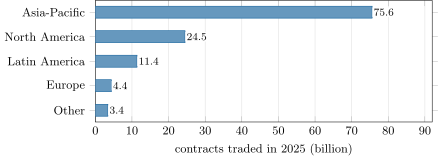
In 2025 the world’s exchanges traded 119 billion futures and options contracts. Sixty-three of every hundred changed hands in Asia-Pacific, twenty in North America, fewer than four in Europe; and eighty of every hundred were on equities. A reader who has met only the Chicago contracts of Chapter 18 has seen a fifth of the picture, measured in contracts. Measured in dollars the picture is very different, and that gap is the first lesson of the chapter. The second is that the equity future has relatives: contracts on the dividends an index will pay, contracts on its total return, contracts on single shares. Each isolates one of the terms that the fair-value formula of Proposition 21.3 lumps together.
22.1 Counting contracts, counting money
Definition 22.1 (Index point, mini and micro contracts)
An index point is one unit of the quoted index; a contract’s multiplier gives the point its value in money. A mini contract or micro contract is a version of an existing future with a multiplier cut, typically to a fifth or a tenth, and then to a tenth again, so that the same market can be traded in smaller size; minis often end up far more liquid than the contracts they were cut from.
As of September 2026 — What the volume statistics say, and do not
The futures industry association counted 119.29 billion contracts in 2025: 88.65 billion options, down 50.3% on the year, and 30.64 billion futures, up 8.6%. Equity contracts were 94.79 billion, down 48.8%, which accounts for most of the fall. By region: Asia-Pacific 75.59 billion (), North America 24.50 (), Latin America 11.39, Europe 4.38, others 3.43. The counts weigh every contract equally. A halving of the world total in a year in which futures volume rose says that the number is dominated by very small equity options in a few markets, and by their regulators’ decisions about contract sizes and expiries, not by the amount of risk transferred.
22.2 Three regional benchmarks
| E-mini S&P 500 | EURO STOXX 50 future | Hang Seng Index future | |
|---|---|---|---|
| Exchange | Chicago | Frankfurt | Hong Kong |
| Multiplier | $50 | € 10 | HK$50 |
| Tick | 0.25 ($12.50) | 1 (€ 10) | 1 (HK$50) |
| Expiries | quarterly | quarterly | monthly and quarterly |
| Last trading day | third Friday, open | third Friday, noon | second-last trading day |
| Final settlement | opening quotation | ten-minute average | five-minute quotations, averaged |
As of September 2026 — Hours
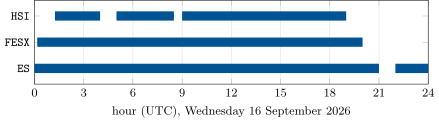
The EURO STOXX 50 future trades from 02:10 to 22:00 Frankfurt time. The Hang Seng future trades from 09:15 to 12:00 and 13:00 to 16:30 Hong Kong time, then in an after-hours session from 17:00 to 03:00 whose trades belong to the next day’s clearing. Its contract months are the spot month, the next three calendar months and the next three quarter months, with longer-dated June and December contracts.
Each of the three is the hedging instrument of its region’s equity derivatives and the first price to move on news when the cash market is closed. Between them they are open almost continuously from the Asian morning to the American evening (Figure 22.2), and a firm that trades one around the clock must know what is open elsewhere: liquidity in each contract rises sharply when its own cash market is open and again when another region’s opens.
22.3 Dividend futures
Definition 22.2 (Dividend future)
A dividend future on an index settles at the sum of the ordinary gross dividends paid by the index’s constituents during a contract period, usually a year, expressed in index points. Before expiry its price is the market’s price for that stream of dividends.
As of September 2026 — The EURO STOXX 50 index dividend future
Contract value € 100 per index dividend point; tick 0.1 point, € 10. Listed: the five nearest quarterly months, the next two semi-annual months and the eight following annual December months. Trading ends at 12:00 CET on the third Friday of the maturity month; the final settlement price is the cumulative total of the relevant gross dividends of the index’s constituents for the contract period, as defined by the index provider.
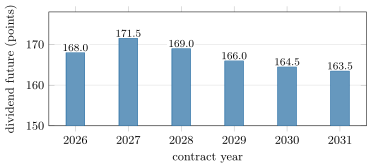
The contract exists because of a by-product. Banks that sell structured products on an index are left long the index’s future dividends for years ahead, a risk they cannot hedge with index futures, whose dividend exposure they already have. Selling dividend futures transfers it. The buyers are funds who consider the price low: a strip of dividend futures has often traded below any reasonable forecast of dividends for distant years, the discount being the price the banks pay to be rid of the risk. The strip’s slope is therefore not a forecast (Figure 22.3).
Proposition 22.3 (Implied dividends)
From an index future with time to expiry, spot and financing rate , the dividends the market prices between now and expiry are
(reinvestment neglected). A long index future is short these dividends: if expected dividends fall by points, the future’s fair value rises by .
22.4 Total return futures
Definition 22.4 (Total return future)
A total return future is a listed future that replicates an equity total return swap (Definition 17.3): the holder receives the index’s price return and its distributions and pays an overnight benchmark rate plus a spread. It is quoted and traded in that spread, in basis points a year; the exchange converts the spread into a futures price in index points using the index close, the distributions accrued and the funding accrued.
As of September 2026 — The EURO STOXX 50 index total return future
Multiplier € 10 per index point. Quoted as an annualised spread in basis points with one decimal, minimum change 0.5 basis point. Underlyings: the price index, the provider’s distribution index, and the euro short-term rate, flat, as funding rate. Distributions and funding accrue from launch and are added to the price; their daily changes pass through variation margin. Expiries run to almost ten years: the 21 nearest quarterly months and five further Decembers.
In the ordinary index future, financing and dividends are inside one number, the basis, and the holder is exposed to both. The total return future pays realised dividends and charges a realised overnight rate, so that what is left to trade is the spread alone: the term price of equity financing, the same quantity as the richness of the roll in Definition 21.7, fixed for years instead of a quarter and cleared. Banks use it to move the financing of their equity hedges off their balance sheets; funds use it to lock in the funding cost of a long-term position.
22.5 Single-stock futures
Definition 22.5 (Single-stock future)
A single-stock future is a future on one share, settled in cash or by delivery of the shares. It is a delta-one wrapper (Chapter 17): financing inside the price, no stock borrow needed to be short, and corporate actions handled by the exchange’s adjustment of the contract.
Their fortunes are national. They trade actively in India and on the European derivatives exchanges, where one exchange lists futures and options on more than 1 200 underlyings from over twenty countries, much of the volume being dividend- and financing-driven trades between professionals around dividend dates. In the United States the one exchange devoted to them stopped trading in September 2020 and withdrew its registration, swaps and options combinations having taken the business. Where a transaction tax applies to shares and not to futures, or where shorting shares is restricted, the single-stock future is the natural instrument; where neither applies, the swap wins.
22.6 Tutorial: implied dividends and the strip
Goal. Extract implied dividends from an index future, read growth from a dividend strip, price a total return future from its spread, and find out which contracts are open at a given instant. End state: the three data figures of this chapter.
Implied dividends and growth.
def implied_dividends(spot: float, future: float, rate: float, years: float) -> float:
    """Dividend points to expiry implied by an index future, simple interest, reinvestment ignored."""
    return spot * (1.0 + rate * years) - future


def implied_growth(strip: list[float]) -> list[float]:
    """Year-on-year growth implied by consecutive annual dividend futures."""
    return [b / a - 1.0 for a, b in zip(strip[:-1], strip[1:], strict=True)]
Listing 22.1. Dividends implied by a future, and growth implied by a strip. code/markets-1/22-index-and-single-stock-futures-worldwide/python/div_implied.py A total return future from its spread.
def trf_price(index_close: float, accrued_distributions: float, accrued_funding: float,
              spread_bp: float, years_to_expiry: float) -> float:
    """Total return future in index points: close plus what has accrued, plus the traded spread
    (annualised, in basis points) applied to the index level for the remaining life."""
    return index_close + accrued_distributions - accrued_funding + index_close * spread_bp * 1e-4 * years_to_expiry
Listing 22.2. From the traded spread to a price in index points. code/markets-1/22-index-and-single-stock-futures-worldwide/python/div_implied.py Sessions in UTC. Local times, time zones, sessions that cross midnight, weeks that start on Sunday.
    def interval(self, local_date: dt.date) -> tuple[dt.datetime, dt.datetime] | None:
        """UTC interval of the session that opens on `local_date`, or None."""
        if not self.opens_on(local_date.weekday()):
            return None
        zone = ZoneInfo(self.tz)
        start = dt.datetime.combine(local_date, self.open, zone)
        end_date = local_date if self.close > self.open else local_date + dt.timedelta(days=1)
        end = dt.datetime.combine(end_date, self.close, zone)
        return start.astimezone(UTC), end.astimezone(UTC)
Listing 22.3. The UTC interval of a session that opens on a given local date. code/firm/calendar/firm_calendar.py
What to change next. Add each exchange’s holidays for the current year and recompute the hours of the year in which all three contracts are open together.
22.7 Build: the global contract calendar
Purpose. Strategies of the miniature firm that run across regions must know, for any timestamp, which contracts are open, and the simulator must refuse orders in closed ones.
Interface. load(path) returning sessions; Session.interval(local_date); is_open(sessions, root, when); open_roots(sessions, when); utc_intervals(sessions, root, day).
Rules. Sessions are stored in exchange-local time with an IANA time zone; all answers are in UTC; daylight saving comes from the zone database, never from a hand-written offset. A session whose close is not after its open ends on the next local day. The week is defined by the weekdays on which a session opens. Holidays are out of scope and documented as such.
Data. data/markets-1/sessions_sample.csv: five rows; the ES row is an assumption and says so in the file.
Acceptance tests. code/firm/calendar/tests/: the European open moving by an hour in UTC between September and December; Hong Kong’s lunch break and its session across midnight; Friday and Sunday boundaries; the set of open contracts at three instants; clipping to a UTC day.
Stretch. Holidays and half-days per exchange; expiry-day early closes from the contract master.
Sources and further reading
- FIA, ETD Volume — December 2025 (annual totals by category and region).
- Eurex, product pages EURO STOXX 50 Index Futures, EURO STOXX 50 Index Dividend Futures (FEXD), EURO STOXX 50 Index Total Return Futures (TESX) and the circular on the transition of the TESX funding rate to € STR flat; Single Stock Futures.
- HKEX, Hang Seng Index Futures, contract summary.
- US Securities and Exchange Commission, order granting OneChicago LLC’s request to withdraw from registration, Federal Register, 18 February 2021.
22.8 Exercises
Exercise 22.1 ★
Give the notional of one contract of each of the three benchmarks at index levels of 6 000, 5 400 and 26 000, in its own currency, and the value of a 1% move.
Solution
Solution of Exercise 22.1.
$300 000, € 54 000 and HK$1 300 000; a 1% move is $3 000, € 540 and HK$13 000 per contract.
Exercise 22.2 ★
The index is at 5 400, the three-month future at 5 412.0 and the financing rate 2.5%. Give the dividends implied for the quarter.
Solution
Solution of Exercise 22.2.
points.
Exercise 22.3 ★
A fund buys 50 dividend futures of December 2027 at 171.5. The year’s dividends come to 158.2 points. Give the P&L.
Solution
Solution of Exercise 22.3.
.
Exercise 22.4 ★★
From the strip of Figure 22.3 (168.0, 171.5, 169.0, 166.0, 164.5, 163.5) compute each year’s implied growth and the annualised growth over the five years. An analyst forecasts a year. Is the strip “wrong”?
Solution
Solution of Exercise 22.4.
, , , , ; over five years a year. The strip is a price, not a forecast: it is what the sellers of dividend risk, mostly hedgers of structured products, accept to be rid of it. The gap to the analyst’s forecast is the premium a buyer earns for carrying that risk, together with the possibility that the analyst is wrong.
Exercise 22.5 ★★
From Figure 22.2: for how many hours of that UTC day are all three contracts open together, and during which hour is none open? Which bars move in December, and which way?
Solution
Solution of Exercise 22.5.
Hong Kong’s three sessions lie inside the hours of the other two: hours with all three open. Nothing is open from 21:00 to 22:00 UTC, the American contract’s daily break. In December Frankfurt and Chicago are one hour later in UTC (their clocks go back; UTC and Hong Kong do not move): the European bar runs from 01:10 to 21:00 and the break falls at 22:00.
Exercise 22.6 ★★
A fund is long 200 total return futures with two years to expiry, bought at a spread of 40 basis points with the index at 5 400. The spread goes to 55. Give the P&L and explain its sign.
Solution
Solution of Exercise 22.6.
. The long pays the spread as financing; having locked 40 when the market now charges 55, the position is worth the difference for the two remaining years.
Exercise 22.7 ★★★
Coding. With firm_calendar find, for Wednesday 16 December 2026, the UTC hour in which none of the three contracts is open, and compare with September. Then list every instant of the week of 14 September at which the set of open contracts changes.
Solution
Solution of Exercise 22.7.
On 16 December the empty hour is 22:00 to 23:00 UTC, against 21:00 to 22:00 in September. During the week of 14 September the set changes at each session boundary: Sunday 22:00 UTC (the American contract opens), then each day 00:10 (Europe opens), 01:15, 04:00, 05:00, 08:30, 09:00 and 19:00 (Hong Kong’s three sessions), 20:00 (Europe closes), 21:00 and 22:00 (the American break), until Friday 21:00, when the last contract closes.
Exercise 22.8 ★★★
Find the flaw. “Asia-Pacific trades 63% of the world’s derivatives, so that is where 63% of the world’s risk is transferred, and where a new trading firm should go first.” Use Box 22.1.
Solution
Solution of Exercise 22.8.
The statistic counts contracts, and contracts differ in size by factors of a thousand. The 2025 total fell 42% while futures volume rose 8.6%: the count is dominated by very small equity options in a few markets, and moved with regulatory changes to those contracts, not with the amount of risk transferred. A firm should rank markets by notional or, better, by the revenue available to its kind of strategy: volume in money, spreads, fees, access and competition. Some of the markets behind the 63% are also closed, or nearly so, to foreign proprietary firms.
22.9 Problem: The Dividend Curve
Problem 22.1
Weekend problem — trading what the index will pay
The index is at 5 400. Annual dividend futures for 2026 to 2031 trade at 168.0, 171.5, 169.0, 166.0, 164.5 and 163.5 points (€ 100 a point). The index future has a multiplier of € 10.
Part I — Reading the strip.
- Give the dividend yield implied for 2027.
- Give the implied growth from 2026 to 2027.
- Give the annualised implied growth from 2026 to 2031.
- Dividends have grown 4% a year for a decade. Give the 2031 dividend on that trend and the discount of the 2031 future to it.
- Who is selling the 2031 future at that discount, and why?
Part II — A position. A fund buys 200 futures of 2031 at 163.5.
- Give the notional in euros.
- Give the P&L if 2031 dividends come in on the 4% trend.
- Give the P&L if they are cut by 30% from the 2026 level, as in a deep recession.
- The future is marked daily. In a crisis it falls to 110 in a month although 2031 is five years away. Give the variation margin, and say why a long-term investor cannot ignore it.
Part III — Dividends inside the index future. A desk is long 500 index futures expiring in December 2027 as a hedge.
- Expected 2027 dividends are cut by 20%. Give the change in points.
- Give the desk’s P&L from this repricing alone, with its sign.
- How many 2027 dividend futures would neutralise that exposure?
- Explain why a structured-products desk ends up long dividends.
- Why would the same desk prefer a total return future to the ordinary future for its hedge?
Part IV — Judgement.
- Is the strip a forecast? What is it?
- Dividend futures fell much more than dividends were eventually cut in past crises. What does that say about who holds them?
- What plays the role of “the underlying” for the 2031 future today, and what does that imply for hedging it?
- Would you expect single-stock dividend futures to be more or less liquid than the index contract? Why do they exist?
- State the named result: the implied dividend growth, first year and five-year annualised.
- In one sentence: what does a dividend future unbundle?
Solution
Solution of Problem 22.1.
1. . 2. . 3. a year. 4. ; the future at 163.5 is 20% below. 5. Dealers hedging the long-dividend exposure that structured products leave them with; they sell at a discount because nobody else is a natural seller’s counterpart in size for a date five years away. 6. million. 7. . 8. ; . 9. million, in cash, within the month, on a position of € 3.27 million. Being right in 2031 requires surviving the margin calls of Chapter 20 until then. 10. points. 11. The future’s fair value rises by 34.3 points: . A long future is short dividends, so a cut is a gain. 12. Buy 50 dividend futures of 2027: . 13. The products it sells pay investors the index’s price return, often with a guarantee; the desk hedges by holding the index, through shares or futures, and collects the dividends while owing none. Its profit depends on dividends for the product’s life, five to ten years. 14. The total return future pays realised dividends instead of embedding an estimate of them, so the hedge has no dividend exposure to begin with, and it fixes the financing spread for the product’s life. 15. No. It is the price at which dividend risk clears between structural sellers and the capital willing to hold it, and moves with that capital’s appetite as much as with dividend expectations. 16. That the holders are leveraged or marked-to-market investors who are forced out when prices fall and margins rise, so that the contract behaves in a crisis like a leveraged equity position, not like the slow variable it settles on. 17. Nothing tradable: the 2031 dividends do not exist yet. The contract can be hedged only approximately, with the index, with other points of the strip, or with options; its risk is largely unhedgeable, which is why it carries a premium. 18. Less liquid. They exist for the same reason at the level of one share: option and structured-product desks are long single-stock dividends and need to sell them, and a dividend cut in one name is a large, discrete risk. 19. for the first year; a year over five years. 20. The dividend leg of owning equity, from its price and its financing.
22.10 Interview questions
Interview question 22.1 ★ trader, researcher
Name the main equity-index future of three regions and one way in which their expiries differ.
Solution
Solution of Interview question 22.1.
The E-mini S&P 500 in Chicago, the EURO STOXX 50 future in Frankfurt, the Hang Seng or Nikkei futures in Asia. The E-mini expires on the third Friday against an opening quotation; the EURO STOXX 50 future the same day at noon against a ten-minute average; the Hang Seng future monthly, on the second-last trading day, against an average of five-minute quotations.
What the interviewer is looking for: one concrete expiry detail per contract.
Interview question 22.2 ★ trader, researcher, bank
What is a dividend future and who uses it?
Solution
Solution of Interview question 22.2.
A future settling on the dividends an index pays over a period, in index points. Sellers: dealers long dividends from structured products and options books. Buyers: funds collecting the discount, and relative-value traders against the index future, options and single-name dividends.
What the interviewer is looking for: the structural seller.
Interview question 22.3 ★★ trader, bank
You are long an index future. A large constituent cancels its dividend. What happens to your P&L?
Solution
Solution of Interview question 22.3.
If the dividend fell before my future’s expiry, I gain: the future was priced below spot-plus-interest by the expected dividend, the index will no longer drop by that amount on the ex-date, so fair value rises by the dividend in index points. The spot index itself may fall on the news; that is a separate, ordinary price move.
What the interviewer is looking for: long future equals short dividends, separated from the price reaction.
Interview question 22.4 ★★ trader, bank, researcher
What does a total return future let you trade that an ordinary index future does not?
Solution
Solution of Interview question 22.4.
The term financing spread of equities, alone. The ordinary future bundles an estimate of dividends and a financing rate to one expiry; the total return future pays realised dividends and charges a realised overnight rate, is quoted in the spread, and lists expiries out to ten years, so that a view or a hedge on equity repo can be held as a cleared, margined position.
What the interviewer is looking for: “quoted in the spread” and the bank balance-sheet motive.
Interview question 22.5 ★★ developer, researcher
How would you store trading hours for two hundred contracts on twenty exchanges?
Solution
Solution of Interview question 22.5.
Sessions in exchange-local time with an IANA zone name, never as UTC offsets; several sessions per product per day, allowed to cross midnight; the weekdays on which each session opens; a holiday and half-day table per exchange and year; expiry-day exceptions from the contract master; an effective-date range on every row, since hours change. All queries answered in UTC by one function that every system shares.
What the interviewer is looking for: zone names not offsets; effective dating.
Interview question 22.6 ★★★ researcher, trader
A league table ranks exchanges by number of contracts traded. How would you turn it into something a trading firm can use?
Solution
Solution of Interview question 22.6.
Convert contracts to notional with each contract’s multiplier and price, and for options to premium or delta-adjusted notional. Separate futures from options. Then add what decides whether a firm can earn anything there: typical spread in basis points, tick constraint, fee and tax per trade, who is allowed to trade and through whom, and the share of volume that is professional against retail. The ranking that results bears little resemblance to the league table.
What the interviewer is looking for: notional conversion first, then economics and access.