Markets I: The Ecosystem and Exchange-Traded Markets · Markets
23Option Contracts and the Options Exchanges
A large American company has one share. On that share, this morning, there are some two thousand different option contracts: calls and puts, at seventy strike prices, for expiries from this Friday to two years out. Each of the two thousand is quoted, two-sided, on more than fifteen exchanges at once, by market makers who must update every one of those quotes whenever the share moves a cent. The equity market of Chapter 9 has a few thousand instruments; the options market built on top of it has hundreds of times as many. This chapter describes the contract, the single clearing house that makes all those exchanges one market, and the evening of the third Friday, when options turn back into shares. What an option is worth is the subject of One Quant Books 5 and 6; here the question is what it is.
23.1 The contract
Definition 23.1 (Call, put, strike, expiry, premium)
A call option gives its holder the right, and not the obligation, to buy the underlying at a fixed strike price on or before an expiry date; a put option gives the right to sell. The price paid for the option is its option premium. The seller, or writer, receives the premium and bears the obligation.
Definition 23.2 (Multiplier, series, moneyness)
The option multiplier is the quantity of underlying per contract: 100 shares for a standard US equity option, $100 per index point for the large index options. An option series is the set of contracts with the same underlying, type, strike and expiry: the unit that has a symbol, a quote and an order book. A call is in the money when the underlying is above its strike, a put when it is below; the amount is the option’s intrinsic value.
Definition 23.3 (American and European exercise)
An option with American exercise can be exercised on any business day up to expiry; one with European exercise only at expiry. US options on shares and funds are American and settle by delivery of the shares; the large index options are European and settle in cash.
A US option symbol spells its series out. Since 2010 every listed option carries a 21-character key: six characters for the root, padded with spaces; the expiry as six digits, year, month, day; C or P; and the strike in eight digits, five for dollars and three for decimals. XYZ␣␣␣261218C00052500 is the XYZ call expiring on 18 December 2026 with a strike of $52.50.
How many series a name carries follows from the exchanges’ listing rules: weekly expiries for the next several weeks, monthly expiries for the next several months, quarterly and long-dated expiries beyond, each with strikes at intervals that widen away from the money and out in time. Five weeklies and six monthlies with seventy strikes each, and five distant expiries with thirty, make series on one share.
23.2 One clearing house
In the United States every listed option, whichever exchange it trades on, is issued and guaranteed by a single clearing house owned by the exchanges. The buyer’s contract is with the clearing house, not with the writer, as for any central counterparty (Definition 5.4); what is unusual is that there is only one. A call bought on one exchange can be sold on any other, because it is the same contract with the same counterparty: options are fungible across exchanges, which futures are not (Chapter 18).
As of September 2026 — Size
The clearing house reported 10.38 billion contracts cleared in 2022, then a record. It assigns exercise notices to its clearing members at random; each member then allocates them to its customers by its own procedure.
23.3 The exchanges
Fungibility made competition between exchanges possible, and the result resembles the equity market: more than fifteen options exchanges, owned by a handful of groups, all listing the same series; a consolidated best bid and offer across them; a rule against trading through a better displayed price; and a family of pricing models, from maker-taker exchanges with price-time priority to exchanges that charge the maker, pay for customer orders and allocate pro rata with privileges for designated market makers (Chapter 19). Index options are the exception: the most important are licensed exclusively to one exchange group and trade only there. The structure, and the flow that moves through it, are the subject of Chapter 24.
In Europe the picture is the futures picture. Each exchange lists options on its home market’s shares and indices and clears them in its own clearing house; a position opened on one exchange cannot be closed on another, and liquidity in each underlying sits in one place. Much European volume in large size is negotiated off the book and reported to the exchange as a block.
23.4 Exercise, assignment and expiry
Definition 23.4 (Assignment)
When a holder exercises, the clearing house selects a clearing member with a short position in the series and assigns it the obligation; the member passes the assignment to one of its customers who is short. The assigned writer of a call must deliver the shares at the strike; the assigned writer of a put must buy them. A writer learns of an assignment the next morning.
As of September 2026 — The rules of expiry
Exercise by exception. At expiry the clearing house exercises every option that is in the money by $0.01 or more, for equity and index options alike, unless the clearing member instructs otherwise. It is a convenience between the clearing house and its members, and brokers may apply their own thresholds. Instructions. Holders can also exercise options that are not in the money, or decline to exercise options that are: the exchanges’ cut-off for exercise notices is 16:30 Chicago time, ninety minutes after the close, and most brokers’ deadlines are earlier. Index options. Standard S&P 500 index options stop trading on the Thursday and settle on the third Friday against a value computed from the components’ opening prices; the weekly and end-of-month series trade until 16:00 New York time on their expiry date and settle against the components’ closing prices. Both are European and pay the in-the-money amount times $100 in cash.

Definition 23.5 (Pin risk)
Pin risk is the uncertainty of a writer whose short options expire with the underlying at or very near the strike: it cannot know how many will be exercised, hence how many shares it will hold on Monday, and cannot hedge what it does not know.
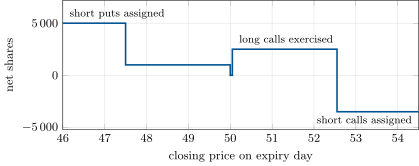
Exercise is a decision made by holders with ninety minutes of hindsight. An option out of the money by two cents at 16:00 is in the money if the share trades three cents higher in the after-hours session on news released at 16:05, and its holder may exercise. Figure 23.3 shows what one expiry turns a small book into, as a function of the closing price alone; the jumps are at the strikes, and on each jump the true answer is a random variable.
Early exercise of American options is rational in two cases that a desk must anticipate every day, not only at expiry: a call just before an ex-dividend date, when the dividend exceeds the option’s remaining time value; and a deep in-the-money put, when the interest on the strike exceeds it. The writer of such options is assigned overnight and wakes up with a share position and without the dividend.
23.5 Tutorial: symbols, a chain, payoffs
Goal. Parse and produce OSI symbols, hold a chain in a structure keyed by integers, compute payoffs, and turn a book into shares at expiry. End state: the two data figures of this chapter.
A series with its symbol, intrinsic value and payoff.
@dataclass(frozen=True, order=True)
class Series:
    root: str
    expiry: dt.date
    right: str                      # 'C' or 'P'
    strike_milli: int               # strike price x 1000
    multiplier: int = 100
    style: str = "american"         # or 'european'
    settlement: str = "physical"    # or 'cash'

    @property
    def strike(self) -> float:
        return self.strike_milli / 1000.0

    @property
    def osi(self) -> str:
        return f"{self.root:<6}{self.expiry:%y%m%d}{self.right}{self.strike_milli:08d}"

    def intrinsic(self, underlying: float) -> float:
        diff = underlying - self.strike if self.right == "C" else self.strike - underlying
        return max(diff, 0.0)

    def payoff(self, underlying: float, premium: float, qty: int) -> float:
        """P&L at expiry of `qty` contracts (negative = short) bought or sold at `premium`."""
        return qty * self.multiplier * (self.intrinsic(underlying) - premium)
Listing 23.1. One option series. The strike is an integer of thousandths of a dollar. code/firm/chain/firm_chain.py Parsing. Twenty-one characters, four fields, and an error for anything else.
def parse_osi(symbol: str, **kwargs) -> Series:
    if len(symbol) != 21:
        raise ValueError(f"an OSI symbol has 21 characters, got {len(symbol)}: {symbol!r}")
    root, date, right, strike = symbol[:6].rstrip(), symbol[6:12], symbol[12], symbol[13:]
    if not root or right not in "CP" or not (date + strike).isdigit():
        raise ValueError(f"malformed OSI symbol {symbol!r}")
    expiry = dt.datetime.strptime(date, "%y%m%d").date()
    return Series(root, expiry, right, int(strike), **kwargs)
Listing 23.2. From an OSI symbol to a series. code/firm/chain/firm_chain.py -
def expiry_shares(positions: dict[Series, int], closing_price: float,
                  overrides: dict[Series, bool] | None = None) -> int:
    """Net shares received (+) or delivered (-) after expiry of physically settled options,
    assuming every short in-the-money position is assigned in full. `overrides` forces the
    exercise decision of LONG positions (contrary instructions)."""
    shares = 0
    for s, qty in positions.items():
        if s.settlement != "physical":
            continue
        exercise = exercised_by_exception(s, closing_price)
        if qty > 0 and overrides and s in overrides:
            exercise = overrides[s]
        if not exercise:
            continue
        direction = 1 if s.right == "C" else -1      # exercising a call buys shares; a put sells them
        shares += direction * qty * s.multiplier
    return shares
Listing 23.3. Shares received or delivered at expiry under exercise by exception. code/firm/chain/firm_chain.py
What to change next. Make assignment random: each short contract within five cents of the money is exercised against with a probability that depends on the distance and on an after-hours move. Report the distribution of Monday’s share position, not a number.
23.6 Build: the option chain
Purpose. Every options component of the miniature firm, from the volatility surface of One Quant Book 5 to the market maker of Book 11, asks one container for the series of an underlying.
Interface. Series(root, expiry, right, strike_milli, multiplier, style, settlement) with osi, strike, intrinsic, payoff; parse_osi(symbol); Chain(series) with expiries(), strikes(expiry), get(expiry, strike_milli, right), atm_strike(expiry, underlying); exercised_by_exception(series, close); expiry_shares(positions, close, overrides).
Rules. Strikes are integers of thousandths everywhere; a float strike is never a key. Duplicate series are an error. The at-the-money strike resolves ties downwards, deterministically. Cash-settled series deliver no shares. Corporate actions that change the deliverable (Section 8.7) create adjusted series with non-standard multipliers: the multiplier is a field, not a constant.
Acceptance tests. code/firm/chain/tests/: symbol round trips and malformed symbols; chain lookup and the at-the-money rule; payoffs of long and short positions; exercise by exception at one cent; net shares of a book at several closing prices, with a contrary instruction.
Stretch. Adjusted series after a split and a special dividend, with the deliverable as a basket.
Sources and further reading
- The Options Industry Council, Options Exercise (frequently asked questions: thresholds, cut-off, assignment).
- The Options Clearing Corporation, press release on 2022 cleared volume, 3 January 2023; Options Symbology Initiative documentation.
- Cboe, S&P 500 Index Options: product specifications and S&P 500 Weeklys Options: specifications.
23.7 Exercises
Exercise 23.1 ★
Decode XYZ␣␣␣270115P00047500 and write the symbol of the XYZ call of 19 March 2027 with a strike of $112.50.
Solution
Solution of Exercise 23.1.
The XYZ put expiring on 15 January 2027 with a strike of $47.50. The call: XYZ␣␣␣270319C00112500.
Exercise 23.2 ★
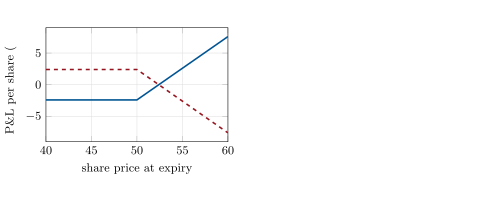
A trader buys 10 calls with a strike of 50 for a premium of 2.40. Give the P&L at expiry with the share at 56 and at 48, and the break-even share price.
Solution
Solution of Exercise 23.2.
At 56: . At 48: the calls expire worthless, . Break-even at .
Exercise 23.3 ★
With five weekly and six monthly expiries of seventy strikes each and five long-dated expiries of thirty, count the series. How many quote updates does one one-cent move of the share require from a market maker quoting all of them on sixteen exchanges?
Solution
Solution of Exercise 23.3.
series. On sixteen exchanges: 29 440 two-sided quotes to refresh for one cent in one share, which is why options market making is first a problem of message rates and of deciding which quotes not to update.
Exercise 23.4 ★★
For the book of Figure 23.3 give the shares received or delivered for closing prices of 47.00, 49.00, 50.00, 50.01, 52.50 and 52.51.
Solution
Solution of Exercise 23.4.
47.00: both short puts are assigned, shares. 49.00: only the 50 puts, . 50.00: nothing is in the money, 0. 50.01: the long calls are exercised, . 52.50: still . 52.51: the 60 short calls are assigned, .
Exercise 23.5 ★★
A call with a strike of 40 has 0.15 of time value left; the share trades at 46 and goes ex-dividend tomorrow with a dividend of 0.60. Should the holder exercise today? What happens to a writer who has hedged with shares and is assigned?
Solution
Solution of Exercise 23.5.
Yes. Exercising captures the 0.60 dividend and gives up 0.15 of time value; not exercising keeps an option whose underlying will open 0.60 lower. The writer hedged with long shares is assigned overnight: the shares are called away at 40, the dividend goes to the new owner, and the writer has lost the 0.60 it was counting on unless the option’s price already reflected early exercise. Desks run an early-exercise report every day before each ex-date.
Exercise 23.6 ★★
An index option series stops trading on Thursday and settles on Friday against opening prices; another trades until Friday’s close and settles against closing prices. A desk is short both, with the same strike. Describe its risk between Thursday’s close and Friday’s close in each.
Solution
Solution of Exercise 23.6.
The first: the option cannot be traded after Thursday, yet its value is set by Friday’s opening prices. The desk carries the overnight gap and the dispersion of the opening prints with no ability to adjust the option, only its hedge, and must unwind the hedge in the opening auctions. The second: the option trades until the close, so the risk is continuous, but its gamma in the final minutes is extreme near the strike, and the hedge must be unwound in the closing auction.
Exercise 23.7 ★★★
Coding. With expiry_shares and the chapter’s book, add a contrary instruction: the holder of the long 50 calls declines to exercise at a close of 50.01. Give the net shares with and without it, and explain when declining is right.
Solution
Solution of Exercise 23.7.
shares with exercise by exception, 0 with the contrary instruction. Declining is right when the one cent of intrinsic value is less than the cost and risk of the shares received: commissions and fees on 2 500 shares, and above all the exposure from Friday’s close to Monday’s open on shares bought at 50 that may open at 49.50. For a holder who is not hedged short, one cent does not pay for a weekend.
Exercise 23.8 ★★★
Find the flaw. “The stock closed at 52.48. My short 52.50 calls expired worthless, I keep the premium, and my hedge can come off at Monday’s open.” What has the writer assumed, and what should have been done at 15:59?
Solution
Solution of Exercise 23.8.
The writer has assumed that holders exercise according to the 16:00 close. They have until the evening cut-off and will exercise if the share trades above 52.50 after hours. The writer does not know its position until the next morning; with a hedge sized for “expired worthless” it may be short 6 000 shares into Monday. At 15:59 the calls could have been bought back for a few cents: the premium of certainty.
23.8 Problem: Expiry Friday
Problem 23.1
Weekend problem — what the book is on Monday
A desk holds the book of Figure 23.3 in XYZ, all expiring today: short 40 puts at 47.50, short 10 puts at 50, long 25 calls at 50, short 60 calls at 52.50. Multiplier 100. It is hedged with a short position of 1 900 shares. XYZ closes at 52.48.
Part I — At the close.
- Which series are in the money at 52.48, and by how much?
- Under exercise by exception, what happens to each position?
- Give the shares received from exercise.
- Give the desk’s share position on Monday if nothing else happens.
- What should the desk do with that position, and when?
Part II — After the close. At 16:10 XYZ announces a contract and trades at 53.20 in the after-hours session.
- Until when can holders of the 52.50 calls submit exercise instructions?
- Why would a holder exercise a call that closed out of the money?
- On Saturday the desk learns that 45 of its 60 short calls were assigned. Give the shares delivered.
- Give the desk’s share position on Monday.
- XYZ opens on Monday at 54.10. Give the loss on the unexpected part of the position, relative to the strike.
Part III — What could have been done.
- At 15:55, with XYZ at 52.45, the 52.50 calls were offered at 0.04. What would buying back the 60 have cost?
- Compare with question 10.
- Why does the option still cost 0.04 five minutes before it “expires worthless”?
- The desk could instead have bought 3 000 shares at the close as a precaution. Evaluate.
- Why is the long 50 call not a worry of the same kind?
Part IV — Judgement.
- Market makers’ hedging is said to “pin” stocks to strikes on expiry day. Give the mechanism in two sentences.
- Would this problem exist for a cash-settled European index option?
- A retail client is assigned on a short call in a stock that then gaps up. Where does the loss sit until Monday?
- State the named result: the desk’s share position on Monday after exercise and assignment.
- In one sentence: who decides when an option position becomes a share position?
Solution
Solution of Problem 23.1.
1. Only the long 50 calls, by 2.48. The 52.50 calls are out of the money by 0.02; both put series are out of the money. 2. The 25 long calls are exercised; everything else expires. 3. shares, bought at 50. 4. shares. 5. The hedge was for a book that no longer exists: sell 600 shares, ideally in Friday’s closing auction, by estimating at 15:55 what exercise will deliver. 6. Until the exchanges’ cut-off, 16:30 Chicago time, 17:30 in New York, and earlier at most brokers. 7. Because the share is worth 53.20 where it can now be sold, and the call gives it for 52.50: exercise is worth 0.70 a share whatever the 16:00 print said. 8. 4 500 shares delivered at 52.50. 9. shares. 10. . 11. . 12. Thirty times less. 13. Because of exactly this: the option does not expire at 16:00 but at the cut-off, and its seller is paid for ninety minutes of news and for the buyer’s right to decide afterwards. 14. It hedges the wrong scenario half of the time: if the stock falls after hours nobody exercises, and the desk is long 3 000 unwanted shares into a lower open. Against Monday’s 54.10 it would have gained $4 860 on the shares and still been short 1 500. Buying the options back removes the uncertainty; buying shares bets on its outcome. 15. The desk holds the right: it decides, with the same ninety minutes of hindsight, and can decline. 16. A market maker long options near the strike is long gamma: it sells shares as the price rises above the strike and buys as it falls below, which pushes the price back towards the strike; the effect is strongest when open interest at that strike is large relative to the day’s volume. 17. No: nothing is delivered, exercise is automatic against one published settlement value, and there is no decision after the fact. The risk moves into the settlement value itself (exercise 6). 18. With the client, as a short position in shares acquired at the strike over the weekend; if the client cannot cover the margin, with the broker, and beyond the broker with the clearing house’s guarantee. 19. Short 3 900 shares. 20. The holder of the option, after the close, with information the writer also has but cannot act upon.
23.9 Interview questions
Interview question 23.1 ★ trader, researcher, developer
What is the difference between American and European options, and which listed products are which?
Solution
Solution of Interview question 23.1.
American options can be exercised on any day up to expiry, European only at expiry. In the US, options on shares and funds are American and physically settled; the main index options are European and cash settled. The difference matters around dividends and for deep in-the-money puts, where early exercise is optimal, and for the writer’s assignment risk.
What the interviewer is looking for: the product mapping and one consequence.
Interview question 23.2 ★ trader, developer
Why can a US equity option bought on one exchange be sold on another, when a future cannot?
Solution
Solution of Interview question 23.2.
All US listed options are issued and cleared by one clearing house, so a series is the same contract wherever it trades: long on one exchange and short on another net to zero. A future is cleared by its own exchange’s clearing house, and an identical contract elsewhere is a different counterparty.
What the interviewer is looking for: clearing, not trading, as the source of fungibility.
Interview question 23.3 ★★ trader, researcher
When is it rational to exercise an American call early? A put?
Solution
Solution of Interview question 23.3.
A call: only to capture a dividend, just before the ex-date, when the dividend exceeds the remaining time value (roughly, the value of the put at the same strike plus interest on the strike). Otherwise selling the call is better than exercising it. A put: when it is deep enough in the money that interest earned on the strike, received now, exceeds the remaining time value; more often when rates are high.
What the interviewer is looking for: the comparison with time value in both cases.
Interview question 23.4 ★★ trader
What is pin risk and how do you manage it?
Solution
Solution of Interview question 23.4.
Being short options that expire with the underlying at the strike: the number assigned, hence Monday’s share position, is unknown until the next morning, and holders decide after the close with later information. Manage it by buying back short options near the strike before the close, by flattening expiring strikes during the last days, by estimating assignment probabilities for what remains, and by keeping capacity to trade after hours and at Monday’s open.
What the interviewer is looking for: closing the position rather than hedging the unknown.
Interview question 23.5 ★★ developer, researcher
Design the key for an option instrument in a trading system.
Solution
Solution of Interview question 23.5.
An immutable record: underlying identifier, expiry date, right, strike as an integer in the smallest unit, multiplier, exercise style, settlement type, and the deliverable for adjusted contracts. Never a float strike; never the display symbol as the key, since roots change after corporate actions. Map exchange symbols and OSI strings to the record through reference data with effective dates; give each record a compact integer identifier for the hot path.
What the interviewer is looking for: integer strike, adjusted contracts, effective dating.
Interview question 23.6 ★★★ trader, researcher
You are short an index option that settles on the opening prices of expiry morning. How do you hedge the last night?
Solution
Solution of Interview question 23.6.
The option stops trading on Thursday; its payoff depends on a quotation built from each stock’s opening print. Hold the delta in futures or a basket overnight; the exposure that remains is gamma against the overnight move, which cannot be re-hedged in the option. On Friday morning the hedge must be converted into exactly the settlement value: sell (or buy) the basket in the opening auctions, or use futures that settle on the same quotation, which removes the basis entirely. Size the position on Thursday with the overnight gap, not the intraday volatility, in mind.
What the interviewer is looking for: matching the hedge’s exit to the settlement mechanism.